SmarterEd

Aussie Maths & Science Teachers: Save your time with SmarterEd

  • Login
  • Get Help
  • About

PHYSICS, M4 EQ-Bank 7 MC

What happens when a ferromagnetic material is placed in a magnetic field?

  1. Its electrons align randomly, producing zero net field.
  2. Domains within the material align with the external magnetic field.
  3. It becomes permanently non-magnetic.
  4. The material conducts current and generates its own field.
Show Answers Only

\(B\)

Show Worked Solution
  • Ferromagnetic materials consist of magnetic domains.
  • When placed in an external magnetic field, these domains begin to align with the field, creating a net magnetisation and reinforcing the external field locally.
  • This process explains why such materials become magnetised.

\(\Rightarrow B\)

Filed Under: Magnetism Tagged With: Band 3, smc-4285-50-Properties of magnets

PHYSICS, M4 EQ-Bank 12

An electromagnet consists of a solenoid with an iron core. The solenoid has 1200 turns wound on a cylindrical former that is 18 cm long. A current of 2.5 A flows through the solenoid.

  1. Calculate the magnetic field strength inside the solenoid (assuming air core).   (1 marks)

--- 2 WORK AREA LINES (style=lined) ---

  1. Explain why inserting an iron core significantly increases the magnetic field strength.   (2 marks)

--- 4 WORK AREA LINES (style=lined) ---

  1. A student suggests three ways to increase the magnetic field strength of this electromagnet:
      • Increase the current to 7.0 A
      • Add another 600 turns to the solenoid (keeping same length)
      • Compress the solenoid to half its length (keeping same number of turns)
  1. Determine which modification produces the greatest increase in magnetic field strength. Show calculations to support your answer.   (3 marks)

--- 6 WORK AREA LINES (style=lined) ---

Show Answers Only

a.    \(B = \dfrac{\mu_0 NI}{L} = \dfrac{4\pi \times 10^{-7} \times 1200 \times 2.5}{0.18} = 2.094 \times 10^{-2}\ \text{T}\).
   

b.   Magnetic field strength increases with iron core insertion because:

  • Iron is a ferromagnetic material, which means it contains magnetic domains that can align with an external magnetic field.
  • These domains align and reinforce the external field when the core is iron, significantly increasing the total magnetic field strength.

c.    Increasing the current to 7 A: \(\dfrac{7}{2.5} \times 2.094 \times 10^{-2} = 5.86 \times 10^{-2}\ \text{T}\).

Adding 600 turns: \(\dfrac{1800}{1200} \times 2.094 \times 10^{-2} = 3.14 \times 10^{-2}\ \text{T}\).

Halving the length: \(\dfrac{1}{0.5} \times 2.094 \times 10^{-2} = 4.19 \times 10^{-2}\ \text{T}\).

  • Increasing the current to 7 A will cause the greatest increase in magnetic field strength.
Show Worked Solution

a.    \(B = \dfrac{\mu_0 NI}{L} = \dfrac{4\pi \times 10^{-7} \times 1200 \times 2.5}{0.18} = 2.094 \times 10^{-2}\ \text{T}\).
   

b.   Magnetic field strength increases with iron core insertion because:

  • Iron is a ferromagnetic material, which means it contains magnetic domains that can align with an external magnetic field.
  • These domains align and reinforce the external field when the core is iron, significantly increasing the total magnetic field strength.

c.    Increasing the current to 7 A: \(\dfrac{7}{2.5} \times 2.094 \times 10^{-2} = 5.86 \times 10^{-2}\ \text{T}\).

Adding 600 turns: \(\dfrac{1800}{1200} \times 2.094 \times 10^{-2} = 3.14 \times 10^{-2}\ \text{T}\).

Halving the length: \(\dfrac{1}{0.5} \times 2.094 \times 10^{-2} = 4.19 \times 10^{-2}\ \text{T}\).

  • Increasing the current to 7 A will cause the greatest increase in magnetic field strength.

Filed Under: Magnetism Tagged With: Band 4, smc-4285-20-Fields around wires/solenoids, smc-4285-50-Properties of magnets

PHYSICS, M4 EQ-Bank 8

A student is investigating the magnetic field produced by a solenoid. The solenoid consists of tightly wound loops of wire carrying a current \(I\). A small piece of soft unmagnetised iron is placed inside the solenoid, and a bar magnet is placed outside the solenoid near one end.

  1. Describe the effect of placing the soft iron inside the solenoid on the magnetic field, and explain this effect in terms of ferromagnetic behaviour.   (3 marks)

--- 8 WORK AREA LINES (style=lined) ---

  1. Compare and contrast the magnetic field produced by a solenoid with the magnetic field produced by a bar magnet. Explain two similarities and two differences.   (4 marks)

--- 810 WORK AREA LINES (style=lined) ---

Show Answers Only

a.    Effect of placing a soft iron core inside a solenoid:

  • The strength and concentration of the magnetic field within the solenoid increases significantly.
  • This occurs because soft iron is a ferromagnetic material with a high magnetic permeability, meaning it allows magnetic field lines to pass through it more easily than air.
  • Ferromagnetic materials are made up of regions called magnetic domains. In an unmagnetised state, these domains are randomly oriented, so their individual magnetic fields cancel out.
  • However, when a soft iron core is placed inside the solenoid, the external magnetic field produced by the current causes the domains to align with the field, creating a net magnetic field that reinforces the original one.
  • Because soft iron is easily magnetised and demagnetised, it is ideal for use in electromagnets, where a strong, controllable, and reversible magnetic field is needed.

b.    Similarities:

  • Field Pattern: Both produce magnetic fields with a similar dipole shape — field lines emerge from the north pole, curve around, and enter at the south pole, forming closed loops. Internally, the field lines run from south to north, creating a uniform field inside both the solenoid and the bar magnet.
  • Effect on Magnetic Materials: Both fields can attract ferromagnetic materials (like iron) and influence their magnetic domains. A compass needle or small magnetic object placed near either field will align with the field lines.

Differences:

  • Source of the Magnetic Field: A bar magnet’s field is generated by the alignment of permanent magnetic domains in the material. In contrast, a solenoid’s field is produced by electric current flowing through the wire coils, and can be turned on or off.
  • Controllability: The magnetic field of a solenoid is adjustable, it can be increased by raising the current or number of turns and its direction reversed by changing current direction. A bar magnet’s field is fixed in strength and polarity unless the material is physically altered or demagnetised.
Show Worked Solution

a.    Effect of placing a soft iron core inside a solenoid:

  • The strength and concentration of the magnetic field within the solenoid increases significantly.
  • This occurs because soft iron is a ferromagnetic material with a high magnetic permeability, meaning it allows magnetic field lines to pass through it more easily than air.
  • Ferromagnetic materials are made up of regions called magnetic domains. In an unmagnetised state, these domains are randomly oriented, so their individual magnetic fields cancel out.
  • However, when a soft iron core is placed inside the solenoid, the external magnetic field produced by the current causes the domains to align with the field, creating a net magnetic field that reinforces the original one.
  • Because soft iron is easily magnetised and demagnetised, it is ideal for use in electromagnets, where a strong, controllable, and reversible magnetic field is needed.

b.    Similarities:

  • Field Pattern: Both produce magnetic fields with a similar dipole shape — field lines emerge from the north pole, curve around, and enter at the south pole, forming closed loops. Internally, the field lines run from south to north, creating a uniform field inside both the solenoid and the bar magnet.
  • Effect on Magnetic Materials: Both fields can attract ferromagnetic materials (like iron) and influence their magnetic domains. A compass needle or small magnetic object placed near either field will align with the field lines.

Differences:

  • Source of the Magnetic Field: A bar magnet’s field is generated by the alignment of permanent magnetic domains in the material. In contrast, a solenoid’s field is produced by electric current flowing through the wire coils, and can be turned on or off.
  • Controllability: The magnetic field of a solenoid is adjustable, it can be increased by raising the current or number of turns and its direction reversed by changing current direction. A bar magnet’s field is fixed in strength and polarity unless the material is physically altered or demagnetised.

Filed Under: Magnetism Tagged With: Band 5, Band 6, smc-4285-20-Fields around wires/solenoids, smc-4285-40-Properties of magnetic fields, smc-4285-50-Properties of magnets

PHYSICS, M4 EQ-Bank 2 MC

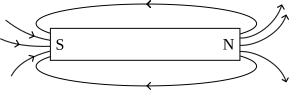
Which of the arrows correctly illustrates the magnetic field direction at the given position around the magnet?
 

  1. 1
  2. 2
  3. 3
  4. 4
Show Answers Only
 

\(D\)

Show Worked Solution
  • Magnetic field lines indicate the direction a north magnetic pole would move if placed in the field.
  • Hence the field lines run from the north pole to the south pole as seen in the diagram below.
     

\(\Rightarrow D\)

Filed Under: Magnetism Tagged With: Band 4, smc-4285-50-Properties of magnets

PHYSICS, M4 EQ-Bank 6

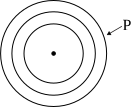
Consider the diagram below:
 

  1. A straight, vertical wire carries a steady current. Explain how you would determine the direction of the magnetic field around the wire and state the direction.   (2 marks)

--- 4 WORK AREA LINES (style=lined) ---

  1. The distance from the wire to point \(\text{P}\) is 80 mm, and the current flowing through the wire is 8 A. Calculate the magnitude of the magnetic field at point \(\text{P}\).   (2 marks)

--- 4 WORK AREA LINES (style=lined) ---

  1. Describe how ferromagnetic materials can become strongly magnetised and explain the underlying reason for this behaviour.   (3 marks)

--- 6 WORK AREA LINES (style=lined) ---

Show Answers Only

a.    Using the right-hand rule:

  • Thumb goes in the direction of the current (out of the page)
  • Fingers curl in the direction of the magnetic field.
  • Hence the direction of the field is anticlockwise.

b.    \(2.0 \times 10^{-5}\ \text{T}\)
 

c.   Ferromagnetic materials (like iron, cobalt, nickel) contain magnetic domains.

  • These domains are regions where atomic magnetic moments are aligned.
  • When placed in a magnetic field, the individual domains align with the field and no longer cancel each other out, causing strong magnetisation.
  • Even after the external field is removed, alignment may persist, making them useful for permanent magnets.
Show Worked Solution

a.    Using the right-hand rule:

  • Thumb goes in the direction of the current (out of the page)
  • Fingers curl in the direction of the magnetic field.
  • Hence the direction of the field is anticlockwise.
     
b.     \(B\) \(=\dfrac{\mu_0I}{2\pi r}\)
    \(=\dfrac{4\pi \times 10^{-7} \times 8}{2 \pi \times 80 \times 10^{-3}} =2.0 \times 10^{-5}\ \text{T}\) 


c.   Ferromagnetic materials (like iron, cobalt, nickel) contain magnetic domains.

  • These domains are regions where atomic magnetic moments are aligned.
  • When placed in a magnetic field, the individual domains align with the field and no longer cancel each other out, causing strong magnetisation.
  • Even after the external field is removed, alignment may persist, making them useful for permanent magnets.

Filed Under: Magnetism Tagged With: Band 4, Band 5, smc-4285-20-Fields around wires/solenoids, smc-4285-50-Properties of magnets

PHYSICS, M4 EQ-Bank 5

Outline and explain the process by which ferromagnetic materials can become magnetised using a bar magnet.   (3 marks)

--- 8 WORK AREA LINES (style=blank) ---

Show Answers Only
  • A ferromagnetic material contains many free electrons due to its metallic bonding.
  • Each electron has its own magnetic domain but due to the electrons spinning in opposite directions, the domains cancel each other out.
  • Using a bar magnet, stroke the ferromagnetic material in one direction.
  • This causes the electrons to spin in the same direction, hence all of their domains line up.
  • The cumulative effect of all the small magnetic domains creates a large magnetic field, turning the ferromagnetic material into a magnet.
Show Worked Solution
  • A ferromagnetic material contains many free electrons due to its metallic bonding.
  • Each electron has its own magnetic domain but due to the electrons spinning in opposite directions, the domains cancel each other out.
  • Using a bar magnet, stroke the ferromagnetic material in one direction.
  • This causes the electrons to spin in the same direction, hence all of their domains line up.
  • The cumulative effect of all the small magnetic domains creates a large magnetic field, turning the ferromagnetic material into a magnet.

Filed Under: Magnetism Tagged With: Band 5, smc-4285-50-Properties of magnets

PHYSICS, M4 EQ-Bank 3

Identify three properties of a bar magnet.  (3 marks)

--- 5 WORK AREA LINES (style=blank) ---

Show Answers Only

Answers could include three of the following properties:

  • They have a north and a south pole.
  • The magnetic field lines run from north to south.
  • The magnetic field lines leave and enter the magnet at right angles to the surface.
  • They are permanent magnets.
  • Like poles repel and opposite poles attract.
Show Worked Solution

Answers could include three of the following properties:

  • They have a north and a south pole.
  • The magnetic field lines run from north to south.
  • The magnetic field lines leave and enter the magnet at right angles to the surface.
  • They are permanent magnets.
  • Like poles repel and opposite poles attract.

Filed Under: Magnetism Tagged With: Band 3, smc-4285-50-Properties of magnets

Copyright © 2014–2025 SmarterEd.com.au · Log in