SmarterEd

Aussie Maths & Science Teachers: Save your time with SmarterEd

  • Login
  • Get Help
  • About

BIOLOGY, M1 2020 VCE 3c

In plants and algae, photosynthesis is carried out in chloroplasts. It is thought that chloroplasts originated from bacteria.

Describe two features of chloroplasts that support the theory that chloroplasts originated from bacteria.   (2 marks)

--- 4 WORK AREA LINES (style=lined) ---
Show Answers Only

Answers can include two of the following:

  • Chloroplasts contain their own DNA, which in itself has many parallels to the DNA found in bacteria, such as it being circular.
  • Chloroplasts contain their own ribosomes.
  • New chloroplasts are made by division of previously existing chloroplasts, similar to the division of bacterial cells.
Show Worked Solution

Answers can include two of the following:

  • Chloroplasts contain their own DNA, which in itself has many parallels to the DNA found in bacteria, such as it being circular.
  • Chloroplasts contain their own ribosomes.
  • New chloroplasts are made by division of previously existing chloroplasts, similar to the division of bacterial cells.

Filed Under: Cell Structure Tagged With: Band 4, smc-4302-20-Organelles

BIOLOGY, M1 2020 VCE 1

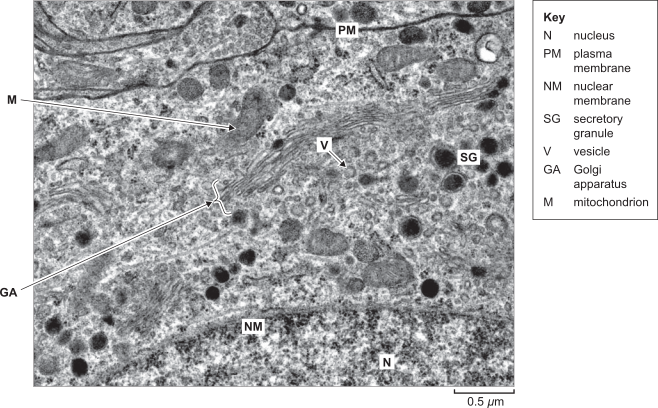
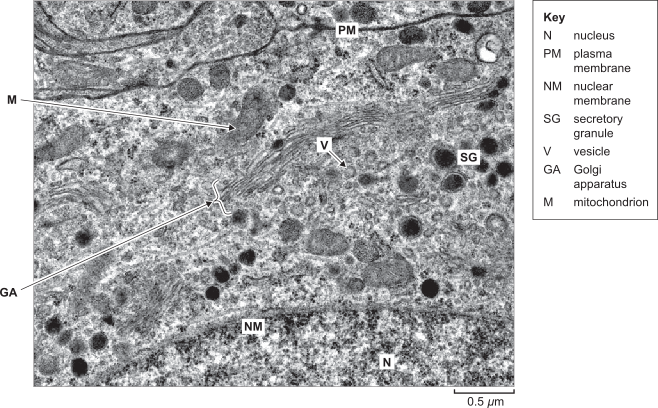
Adrenaline is an amino-acid-based hormone. The image below shows a cell section of an adrenaline-secreting cell examined under a transmission electron microscope.

A secretory granule is a large vesicle formed when several smaller vesicles fuse. Each secretory granule contains a large amount of adrenaline, which is stored until the cell receives a signal to release it.
 

  1. There are many organelles of the types labelled GA and M visible in the cell section.
  2. Complete the table below by stating the specific function of each organelle with the following labels in the adrenaline-secreting cell.   (2 marks)
     

\begin{array} {|c|l|}
\hline \ \ \ \textbf{Label} & \ \ \ \ \ \ \ \ \ \ \textbf{Specific function in the adrenaline-secreting cell} \ \ \ \ \ \ \ \ \ \  \\ 
\hline   &  \\ \text{GA} & \text{......................................................................................................................} \\ & \\ & \text{......................................................................................................................} \\
\hline   &  \\ \text{M} & \text{......................................................................................................................} \\& \\ & \text{......................................................................................................................}  \\
\hline \end{array}

--- 0 WORK AREA LINES (style=lined) ---

  1. Adrenaline is secreted from the cell by exocytosis.
  2. Describe this process with reference to the roles of relevant organelles labelled in the cell section above.  (2 marks)

--- 4 WORK AREA LINES (style=lined) ---
Show Answers Only

a.    

\begin{array} {|c|l|}
\hline
\rule{0pt}{2.5ex} \textbf{Label} \rule[-1ex]{0pt}{0pt} & \textbf{Specific function in the adrenaline-secreting cell} \ \ \ \ \ \ \ \ \ \  \\ 
\hline
\rule{0pt}{2.5ex} \text{GA} \rule[-1ex]{0pt}{0pt} & \text{To modify a protein into adrenaline and/or package adrenaline into } \\
\rule{0pt}{2.5ex} \text{} \rule[-1ex]{0pt}{0pt} & \text{vesicles to be secreted from cell.} \\
\hline
\rule{0pt}{2.5ex} \text{M} \rule[-1ex]{0pt}{0pt} & \text{To create ATP molecules to be used as energy in the transport or } \\
\rule{0pt}{2.5ex} \text{} \rule[-1ex]{0pt}{0pt} & \text{synthesis of adrenaline.} \\
\hline
\end{array}

 
b. 
  The mitochondria (M) provides energy for vesicles (V) and secretory granules (SG) to form.

  • They then fuse with the plasma membrane (PM) and release their contents, in this case adrenaline, into the environment.
Show Worked Solution

a.    

\begin{array} {|c|l|}
\hline
\rule{0pt}{2.5ex} \textbf{Label} \rule[-1ex]{0pt}{0pt} & \textbf{Specific function in the adrenaline-secreting cell} \ \ \ \ \ \ \ \ \ \  \\ 
\hline
\rule{0pt}{2.5ex} \text{GA} \rule[-1ex]{0pt}{0pt} & \text{To modify a protein into adrenaline and/or package adrenaline into } \\
\rule{0pt}{2.5ex} \text{} \rule[-1ex]{0pt}{0pt} & \text{vesicles to be secreted from cell.} \\
\hline
\rule{0pt}{2.5ex} \text{M} \rule[-1ex]{0pt}{0pt} & \text{To create ATP molecules to be used as energy in the transport or } \\
\rule{0pt}{2.5ex} \text{} \rule[-1ex]{0pt}{0pt} & \text{synthesis of adrenaline.} \\
\hline
\end{array}

 
b. 
  The mitochondria (M) provides energy for vesicles (V) and secretory granules (SG) to form.

  • They then fuse with the plasma membrane (PM) and release their contents, in this case adrenaline, into the environment.

Filed Under: Cell Structure Tagged With: Band 4, smc-4302-20-Organelles

BIOLOGY, M1 2022 VCE 4a

Increased protein consumption is a global trend. Chicken eggs are a good source of protein.

Ovalbumin (egg white protein) is formed from chicken cells during egg production.

Describe the role of organelles in the export of ovalbumin from a chicken's cells into an egg.  (3 marks)

--- 6 WORK AREA LINES (style=lined) ---

Show Answers Only

→ The production, transport and exportation of ovalbumin requires energy, which is supplied via mitochondria within the cell.

→ After ovalbumin is made, the rough endoplasmic reticulum transports it to the Golgi, where it is packaged into vesicles.

→ The vesicles then fuse with the plasma membrane of the cell and the ovalbumin can be released from the cell via exocytosis into an egg.

Show Worked Solution

→ The production, transport and exportation of ovalbumin requires energy, which is supplied via mitochondria within the cell.

→ After ovalbumin is made, the rough endoplasmic reticulum transports it to the Golgi, where it is packaged into vesicles.

→ The vesicles then fuse with the plasma membrane of the cell and the ovalbumin can be released from the cell via exocytosis into an egg.

Filed Under: BIO - Ex-syllabus checks required Tagged With: Band 4, smc-4302-20-Organelles

BIOLOGY, M1 EQ-Bank 1 MC

Which of the following eukaryotic organelles is correctly matched with its function?

  \(\textbf{Organelle}\) \(\textbf{Function}\)
\(\text{A.}\)   Golgi body mRNA production
\(\text{B.}\)  Mitochondria ATP synthesis
\(\text{C.}\)    Ribosome Waste storage
\(\text{D.}\)  Lysosome Movement
Show Answers Only

\(B\) 

Show Worked Solution

By Elimination

  • Golgi bodies are involved in the modification, storage and distribution of the lipids, carbohydrates and proteins made in the E.R. (Eliminate A).
  • Ribosomes carry out protein synthesis (Eliminate C).
  • Lysosomes are involved in solid waste processing (Eliminate D).

\(\Rightarrow B\)

Filed Under: Cell Structure Tagged With: Band 3, smc-4302-20-Organelles

Copyright © 2014–2025 SmarterEd.com.au · Log in