SmarterEd

Aussie Maths & Science Teachers: Save your time with SmarterEd

  • Login
  • Get Help
  • About

BIOLOGY, M1 2020 VCE 4c

The diagram below is a simplified example of a signal transduction pathway. Three steps in the pathway are labelled.


Explain whether the pathway shown is initiated at Step 1 by a hydrophobic molecule or by a hydrophilic molecule.   (2 marks)

--- 3 WORK AREA LINES (style=lined) ---
Show Answers Only

→ The molecule must be hydrophilic as it does not pass through the plasma membrane but instead attaches to a receptor protein.

Show Worked Solution

→ The molecule does not pass through the plasma membrane but instead attaches to a receptor protein.

→ Therefore, the molecule is hydrophilic.

Filed Under: BIO - Ex-syllabus checks required Tagged With: Band 4, smc-4302-50-Cell membrane

BIOLOGY, M1 2021 VCE 1

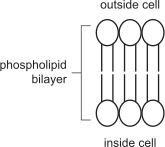
The diagram below shows a small part of a cross-section of the plasma membrane of a cell.
 

Some substances can move directly through the phospholipid bilayer.

  1. Complete the table below by naming one small hydrophilic substance and one small hydrophobic substance that can move through the phospholipid bilayer. Provide an example of a situation when each small substance would move through the phospholipid bilayer. The first row has been completed for you.   (2 marks)

    --- 0 WORK AREA LINES (style=lined) ---

\begin{array} {|c|l|l|}
\hline \textbf{Name of small} & \textbf{Hydrophilic or} & \ \ \textbf{Situation when substance moves} \ \ \\
\textbf{substance} & \ \ \textbf{hydrophobic} & \ \ \ \ \  \textbf{through phospholipid bilayer}  \\
\hline \text{oxygen}  & \text{hydrophobic} & \text{Oxygen diffuses out of photosynthetic}  \\
& & \text{plant.}\\
\hline  & \text{hydrophilic} &  \\
& & \\
\hline  & \text{hydrophobic} &  \\
& & \\
\hline \end{array}

  1. Some very large substances and/or large particles that do not dissolve in the phospholipid bilayer can still move into or out of a cell.

    Using one example, explain how the phospholipid bilayer transports these very large substances and/or large particles without the use of channel or carrier proteins either into a cell or out of a cell.   (3 marks)

--- 6 WORK AREA LINES (style=lined) ---

Show Answers Only

a.   

\begin{array} {|c|l|l|}
\hline \textbf{Name of small} & \textbf{Hydrophilic or} & \ \ \textbf{Situation when substance moves} \ \ \\
\textbf{substance} & \ \ \textbf{hydrophobic} & \ \ \ \ \  \textbf{through phospholipid bilayer}  \\
\hline \text{oxygen}  & \text{hydrophobic} & \text{Oxygen diffuses out of photosynthetic}  \\
& & \text{plant}\\
\hline \text{water} & \text{hydrophilic} & \text{Water diffuses out of a cell during} \\
& & \text{respiration. }\\
\hline \text{carbon dioxide} & \text{hydrophobic} & \text{Carbon dioxide diffuses out of a cell} \\
& & \text{during respiration. } \\
\hline \end{array}

b.    Into a cell:

  • Endocytosis is a process which allows large particles such as proteins or antigens to enter a cell.
  • Endocytosis involves the folding over of a membrane to form a vesicle. The contents of the vesicle can then be digested by enzymes within the cell. 

Out of a cell:

  • Exocytosis is a process which allows large particles such as proteins, antibodies or neurotransmitters to exit a cell.
  • Exocytosis involves the formation of a vesicle around the materials which need to exit the cell.
  • This vesicle then fuses with the plasma membrane, releasing the contents into the environment.
Show Worked Solution

a.   

\begin{array} {|c|l|l|}
\hline \textbf{Name of small} & \textbf{Hydrophilic or} & \ \ \textbf{Situation when substance moves} \ \ \\
\textbf{substance} & \ \ \textbf{hydrophobic} & \ \ \ \ \  \textbf{through phospholipid bilayer}  \\
\hline \text{oxygen}  & \text{hydrophobic} & \text{Oxygen diffuses out of photosynthetic}  \\
& & \text{plant}\\
\hline \text{water} & \text{hydrophilic} & \text{Water diffuses out of a cell during} \\
& & \text{respiration. }\\
\hline \text{carbon dioxide} & \text{hydrophobic} & \text{Carbon dioxide diffuses out of a cell} \\
& & \text{during respiration. } \\
\hline \end{array}

 
b.
    Into a cell:

  • Endocytosis is a process which allows large particles such as proteins or antigens to enter a cell.
  • Endocytosis involves the folding over of a membrane to form a vesicle. The contents of the vesicle can then be digested by enzymes within the cell. 

Out of a cell:

  • Exocytosis is a process which allows large particles such as proteins, antibodies or neurotransmitters to exit a cell.
  • Exocytosis involves the formation of a vesicle around the materials which need to exit the cell.
  • This vesicle then fuses with the plasma membrane, releasing the contents into the environment.

Filed Under: Cell Structure Tagged With: Band 4, Band 5, smc-4302-50-Cell membrane

BIOLOGY, M1 EQ-Bank 2 MC

Which of the following best describes the fluid-mosaic model of the cell membrane?

  1. Phospholipid bilayer with a protein coating.
  2. Phospholipid bilayer with embedded proteins.
  3. Phospholipid monolayer with protein coating.
  4. Phospholipid monolayer with embedded proteins.
Show Answers Only

\(B\) 

Show Worked Solution

By Elimination

  • The model has it’s phospholipids arranged in a bilayer, with the heads facing outwards and the tails facing each other inward (Eliminate C and D).
  • The model’s proteins do not form a coat around the membrane, but are rather embedded within different locations within the bilayer depending on their function (Eliminate A).

\(\Rightarrow B\)

Filed Under: Cell Structure Tagged With: Band 4, smc-4302-50-Cell membrane

Copyright © 2014–2025 SmarterEd.com.au · Log in