SmarterEd

Aussie Maths & Science Teachers: Save your time with SmarterEd

  • Login
  • Get Help
  • About

BIOLOGY, M1 2016 HSC 9 MC

Why is passive transport alone inadequate for the production of urine that is high in nitrogenous wastes?

  1. Osmosis cannot target specific solutes.
  2. Solutes cannot move against a concentration gradient.
  3. Solute transport increases at low concentration gradients.
  4. Osmosis moves water from a low concentration to a high concentration.
Show Answers Only

\(B\)

Show Worked Solution
  • Highly concentrated urine must move against the concentration gradient to be able to be excreted from the body.

\(\Rightarrow B\)

♦ Mean mark 53%.

Filed Under: Cell Function Tagged With: Band 5, smc-4303-30-Movement of materials

BIOLOGY, M1 2017 HSC 16 MC

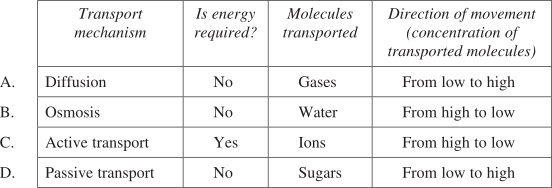
Which row in the table correctly identifies the features of the named transport mechanism?
 

Show Answers Only

\(B\)

Show Worked Solution

By Elimination

  • Diffusion moves molecules from high to low concentration (Eliminate A).
  • Active transport uses energy to move molecules against the concentration gradient, therefore from low to high (Eliminate C).
  • Passive transport refers to the diffusion of simple molecules which can ‘squeeze between’ the phospholipid molecules of the membrane. Sugars are too large to do this and require carrier or channel proteins. (Eliminate D).

\(\Rightarrow B\)

Filed Under: Cell Function Tagged With: Band 4, smc-4303-30-Movement of materials

BIOLOGY, M1 2018 HSC 23

  1. A student plans to investigate the effect of light intensity on transpiration in plants. 
  2. Complete the table, identifying features that this student should include to ensure valid experimental design.  (3 marks)

\begin{array} {|l|l|}
\hline
\rule{0pt}{2.5ex}\textit{Dependent variable}\rule[-1ex]{0pt}{0pt} &  \text{•}  \ \ \ \ \ \ \ \ \ \ \ \ \ \ \ \ \ \ \ \ \ \ \ \ \ \ \ \ \ \ \ \ \ \ \ \ \ \ \ \ \ \ \ \ \ \ \ \ \ \ \ \ \ \ \ \ \ \ \ \ \ \ \ \ \ \ \ \  \ \ \ \ \ \ \ \ \\
\hline
\rule{0pt}{2.5ex}\textit{Control}\rule[-1ex]{0pt}{0pt} &  \text{•} \\
\hline
\rule{0pt}{2.5ex}\textit{Variables to be kept constant}\rule[-1ex]{0pt}{0pt} &   \text{•} \\  &   \text{•} \\
\hline
\end{array}

  1. Explain ONE mechanism for the movement of materials in xylem vessels.  (2 marks)

    --- 4 WORK AREA LINES (style=lined) ---

Show Answers Only

a.   

\begin{array} {|l|l|}
\hline
\rule{0pt}{2.5ex}\textit{Dependent variable}\rule[-1ex]{0pt}{0pt} &  \text{• Amount of water lost}  \\
\hline
\rule{0pt}{2.5ex}\textit{Control}\rule[-1ex]{0pt}{0pt} &  \text{• Plant kept in the dark} \\
\hline
\rule{0pt}{2.5ex}\textit{Variables to be kept constant}\rule[-1ex]{0pt}{0pt} &   \text{• Plant type} \\  &   \text{• Temperature} \\
\hline
\end{array}
 

b.    Water molecules have chemical properties which make them cohesive.

  • Due to this, when water evaporates or transpires, other water molecules are pulled up the xylem vessels.
  • This is one of the core mechanisms that drives the movement of water from roots to leaves.

Show Worked Solution

a.   

\begin{array} {|l|l|}
\hline
\rule{0pt}{2.5ex}\textit{Dependent variable}\rule[-1ex]{0pt}{0pt} &  \text{• Amount of water lost}  \\
\hline
\rule{0pt}{2.5ex}\textit{Control}\rule[-1ex]{0pt}{0pt} &  \text{• Plant kept in the dark} \\
\hline
\rule{0pt}{2.5ex}\textit{Variables to be kept constant}\rule[-1ex]{0pt}{0pt} &   \text{• Plant type} \\  &   \text{• Temperature} \\
\hline
\end{array}

♦ Mean mark (a) 54%.

 b.    Water molecules have chemical properties which make them cohesive.

  • Due to this, when water evaporates or transpires, other water molecules are pulled up the xylem vessels.
  • This is one of the core mechanisms that drives the movement of water from roots to leaves. 

Filed Under: Cell Function Tagged With: Band 4, Band 5, smc-4303-10-Photosynthesis, smc-4303-30-Movement of materials

Copyright © 2014–2025 SmarterEd.com.au · Log in