SmarterEd

Aussie Maths & Science Teachers: Save your time with SmarterEd

  • Login
  • Get Help
  • About

BIOLOGY, M1 2018 HSC 27

With the breakdown of proteins, animals produce ammonia, a nitrogenous waste product that must be removed. Direct removal of ammonia requires the excretion of large amounts of water.

Explain how both terrestrial mammals and insects conserve water while excreting nitrogenous wastes.  (4 marks)

--- 6 WORK AREA LINES (style=lined) ---
Show Answers Only
  • In order to conserve water, terrestrial mammals concentrate their urine which can be done through structural adaptations such as elongated loops of Henle and collecting ducts in the kidney.
  • Because ammonia is toxic, mammals convert ammonia to the less toxic urea which can be excreted in concentrated form.
  • Insects can produce uric acid, a substance even less toxic than urea which can be excreted in very concentrated form with little water required.
Show Worked Solution
  • In order to conserve water, terrestrial mammals concentrate their urine which can be done through structural adaptations such as elongated loops of Henle and collecting ducts in the kidney.
  • Because ammonia is toxic, mammals convert ammonia to the less toxic urea which can be excreted in concentrated form.
  • Insects can produce uric acid, a substance even less toxic than urea which can be excreted in very concentrated form with little water required.
♦ Mean mark 39%.

Filed Under: Cell Function Tagged With: Band 5, smc-4303-50-Excretion

BIOLOGY, M1 2013 HSC 29

  1. What chemicals are filtered out of the blood by the kidney?   (2 marks)

    --- 2 WORK AREA LINES (style=lined) ---

  2. What chemicals are reabsorbed into the blood by the kidney?   (2 marks)

    --- 2 WORK AREA LINES (style=lined) ---

  3. Explain the steps involved in the formation of urine.   (4 marks)

    --- 10 WORK AREA LINES (style=lined) ---

Show Answers Only

a.    Glucose and \(\ce{NaCl}\).

b.    Water \(\ce{(H2O)}\) and glucose.

c.    Blood is filtered at the glomerulus through Bowman’s capsule.

  • Blood cells and large molecules remain in the blood and small molecules, salts and water enter the proximal tubule.
  • Glucose is actively taken back to the blood through the wall of the proximal tubule.
  • The filtrate then enters the loop of Henle where a countercurrent mechanism uses active transport (ascending limb) and osmosis causes a concentration gradient of ions down the loop of Henle (towards the medulla).
  • The filtrate then enters the distal tubule where its other ions are removed. The urine can be made more acidic here. It then enters the collecting tubule which is not permeable to water unless stimulated by ADH.
  • ADH causes it to be permeable to water as it descends past the loop of Henle in the medulla. This then leads to a concentration of the urine by osmosis.
Show Worked Solution

a.    Glucose and \(\ce{NaCl}\).

b.    Water \(\ce{(H2O)}\) and glucose.

c.    Blood is filtered at the glomerulus through Bowman’s capsule.

  • Blood cells and large molecules remain in the blood and small molecules, salts and water enter the proximal tubule.
  • Glucose is actively taken back to the blood through the wall of the proximal tubule.
  • The filtrate then enters the loop of Henle where a countercurrent mechanism uses active transport (ascending limb) and osmosis causes a concentration gradient of ions down the loop of Henle (towards the medulla).
  • The filtrate then enters the distal tubule where its other ions are removed. The urine can be made more acidic here. It then enters the collecting tubule which is not permeable to water unless stimulated by ADH.
  • ADH causes it to be permeable to water as it descends past the loop of Henle in the medulla. This then leads to a concentration of the urine by osmosis.
Mean mark (c) 53%.

Filed Under: Cell Function Tagged With: Band 4, smc-4303-50-Excretion

BIOLOGY, M1 2015 HSC 22

Explain why insects excrete uric acid as their principal nitrogenous waste.  (2 marks)

Show Answers Only
  • Insects need to conserve water within their bodies by reducing water loss.
  • This is done through their creation of uric acid which low toxicity and therefore it can be excreted in a highly concentrated form, reducing insects need for large amounts of water to excrete their nitrogenous wastes.
Show Worked Solution
  • Insects need to conserve water within their bodies by reducing water loss.
  • This is done through their creation of uric acid which low toxicity and therefore it can be excreted in a highly concentrated form, reducing insects need for large amounts of water to excrete their nitrogenous wastes.
♦ Mean mark 48%.

Filed Under: Cell Function Tagged With: Band 5, smc-4303-50-Excretion

BIOLOGY, M1 2016 HSC 23

  1. Explain ONE reason why the concentration of water in cells should be maintained within a narrow range for optimal cell function.  (2 marks)

    --- 5 WORK AREA LINES (style=lined) ---

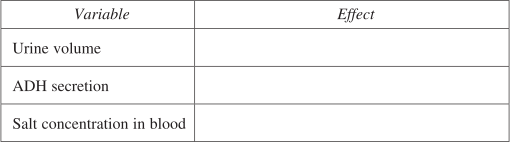
  2. A person has consumed large amounts of water. Complete the table to show the effect on each of the variables listed.  (3 marks)


--- 0 WORK AREA LINES (style=lined) ---

Show Answers Only

a.    Correct answers could include:

  • Concentration of water in cells is maintained to regulate concentrations of solutes in cells.
  • Concentration of water in a narrow range provides appropriate substrate concentrations for metabolic function.

b.

\begin{array} {|l|l|}
\hline
\rule{0pt}{2.5ex}\ \ \ \ \ \ \ \ \textit{Variable}\rule[-1ex]{0pt}{0pt} & \rule{0pt}{2.5ex}\textit{Effect}\rule[-1ex]{0pt}{0pt}\\
\hline
\rule{0pt}{2.5ex}\text{Urine Volume}\rule[-1ex]{0pt}{0pt} & \rule{0pt}{2.5ex}\text{Increase}\rule[-1ex]{0pt}{0pt}\\
\hline
\rule{0pt}{2.5ex}\text{ADH Secretion}\rule[-1ex]{0pt}{0pt} & \rule{0pt}{2.5ex}\text{Decrease}\rule[-1ex]{0pt}{0pt}\\
\hline
\rule{0pt}{2.5ex}\text{Salt concentration in blood}\rule[-1ex]{0pt}{0pt} & \rule{0pt}{2.5ex}\text{Decrease}\rule[-1ex]{0pt}{0pt}\\
\hline
\end{array}

Show Worked Solution

a.    Correct answers could include:

  • Concentration of water in cells is maintained to regulate concentrations of solutes in cells.
  • Concentration of water in a narrow range provides appropriate substrate concentrations for metabolic function.
♦ Mean mark 43%.

b.

\begin{array} {|l|l|}
\hline
\rule{0pt}{2.5ex}\ \ \ \ \ \ \ \ \textit{Variable}\rule[-1ex]{0pt}{0pt} & \rule{0pt}{2.5ex}\textit{Effect}\rule[-1ex]{0pt}{0pt}\\
\hline
\rule{0pt}{2.5ex}\text{Urine Volume}\rule[-1ex]{0pt}{0pt} & \rule{0pt}{2.5ex}\text{Increase}\rule[-1ex]{0pt}{0pt}\\
\hline
\rule{0pt}{2.5ex}\text{ADH Secretion}\rule[-1ex]{0pt}{0pt} & \rule{0pt}{2.5ex}\text{Decrease}\rule[-1ex]{0pt}{0pt}\\
\hline
\rule{0pt}{2.5ex}\text{Salt concentration in blood}\rule[-1ex]{0pt}{0pt} & \rule{0pt}{2.5ex}\text{Decrease}\rule[-1ex]{0pt}{0pt}\\
\hline
\end{array}

Filed Under: Cell Function Tagged With: Band 4, Band 5, smc-4303-50-Excretion

BIOLOGY, M1 2017 HSC 25

Explain the difference in the urine concentration of marine fish and freshwater fish.  (4 marks)

--- 8 WORK AREA LINES (style=lined) ---

Show Answers Only
  • Marine fish live in an environment which has a higher salt concentration than the concentration inside their cells, causing them to lose too much water through osmosis.
  • To maintain their internal environment they release very concentrated but small amounts of urine, which allows them to conserve water.
  • Freshwater fish live in an environment which has a lower salt concentration than the concentration inside their cells, causing too much water to move into their cells through osmosis.
  • To maintain their internal environment they produce large quantities of dilute urine, which allows them to expel the ‘extra’ water.
Show Worked Solution
  • Marine fish live in an environment which has a higher salt concentration than the concentration inside their cells, causing them to lose too much water through osmosis.
  • To maintain their internal environment they release very concentrated but small amounts of urine, which allows them to conserve water.
  • Freshwater fish live in an environment which has a lower salt concentration than the concentration inside their cells, causing too much water to move into their cells through osmosis.
  • To maintain their internal environment they produce large quantities of dilute urine, which allows them to expel the ‘extra’ water.

Filed Under: Cell Function Tagged With: Band 4, smc-4303-50-Excretion

Copyright © 2014–2025 SmarterEd.com.au · Log in