SmarterEd

Aussie Maths & Science Teachers: Save your time with SmarterEd

  • Login
  • Get Help
  • About

BIOLOGY, M3 EQ-Bank 4 MC

Which of the following scenarios best demonstrates a physiological adaptation rather than a structural or behavioural adaptation in an Australian organism?

  1. A kangaroo's ability to hop at high speeds over long distances.
  2. The drought deciduousness of mulga trees in arid regions.
  3. The mallee fowl's behaviour of building and maintaining large incubation mounds.
  4. The production of cyanide compounds by Swainsona plants when grazed upon.
Show Answers Only

\(D\)

Show Worked Solution
  • Physiological adaptations refer to functions of an organism’s structural features that have evolved to help them survive in their specific environments.

\(\Rightarrow D\)

Filed Under: Adaptations Tagged With: Band 4, smc-4308-10-Structural adaptations, smc-4308-15-Physiological adaptations

BIOLOGY, M3 EQ-Bank 3 MC

Consider the following adaptations in Australian organisms:

\(\text{I.}\)   The ability of koalas to detoxify eucalyptus leaves.  
\(\text{II.}\)   The migration of bogong moths to alpine areas in summer.  
\(\text{III.}\)   The spines on an echidna.  
\(\text{IV.}\)   The camouflage patterns on a leaf-tailed gecko.  

 
Which combination correctly identifies one of each type of adaptation (structural, physiological, and behavioural)?

  1. \(\text{I, II,}\) and \(\text{III}\)
  2. \(\text{I, II,}\) and \(\text{IV}\)
  3. \(\text{I, III,}\) and \(\text{IV}\)
  4. \(\text{II, III,}\) and \(\text{IV}\)
Show Answers Only

\(D\)

Show Worked Solution

Consider each statement:

  • \(\text{I.}\) Physiological adaptation. The ability of koalas to detoxify eucalyptus leaves involves internal metabolic processes.
  • \(\text{II.}\) Behavioral adaptation. The migration of bogong moths is a seasonal behavior that helps them survive and reproduce.
  • \(\text{III.}\) Structural adaptation. The spines on an echidna are physical features that provide protection.
  • \(\text{IV.}\) Structural adaptation. The camouflage patterns on a leaf-tailed gecko are physical characteristics, though they can change slightly which could be considered physiological.

\(\Rightarrow D\)

Filed Under: Adaptations Tagged With: Band 5, smc-4308-10-Structural adaptations, smc-4308-15-Physiological adaptations, smc-4308-18-Behavioural adaptations

BIOLOGY, M3 EQ-Bank 2

Explain the concept of physiological adaptation in living organisms. In your answer, describe one example of a physiological adaptation in a plant species and one example in an animal species.   (3 marks)

--- 5 WORK AREA LINES (style=lined) ---

Show Answers Only
  • Physiological adaptations refer to functions of an organism’s structural features that have evolved to help them survive in their specific environments.
  • Plant example: Photosynthesis used by many succulent plants in arid regions, such as the Australian pigface, allows them to conserve water by opening their stomata at night to collect \(\ce{CO2}\).
  • Animal example: The salt glands of marine birds like the Australian pelican are a physiological adaptation that allows them to excrete excess salt from their bodies. This enables them to maintain proper osmotic balance despite drinking seawater.
Show Worked Solution
  • Physiological adaptations refer to functions of an organism’s structural features that have evolved to help them survive in their specific environments.
  • Plant example: Photosynthesis used by many succulent plants in arid regions, such as the Australian pigface, allows them to conserve water by opening their stomata at night to collect \(\ce{CO2}\).
  • Animal example: The salt glands of marine birds like the Australian pelican are a physiological adaptation that allows them to excrete excess salt from their bodies. This enables them to maintain proper osmotic balance despite drinking seawater.

Filed Under: Adaptations Tagged With: Band 4, smc-4308-15-Physiological adaptations

BIOLOGY, M3 EQ-Bank 5-6 MC

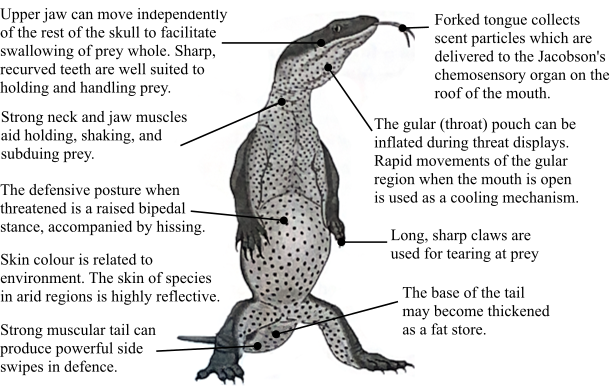
The following diagram shows features which relate to the goanna.
 

Question 5

Which of the following features is a behavioural adaptation?

  1. Skin colour related to the environment.
  2. The base of the tail becoming thick to store fat.
  3. Long, sharp claws that are used for tearing at prey.
  4. Rapid movements of the gular region to cool down.

 
Question 6

Which of the following features is a physiological adaptation?

  1. Skin colour related to the environment.
  2. The base of the tail becoming thick to store fat.
  3. Long, sharp claws that are used for tearing at prey.
  4. Rapid movements of the gular region to cool down.
Show Answers Only

Question 5: \(D\)

Question 6: \(B\)

Show Worked Solution

Question 5

  • A behavioural adaptation is an action that is carried out by the organism. This would be the action of moving the gular region to cool down.

\(\Rightarrow D\)
 

Question 6

  • A physiological adaptation is a process which occurs within the organism. This would be the thickening of the tail to store fat.

\(\Rightarrow B\) 

Filed Under: Adaptations Tagged With: Band 4, smc-4308-15-Physiological adaptations, smc-4308-18-Behavioural adaptations

Copyright © 2014–2025 SmarterEd.com.au · Log in