SmarterEd

Aussie Maths & Science Teachers: Save your time with SmarterEd

  • Login
  • Get Help
  • About

BIOLOGY, M3 EQ-Bank 4

The illustrations below depict three species of finches from the Galapagos Islands, as observed by Charles Darwin during his voyage.
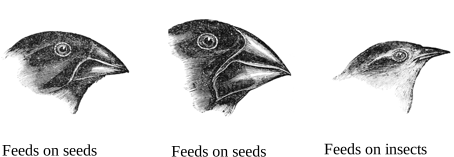
Explain why these finch species inhabit distinct ecological niches.   (3 marks)

--- 6 WORK AREA LINES (style=lined) ---

Show Answers Only
  • The distinct beak shapes of these finch species are adaptations that allow them to exploit different food sources, leading to occupation of distinct ecological niches.
  • The two finches with wider, shorter beaks are adapted for eating seeds, with the variation in width likely corresponding to different seed sizes or hardness they can crack.
  • The finch with the thin, long beak is specialised for probing and catching insects, allowing it to access food sources that the seed-eating finches cannot.
  • These adaptations reduce direct competition for food between the species, enabling them to coexist in the same general area by utilising different resources, a concept known as niche partitioning.
Show Worked Solution
  • The distinct beak shapes of these finch species are adaptations that allow them to exploit different food sources, leading to occupation of distinct ecological niches.
  • The two finches with wider, shorter beaks are adapted for eating seeds, with the variation in width likely corresponding to different seed sizes or hardness they can crack.
  • The finch with the thin, long beak is specialised for probing and catching insects, allowing it to access food sources that the seed-eating finches cannot.
  • These adaptations reduce direct competition for food between the species, enabling them to coexist in the same general area by utilising different resources, a concept known as niche partitioning.

Filed Under: Adaptations Tagged With: Band 4, smc-4308-50-Galapagos

BIOLOGY, M3 2022 VCE 8a

There are 13 species of small birds commonly known as Darwin's finches, found only on the Galápagos Islands in the Pacific Ocean, 1000 km west of South America. Their closest living relative is the dull-coloured grassquit, Asemospiza obscura, which is found on mainland South America. It is believed that Darwin's finches evolved from A. obscura or from its ancestor on the mainland.

The different finch species are similar in colour but vary in beak size and shape, habitat and diet.

Discuss how the different species of Darwin's finches arose from an ancestral population on the mainland. In your response, name the type of speciation that occurred and identify the main selection pressure(s) that has acted on finch populations.   (6 marks)

--- 12 WORK AREA LINES (style=lined) ---

Show Answers Only

  • The variation in Darwin’s finches can be explained by allopatric speciation, where a few million years ago geographical separation of an ancestral finch species prevented gene flow between these isolated groups.
  • On the separate islands, varying factors including available food, water and shelter acted as selection pressures on the finch communities.
  • Random mutations in the finches, including ones which caused changes in beak size and shape, were potentially beneficial to the finch on it’s respective island. For example, if grubs were a common sauce of food on an island, a random mutation in a finch that produced a longer beak would make the grubs more accessible.
  • By Natural Selection, these traits would then be passed on by generations and overtime creating a new species of finch which is unique compared to those found on the other islands.

Show Worked Solution

  • The variation in Darwin’s finches can be explained by allopatric speciation, where a few million years ago geographical separation of an ancestral finch species prevented gene flow between these isolated groups.
  • On the separate islands, varying factors including available food, water and shelter acted as selection pressures on the finch communities.
  • Random mutations in the finches, including ones which caused changes in beak size and shape, were potentially beneficial to the finch on it’s respective island. For example, if grubs were a common sauce of food on an island, a random mutation in a finch that produced a longer beak would make the grubs more accessible.
  • By Natural Selection, these traits would then be passed on by generations and overtime creating a new species of finch which is unique compared to those found on the other islands.

Filed Under: Adaptations Tagged With: Band 5, smc-4308-50-Galapagos

BIOLOGY, M3 EQ-Bank 23

Explain how the finches on the Galapagos Islands support Darwin's theory of Natural Selection.   (5 marks)

--- 10 WORK AREA LINES (style=lined) ---

Show Answers Only
  • The diversity between finches that exist on seperate islands in the Galapagos can be explained by Darwin’s theory of evolution and Natural Selection.
  • It is believed that a few million years ago, one species of finch migrated to the rocky Galapagos from Central or South America. This finch species can be considered the common ancestor.
  • As the finch species spread out between the islands, the ecological niches of each island placed different selection pressures that pushed the two finch populations in different directions.
  • Some random variations that provided a breeding or survival advantage became more prevalent after generations because finches with the advantage reproduced more.
  • This process resulted in the development of different finch species between the islands, each with varying beak sizes and shapes which were better suited to the different diets on each island. For example, one species that eat grubs developed longer beaks to poke into holes and extract the grubs.
  • In this way, the varying finch species observed by Darwin provides evidence for his theory of Natural Selection.
Show Worked Solution
  • The diversity between finches that exist on seperate islands in the Galapagos can be explained by Darwin’s theory of evolution and Natural Selection.
  • It is believed that a few million years ago, one species of finch migrated to the rocky Galapagos from Central or South America. This finch species can be considered the common ancestor.
  • As the finch species spread out between the islands, the ecological niches of each island placed different selection pressures that pushed the two finch populations in different directions.
  • Some random variations that provided a breeding or survival advantage became more prevalent after generations because finches with the advantage reproduced more.
  • This process resulted in the development of different finch species between the islands, each with varying beak sizes and shapes which were better suited to the different diets on each island. For example, one species that eat grubs developed longer beaks to poke into holes and extract the grubs.
  • In this way, the varying finch species observed by Darwin provides evidence for his theory of Natural Selection.

Filed Under: Adaptations Tagged With: Band 4, smc-4308-50-Galapagos

Copyright © 2014–2025 SmarterEd.com.au · Log in