SmarterEd

Aussie Maths & Science Teachers: Save your time with SmarterEd

  • Login
  • Get Help
  • About

BIOLOGY, M4 EQ-Bank 35

"The thylacine was declared extinct in 1982, 50 years after it's last record. It is believed multiple factors influenced it's decline and extinction including competition with wild dogs, erosion of its habitat, the concurrent extinction of its prey and a distemper-like disease which affected many captive specimens at the time".

Using the extract above, outline measures that could have been implemented to save the thylacine.   (4 marks)
Show Answers Only
  • If European settlers researched the implication of introducing dogs into Australia then their numbers may be reduced or may have not been introduced at all, and a better alternative would have been found.
  • Introducing mulch and vegetation would have reduced erosion, better preserving thylacine habitats.
  • The concurrent extinction of it’s prey would have contributed to the thylacines extinction due to the reduction of it’s food source. By protecting prey species through strategies such as reducing the erosion in the habitat, breeding programs and legal protection can subsequently save the thylacine.
  • Better monitoring and research surrounding the disease which affected captive specimens may have prevented it’s extreme impact on the thylacine and perhaps many other species.
Show Worked Solution
  • If European settlers researched the implication of introducing dogs into Australia then their numbers may be reduced or may have not been introduced at all, and a better alternative would have been found.
  • Introducing mulch and vegetation would have reduced erosion, better preserving thylacine habitats.
  • The concurrent extinction of it’s prey would have contributed to the thylacines extinction due to the reduction of it’s food source. By protecting prey species through strategies such as reducing the erosion in the habitat, breeding programs and legal protection can subsequently save the thylacine.
  • Better monitoring and research surrounding the disease which affected captive specimens may have prevented it’s extreme impact on the thylacine and perhaps many other species.

Filed Under: Population Dynamics Tagged With: Band 4, smc-4311-50-Extinction

BIOLOGY, M4 2021 VCE 23 MC

Mass extinction events

  1. allow new species to evolve to occupy available niches.
  2. allow all species that survive to recover and diverge.
  3. result from a constant global climate.
  4. affect all species equally.
Show Answers Only

\(A\)

Show Worked Solution
  • When a mass extinction event occurs, it allows the remaining species to occupy the previously inhabited niches.

\(\Rightarrow A\)

Filed Under: Population Dynamics Tagged With: Band 4, smc-4311-50-Extinction

BIOLOGY, M4 2021 VCE 22 MC

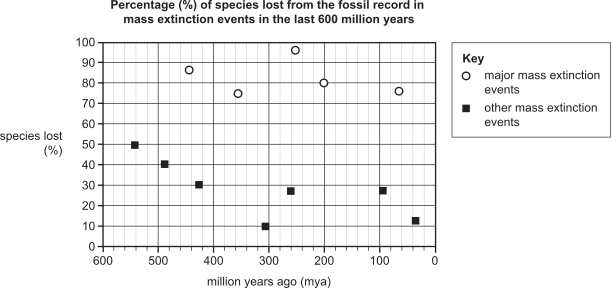
The graph below shows when the five major mass extinction events and several other mass extinction events occurred. It also shows the percentage of species that were lost in each event.
 

According to the graph, to be classified as a major mass extinction event, the percentage of species that are lost has to be at least

  1. 10%
  2. 50%
  3. 74%
  4. 97%
Show Answers Only

\(C\)

Show Worked Solution
  • The lowest % of species lost in a mass extinction event is 74% within this data set.
  • It follows that for an extinction event to be classified as major, at least 74% of species must have been lost.

\(\Rightarrow C\)

Filed Under: Population Dynamics Tagged With: Band 3, smc-4311-50-Extinction

Copyright © 2014–2025 SmarterEd.com.au · Log in