SmarterEd

Aussie Maths & Science Teachers: Save your time with SmarterEd

  • Login
  • Get Help
  • About

BIOLOGY, M4 2018 HSC 34aii

Using an example, outline a limitation of only using the fossil record to interpret the past.  (2 marks)

Show Answers Only
  • Using just a fossil record to date events may lead to inaccurate results if not compared to another dating method.
  • For example, radioactive dating of fossils from campsites gives the date for colonisation of Australia at 40,000 years ago while thermoluminescence data, a process used to date certain crystalline minerals, puts the date at 50-60,000 years.
Show Worked Solution
  • Using just a fossil record to date events may lead to inaccurate results if not compared to another dating method.
  • For example, radioactive dating of fossils from campsites gives the date for colonisation of Australia at 40,000 years ago while thermoluminescence data, a process used to date certain crystalline minerals, puts the date at 50-60,000 years.

Filed Under: Past Ecosystems Tagged With: Band 4, smc-4312-25-Palaeontology

BIOLOGY, M4 2015 HSC 35d

  1. Distinguish between relative dating and absolute dating of fossils.   (2 marks)

    --- 4 WORK AREA LINES (style=lined) ---

  2. Students found three fossils (A, B and C) at an archaeological site. 
     

The students concluded that their data were conflicting and they could not determine the relative ages of the fossils.

Evaluate the students' conclusion with reference to the data presented.   (4 marks)

--- 8 WORK AREA LINES (style=lined) ---

Show Answers Only

i.    Relative vs absolute dating:

  • Relative dating is used to compare fossils, giving scientists data to determine if one fossil is older/younger than another.
  • Absolute dating can provide a quantitative value for the actual age of individual fossils. 

ii.    Evaluation of conclusion:

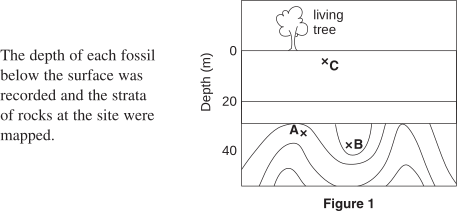
  • Fossil B is located at a lower depth than fossil A, however, the strata that contains fossil A is below the strata that contains fossil B.
  • This has occurred because the landscape was folded via geological processes, pushing up some of the strata containing fossil A and pushing down the strata containing fossil B. Therefore, fossil A is the older of the two. 
  • Fossil C is younger because it is located in a higher strata than the other two fossils.
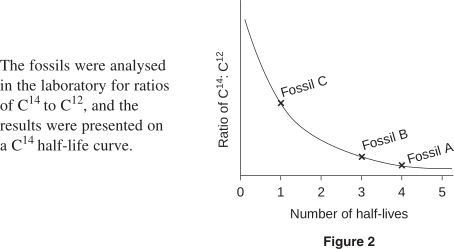
  • In Figure 2, fossil A is shown to have an age of four half-lives of \(\ce{C^{14}}\), fossil B three half-lives and fossil C one half-life. This evidence suggests fossil A is the oldest and fossil C is much younger. Therefore the students’ conclusion is incorrect as the graphical data is consistent with the mapped data.
Show Worked Solution

i.    Relative vs absolute dating:

  • Relative dating is used to compare fossils, giving scientists data to determine if one fossil is older/younger than another.
  • Absolute dating can provide a quantitative value for the actual age of individual fossils. 

ii.    Evaluation of conclusion:

  • Fossil B is located at a lower depth than fossil A, however, the strata that contains fossil A is below the strata that contains fossil B.
  • This has occurred because the landscape was folded via geological processes, pushing up some of the strata containing fossil A and pushing down the strata containing fossil B. Therefore, fossil A is the older of the two. 
  • Fossil C is younger because it is located in a higher strata than the other two fossils.
  • In Figure 2, fossil A is shown to have an age of four half-lives of \(\ce{C^{14}}\), fossil B three half-lives and fossil C one half-life. This evidence suggests fossil A is the oldest and fossil C is much younger. Therefore the students’ conclusion is incorrect as the graphical data is consistent with the mapped data.

Filed Under: Past Ecosystems Tagged With: Band 4, Band 5, smc-4312-07-Rock structure/formation, smc-4312-25-Palaeontology, smc-4312-40-Evaluating hypotheses

Copyright © 2014–2025 SmarterEd.com.au · Log in