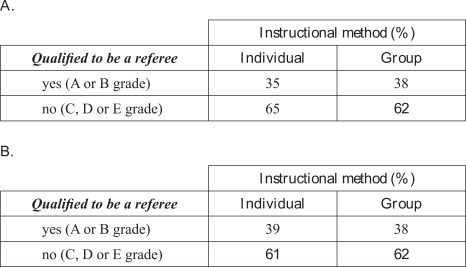
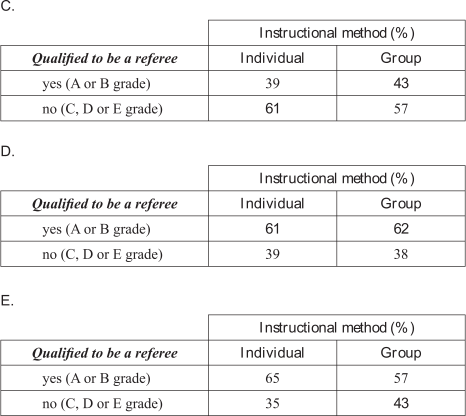
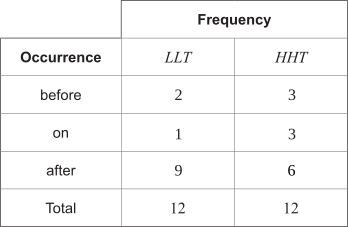
In the year 2021 there were 12 days where a new moon appeared in Sydney Harbour. For these 12 days the occurrence of the highest high tides (HHT) and lowest low tides ( \(L L T\) ) occurred before, on or after the appearance of the new moon. These records are displayed in the table below. Table 3 --- 0 WORK AREA LINES (style=lined) --- --- 4 WORK AREA LINES (style=lined) --- a. b. \(\text{% \(LLT\) “before” =}\ \dfrac{2}{12}=16.7\%\) \(\text{% \(LLT\) “on” =}\ \dfrac{1}{12}=8.3\%\) \(\text{% \(LLT\) “after” =}\ \dfrac{9}{12}=75\%\) \(\therefore\ \text{The data does support the contention as the percentage of “after” is}\) \(\text{significantly higher than those from “before” and “on”.}\) a. b. \(\text{% \(LLT\) “before” =}\ \dfrac{2}{12}=16.7\%\) \(\text{% \(LLT\) “on” =}\ \dfrac{1}{12}=8.3\%\) \(\text{% \(LLT\) “after” =}\ \dfrac{9}{12}=75\%\) \(\therefore\ \text{The data does support the contention as the percentage of “after” is}\) \(\text{significantly higher than those from “before” and “on”.}\)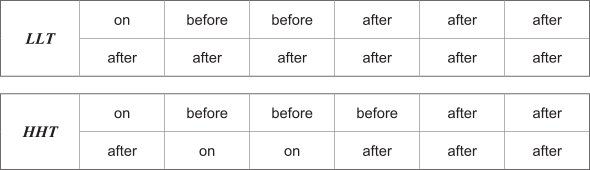
Data Analysis, GEN1 2022 VCAA 9-11 MC
Table 1 summarises the results of a study that compared the effectiveness of individual and group instruction (instructional method) when training future basketball referees.
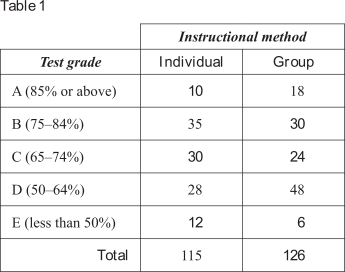
In this table, test grade is the response variable and instructional method is the explanatory variable.
Question 9
The variables test grade (A, B, C, D, E) and instructional method (individual, group) are
- a numerical and a categorical variable respectively.
- both nominal variables.
- a nominal and an ordinal variable respectively.
- both ordinal variables.
- an ordinal and a nominal variable respectively.
Question 10
Of the students who received an A grade, the percentage who were instructed individually is closest to
- 9%
- 22%
- 36%
- 56%
- 64%
Question 11
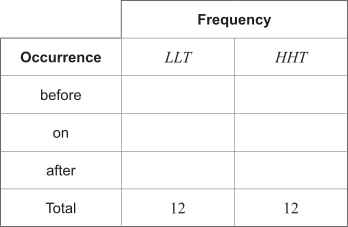
To become a qualified referee, a grade of A or B on the test is required. Those who receive a C, a D or an E will not qualify.
Using column percentages, a new two-way percentage frequency table is constructed from the data in Table 1.
In this new table, qualified to be a referee (yes, no) is the response variable and instructional method (individual, group) is the explanatory variable.
Which one of the following tables correctly displays the data from Table 1?