SmarterEd

Aussie Maths & Science Teachers: Save your time with SmarterEd

  • Login
  • Get Help
  • About

Bivariate Data, SM-Bank 016

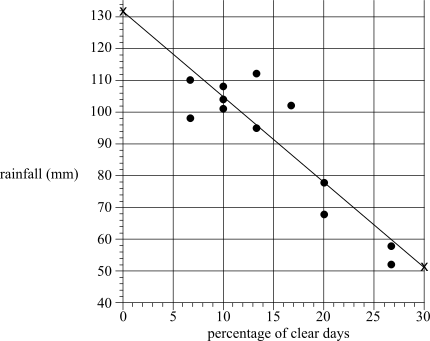
The scatterplot below shows the rainfall (in mm) and the percentage of clear days for each month of 2023. 
 

An equation of the line of best fit for this data set is

\(\textit{rainfall}\ = 131-2.68 \times\ \textit{percentage of clear days} \)

  1. Using coordinates at the graph extremities or otherwise, draw this line on the scatterplot.  (2 marks)

    --- 2 WORK AREA LINES (style=lined) ---

  2. Describe this association in terms of strength and direction.  (1 mark)

    --- 2 WORK AREA LINES (style=lined) ---

Show Answers Only

i.   
       

ii.    \(\text{Strength: moderate (data points are moderately close to the LOBF)}\)

\(\text{Direction: negative (as percentage of clear days ↑, rainfall ↓)}\)

Show Worked Solution

i.    \(\text{Calculate values at the limits of the graph:}\)

\((0, 131)\ \ \Rightarrow \ \ y \text{-intercept}\ = 131 \)

\( (30, 50.6)\ \ \Rightarrow \ \text{At}\ x=30, \ y=131-2.68 \times 30 = 50.6 \)
 

ii.    \(\text{Strength: moderate (data points are moderately close to the LOBF)}\)

\(\text{Direction: negative (as percentage of clear days ↑, rainfall ↓)}\)
Filed Under: Bivariate Data Tagged With: num-title-ct-coreb, smc-5022-25-Draw LOBF, smc-5022-30-Correlation

Bivariate Data, SM-Bank 004

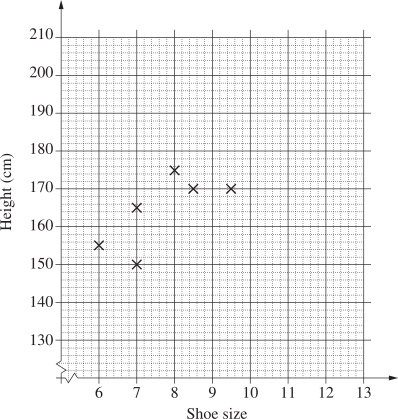
The shoe size and height of ten students were recorded.

\begin{array} {|l|c|c|}
\hline \rule{0pt}{2.5ex} \text{Shoe size} \rule[-1ex]{0pt}{0pt} & \text{6} & \text{7} & \text{7} & \text{8} & \text{8.5} & \text{9.5} & \text{10} & \text{11} & \text{12} & \text{12} \\
\hline \rule{0pt}{2.5ex} \text{Height} \rule[-1ex]{0pt}{0pt} & \text{155} & \text{150} & \text{165} & \text{175} & \text{170} & \text{170} & \text{190} & \text{185} & \text{200} & \text{195} \\
\hline
\end{array}

  1. Complete the scatter plot AND draw a line of best fit by eye.  (2 marks)
     
     
  2. Use the line of best fit to estimate the height difference between a student who wears a size 7.5 shoe and one who wears a size 9 shoe.  (1 mark)

    --- 2 WORK AREA LINES (style=lined) ---

Show Answers Only
  1. `text(See Worked Solutions.)`
  2. `text{13 cm (or close given LOBF drawn)}`
Show Worked Solution

i.    
     

ii.    `text{Shoe size 7.5 gives a height estimate of 162 cm (see graph)}`

`text{Shoe size 9 gives a height estimate of 175 cm (see graph)}`

`:.\ text(Height difference)` `= 175-162`
  `= 13\ text{cm  (or close given LOBF drawn)}`

Filed Under: Bivariate Data Tagged With: num-title-ct-coreb, smc-5022-10-Line of best fit graphs, smc-5022-20-Scatterplot from table, smc-5022-25-Draw LOBF

Bivariate Data, SM-Bank 002

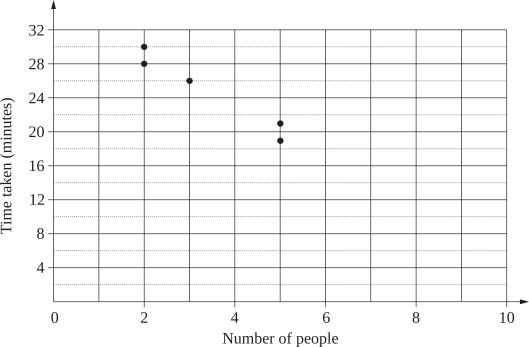
People are placed into groups to complete a puzzle. There are 9 different groups.

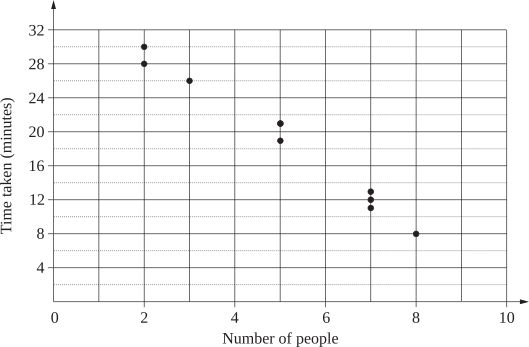
The table shows the number of people in each group and the amount of time, in minutes, for each group to complete the puzzle.

\begin{array} {|l|c|c|c|c|c|c|c|c|c|}
\hline
\rule{0pt}{2.5ex} \text{Number of people} \rule[-1ex]{0pt}{0pt} & 2 & 2 & 3 & 5 & 5 & 7 & 7 & 7 & 8 \\
\hline
\rule{0pt}{2.5ex} \text{Time taken (min)} \rule[-1ex]{0pt}{0pt} & 28 & 30 & 26 & 19 & 21 & 12 & 13 & 11 & 8 \\
\hline
\end{array}

  1. Complete the scatterplot by adding the last four points from the table.  (1 mark)
     
       
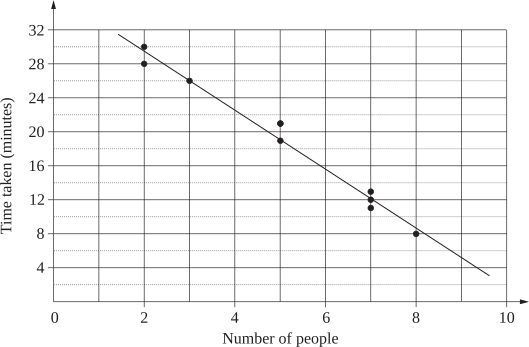
  2. Add a line of best fit by eye to the graph in part (a).  (1 mark)

    --- 0 WORK AREA LINES (style=lined) ---

  3. The graph in part (a) shows the association between the time to complete the puzzle and the number of people in the group.
  4. Identify the form (linear or non-linear), the direction and the strength of the association.  (2 marks)

    --- 3 WORK AREA LINES (style=lined) ---

Show Answers Only

a.

b.


c.    `text(Form: linear)

`text{Direction: negative}`

`text{Strength: strong}`

Show Worked Solution

a.

b.


c.    `text{Form: linear (i.e. straight line)}`

`text{Direction: negative}`

`text{Strength: strong}`

Filed Under: Bivariate Data Tagged With: num-title-ct-coreb, smc-5022-20-Scatterplot from table, smc-5022-25-Draw LOBF, smc-5022-30-Correlation

Statistics, STD1 S3 2020 HSC 22

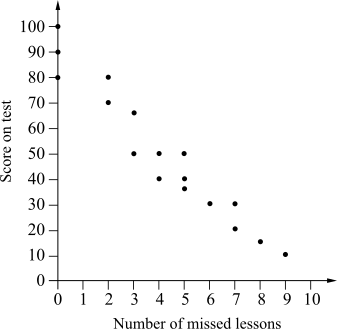
A group of students sat a test at the end of term. The number of lessons each student missed during the term and their score on the test are shown on the scatterplot.


  1. Describe the strength and direction of the linear association observed in this dataset.  (2 marks)

    --- 5 WORK AREA LINES (style=lined) ---

  2. Calculate the range of the test scores for the students who missed no lessons.  (1 mark)

    --- 1 WORK AREA LINES (style=lined) ---

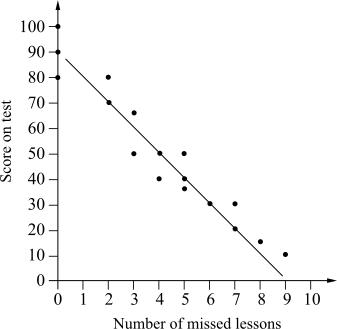
  3. Draw a line of the best fit in the scatterplot above.  (1 mark)
  4. Meg did not sit the test. She missed five lessons.


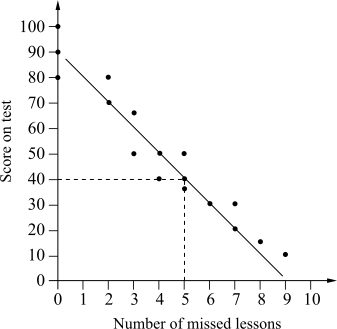
    Use the line of the best fit drawn in part (c) to estimate Meg's score on this test. (1 mark)

    --- 1 WORK AREA LINES (style=lined) ---

  5. John also did not sit the test and he missed 16 lessons.


    Is it appropriate to use the line of the best fit to estimate his score on the test? Briefly explain your answer. (1 mark)

    --- 2 WORK AREA LINES (style=lined) ---

Show Answers Only

a.    \(\text{Strength : strong}\)

\(\text{Direction : negative} \)

b.    \(\text{Range}\ = \text{high}-\text{low}\ = 100-80=20\)
 

c.   

d. 


e.    \(\text{John’s missed days are too extreme and the LOBF is not}\)

\(\text{appropriate. The model would estimate a negative score for}\)

\(\text{John which is impossible.}\)

Show Worked Solution

a.    \(\text{Strength : strong}\)

\(\text{Direction : negative} \)

♦ Mean mark (a) 45%.
♦♦ Mean mark (b) 31%.

b.    \(\text{Range}\ = \text{high}-\text{low}\ = 100-80=20\)
 

c.   

d. 


\(\therefore\ \text{Meg’s estimated score = 40}\)
 

e.    \(\text{John’s missed days are too extreme and the LOBF is not}\)

\(\text{appropriate. The model would estimate a negative score for}\)

\(\text{John which is impossible.}\)

♦ Mean mark (e) 38%.

Filed Under: Bivariate Data, S3 Further Statistical Analysis (Y12) Tagged With: Band 4, Band 5, num-title-ct-coreb, num-title-qs-hsc, smc-1113-10-Line of Best Fit, smc-1113-60-Limitations, smc-5022-10-Line of best fit graphs, smc-5022-25-Draw LOBF, smc-5022-30-Correlation, smc-5022-60-Limitations

Statistics, STD1 S3 2019 HSC 27

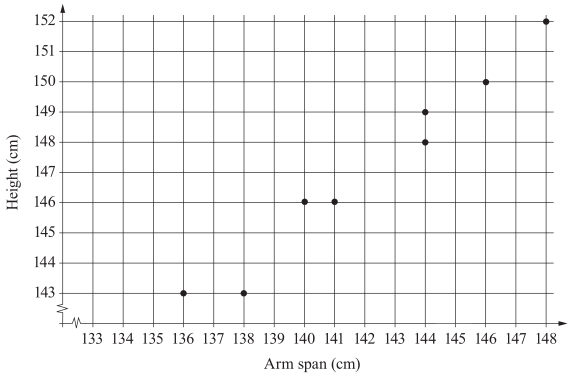
A set of bivariate data is collected by measuring the height and arm span of eight children. The graph shows a scatterplot of these measurements.
 

  1. On the graph, draw a line of best fit by eye.  (1 mark)

    --- 0 WORK AREA LINES (style=lined) ---

  2. Robert is a child from the class who was absent when the measurements were taken. He has an arm span of 147 cm. Using your line of best fit from part (a), estimate Robert’s height.  (1 mark)

    --- 1 WORK AREA LINES (style=lined) ---

Show Answers Only
  1.   
  2. `text(Robert’s height ≈ 151.1 cm)`
Show Worked Solution

a.     
       

♦ Mean mark (a) 38%.

b.   `text(Robert’s height ≈ 151.1 cm)`

`text{(Answers can vary slightly depending on line of best fit drawn).}`

Filed Under: S3 Further Statistical Analysis (Y12) Tagged With: Band 4, Band 5, num-title-ct-coreb, num-title-qs-hsc, smc-1113-10-Line of Best Fit, smc-5022-10-Line of best fit graphs, smc-5022-25-Draw LOBF

Copyright © 2014–2025 SmarterEd.com.au · Log in