SmarterEd

Aussie Maths & Science Teachers: Save your time with SmarterEd

  • Login
  • Get Help
  • About

Bivariate Data, SM-Bank 010

The scatterplot below shows the wrist circumference and ankle circumference, both in centimetres, of 13 people.

A line of best fit been drawn with ankle circumference as the independent variable.
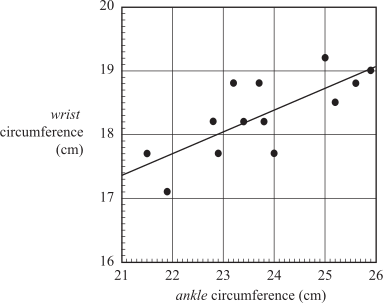
 

  1. If a person has a wrist circumference of 18.5 centimetres, estimate the ankle circumference that is predicted by the line of best fit.   (1 mark)

    --- 1 WORK AREA LINES (style=lined) ---

  2. Explain why the \(y\)-intercept of this graph has no meaning in this context.   (1 mark)

    --- 2 WORK AREA LINES (style=lined) ---
Show Answers Only

i.    \(\text{18.5 cm wrist}\ \ \Rightarrow \ \ \text{Ankle circumference ≈ 24.5 cm}\)

ii.    \(y \text{-intercept occurs when ankle circumference = 0 cm, which is}\)

\(\text{meaningless in this context.}\)

Show Worked Solution

i.    \(\text{18.5 cm wrist}\ \ \Rightarrow \ \ \text{Ankle circumference ≈ 24.5 cm}\)
 

ii.    \(y \text{-intercept occurs when ankle circumference = 0 cm, which is}\)

\(\text{meaningless in this context.}\)

Filed Under: Bivariate Data Tagged With: num-title-ct-coreb, smc-5022-10-Line of best fit graphs, smc-5022-60-Limitations

Bivariate Data, SM-Bank 005

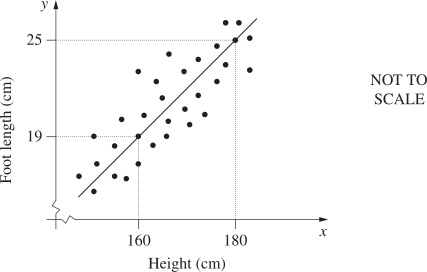
Each member of a group of males had his height and foot length measured and recorded. The results were graphed and a line of fit drawn.
 

  1. Why does the value of the `y`-intercept have no meaning in this situation?  (1 mark)

    --- 2 WORK AREA LINES (style=lined) ---

  2. George is 10 cm taller than his brother Harry. Use the line of fit to estimate the difference in their foot lengths.  (1 mark)

    --- 2 WORK AREA LINES (style=lined) ---
Show Answers Only
  1. `text(The y-intercept occurs when)\ x = 0.\ text(It has`
    `text(no meaning to have a height of 0 cm.)`
  2. `text(A 10 cm height difference means George should)`
    `text(have a 3 cm longer foot.)`
Show Worked Solution

i.  `text(The y-intercept occurs when)\ x = 0.\ text(It has)`

`text(no meaning to have a height of 0 cm.)`


ii.  `text(A 20 cm height difference results in a foot length)`

`text(difference of 6 cm.)`

`:.\ text(A 10 cm height difference means George should)`

`text(have a 3 cm longer foot.)`

Filed Under: Bivariate Data Tagged With: num-title-ct-coreb, smc-5022-10-Line of best fit graphs, smc-5022-60-Limitations

Bivariate Data, SM-Bank 003

Ahmed collected data on the age (`a`) and height (`h`) of males aged 11 to 16 years.

He created a scatterplot of the data and constructed a line of best fit to model the relationship between the age and height of males.
 

  1. Determine the gradient of the line of best fit shown on the graph.   (1 mark)

    --- 2 WORK AREA LINES (style=lined) ---
  2. Determine the equation of the line of best fit shown on the graph.  (2 marks)

    --- 5 WORK AREA LINES (style=lined) ---

  3. Use the line of best fit to predict the height of a typical 17-year-old male.   (1 mark)

    --- 1 WORK AREA LINES (style=lined) ---

  4. Why would this model not be useful for predicting the height of a typical 45-year-old male?   (1 mark)

    --- 2 WORK AREA LINES (style=lined) ---
Show Answers Only
  1. `text(Gradient = 6)`
  2. `h = 6a + 80`
  3. `text(182 cm)`
  4. `text(People slow and eventually stop growing)`
  5.  

    `text(after they become adults.)`

Show Worked Solution

i.    `text{Gradient}\ =(176-146)/(16-11)=30/5=6`
 

ii.   `text{Gradient = 6,  Passes through (11, 146)}`

`y-y_1` `=m(x-x_1)`
`h-146` `=6(a-11)`
`:. h` `=6a-66+146`
  `=6a + 80`
♦♦ Mean marks of 38% and 25% respectively for parts (i)-(ii).
COMMENT: Choose extreme points for calculating gradient.

 
iii.
   `text{Substitue}\ \ a=17\ \ \text{into equation from part (ii):}`

`h=(6 xx 17) +80=182`

`:.\ text{A typical 17 year old is expected to be 182cm.}`
  

iv.    `text(People slow and eventually stop growing)`
  `text(after they become adults.)`

Filed Under: Bivariate Data Tagged With: num-title-ct-coreb, smc-5022-28-LOBF equations, smc-5022-40-Gradient, smc-5022-60-Limitations

Statistics, STD1 S3 2020 HSC 22

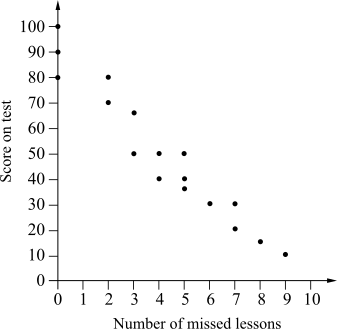
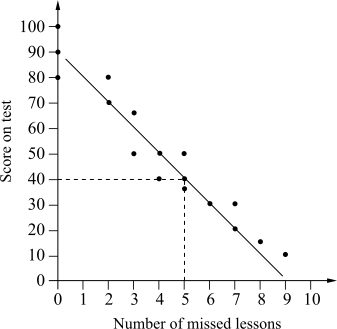
A group of students sat a test at the end of term. The number of lessons each student missed during the term and their score on the test are shown on the scatterplot.


  1. Describe the strength and direction of the linear association observed in this dataset.  (2 marks)

    --- 5 WORK AREA LINES (style=lined) ---

  2. Calculate the range of the test scores for the students who missed no lessons.  (1 mark)

    --- 1 WORK AREA LINES (style=lined) ---

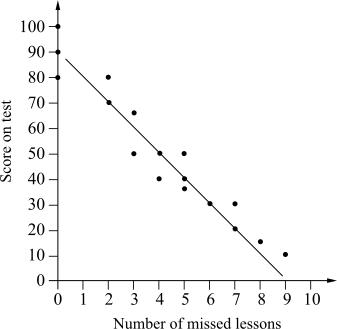
  3. Draw a line of the best fit in the scatterplot above.  (1 mark)
  4. Meg did not sit the test. She missed five lessons.


    Use the line of the best fit drawn in part (c) to estimate Meg's score on this test. (1 mark)

    --- 1 WORK AREA LINES (style=lined) ---

  5. John also did not sit the test and he missed 16 lessons.


    Is it appropriate to use the line of the best fit to estimate his score on the test? Briefly explain your answer. (1 mark)

    --- 2 WORK AREA LINES (style=lined) ---

Show Answers Only

a.    \(\text{Strength : strong}\)

\(\text{Direction : negative} \)

b.    \(\text{Range}\ = \text{high}-\text{low}\ = 100-80=20\)
 

c.   

d. 


e.    \(\text{John’s missed days are too extreme and the LOBF is not}\)

\(\text{appropriate. The model would estimate a negative score for}\)

\(\text{John which is impossible.}\)

Show Worked Solution

a.    \(\text{Strength : strong}\)

\(\text{Direction : negative} \)

♦ Mean mark (a) 45%.
♦♦ Mean mark (b) 31%.

b.    \(\text{Range}\ = \text{high}-\text{low}\ = 100-80=20\)
 

c.   

d. 


\(\therefore\ \text{Meg’s estimated score = 40}\)
 

e.    \(\text{John’s missed days are too extreme and the LOBF is not}\)

\(\text{appropriate. The model would estimate a negative score for}\)

\(\text{John which is impossible.}\)

♦ Mean mark (e) 38%.

Filed Under: Bivariate Data, S3 Further Statistical Analysis (Y12) Tagged With: Band 4, Band 5, num-title-ct-coreb, num-title-qs-hsc, smc-1113-10-Line of Best Fit, smc-1113-60-Limitations, smc-5022-10-Line of best fit graphs, smc-5022-25-Draw LOBF, smc-5022-30-Correlation, smc-5022-60-Limitations

Copyright © 2014–2025 SmarterEd.com.au · Log in