SmarterEd

Aussie Maths & Science Teachers: Save your time with SmarterEd

  • Login
  • Get Help
  • About

HMS, HIC 2020 HSC 28aii

Compare the health status of young people with the health status of individuals in a different age group.   (5 marks)

--- 15 WORK AREA LINES (style=lined) ---

Show Answers Only

Similarities:

  • Both young people (15-24 years) and older adults (65+ years) experience gender differences in health outcomes, with males having higher mortality rates in both age groups.
  • Both groups utilise healthcare services regularly, though for different reasons.

Differences:

  • Young people’s leading mortality causes are preventable injuries and suicide, whilst older adults die primarily from chronic diseases like coronary heart disease and cancer.
  • Mental health conditions dominate young people’s morbidity patterns, including anxiety and depression.
  • Older adults experience chronic conditions such as arthritis, diabetes, and cardiovascular disease.
  • Young people have lower healthcare utilisation rates but higher emergency department presentations for injuries.
  • Older adults have frequent GP visits and higher hospitalisation rates for chronic disease management.
  • Young people’s health risks stem from behavioural factors, whilst older adults face age-related physiological decline and accumulated lifestyle effects.
Show Worked Solution

Similarities:

  • Both young people (15-24 years) and older adults (65+ years) experience gender differences in health outcomes, with males having higher mortality rates in both age groups.
  • Both groups utilise healthcare services regularly, though for different reasons.

Differences:

  • Young people’s leading mortality causes are preventable injuries and suicide, whilst older adults die primarily from chronic diseases like coronary heart disease and cancer.
  • Mental health conditions dominate young people’s morbidity patterns, including anxiety and depression.
  • Older adults experience chronic conditions such as arthritis, diabetes, and cardiovascular disease.
  • Young people have lower healthcare utilisation rates but higher emergency department presentations for injuries.
  • Older adults have frequent GP visits and higher hospitalisation rates for chronic disease management.
  • Young people’s health risks stem from behavioural factors, whilst older adults face age-related physiological decline and accumulated lifestyle effects.

♦♦ Mean mark 45%.
Filed Under: Health Status of Young People Tagged With: Band 5, smc-5509-70-ATSI

HMS, HIC EQ-Bank 080

Explain how community connection and cultural identity serve as protective factors for the health and wellbeing of Aboriginal and Torres Strait Islander young people.   (5 marks)

--- 15 WORK AREA LINES (style=lined) ---

Show Answers Only

*Language highlighting the cause-effect relationship is bolded in the answer below.

  • Strong cultural identity provides ATSI young people with belonging and purpose. This leads to protection from mental health problems because it builds strength and self-worth.
  • Connection to Country creates spiritual wellbeing through traditional practices. This relationship results in improved mental health due to meaningful connections with the land.
  • Cultural ceremonies strengthen intergenerational relationships. This process ensures young people access role models and traditional knowledge. As a result, they learn ancestral wellbeing practices.
  • Community connection provides social support networks. This occurs because trusted relationships reduce isolation. This interaction allows easier help-seeking through familiar community members.
  • Cultural continuity develops strengths through traditional narratives. This demonstrates why cultural pride counters negative stereotypes – it works by emphasising ancestral wisdom.
  • These protective factors mitigate socioeconomic disadvantage impacts. This shows a clear connection between cultural strength and positive health outcomes. To put it simply, culture creates resilience pathways despite structural barriers.
Show Worked Solution

*Language highlighting the cause-effect relationship is bolded in the answer below.

  • Strong cultural identity provides ATSI young people with belonging and purpose. This leads to protection from mental health problems because it builds strength and self-worth.
  • Connection to Country creates spiritual wellbeing through traditional practices. This relationship results in improved mental health due to meaningful connections with the land.
  • Cultural ceremonies strengthen intergenerational relationships. This process ensures young people access role models and traditional knowledge. As a result, they learn ancestral wellbeing practices.
  • Community connection provides social support networks. This occurs because trusted relationships reduce isolation. This interaction allows easier help-seeking through familiar community members.
  • Cultural continuity develops strengths through traditional narratives. This demonstrates why cultural pride counters negative stereotypes – it works by emphasising ancestral wisdom.
  • These protective factors mitigate socioeconomic disadvantage impacts. This shows a clear connection between cultural strength and positive health outcomes. To put it simply, culture creates resilience pathways despite structural barriers.

Filed Under: Health Status of Young People Tagged With: Band 4, smc-5509-40-Protective factors, smc-5509-70-ATSI, smkey-hsc-Explain

HMS, HIC EQ-Bank 76

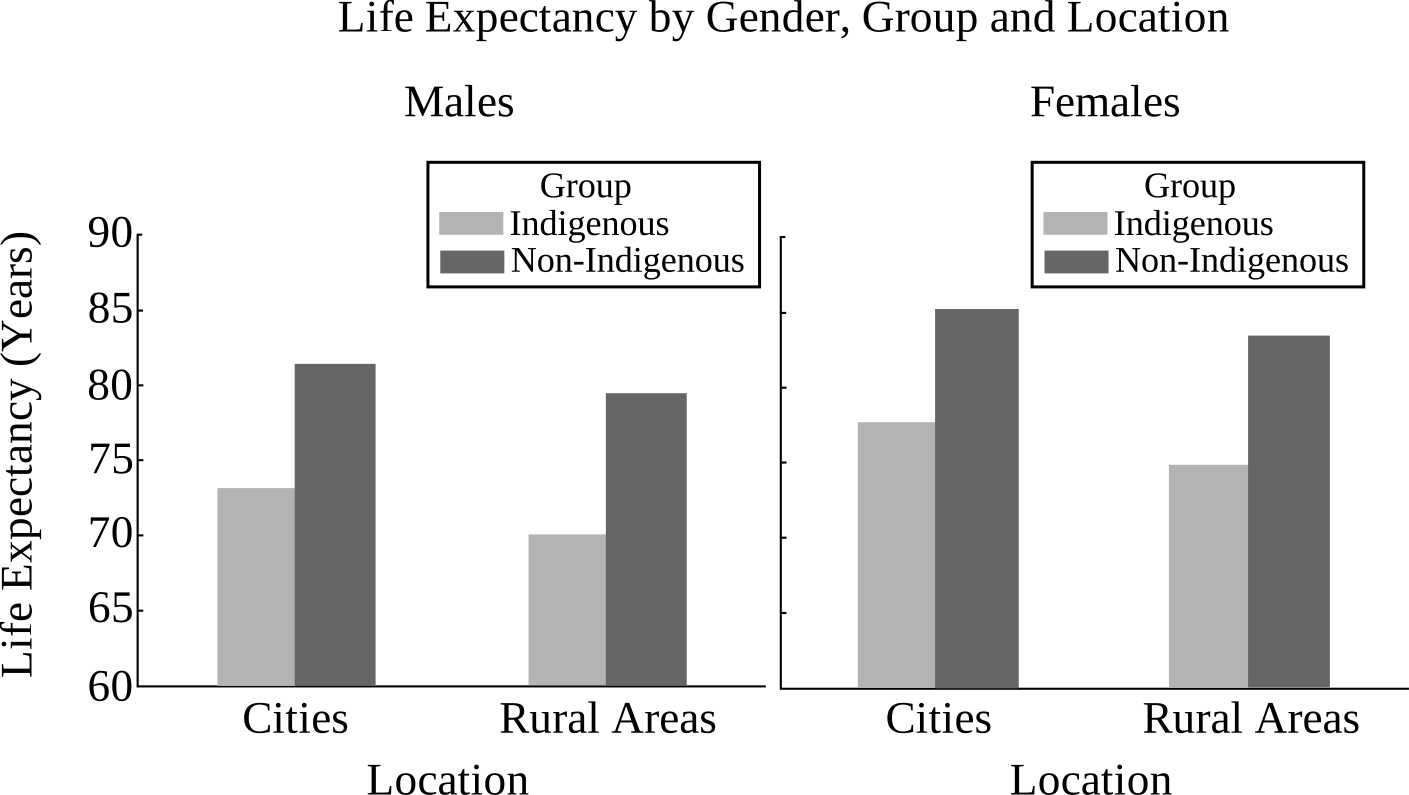
The graph below shows the life expectancy of indigenous vs non-indigenous males and females in city and rural locations.
 

Analyse the key trends in this data.   (8 marks)

--- 22 WORK AREA LINES (style=lined) ---

Show Answers Only

*PEEL – Solution is structured using an adjusted PEEL method; [P] Identify components and their relationship, [E] explain the interaction/influence between them, [Ev] provide evidence showing the relationship in action, [L] linking sentence back to question.

Geographic Disparities Within ATSI Population

  • [P] The data reveals significant geographic disparities in life expectancy within the Aboriginal and Torres Strait Islander (ATSI) population.
  • [E] This pattern demonstrates how location directly influences health outcomes for Indigenous Australians, with rural residence creating additional disadvantage.
  • [Ev] The graph shows rural ATSI people have markedly shorter lives than their urban counterparts, reflecting limited access to healthcare services and preventative programs. For example, city males have a 3-year higher life expectancy than rural males (73 vs 70).
  • [L] This geographic disparity highlights how environmental determinants compound existing health challenges for rural Indigenous communities.

 
ATSI vs Non-Indigenous Life Expectancy Gap

  • [P] A persistent life expectancy gap exists between Indigenous and non-Indigenous populations across all locations.
  • [E] This consistent disparity indicates systemic health inequities affecting ATSI communities regardless of geographic setting.
  • [Ev] The graph demonstrates both urban and rural ATSI populations have lower life expectancies than non-Indigenous Australians in comparable locations. For example, city non-indigenous females have a 7-year higher life expectancy than rural city indigenous females (85 vs 78).
  • [L] These findings suggest addressing Indigenous health requires both location-specific approaches and broader structural reforms.

 
Gender Disparities Within ATSI Population

  • [P] Notable gender differences exist in Indigenous life expectancy patterns.
  • [E] This gender disparity reflects different health challenges and risk factors affecting ATSI males and females.
  • [Ev] The graph shows ATSI women consistently outlive ATSI men in both rural and urban settings.
  • [L] This pattern indicates the need for gender-specific approaches within Indigenous health initiatives.
Show Worked Solution

*PEEL – Solution is structured using an adjusted PEEL method; [P] Identify components and their relationship, [E] explain the interaction/influence between them, [Ev] provide evidence showing the relationship in action, [L] linking sentence back to question.

Geographic Disparities Within ATSI Population

  • [P] The data reveals significant geographic disparities in life expectancy within the Aboriginal and Torres Strait Islander (ATSI) population.
  • [E] This pattern demonstrates how location directly influences health outcomes for Indigenous Australians, with rural residence creating additional disadvantage.
  • [Ev] The graph shows rural ATSI people have markedly shorter lives than their urban counterparts, reflecting limited access to healthcare services and preventative programs. For example, city males have a 3-year higher life expectancy than rural males (73 vs 70).
  • [L] This geographic disparity highlights how environmental determinants compound existing health challenges for rural Indigenous communities.

 
ATSI vs Non-Indigenous Life Expectancy Gap

  • [P] A persistent life expectancy gap exists between Indigenous and non-Indigenous populations across all locations.
  • [E] This consistent disparity indicates systemic health inequities affecting ATSI communities regardless of geographic setting.
  • [Ev] The graph demonstrates both urban and rural ATSI populations have lower life expectancies than non-Indigenous Australians in comparable locations. For example, city non-indigenous females have a 7-year higher life expectancy than rural city indigenous females (85 vs 78).
  • [L] These findings suggest addressing Indigenous health requires both location-specific approaches and broader structural reforms.

 
Gender Disparities Within ATSI Population

  • [P] Notable gender differences exist in Indigenous life expectancy patterns.
  • [E] This gender disparity reflects different health challenges and risk factors affecting ATSI males and females.
  • [Ev] The graph shows ATSI women consistently outlive ATSI men in both rural and urban settings.
  • [L] This pattern indicates the need for gender-specific approaches within Indigenous health initiatives.

Filed Under: Health Status of Young People Tagged With: Band 4, Band 5, smc-5509-70-ATSI

HMS, HIC EQ-Bank 061

Discuss how the relationship between connection to Country and health outcomes can work as a protective factor for Aboriginal and Torres Strait Islander young people.   (5 marks)

--- 15 WORK AREA LINES (style=lined) ---

Show Answers Only

*PEEL – Solution is structured using separate PEEL methods for each side of the argument; [P] Identify the point, [E] expand on the point with a link to question asked, [Ev] apply evidence/examples, [L] linking sentence back to question.

  • [P] On one hand, connection to Country provides holistic health benefits.
  • [E] This approach offers protection across physical, mental, spiritual and social wellbeing simultaneously.
  • [Ev] ABS data shows ATSI youth on traditional Country report better self-rated health outcomes.
  • [L] This demonstrates Country connection as an important protective factor.
     
  • [P] From one perspective, cultural activities on Country strengthen resilience.
  • [E] Young people gain mental health protection through ceremonies, bush tucker gathering and storytelling.
  • [Ev] These practices can reduce psychological distress by providing ATSI youth with identity and belonging.
  • [L] A key advantage is how traditional activities directly support youth wellbeing
     
  • [P] Conversely, barriers to Country such as living in urban areas can create significant negative influences on health.
  • [E] This raises the issue of ATSI youth needing economic necessities such as education and jobs, that are more accessible in cities. This reality separates them from Country.
  • [Ev] Compounding this problem, a majority of ATSI young people now live in cities, limiting their traditional connections.
  • [L] In summary, despite the obvious health benefits of connection to Country, economic realities prevent many ATSI youth from accessing its protective factors.
Show Worked Solution

*PEEL – Solution is structured using separate PEEL methods for each side of the argument; [P] Identify the point, [E] expand on the point with a link to question asked, [Ev] apply evidence/examples, [L] linking sentence back to question.

  • [P] On one hand, connection to Country provides holistic health benefits.
  • [E] This approach offers protection across physical, mental, spiritual and social wellbeing simultaneously.
  • [Ev] ABS data shows ATSI youth on traditional Country report better self-rated health outcomes.
  • [L] This demonstrates Country connection as an important protective factor.
     
  • [P] From one perspective, cultural activities on Country strengthen resilience.
  • [E] Young people gain mental health protection through ceremonies, bush tucker gathering and storytelling.
  • [Ev] These practices can reduce psychological distress by providing ATSI youth with identity and belonging.
  • [L] A key advantage is how traditional activities directly support youth wellbeing
     
  • [P] Conversely, barriers to Country such as living in urban areas can create significant negative influences on health.
  • [E] This raises the issue of ATSI youth needing economic necessities such as education and jobs, that are more accessible in cities. This reality separates them from Country.
  • [Ev] Compounding this problem, a majority of ATSI young people now live in cities, limiting their traditional connections.
  • [L] In summary, despite the obvious health benefits of connection to Country, economic realities prevent many ATSI youth from accessing its protective factors.

Filed Under: Health Status of Young People Tagged With: Band 4, Band 5, smc-5509-40-Protective factors, smc-5509-70-ATSI

HMS, HIC EQ-Bank 060

Explain how Aboriginal Community Controlled Health Organisations (ACCHOs) are addressing barriers to healthcare access for Aboriginal and Torres Strait Islander young people.   (4 marks)

--- 10 WORK AREA LINES (style=lined) ---

Show Answers Only

*PEEL – Solution is structured using an adjusted PEEL method to show cause and effect: [P] State the cause/factor [E] Show how it causes the effect [Ev] Evidence demonstrating why/how [L] Reinforce the causal relationship.

Language highlighting the cause-effect relationship is bolded in the answer below.

  • [P] ACCHOs employ Aboriginal staff who understand cultural needs.
  • [E] This leads to culturally safe healthcare environments.
  • [Ev] As a result, young ATSI people feel comfortable seeking help without fear of judgment or discrimination.
  • [L] This demonstrates why ACCHO’s can utilise cultural alignment to remove access barriers.
     
  • [P] ACCHOs operate in remote communities.
  • [E] This causes reduced travel distances for healthcare.
  • [Ev] This happens when services locate where young people live, eliminating multi-hour trips to cities.
  • [L] In this way, ACCHO’s provide local services that is critical to providing a more equitable access to healthcare.
     
  • [P] Community control creates self-determination..
  • [E] ACCHO’s can effectively promote trust in the healthcare system by taking on the role of health provider.
  • [Ev] In effect, this system allows ATSI communities to make their own health decisions.
  • [L] An important result of this relationship is an increased use of health services by young people.
Show Worked Solution

*PEEL – Solution is structured using an adjusted PEEL method to show cause and effect: [P] State the cause/factor [E] Show how it causes the effect [Ev] Evidence demonstrating why/how [L] Reinforce the causal relationship.

Language highlighting the cause-effect relationship is bolded in the answer below.

  • [P] ACCHOs employ Aboriginal staff who understand cultural needs.
  • [E] This leads to culturally safe healthcare environments.
  • [Ev] As a result, young ATSI people feel comfortable seeking help without fear of judgment or discrimination.
  • [L] This demonstrates why ACCHO’s can utilise cultural alignment to remove access barriers.
     
  • [P] ACCHOs operate in remote communities.
  • [E] This causes reduced travel distances for healthcare.
  • [Ev] This happens when services locate where young people live, eliminating multi-hour trips to cities.
  • [L] In this way, ACCHO’s provide local services that is critical to providing a more equitable access to healthcare.
     
  • [P] Community control creates self-determination..
  • [E] ACCHO’s can effectively promote trust in the healthcare system by taking on the role of health provider.
  • [Ev] In effect, this system allows ATSI communities to make their own health decisions.
  • [L] An important result of this relationship is an increased use of health services by young people.

Filed Under: Health Status of Young People Tagged With: Band 4, Band 5, smc-5509-20-Causes of health issues, smc-5509-40-Protective factors, smc-5509-70-ATSI, smkey-hsc-Explain

HMS, HIC EQ-Bank 050 MC

Which of the following represents the MOST significant protective factor for improving the health of Aboriginal and Torres Strait Islander young people?

  1. Lowering the cost of transport to healthcare facilities.
  2. Connection to Country and participation in cultural activities.
  3. Developing more healthcare facilities in major cities.
  4. Increasing diagnostic testing facilities across all regions.
Show Answers Only

\(B\)

Show Worked Solution
  • B is correct because connection to Country and participation in cultural activities have been identified as significant protective factors that positively influence overall health and wellbeing.

Other options:

  • A is incorrect because while important, transport cost is just one aspect of healthcare access.
  • C is incorrect because most healthcare development is needed in regional and remote areas, not major cities.
  • D is incorrect because merely increasing diagnostic facilities doesn’t address the crucial cultural, social and holistic aspects of health.

Filed Under: Health Status of Young People Tagged With: Band 4, smc-5509-40-Protective factors, smc-5509-70-ATSI

Copyright © 2014–2025 SmarterEd.com.au · Log in