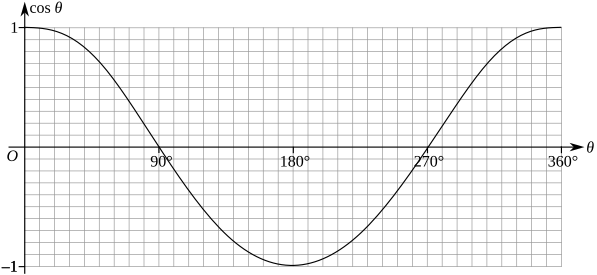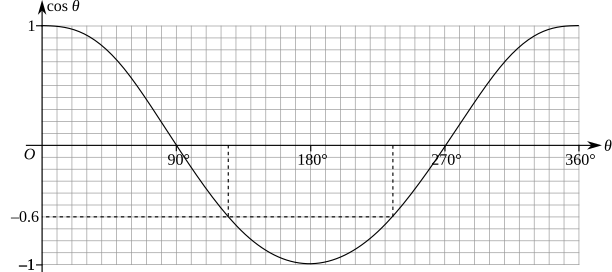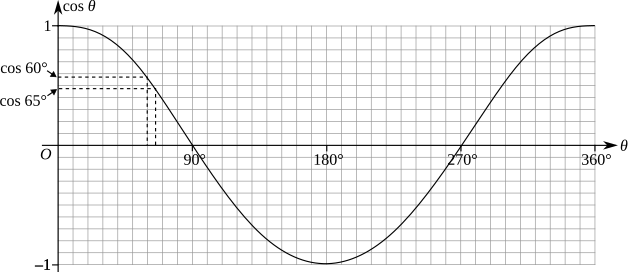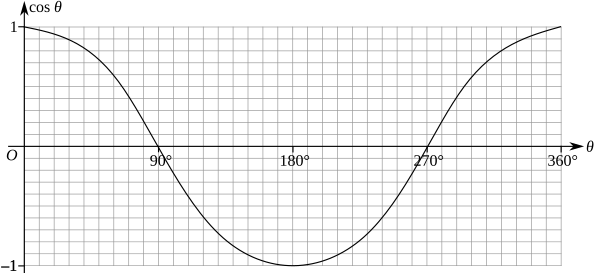
- Use the graph to estimate the two values of \(\theta\) where \(\cos\,\theta=0.3\). (1 mark)
--- 2 WORK AREA LINES (style=lined) ---
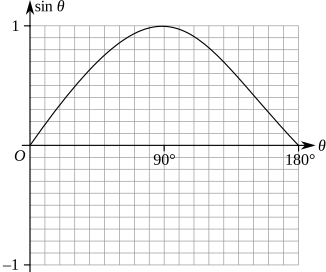
- \(\cos 300^{\circ} \gt \sin 50^{\circ}\)
- Determine whether this statement is correct, using the graph to provide evidence for your answer. (2 marks)
--- 4 WORK AREA LINES (style=lined) ---
a.
\(\text{Draw a horizontal line on graph from}\ \ \cos\,\theta=0.3:\)
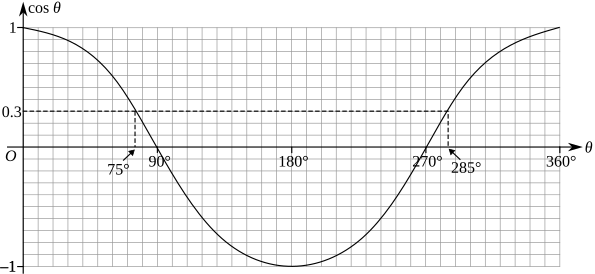
\(\theta \approx 75^{\circ}, 285^{\circ}\)
b. \(\cos\,300^{\circ}\ \text{is in the 4th quadrant.}\)
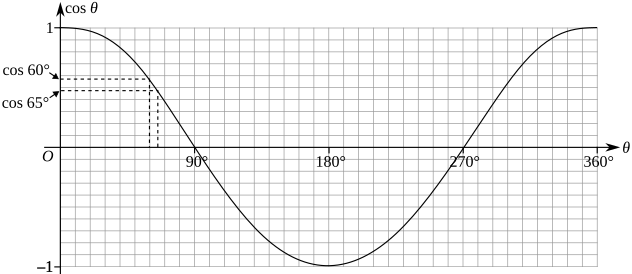
\(\text{Reference angle:}\ \theta=360-300=60^{\circ}\)
\(\Rightarrow \ \cos\,300^{\circ} = \cos\,60^{\circ} \)
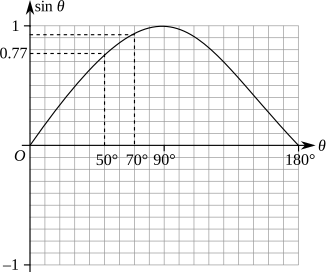
\(\sin\,50^{\circ} = \cos(90-50)^{\circ} = \cos\,40^{\circ}\)
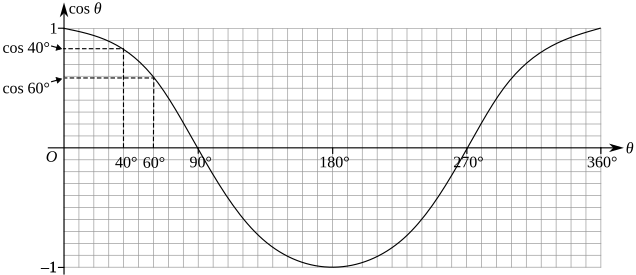
\(\text{Graphically, it can be seen that}\ \ \cos 60^{\circ} \lt \cos\,40^{\circ}\)
\(\Rightarrow\ \cos 300^{\circ} \lt \sin\,50^{\circ}\)
\(\therefore \ \text{Statement is not correct.}\)
a. \(\text{Draw a horizontal line on graph from}\ \ \cos\,\theta=0.3:\)
\(\theta \approx 75^{\circ}, 285^{\circ}\)
b. \(\cos\,300^{\circ}\ \text{is in the 4th quadrant.}\)
\(\text{Reference angle:}\ \theta=360-300=60^{\circ}\)
\(\Rightarrow \ \cos\,300^{\circ} = \cos\,60^{\circ} \)
\(\sin\,50^{\circ} = \cos(90-50)^{\circ} = \cos\,40^{\circ}\)
\(\text{Graphically, it can be seen that}\ \ \cos 60^{\circ} \lt \cos\,40^{\circ}\)
\(\Rightarrow\ \cos 300^{\circ} \lt \sin\,50^{\circ}\)
\(\therefore \ \text{Statement is not correct.}\)