A graph of \(y=f(x)\) is shown.
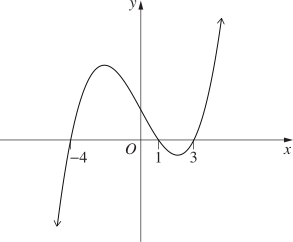
Which of the following expressions best represents \(f(x)\)?
- \(-(x-1)(x-3)(x+4)\)
- \(-(x+1)(x+3)(x-4)\)
- \((x-1)(x-3)(x+4)\)
- \((x+1)(x+3)(x-4)\)
Aussie Maths & Science Teachers: Save your time with SmarterEd
A graph of \(y=f(x)\) is shown.
Which of the following expressions best represents \(f(x)\)?
\(C\)
\(y=0\ \ \text{when}\ \ x=-4, \ 1\ \text{or}\ 3\ \ \text{(eliminate B and D)}\)
\(\text{Test equation in A for $x=0$:}\)
\(y=-(-1)(-3)(4)=-12<0\ \ \text{(eliminate A)}\)
\(\Rightarrow C\)
`B`
`text{By elimination:}`
`text{Double root where graph SP touches}\ xtext{-axis (C and D are incorrect)}`
`(x-c)^2\ text{occurs where}\ x>0`
`:. c>0\ text{(A is incorrect})`
`=>B`
The graph of `y = f(x)` is shown.
Which of the following could be the equation of this graph?
`C`
`text(By elimination:)`
`text(A single negative root occurs when)\ \ x =–1`
`->\ text(Eliminate A and D)`
`text(When)\ \ x = 0, \ y > 0`
`->\ text(Eliminate B)`
`=> C`