SmarterEd

Aussie Maths & Science Teachers: Save your time with SmarterEd

  • Login
  • Get Help
  • About

Calculus, 2ADV C1 2006 HSC 8a

A particle is moving in a straight line. Its displacement, `x` metres, from the origin, `O`, at time `t` seconds, where  `t ≥ 0`, is given by  `x = 1 - 7/(t + 4)`.

  1. Find the initial displacement of the particle.  (1 mark)

    --- 1 WORK AREA LINES (style=lined) ---

  2. Find the velocity of the particle as it passes through the origin.  (3 marks)

    --- 5 WORK AREA LINES (style=lined) ---

  3. Show that the acceleration of the particle is always negative.  (1 mark)

    --- 2 WORK AREA LINES (style=lined) ---

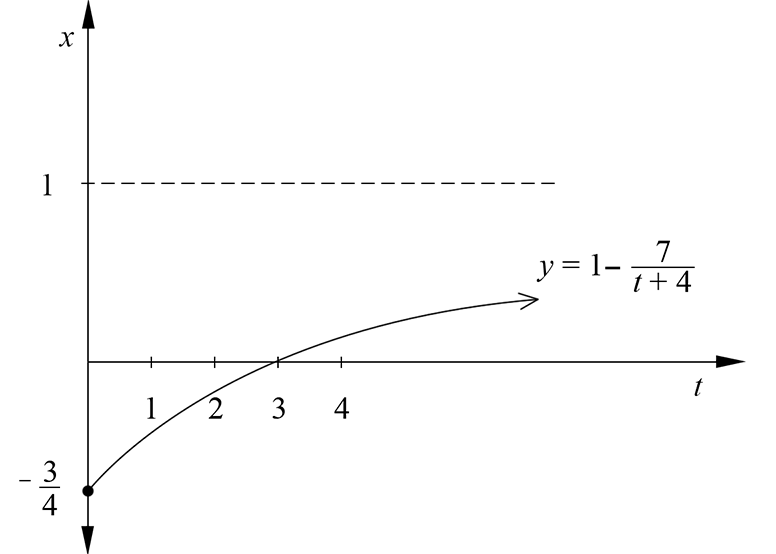
  4. Sketch the graph of the displacement of the particle as a function of time.  (2 marks)

    --- 8 WORK AREA LINES (style=lined) ---

Show Answers Only
  1. `text(–3/4 m)`
  2. `1/7\ text(ms)^-1`
  3. `text(Proof)\ \ text{(See Worked Solutions)}`
  4.  
Show Worked Solution

i.   `x = 1 – 7/(t + 4)`
 

`text(When)\ \ t = 0,`

`x` `= 1 – 7/4`
  `= -3/4 \ \ text(m)`

 
`:.\ text(Initial displacement is)\ 3/4\ text(metres to)`

`text(the left of the origin.)`


ii.  `x = 1 – 7/(t+4) = 1 – 7(t + 4)^-1`

`dot x` `= (-1)  -7(t + 4)^-2 xx d/(dt)(t + 4)`
  `= 7 (t + 4)^-2 xx 1`
  `= 7/(t + 4)^2`


`text(Find)\ t\ text(when)\ x = 0`

`0` `= 1 – 7/(t + 4)`
`7/(t + 4)` `= 1`
`7` `= (t + 4)`
`t` `= 3`


`text(When)\ t = 3`

`dot x` `= 7/(3 + 4)^2`
  `= 1/7\ text(ms)^-1`


`:.\ text(The velocity of the particle as it passes)`

`text(through the origin is)\ 1/7\ text(ms)^-1.`


iii.  `dot x` `= 7(t + 4)^-2`
`ddot x` `= (d dot x)/(dt) = -14 (t +4)^-3`

 
`text(Given)\ t >= 0`

`=>  (t + 4)^-3 >= 0`

`=> -14 (t + 4)^-3 <= 0`

`:. ddot x\ text(is always negative.)`
 

(iv)  2UA HSC 2006 8a

Filed Under: Motion, Rates of Change (Adv-2027), Rates of Change (Y11) Tagged With: Band 4, Band 5, smc-1083-30-Quotient Function, smc-6438-30-Quotient Function

Calculus, 2ADV C1 2014 HSC 13c

The displacement of a particle moving along the  `x`-axis is given by

 `x = t - 1/(1 + t)`,

where  `x`  is the displacement from the origin in metres,  `t`  is the time in seconds, and  `t >= 0`.

  1. Show that the acceleration of the particle is always negative.    (2 marks)

    --- 4 WORK AREA LINES (style=lined) ---

  2. What value does the velocity approach as  `t`  increases indefinitely?    (1 mark)

    --- 2 WORK AREA LINES (style=lined) ---

Show Answers Only
  1. `text(Proof)\ \ text{(See Worked Solutions)}`
  2. `1`
Show Worked Solution
i.    `x` `= t\ – 1/(1 + t)`
    `= t\ – (1 + t)^(-1)`


`dot x` `= 1\ – (-1) (1 + t)^(-2)`
  `= 1 + 1/((1 + t)^2)`


`ddot x` `= -2(1 + t)^(-3)`
  `= – 2/((1 + t)^3)`

 
`text(S)text(ince)\ \ t >= 0,`

`=> -2/((1 + t)^3) < 0`
 

`:.\ text(Acceleration is always negative.)`


ii.    `text(Velocity)\ (dot x) = 1 + 1/((1 + t)^2)`

 
`text(As)\ t -> oo,\ 1/((1 + t)^2) -> 0`

`:.\ text(As)\ t -> oo,\ dot x -> 1`

Filed Under: Motion, Rates of Change (Adv-2027), Rates of Change (Y11) Tagged With: Band 4, smc-1083-30-Quotient Function, smc-6438-30-Quotient Function

Copyright © 2014–2025 SmarterEd.com.au · Log in