Which curve best represents the graph of the function \(f(x)=-a \sin x+b \cos x\) given that the constants \(a\) and \(b\) are both positive?
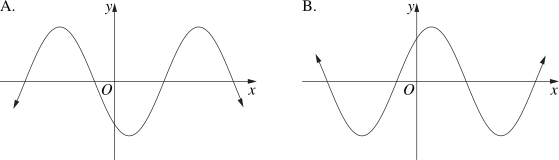
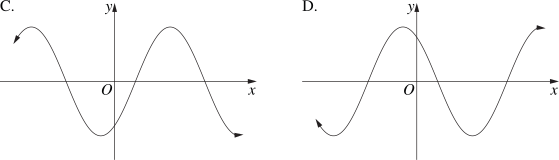
\(D\)
\(\text{Method 1 (non-calculus)}\)
\(f(x)=-a \sin x+b \cos x\)
\(\text{At}\ \ x=0, \ f(x)=b \gt 0\ \ \text{(Eliminate A and C)}\)
\(\text{Express as auxiliary angle:}\)
| \(f(x)\) | \(=-a \sin x+b \cos x\) |
| \(=b \cos x-a \sin x\) | |
| \(=R \cos (x+\alpha)\) |
\(\text{where}\ \ R=\sqrt{a^2+b^2}\ \ \text{and}\ \ \tan \alpha = \dfrac{a}{b}.\)
\(\text{Since}\ a, b \gt 0,\ \ 0 \lt \alpha \lt \dfrac{\pi}{2}.\)
\(\text{So}\ f(x)\ \text{is}\ \ y=\cos x\ \ \text{dilated by factor}\ R\ \text{from}\ x\text{-axis and shifted left by}\ \alpha.\)
\(\Rightarrow D\)
\(\text{Method 2 (with calculus)}\)
\(f(x)=-a \sin x+b \cos x,\ \ f^{′}(x)=-a \cos x-b \sin x\)
\(\text{By elimination:}\)
\(\text{At}\ \ x=0, \ f(x)=b \gt 0\ \ \text{(Eliminate A and C)}\)
\(\text{At}\ \ x=0, \ f^{′}(x)=-a \lt 0\)
\(\text{By inspection of graphs, option B gradient > 0 at}\ \ x=0\ \text{(Eliminate B)}\)
\(\Rightarrow D\)