A polynomial \(f(x)\) is defined by
\(f(x)=-3x^3+27x^2+12x-1\)
Explain what happens to \(f(x)\) as \(x \rightarrow-\infty\). (2 marks)
--- 5 WORK AREA LINES (style=lined) ---
Aussie Maths & Science Teachers: Save your time with SmarterEd
A polynomial \(f(x)\) is defined by
\(f(x)=-3x^3+27x^2+12x-1\)
Explain what happens to \(f(x)\) as \(x \rightarrow-\infty\). (2 marks)
--- 5 WORK AREA LINES (style=lined) ---
Consider a polynomial \(y=(x+3)^2(2-x) \cdot Q(x)\)
where \(Q(x)=6-x-x^2\)
Explain what happens to \(y\) as \(x \rightarrow-\infty\). (2 marks)
--- 5 WORK AREA LINES (style=lined) ---
Consider the polynomial \(P(x)=x(3-x)^3\).
--- 2 WORK AREA LINES (style=lined) ---
--- 2 WORK AREA LINES (style=lined) ---
--- 6 WORK AREA LINES (style=lined) ---
a. \(\text{Degree}\ P(x)=4\)
\(\text{Leading co-efficient}=-1\)
b. \(\text{As} \ \ x \rightarrow-\infty,-x^4 \rightarrow-\infty, \ y \rightarrow-\infty\).
\(\text{As} \ \ x \rightarrow \infty,-x^4 \rightarrow-\infty, \ y \rightarrow-\infty\).
c. \(P(x)\ \text{has zeroes at}\ \ x=0, 3:\)
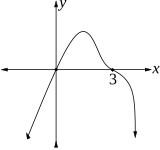
a. \(\text{Degree}\ P(x)=4\)
\(\text{Leading co-efficient}=-1\)
b. \(\text{As} \ \ x \rightarrow-\infty,-x^4 \rightarrow-\infty, \ y \rightarrow-\infty\).
\(\text{As} \ \ x \rightarrow \infty,-x^4 \rightarrow-\infty, \ y \rightarrow-\infty\).
c. \(P(x)\ \text{has zeroes at}\ \ x=0, 3:\)
Consider a polynomial \(y=-2 x^5-26 x^4-x+1\).
With reference to the leading term, explain what happens to \(y\) as \(x \rightarrow-\infty\). (2 marks)
--- 5 WORK AREA LINES (style=lined) ---