SmarterEd

Aussie Maths & Science Teachers: Save your time with SmarterEd

  • Login
  • Get Help
  • About

Vectors, EXT1 EQ-Bank 34

The position vector of a particle at time \(t\) is given by  \(\mathbf{r}(t)=n e^{-2 t}\,\mathbf{i}-t^2\,\mathbf{j}\), where \(n\) is a positive constant.

Determine \(n\) if the particle's acceleration is perpendicular to its velocity when  \(t=\dfrac{1}{2}\).   (3 marks)

--- 8 WORK AREA LINES (style=lined) ---

Show Answers Only

\(n=\dfrac{e}{2}\)

Show Worked Solution
\(\underset{\sim}{r}(t)\) \(=n e^{-2 t} \underset{\sim}{i}-t^2 \underset{\sim}{j}\)
\(\underset{\sim}{v}(t)\) \(=-2n e^{-2t} \underset{\sim}{i}-2 t\underset{\sim}{i} \ \ \Rightarrow \ \ v\left(\frac{1}{2}\right)=-2 ne^{-1} \underset{\sim}{i}-\underset{\sim}{j}\)
\(\underset{\sim}{a}(t)\) \(=4 ne^{-2t} \underset{\sim}{i}-2 \underset{\sim}{j} \ \ \Rightarrow \ \ a\left(\frac{1}{2}\right)=4ne^{-1} \underset{\sim}{i}-2 \underset{\sim}{j}\)
 

\(\text{Velocity}\perp \text{acceleration at}\ \  t=\dfrac{1}{2}:\)

   \(\displaystyle \binom{-\tfrac{2 n}{e}}{-1}\binom{\tfrac{4 n}{e}}{-2}=0\)

\(-\dfrac{8 n^2}{e^2}+2=0 \ \ \Rightarrow \ \ n^2=\dfrac{e^2}{4} \ \ \Rightarrow \ \ n=\dfrac{e}{2}\ \ (n\gt 0)\)

Filed Under: Vectors and Motion Tagged With: Band 5, smc-7287-30-Non-constant Velocity, syllabus-2027

Vectors, EXT1 EQ-Bank 30

The position vector of a particle that is moving along a curve at time `t` is given by 

`\mathbf{r}(t) = 3 cos (t) \mathbf{i} + 4 sin (t) \mathbf{j}, \ t >= 0`.

Determine the first time when the speed of the particle is a minimum.   (3 marks)

--- 8 WORK AREA LINES (style=lined) ---

Show Answers Only

`t_1 = pi/2`

Show Worked Solution

`underset ~v(t)= -3 sin(t) underset ~i + 4 cos (t) underset ~j`

`text{Since speed =}\ |underset ~v(t)|:`

`|underset ~v(t)|` `= sqrt (9 sin^2(t) + 16 cos^2(t))`
  `= sqrt (9 sin^2(t) + 9 cos^2(t) + 7 cos^2(t))`
  `= sqrt (9 + 7 cos^2(t))`

 
`text(Minimised speed occurs when)\ cos(t) = 0:`

`:.  t_1 = pi/2`

COMMENT:
Undertilde notation in answers is allowed even when boldface vector notation appears in the question.

Filed Under: Vectors and Motion Tagged With: Band 4, smc-7287-30-Non-constant Velocity, smc-7287-40-Find Speed, syllabus-2027

Vectors, EXT1 EQ-Bank 4 MC

The position of a body is given by  `\mathbf{r} = 3\mathbf{i} + \mathbf{j} `  metres at a particular time. The body moves with constant velocity and two seconds later its displacement is  `−\mathbf{i} + 5\mathbf{j} `  metres.

The velocity, in m s−1, of the body is

  1. `2\mathbf{i} + 6\mathbf{j}`
  2. `−2\mathbf{i} + 2\mathbf{j}`
  3. `−4\mathbf{i} + 4\mathbf{j}`
  4. `4\mathbf{i}-4\mathbf{j}`
Show Answers Only

`B`

Show Worked Solution

`Delta \mathbf{r}= (−1-3)\mathbf{i} + (5-1)\mathbf{j}= −4\mathbf{i} + 4\mathbf{j}`

`\mathbf{v} = (Delta \mathbf{r})/(Delta \mathbf{t})= (−4\mathbf{i} + 4\mathbf{j})/(2-0)=-2\mathbf{i}+\mathbf{j}`

`=> B`

Filed Under: Vectors and Motion Tagged With: Band 4, smc-7287-10-Constant Velocity, syllabus-2027

Vectors, EXT1 EQ-Bank 5 MC

The acceleration vector of a particle that starts from rest is given by

`underset ~a(t) = −4 sin(2t) underset ~i + 20 cos (2t) underset ~j`, where `t >= 0`.

The velocity vector of the particle, `underset ~v(t)`, is given by

  1. `−8 cos(2t) underset ~i-40 sin(2t) underset ~j`
  2. `2 cos(2t) underset ~i + 10 sin(2t) underset ~j`
  3. `(8-8 cos(2t)) underset ~i-40 sin(2t) underset ~j`
  4. `(2 cos(2t)-2) underset ~i + 10 sin(2t) underset ~j`
Show Answers Only

`D`

Show Worked Solution

`underset ~v(t)= int underset ~a (t)\ dt= (2 cos (2t) + c_0) underset ~i + (10 sin (2t) + c_1) underset ~j`

`text(S)text(ince)\ \ v=0\ \ text(when)\ \ t=0:`

`0= (2 cos (0) + c_0) underset ~i + (10 sin (0) + c_1) underset ~j`

`0=(2 + c_0) underset ~i + c_1 underset ~j`

`=> c_0 = -2, \ \  c_1 = 0`
 

`:. underset ~v(t) = (2 cos (2t)-2) underset ~i + 10 sin(2t) underset ~j`

`=> D`

Filed Under: Vectors and Motion Tagged With: Band 4, smc-7287-30-Non-constant Velocity, syllabus-2027

Vectors, EXT1 EQ-Bank 25

Determine the component of  \(\textbf{a} = 2\textbf{i}-\textbf{j} + 3\textbf{k}\)  that is perpendicular to  \(\textbf{b} = \textbf{i} + \textbf{j}-\textbf{k}.\)   (3 marks)

--- 8 WORK AREA LINES (style=lined) ---

Show Answers Only

\(\textbf{a}-\operatorname{proj}_{\textbf{b}}\textbf{a}=\left(\begin{array}{c}2 \\ -1 \\ 3\end{array}\right)+\dfrac{2}{3}\left(\begin{array}{c}1 \\ 1 \\ -1\end{array}\right)=\left(\begin{array}{c}2 \frac{2}{3} \\ -\frac{1}{3} \\ 2 \frac{1}{3}\end{array}\right)\)

Show Worked Solution

\(\textbf{a}=\left(\begin{array}{c}2 \\ -1 \\ 3\end{array}\right), \ \textbf{b}=\left(\begin{array}{c}1 \\ 1 \\ -1\end{array}\right)\)

\(\textbf{a} \cdot \textbf{b}=2-1-3=-2\)

\(\abs{\textbf{b}}^2=1^2+1^2+(-1)^2=3\)
 

\(\text{Projection of} \ \textbf{a} \ \text{in the direction of} \  \textbf{b}\):

\(\operatorname{proj}_{\textbf{b}} \textbf{a}=\left(\dfrac{\textbf{a} \cdot \textbf{b}}{\abs{\textbf{b}}^2}\right) \textbf{b}=-\dfrac{2}{3}\left(\begin{array}{c}1 \\ 1 \\ -1\end{array}\right)\)
 

\(\text {Component of} \ \textbf{a} \ \text {that is perpendicular to} \ \textbf{b}\):

\(\textbf{a}-\operatorname{proj}_{\textbf{b}}\textbf{a}=\left(\begin{array}{c}2 \\ -1 \\ 3\end{array}\right)+\dfrac{2}{3}\left(\begin{array}{c}1 \\ 1 \\ -1\end{array}\right)=\left(\begin{array}{c}2 \frac{2}{3} \\ -\frac{1}{3} \\ 2 \frac{1}{3}\end{array}\right)\)

Filed Under: Operations With Vectors Tagged With: Band 5, smc-7286-25-Perpendicular Vectors, smc-7286-70-3D Vectors, syllabus-2027

Vectors, EXT1 EQ-Bank 8 MC

If  \(\underset{\sim}{u}=2 \underset{\sim}{i}-2 j+\underset{\sim}{k}\)  and  \(\underset{\sim}{v}=3 \underset{\sim}{i}-6 j+2 \underset{\sim}{k}\), the projection of \(\underset{\sim}{v}\) onto \(\underset{\sim}{u}\) is

  1. \(\dfrac{20}{49}(3 \underset{\sim}{i}-6 \underset{\sim}{j}+2 \underset{\sim}{k})\)
  2. \(\dfrac{20}{3}(2 \underset{\sim}{i}-2 \underset{\sim}{j}+\underset{\sim}{k})\)
  3. \(\dfrac{20}{7}(3 \underset{\sim}{i}-6 \underset{\sim}{j}+2 \underset{\sim}{k})\)
  4. \(\dfrac{20}{9}(2 \underset{\sim}{i}-2 \underset{\sim}{j}+\underset{\sim}{k})\)
Show Answers Only

\(D\)

Show Worked Solution

\(\underset{\sim}{u}=\left(\begin{array}{c}2 \\ -2 \\ 1\end{array}\right), \ \ \underset{\sim}{v}=\left(\begin{array}{c}3 \\ -6 \\ 2\end{array}\right)\)

\(\underset{\sim}{u} \cdot \underset{\sim}{v}=6+12+2=20\)

\(\abs{\underset{\sim}{u}}^2=2^2+(-2)^2+1^2=9\)

\(\operatorname{proj}_{\underset{\sim}{u}} \underset{\sim}{v}=\left(\dfrac{\underset{\sim}{u} \cdot \underset{\sim}{v}}{\abs{\underset{\sim}{u}}^2}\right) \underset{\sim}{u}=\dfrac{20}{9}\left(\begin{array}{c}2 \\ -2 \\ 1\end{array}\right)\)

\(\Rightarrow D\)

Filed Under: Operations With Vectors Tagged With: Band 4, smc-7286-30-Unit Vectors and Projections, smc-7286-70-3D Vectors, syllabus-2027

Vectors, EXT1 EQ-Bank 23

An object is travelling around a circular path of radius 5 m with position vector

\(\textbf{r} (t)=5 \cos \left(t^2\right)\textbf{i} +5 \sin \left(t^2\right)\textbf{j} \quad t \geq 0\)

where \(t\) is the time in seconds.

Find an expression for the speed of the object in terms of \(t\).   (2 marks)

--- 5 WORK AREA LINES (style=lined) ---

Show Answers Only

\(\abs{\textbf{v} (t)}=10 t \ \text{ms}^{-1}\)

Show Worked Solution

\(\text {The velocity is given by}\)

\(\textbf{v}(t)=\dfrac{d}{d t} \textbf{r}(t)=-10 t\, \sin \left(t^2\right) \textbf{i} +10 t\, \cos \left(t^2\right) \textbf{j}\)

\(\text {The speed is the magnitude of the velocity:}\)

\(\abs{\textbf{v} (t)}\) \(=\sqrt{100 t^2\, \sin ^2\left(t^2\right)+100 t^2\, \cos ^2\left(t^2\right)}\)
  \(=10 t \sqrt{\sin ^2\left(t^2\right)+\cos ^2\left(t^2\right)}\)
  \(=10 t \ \text{m s}^{-1}\)

Filed Under: Vectors and Motion Tagged With: Band 4, smc-7287-30-Non-constant Velocity, smc-7287-40-Find Speed, syllabus-2027

Vectors, EXT1 EQ-Bank 3 MC

Given that  \(\overrightarrow{OP}=\left(\begin{array}{c}-3 \\ 1 \\ -1\end{array}\right)\)  and  \(\overrightarrow{O Q}=\left(\begin{array}{c}2 \\ 5 \\ -3\end{array}\right)\), what is \(\overrightarrow{P Q}\) ?

  1. \(\left(\begin{array}{c}1 \\ -6 \\ 4\end{array}\right)\)
  2. \(\left(\begin{array}{c}-1 \\ 6 \\ -4\end{array}\right)\)
  3. \(\left(\begin{array}{c}5 \\ 4 \\ -2\end{array}\right)\)
  4. \(\left(\begin{array}{c}-5 \\ -4 \\ 2\end{array}\right)\)
Show Answers Only

\(C\)

Show Worked Solution

\(\overrightarrow{PQ}=\overrightarrow{O Q}-\overrightarrow{O P}=\left(\begin{array}{c}2 \\ 5 \\ -3\end{array}\right)-\left(\begin{array}{c}-3 \\ 1 \\ -1\end{array}\right)=\left(\begin{array}{c}5 \\ 4 \\ -2\end{array}\right)\)

\(\Rightarrow C\)

Filed Under: Operations With Vectors Tagged With: Band 3, smc-7286-10-Basic Calculations, smc-7286-70-3D Vectors, syllabus-2027

Vectors, EXT1 EQ-Bank 38

Let \(\underset{\sim}{a}=2 \underset{\sim}{i}-3 j+\underset{\sim}{k}\) and \(\underset{\sim}{b}=\underset{\sim}{i}+m j-\underset{\sim}{k}\), where \(m\) is an integer.

The vector resolute of \(\underset{\sim}{a}\) in the direction of \(\underset{\sim}{b}\) is \(-\dfrac{11}{18}(\underset{\sim}{i}+m\underset{\sim}{j}-\underset{\sim}{k})\).

  1. Find the value of  \(m\).   (3 marks)

    --- 9 WORK AREA LINES (style=lined) ---

  2. Find the component of \(\underset{\sim}{a}\) that is perpendicular to \(\underset{\sim}{b}\).   (1 mark)

    --- 3 WORK AREA LINES (style=lined) ---

Show Answers Only

a.    \(m=4\)

b.    \(\left(\begin{array}{c}2 \frac{11}{18} \\ -\frac{5}{9} \\ \frac{7}{18}\end{array}\right)\)

Show Worked Solution

a.    \(\underset{\sim}{a}=\left(\begin{array}{c}2 \\ -3 \\ 1\end{array}\right), \quad \underset{\sim}{b}=\left(\begin{array}{c}1 \\ m \\ -1\end{array}\right)\)

\(\underset{\sim}{b} \cdot \underset{\sim}{a}=2-3 m-1=1-3 m\)

\(\abs{\underset{\sim}{b}}=\sqrt{1^2+m^2+(-1)^2}=\sqrt{2+m^2}\)

\(\operatorname{proj}_{\underset{\sim}{b}}\underset{\sim}{a}=\left(\dfrac{\underset{\sim}{a} \cdot \underset{\sim}{b}}{\abs{b}^2}\right) \underset{\sim}{b}=\dfrac{1-3 m}{2+m^2}\, \underset{\sim}{b}\)
 

\(\text{Equating projection vectors:}\)

\(\dfrac{1-3 m}{m^2+2}\) \(=-\dfrac{11}{18}\)  
\(18-54 m\) \(=-11 m^2-22\)  
\(11 m^2-54 m+40\) \(=0\)  
\((11 m-10)(m-4)\) \(=0\)  

 
\(\therefore m=4\ \left(m \neq \frac{10}{11}, m \in Z\right)\)
 

b.    \(\text{Component of \(\underset{\sim}{a}\) perpendicular to \(\underset{\sim}{b}\):}\)

\(\underset{\sim}{a}-\operatorname{proj}_{\underset{\sim}{b}} \underset{\sim}{a}=\left(\begin{array}{c}2 \\ -3 \\ 1\end{array}\right)+\dfrac{11}{18}\left(\begin{array}{c}1 \\ 4 \\ -1\end{array}\right)=\left(\begin{array}{c}2 \frac{11}{18} \\ -\frac{5}{9} \\ \frac{7}{18}\end{array}\right)\)

Filed Under: Operations With Vectors Tagged With: Band 4, Band 5, smc-7286-30-Unit Vectors and Projections, smc-7286-70-3D Vectors, syllabus-2027

Vectors, EXT1 2024 SPEC1 4

Consider the vectors  \(\underset{\sim}{ a }=3 \underset{\sim}{ j }+3 \underset{\sim}{ k }\)  and  \(\underset{\sim}{ b }=2 \underset{\sim}{ i }-\underset{\sim}{ j }-2 \underset{\sim}{ k }\).

Find the angle between \(\underset{\sim}{ a }\) and \(\underset{\sim}{ b }\).   (2 marks)

--- 6 WORK AREA LINES (style=lined) ---

Show Answers Only

\(\theta=\dfrac{3 \pi}{4}\left(\text{or} \ 135^{\circ}\right)\)

Show Worked Solution

\(\underset{\sim}{a}=\left(\begin{array}{l}0 \\ 3 \\ 3\end{array}\right) \Rightarrow \abs{\underset{\sim}{a}}=\sqrt{18}=3 \sqrt{2}\)

     \(\underset{\sim}{b}=\left(\begin{array}{c}2 \\ -1 \\ -2\end{array}\right) \Rightarrow\abs{\underset{\sim}{b}}=\sqrt{9}=3\)

     \(\cos \theta=\dfrac{\underset{\sim}{a} \cdot \underset{\sim}{b}}{\abs{\underset{\sim}{a}} \cdot \abs{\underset{\sim}{b}}}=\dfrac{-3-6}{3 \sqrt{2} \times 3}=-\dfrac{1}{\sqrt{2}}\)

    \(\therefore \theta=\cos ^{-1}\left(-\dfrac{1}{\sqrt{2}}\right)=\dfrac{3 \pi}{4}\left(\text{or} \ 135^{\circ}\right)\)

Filed Under: Operations With Vectors Tagged With: Band 4, smc-7286-20-Angles Between Vectors, smc-7286-70-3D Vectors, syllabus-2027

Vectors, EXT1 2014 SPEC1 1

Consider the vector  `underset ~a = sqrt 3 underset ~i-underset ~j-sqrt 2 underset ~k`, where `underset ~i, underset ~j` and `underset ~k` are unit vectors in the positive directions of the `x, y` and `z` axes respectively.

  1. Find the unit vector in the direction of  `underset ~a`.   (1 mark)

    --- 4 WORK AREA LINES (style=lined) ---

  2. Find the acute angle that `underset ~a` makes with the positive direction of the `x`-axis.   (2 marks)

    --- 5 WORK AREA LINES (style=lined) ---

  3. The vector  `underset ~b = 2 sqrt 3 underset ~i + m underset ~j-5 underset ~k`.
  4. Given that `underset ~b` is perpendicular to `underset ~a,` find the value of `m`.  (2 marks)

    --- 3 WORK AREA LINES (style=lined) ---

Show Answers Only

a.    `1/sqrt 6 (sqrt 3 underset ~i-underset ~j-sqrt 2 underset ~k)`

b.    `theta = 45^@`

c.    `m = 6 + 5 sqrt 2`

Show Worked Solution

a.    `|underset ~a|= sqrt((sqrt 3)^2 + (-1)^2 + (-sqrt 2)^2)= sqrt 6`

`hat underset ~a= underset ~a/|underset ~a|= 1/sqrt 6 (sqrt 3 underset ~i-underset ~j-sqrt 2 underset ~k)`
 

b.    `x text{-axis vectors include}\ (1,0,0).`

`underset ~a ⋅ underset ~i = ((\sqrt3),(-1),(-\sqrt2))((1),(0),(0))=\sqrt3`

  `underset ~a ⋅ underset ~i` `= |underset ~a||underset ~i| cos theta= sqrt 6 cos theta`
  `sqrt 3` `= sqrt 6 cos theta`
  `cos theta` `=1/sqrt 2`
  `:. theta` `= 45^@`

 
c.
   `underset ~a ⋅ underset ~b = sqrt 3 (2 sqrt 3) + (-1)(m) + (-sqrt 2)(-5) = 0`

`6-m + 5 sqrt 2` `=0`  
`:. m` `=6 + 5 sqrt 2`  

Filed Under: Operations With Vectors Tagged With: Band 3, Band 4, Band 5, smc-7286-20-Angles Between Vectors, smc-7286-25-Perpendicular Vectors, smc-7286-30-Unit Vectors and Projections, smc-7286-70-3D Vectors, syllabus-2027

Vectors, EXT1* V1 2025 HSC 11d

  1. Force \({\underset{\sim}{F}}_1\) has magnitude 12 newtons in the direction of vector  \(2 \underset{\sim}{i}-2 \underset{\sim}{j}+\underset{\sim}{k}\).   
  2. Show that  \({\underset{\sim}{F}}_1=8 \underset{\sim}{i}-8 \underset{\sim}{j}+4 \underset{\sim}{k}\).   (1 mark)

    --- 4 WORK AREA LINES (style=lined) ---

  3. Force \({\underset{\sim}{F}}_1\) from part (i) and a second force,  \({\underset{\sim}{F}}_2=-6 \underset{\sim}{i}+12 \underset{\sim}{j}+4 \underset{\sim}{k}\), both act upon a particle.
  4. Show that the resultant force acting on the particle is given by:
  5.      \({\underset{\sim}{F}}_3=2 \underset{\sim}{i}+4 \underset{\sim}{j}+8 \underset{\sim}{k}.\)   (1 mark)

    --- 3 WORK AREA LINES (style=lined) ---

  6. Calculate  \({\underset{\sim}{F}}_3 \cdot \underset{\sim}{d}\), where \({\underset{\sim}{F}}_3\) is the resultant force from part (ii) and  \(\underset{\sim}{d}=\underset{\sim}{i}+\underset{\sim}{j}+2 \underset{\sim}{k}\).   (1 mark)

    --- 3 WORK AREA LINES (style=lined) ---

Show Answers Only

i.    \(\text{Unit vector of the direction vector:}\)

\(\dfrac{2 \underset{\sim}{i}-2 \underset{\sim}{j}+\underset{\sim}{k}}{\abs{2 \underset{\sim}{i}-2 \underset{\sim}{j}+\underset{\sim}{k}}} = \dfrac{2 \underset{\sim}{i}-2 \underset{\sim}{j}+\underset{\sim}{k}}{\sqrt{2^2+(-2)^2 + 1^2}} = \dfrac{1}{3} \left( 2 \underset{\sim}{i}-2 \underset{\sim}{j}+\underset{\sim}{k} \right)\)
 

\(\text{Since \({\underset{\sim}{F}}_1\) has magnitude 12:}\)

\({\underset{\sim}{F}}_1=12 \times \dfrac{1}{3}\left(\begin{array}{c}2 \\ -2 \\ 1\end{array}\right)=\left(\begin{array}{c}8 \\ -8 \\ 4\end{array}\right)\)

\({\underset{\sim}{F}}_1=8\underset{\sim}{i}-8 \underset{\sim}{j}+4 \underset{\sim}{k}\)
    

ii.    \({\underset{\sim}{F}}_3={\underset{\sim}{F}}_1+{\underset{\sim}{F}}_2=\left(\begin{array}{c}8 \\ -8 \\ 4\end{array}\right)+\left(\begin{array}{c}-6 \\ 12 \\ 4\end{array}\right)=\left(\begin{array}{l}2 \\ 4 \\ 8\end{array}\right)\)

\({\underset{\sim}{F}}_3=2 \underset{\sim}{i}+4 \underset{\sim}{j}+8 \underset{\sim}{k}\)
 

iii.  \({\underset{\sim}{F}}_3 \cdot d=\left(\begin{array}{l}2 \\ 4 \\ 8\end{array}\right)\left(\begin{array}{l}1 \\ 1 \\ 2\end{array}\right)=2+4+16=22\)

Show Worked Solution

i.    \(\text{Unit vector of the direction vector:}\)

\(\dfrac{2 \underset{\sim}{i}-2 \underset{\sim}{j}+\underset{\sim}{k}}{\abs{2 \underset{\sim}{i}-2 \underset{\sim}{j}+\underset{\sim}{k}}} = \dfrac{2 \underset{\sim}{i}-2 \underset{\sim}{j}+\underset{\sim}{k}}{\sqrt{2^2+(-2)^2 + 1^2}} = \dfrac{1}{3} \left( 2 \underset{\sim}{i}-2 \underset{\sim}{j}+\underset{\sim}{k} \right)\)
 

\(\text{Since \({\underset{\sim}{F}}_1\) has magnitude 12:}\)

\({\underset{\sim}{F}}_1=12 \times \dfrac{1}{3}\left(\begin{array}{c}2 \\ -2 \\ 1\end{array}\right)=\left(\begin{array}{c}8 \\ -8 \\ 4\end{array}\right)\)

\({\underset{\sim}{F}}_1=8\underset{\sim}{i}-8 \underset{\sim}{j}+4 \underset{\sim}{k}\)
 

ii.    \({\underset{\sim}{F}}_3={\underset{\sim}{F}}_1+{\underset{\sim}{F}}_2=\left(\begin{array}{c}8 \\ -8 \\ 4\end{array}\right)+\left(\begin{array}{c}-6 \\ 12 \\ 4\end{array}\right)=\left(\begin{array}{l}2 \\ 4 \\ 8\end{array}\right)\)

\({\underset{\sim}{F}}_3=2 \underset{\sim}{i}+4 \underset{\sim}{j}+8 \underset{\sim}{k}\)
 

iii.  \({\underset{\sim}{F}}_3 \cdot d=\left(\begin{array}{l}2 \\ 4 \\ 8\end{array}\right)\left(\begin{array}{l}1 \\ 1 \\ 2\end{array}\right)=2+4+16=22\)

Filed Under: Operations With Vectors Tagged With: Band 4, Band 5, smc-7286-10-Basic Calculations, smc-7286-30-Unit Vectors and Projections, smc-7286-70-3D Vectors, syllabus-2027

Vectors, EXT1* V1 2024 HSC 11c

Find the angle between the two vectors  \(\underset{\sim}{u}=\left(\begin{array}{c}1 \\ 2 \\ -2\end{array}\right)\) and  \(\underset{\sim}{v}=\left(\begin{array}{c}4 \\ -4 \\ 7\end{array}\right)\), giving your answer in radians, correct to 1 decimal place.   (2 marks)

--- 5 WORK AREA LINES (style=lined) ---

Show Answers Only

\(\theta=2.3^c \ \ \text{(1 d.p.)}\)

Show Worked Solution

\(\underset{\sim}{u}=\left(\begin{array}{c}1 \\ 2 \\ -2\end{array}\right),\abs{\underset{\sim}{u}}=\sqrt{1+4+4}=3\)

\(\underset{\sim}{v}=\left(\begin{array}{c}4 \\ -4 \\ 7\end{array}\right),\abs{\underset{\sim}{v}}=\sqrt{16+16+49}=9\)

\(\cos \theta=\dfrac{\underset{\sim}{u} \cdot \underset{\sim}{v}}{|\underset{\sim}{u}||\underset{\sim}{v}|}=\dfrac{1 \times 4-2 \times 4-2 \times 7}{3 \times 9}=-\dfrac{2}{3}\)

\(\theta=\cos ^{-1}\left(-\dfrac{2}{3}\right)=2.30 \ldots=2.3^c \ \ \text{(1 d.p.)}\)

Filed Under: Operations With Vectors Tagged With: Band 4, smc-7286-20-Angles Between Vectors, smc-7286-70-3D Vectors, syllabus-2027

Vectors, EXT1* V1 2022 HSC 11d

A triangle is formed in three-dimensional space with vertices `A(1,-1,2)`, `B(0,2,-1)`  and `C(2,1,1)`.

Find the size of `/_ABC`, giving your answer to the nearest degree.   (3 marks)

--- 8 WORK AREA LINES (style=lined) ---

Show Answers Only

`33°`

Show Worked Solution

`vec(BA)=((1),(-1),(2))-((0),(2),(-1))=((1),(-3),(3))`

`abs(vec(BA))=sqrt(1^2+3^2+3^2)=sqrt19`
 

`vec(BC)=((2),(1),(1))-((0),(2),(-1))=((2),(-1),(2))`

`abs(vec(BC))=sqrt(2^2+1^2+2^2)=sqrt9=3`
 

`vec(BA)*vec(BC)=1xx2+ -3xx-1+3xx2=11`

`cos/_ABC=(vec(BA)*vec(BC))/(abs{vec(BA)}abs{vec(BC)})=11/(3sqrt19)`

`:./_ABC=cos^(-1)(11/(3sqrt19))=32.733…=33°\ \ text{(nearest degree)}`

Filed Under: Operations With Vectors Tagged With: Band 4, smc-7286-20-Angles Between Vectors, smc-7286-70-3D Vectors, syllabus-2027

Vectors, EXT1* V1 2020 HSC 11d

Consider the two vectors  `underset~u = 2 underset~i-underset~j + 3 underset~k`  and  `underset~v = p underset~i +  underset~j + 2 underset~k`.
 
For what values of `p` are  `underset~u-underset~v`  and  `underset~u + underset~v`  perpendicular?   (3 marks)

--- 8 WORK AREA LINES (style=lined) ---

Show Answers Only

`p= ± 3`

Show Worked Solution

`underset~u-underset~v = ((-2),(-1),(3))-((p),(1),(2)) = ((-2-p),(-2),(1))`
 

`underset~u + underset~v = ((-2),(-1),(3)) + ((p),(1),(2)) = ((p-2),(0),(5))`
 

`⊥ \ text{when} \ \ (underset~u-underset~v) · (underset~u + underset~v ) = 0 :`
 

`((-2-p),(-2),(1)) · ((p-2),(0),(5)) = 0`
 

`-(p + 2)(p-2) + 5` `= 0`
`-(p^2-4) + 5` `= 0`
`-p^2 + 9` `= 0`
`p^2` `= 9`
`p` `= ± 3`

Filed Under: Operations With Vectors Tagged With: Band 3, smc-7286-25-Perpendicular Vectors, smc-7286-70-3D Vectors, syllabus-2027

Vectors, EXT1* V1 2024 HSC 12a

The vector \(\underset{\sim}{a}\) is \(\left(\begin{array}{l}1 \\ 2 \\ 3\end{array}\right)\) and the vector \(\underset{\sim}{b}\) is \(\left(\begin{array}{c}2 \\ 0 \\ -4\end{array}\right)\).

  1. Find \(\dfrac{\underset{\sim}{a} \cdot \underset{\sim}{b}}{\underset{\sim}{b} \cdot \underset{\sim}{b}}\, \underset{\sim}{b}\).   (1 mark)

    --- 4 WORK AREA LINES (style=lined) ---

  2. Show that  \(\underset{\sim}{a}-\dfrac{\underset{\sim}{a} \cdot \underset{\sim}{b}}{\underset{\sim}{b} \cdot \underset{\sim}{b}}\, \underset{\sim}{b}\)  is perpendicular to \(\underset{\sim}{b}\).   (2 marks)

    --- 6 WORK AREA LINES (style=lined) ---

Show Answers Only

i.     \(\left(\begin{array}{c}-1 \\ 0 \\ 2\end{array}\right)\)

ii.    \(\underset{\sim}{a}-\dfrac{\underset{\sim}{a} \cdot \underset{\sim}{b}}{\underset{\sim}{b} \cdot \underset{\sim}{b}}\, \underset{\sim}{b}=\left(\begin{array}{l}1 \\ 2 \\ 3\end{array}\right)-\left(\begin{array}{c}-1 \\ 0 \\ 2\end{array}\right)=\left(\begin{array}{l}2 \\ 2 \\ 1\end{array}\right)\)

\( \left(\underset{\sim}{a}-\dfrac{\underset{\sim}{a} \cdot \underset{\sim}{b}}{\underset{\sim}{b} \cdot \underset{\sim}{b}}\underset{\sim}{b}\right)\left(\begin{array}{c}-1 \\ 0 \\ 2\end{array}\right)=\left(\begin{array}{l}2 \\ 2 \\ 1\end{array}\right)\left(\begin{array}{c}-1 \\ 0 \\ 2\end{array}\right) = -2+0+2=0\)

\(\therefore\ \text {Vectors are perpendicular.}\)

Show Worked Solution

i.    \(\underset{\sim}{a}=\left(\begin{array}{l}1 \\ 2 \\ 3\end{array}\right), \quad \underset{\sim}{b}=\left(\begin{array}{c}2 \\ 0 \\ -4\end{array}\right)\)
 

\(\dfrac{\underset{\sim}{a} \cdot \underset{\sim}{b}}{\underset{\sim}{b} \cdot \underset{\sim}{b}}\, \underset{\sim}{b}=\dfrac{2+0-12}{4+0+16}\left(\begin{array}{c}2 \\ 0 \\ -4\end{array}\right)=-\dfrac{1}{2}\left(\begin{array}{c}2 \\ 0 \\ -4\end{array}\right)=\left(\begin{array}{c}-1 \\ 0 \\ 2\end{array}\right)\)

 
ii.
    \(\underset{\sim}{a}-\dfrac{\underset{\sim}{a} \cdot \underset{\sim}{b}}{\underset{\sim}{b} \cdot \underset{\sim}{b}}\, \underset{\sim}{b}=\left(\begin{array}{l}1 \\ 2 \\ 3\end{array}\right)-\left(\begin{array}{c}-1 \\ 0 \\ 2\end{array}\right)=\left(\begin{array}{l}2 \\ 2 \\ 1\end{array}\right)\)
 

\( \left(\underset{\sim}{a}-\dfrac{\underset{\sim}{a} \cdot \underset{\sim}{b}}{\underset{\sim}{b} \cdot \underset{\sim}{b}}\,\underset{\sim}{b}\right)\left(\begin{array}{c}-1 \\ 0 \\ 2\end{array}\right)=\left(\begin{array}{l}2 \\ 2 \\ 1\end{array}\right)\left(\begin{array}{c}-1 \\ 0 \\ 2\end{array}\right) = -2+0+2=0\)

 
\(\therefore\ \text{Vectors are perpendicular.}\)

Filed Under: Operations With Vectors Tagged With: Band 3, Band 4, smc-7286-25-Perpendicular Vectors, smc-7286-30-Unit Vectors and Projections, smc-7286-70-3D Vectors, syllabus-2027

Vectors, EXT1* V1 2023 HSC 11b

Find the angle between the vectors

\(\underset{\sim}{a}=\underset{\sim}{i}+2 \underset{\sim}{j}-3 \underset{\sim}{k}\)

\(\underset{\sim}{b}=-\underset{\sim}{i}+4 \underset{\sim}{j}+2 \underset{\sim}{k}\),

giving your answer to the nearest degree.   (3 marks)

--- 8 WORK AREA LINES (style=lined) ---

Show Answers Only

\(87^{\circ} \)

Show Worked Solution

\[\underset{\sim}{a}=\left(\begin{array}{c} 1 \\ 2 \\ -3 \end{array}\right),\ \  \underset{\sim}{b}=\left(\begin{array}{c} -1 \\ 4 \\ 2 \end{array}\right) \]

\(\Big{|} \underset{\sim}{a} \Big{|} = \sqrt{1+4+9} = \sqrt{14} \)

\(\Big{|} \underset{\sim}{b} \Big{|} = \sqrt{1+16+4} = \sqrt{21} \)

\( \underset{\sim}{a} \cdot \underset{\sim}{b} = -1 + 8-6=1 \)

\(\cos\ \theta \) \(=\dfrac{\underset{\sim}{a} \cdot \underset{\sim}{b}}{\Big{|}\underset{\sim}{a}\Big{|} \cdot \Big{|}\underset{\sim}{b}\Big{|}} \)  
  \(=\dfrac{1}{\sqrt{294}} \)  
\( \theta\) \(=\cos ^{-1} \Big{(}\dfrac{1}{\sqrt{294}}\Big{)} \)  
  \(=86.65…\)  
  \(=87^{\circ} \)  

Filed Under: Operations With Vectors Tagged With: Band 3, smc-7286-20-Angles Between Vectors, smc-7286-70-3D Vectors, syllabus-2027

Vectors, EXT1* V1 2021 HSC 11c

Find the angle between the vectors  `underset~a = ((2),(0),(4))`  and  `underset~b = ((-3),(1),(2))`, giving the angle in degrees correct to 1 decimal place.   (3 marks)

Show Answers Only

`83.1^@`

Show Worked Solution

`underset~a = ((2),(0),(4)) \ , \ |underset~a| \ = sqrt{2^2 + 4^2} = sqrt20`

`underset~b = ((-3),(1),(2)) \ , \ |underset~b| \ = sqrt{(-3)^2 + 1^2 + 2^2} = sqrt14`

`underset~a * underset~b` `= ((2),(0),(4)) ((-3),(1),(2)) = – 6 + 0 + 8 = 2`
`underset~a * underset~b` `= |underset~a| |underset~b| \ cos theta`
`2` `= sqrt20 sqrt14 \ cos theta`
`cos theta` `= 2/sqrt280`
`theta` `= cos^(-1) (1/sqrt70)`
  `= 83.1^@ \ text{(1 d.p,)}`

Filed Under: Operations With Vectors Tagged With: Band 3, smc-7286-20-Angles Between Vectors, smc-7286-70-3D Vectors, syllabus-2027

Vectors, EXT1* V1 2020 HSC 1 MC

What is the length of the vector  `- underset~i + 18 underset~j - 6 underset~k`?

  1.  5
  2.  19
  3.  25
  4.  361
Show Answers Only

`B`

Show Worked Solution
`text{Length}` `= | – underset~i + 18 underset~j – 6 underset~k \ |`
  `= sqrt{(-1)^2 + 18^2 + (-6)^2}`
  `= sqrt{361}`
  `= 19`

Filed Under: Operations With Vectors Tagged With: Band 3, smc-7286-10-Basic Calculations, smc-7286-70-3D Vectors, syllabus-2027

Vectors, EXT1 EQ-Bank 18

Two vectors are given by  `underset ~a = 4 underset ~i + m underset ~j - 3 underset ~k`  and  `underset ~b = −2 underset ~i + n underset ~j - underset ~k`, where `m`, `n in R^+`.

If  `|\ underset ~a\ | = 10`  and `underset ~a` is perpendicular to `underset ~b`, determine the exact values of `m` and `n`.   (3 marks)

--- 8 WORK AREA LINES (style=lined) ---

Show Answers Only

`m=5sqrt3, \ n=\sqrt{3}/3`

Show Worked Solution

`text(Using)\ \ |\ underset ~a\ | = 10:`

`10` `= sqrt(4^2 + m^2 + (-3)^2)`
`100` `=m^2+75`
`m^2` `= 25`
`m` `=5sqrt3\ \ (m in R^+)`


`text(S)text(ince)\ \ underset ~a _|_ underset ~b\ \ =>\ \ underset ~a xx underset ~b=0`

`0` `=4 xx (−2) + mn + (−3) xx (−1)`
`0` `=n xx 5sqrt3-5`
`n` `=5/(5\sqrt{3})`
`n` `=1/\sqrt{3}=\sqrt{3}/3`

Filed Under: Operations With Vectors Tagged With: Band 4, smc-7286-25-Perpendicular Vectors, smc-7286-70-3D Vectors, syllabus-2027

Vectors, EXT1 2013 SPEC2 14 MC

The distance from the origin to the point `P(7,−1,5sqrt2)` is

  1. `7sqrt2`
  2. `10`
  3. `6 + 5sqrt2`
  4. `100`
Show Answers Only

`B`

Show Worked Solution
`d` `= sqrt((7-0)^2 + (−1-0)^2 + (5sqrt2-0)^2)`
  `= sqrt(49 + 1 + 25 xx 2)`
  `= 10`

 
`=> B`

Filed Under: Operations With Vectors Tagged With: Band 3, smc-7286-10-Basic Calculations, smc-7286-70-3D Vectors, syllabus-2027

Vectors, EXT1 2012 SPEC2 16 MC

The distance between the points `P(−2 ,4, 3)` and `Q(1, −2, 1)` is

  1. `7`
  2. `sqrt 21`
  3. `sqrt 31`
  4. `11`
Show Answers Only

`A`

Show Worked Solution
`d` `= sqrt((-2-1)^2 + (4-(-2))^2 + (3-1)^2)`
  `= sqrt(9 + 36 + 4)`
  `= 7`

 
`=> A`

Filed Under: Operations With Vectors Tagged With: Band 3, smc-7286-10-Basic Calculations, smc-7286-70-3D Vectors, syllabus-2027

Vectors, EXT1 2012 SPEC2 15 MC

The vectors  `underset~a = 2underset~i + m underset~j-3underset~k`  and  `underset~b = m^2underset~i-underset~j + underset~k`  are perpendicular for

  1. `m = −2/3`  and  `m = 1`
  2. `m = −3/2`  and  `m = 1`
  3. `m = 2/3`  and  `m = −1`
  4. `m = 3/2`  and  `m = −1`
Show Answers Only

`D`

Show Worked Solution

`underset ~a ⊥ underset ~b\ \ =>\ \ underset ~a ⋅ underset ~b=0`

`underset ~a ⋅ underset ~b` `= 2m^2 + m(-1) + (-3)(1)`
`0` `= 2m^2-m-3`
`0` `= (2m-3)(m + 1)`

 
`:. m = 3/2, quad m = -1`

`=> D`

Filed Under: Operations With Vectors Tagged With: Band 3, smc-7286-25-Perpendicular Vectors, smc-7286-70-3D Vectors, syllabus-2027

Vectors, EXT1 2019 SPEC2 11 MC

Let point `M` have coordinates `(a, 1,-2)` and let point `N` have coordinates `(-3, b,-1)`.

If the coordinates of the midpoint of `vec(MN)` are `(-5, 3/2, c)` and `a, b` and `c` are real constants, the the values of `a, b` and `c` are respectively

  1. `−13, 2 and −1/2`
  2. `−7, −2 and −3/2`
  3. `−2, −1/2 and −3`
  4. `−7, 2 and −3/2`
Show Answers Only

`D`

Show Worked Solution

`M = 1/2 ([(a),(1),(−2)] + [(−3),(b),(−1)]) = 1/2 [(a-3),(1 + b),(−3)]`

`1/2(a-3)` `= −5`
`a-3` `= −10`
`a` `= −7`
`1/2(1 + b)` `= 3/2`
`1 + b` `= 3`
`b` `= 2`
`c` `= −3/2`

 
`=>D`

Filed Under: Operations With Vectors Tagged With: Band 3, smc-7286-10-Basic Calculations, smc-7286-70-3D Vectors, syllabus-2027

Vectors, EXT1 2011 SPEC2 12 MC

The angle between the vectors  `3underset~i + 6underset~j-2underset~k`  and  `2underset~i-2underset~j + underset~k`, correct to the nearest tenth of a degree, is

  1. 2.0°
  2. 91.0°
  3. 112.4°
  4. 121.3°
Show Answers Only

`C`

Show Worked Solution

`|3underset~i + 6underset~j-2underset~k| = sqrt(9 + 36 + 4) = sqrt49 = 7`

`|2underset~i-2underset~j + underset~k| = sqrt(4 + 4 + 1) = sqrt9 = 3`

`(3underset~i + 6underset~j-2underset~k) * (2underset~i-2underset~j + underset~k)`

`= 3 xx 2 + 6 xx (−2) + (−2) xx 1`

`= 6-12-2`

`= -8`  

`costheta` `= ((3tildei + 6tildej-2tildek).(2tildei-2tildej + tildek))/(|\ 3tildei + 6tildej-2tildek\ ||\ 2tildei-2tildej + tildek\ |)= -8/21`
`:. theta `= cos^(−1)(−8/12)~~ 112.4^@`

 
`=> C`

Filed Under: Operations With Vectors Tagged With: Band 3, smc-7286-20-Angles Between Vectors, smc-7286-70-3D Vectors, syllabus-2027

Calculus, EXT1 EQ-Bank 25

Graph the polynomial  \(P(x)=(x+1)^2(2-x)^3\)  on the grid below, clearly identifying all axis intercepts.   (3 marks)

--- 5 WORK AREA LINES (style=lined) ---


Show Answers Only

Show Worked Solution

\(P(x)=(x+1)^2(2-x)^3 \ \ \Rightarrow\ \ \text{zeros at} \ \ x=-1,2\)

\(\text{At} \ \ x=-1, m (\text{multiplicity})=2 \ \ \Rightarrow\ \ \text{curve is a tangent to} \ x \text{-axis}\)

\(\text{At} \ \ x=2, m=3 \ \ \Rightarrow\ \ \text{curve has horizontal POI.}\)

\(\text{At} \ \ x=0, P(x)=(1)^2(2)^3=8\)
 

Filed Under: Multiplicity of Zeroes in Polynomials Tagged With: Band 4, smc-7292-10-Draw/Identify Graphs, syllabus-2027

Calculus, EXT1 EQ-Bank 28

\(P(x)\) is a polynomial where  \(P(\alpha)=0\)  and  \(P^{\prime}(\alpha)=0\).

  1. Show that \((x-\alpha)^2\) is a factor of \(P(x)\).   (2 marks)

    --- 7 WORK AREA LINES (style=lined) ---

  2. The curve  \(y=x^3+b x^2+c x+4\)  is tangent to the \(x\)-axis at  \(x=-1\). Find the values of \(b\) and \(c\).   (3 marks)

    --- 12 WORK AREA LINES (style=lined) ---

Show Answers Only

a.    \(P(\alpha)=0\ \ \Rightarrow\ \ (x-a)\ \text{is a factor of \(P(x)\)}\)

\(P(x)=(x-\alpha) \cdot Q(x)\)
 

\(P^{\prime}(x)=Q(x)+(x-a) \cdot Q(x)\)

\(\text{Since}\ \ P^{\prime}(\alpha)=0:\)

\(Q(\alpha)=0 \ \ \Rightarrow\ \ (x-\alpha) \ \text{is a factor of} \ \ Q(\alpha)\)
 

\(\text{Let} \ \ Q(x)=(x-\alpha) \cdot R(x)\)

\(P(x)=(x-\alpha)^2 \cdot R(x)\)

\(\therefore \ (x-\alpha)^2 \ \text{is a factor of} \ P(x).\)
 

b.    \(b=6, c=9\)

Show Worked Solution

a.    \(P(\alpha)=0\ \ \Rightarrow\ \ (x-a)\ \text{is a factor of \(P(x)\)}\)

\(P(x)=(x-\alpha) \cdot Q(x)\)
 

\(P^{\prime}(x)=Q(x)+(x-a) \cdot Q(x)\)

\(\text{Since}\ \ P^{\prime}(\alpha)=0:\)

\(Q(\alpha)=0 \ \ \Rightarrow\ \ (x-\alpha) \ \text{is a factor of} \ \ Q(\alpha)\)
 

\(\text{Let} \ \ Q(x)=(x-\alpha) \cdot R(x)\)

\(P(x)=(x-\alpha)^2 \cdot R(x)\)

\(\therefore \ (x-\alpha)^2 \ \text{is a factor of} \ P(x).\)
 

b.    \(\text{Since the curve is tangent at} \ \ x=-1\)

\(x=-1 \ \ \text{is a double root}\)

\(P(x)=x^3+b x^2+c x+4\)

\(P(-1)=-1+b-c+4=0 \ \ \Rightarrow\ \ b-c=-3\ \ldots\ (1)\)
 

\(P^{\prime}(x)=3 x^2+26 x+c\)

\(P^{\prime}(-1)=3-2 b+c=0 \ \ \Rightarrow\ \ -2 b+c=-3\ \ldots\ (2)\)
 

\(\text{Add} \ (1)+(2):\)

\(-b=-6 \ \ \Rightarrow\ \ b=6\)

\(\text{Substitute \(\ b=6\ \) into (1):}\)

\(-6-c=-3 \ \ \Rightarrow\ \ c=9\).

\(\therefore b=6, c=9\)

Filed Under: Multiplicity of Zeroes in Polynomials Tagged With: Band 4, smc-7292-40-Prove Multiplicity, syllabus-2027

Calculus, EXT1 EQ-Bank 26

Graph the polynomial  \(p(x)=(x-1)\left(x^2+3 x+1\right)\), clearly identifying all axis intercepts.   (3 marks)

--- 5 WORK AREA LINES (style=lined) ---


Show Answers Only

Show Worked Solution

\(p(x)=(x-1)\left(x^2+3 x+1\right)\)

\(\text{Zeros:} \ \ x=1, x=\dfrac{-3 \pm \sqrt{9-4 \cdot 1 \cdot 1}}{2}=\dfrac{-3 \pm \sqrt{5}}{2}\ \ (\approx-2.62,-0.38)\)

\(\text{At}\ \ x=1, m(\text{multiplicity})=1 \ \Rightarrow \ \text{curve crosses}\  x\text {-axis}\)

\(\text{At} \ \ x=\dfrac{-3 \pm \sqrt{5}}{2}, m=1 \ \Rightarrow \ \text{curve crosses} \ x\text {-axis}\)

\(p(0)=(-1)(1)=-1\)

Filed Under: Multiplicity of Zeroes in Polynomials Tagged With: Band 4, smc-7292-10-Draw/Identify Graphs, syllabus-2027

Calculus, 2ADV EQ-Bank 22

The diagram shows the graph of  \(y=\log _e(x+1)\)
 

  1. Express \(x\) as a function of \(y\).   (1 mark)

    --- 2 WORK AREA LINES (style=lined) ---

  2. Hence, or otherwise, find the exact area of the shaded region bounded by the curve  \(y=\log _e(x+1)\), the \(x\)-axis, and the line  \(x=3\).   (3 marks)

    --- 10 WORK AREA LINES (style=lined) ---
Show Answers Only

a.    \(x=e^y-1\)

b.    \(A=4 \ln 4-3 \ \text{u}^2\)

Show Worked Solution

a.    \(y=\ln (x+1) \ \Rightarrow \ x+1=e^y \ \Rightarrow \ x=e^y-1\)
 

b.    \(\text{Area of rectangle}=\ln 4 \times 3=3 \ln 4\)

\(\text{Find the area between curve and \(y\)-axis from  \(\ y=0\ \)  to  \(\ y=\ln 4\):}\)

\(A\) \(=\displaystyle \int_0^{\ln 4} e^y-1\, d y\)
  \(=\Big[e^y-y\Big]_0^{\ln 4}\)
  \(=\left(e^{\ln 4}-\ln 4\right)-(1)\)
  \(=4-\ln 4-1\)
  \(=3-\ln 4\)


\(\text{Shaded Area}\) \(=3 \ln 4-(3-\ln 4)\)
  \(=4 \ln 4-3 \ \text{u}^2\)

Filed Under: Area Under Curves Tagged With: Band 3, Band 5, smc-7131-60-Other, smc-7131-65-\(\large y\)-axis Areas, syllabus-2027

Calculus, 2ADV EQ-Bank 29

The diagram shows the graph of  \(y=\log _2 2 x\)


Determine the exact value of the shaded area bounded by the \(x\)-axis, the \(y\)-axis, and the curve  \(y=\log _2 2 x\).

Express your answer is the form \(\dfrac{a}{\ln b}\), where \(a\) and \(b\) are integers.   (4 marks)

--- 10 WORK AREA LINES (style=lined) ---
Show Answers Only

\(A=\dfrac{7}{\ln 4}\ \text{u}^2\)

Show Worked Solution

\(y=\log _2(2 x) \ \Rightarrow \ 2 x=2^y \ \Rightarrow \ x=\dfrac{1}{2} \times 2^y\)

\(A\) \(=\dfrac{1}{2} \displaystyle \int_0^3 2^y\, d y\)
  \(=\dfrac{1}{2}\left[\dfrac{2^y}{\ln 2}\right]_0^3\)
  \(=\dfrac{1}{2}\left[\dfrac{2^3}{\ln 2}-\dfrac{1}{\ln 2}\right]\)
  \(=\dfrac{7}{2 \ln 2}\)
  \(=\dfrac{7}{\ln 4}\ \text{u}^2\)

Filed Under: Area Under Curves Tagged With: Band 5, smc-7131-60-Other, smc-7131-65-\(\large y\)-axis Areas, syllabus-2027

Statistics, 2ADV S3 EQ-Bank 24

A continuous random variable \(X\) has probability density function \(f(x)\) given by

\begin{align*}
f(x)=\left\{\begin{array}{cl}
k x(1-x)^5, & \text { for } 0 \leq x \leq 1 \\
0, & \text { for all other values of } x
\end{array}\ \ \ , \text { where } k\right. \text { is a constant. }
\end{align*}

It is given that

\(\displaystyle \int_0^a x(1-x)^5\, d x=\frac{1}{42}+\frac{(1-a)^7}{7}-\frac{(1-a)^6}{6}\)

and \(\displaystyle\int_0^1 x^m(1-x)^5\, d x=\dfrac{120}{(m+1)(m+2)(m+3)(m+4)(m+5)(m+6)}\)

where  \(a>0\)  and  \(m>0\).

  1. Show that  \(k=42\).   (1 mark)

    --- 4 WORK AREA LINES (style=lined) ---

  2. Show that  \(E (X)=0.25\).   (2 marks)

    --- 6 WORK AREA LINES (style=lined) ---

  3. Show that the median of \(X\) is less than the expected value of \(X\).   (3 marks)

    --- 9 WORK AREA LINES (style=lined) ---

Show Answers Only

a.    \(k \displaystyle \int_0^1 x(1-x)^5 d x=1\)

\(k\left[\dfrac{1}{42}+\dfrac{(1-1)^7}{7}-\dfrac{(1-1)^6}{6}\right]=1\)

\(\dfrac{k}{42}\) \(=1\)  
\(k\) \(=42\)  


b.     \(E (X)\) \(=\displaystyle \int_0^1 x \times f(x)\, d x\)
    \(=\displaystyle \int_0^1 42 x^2(1-x)^5\, d x\)
    \(=42 \times \dfrac{120}{3 \times 4 \times 5 \times 6 \times 7 \times 8}\)
    \(=0.25\)


c.   \(\text{Let}\ m =\text{ median}\)

\(P(X\leqslant m) = 0.5\ \ \Rightarrow\ \ \displaystyle \int_0^m 42 x(1-x)^5\, d x=0.5 \)

\(E(X)=0.25\)

\(\text{Calculate }\ P(X\leqslant 0.25):\)

\(\displaystyle \int_0^{0.25} 42 x(1-x)^5\, d x\) \(=42\left[\frac{1}{42}+\dfrac{(1-0.25)^7}{7}-\dfrac{(1-0.25)^6}{6}\right]\)  
  \(=0.555 \ldots\ \text{(3 dp)}\)  

 
\(\therefore \displaystyle \int_0^m 42 x(1-x)^5 d x=0.5 \ \ \text{requires the median to be less than 0.25.}\)

Show Worked Solution

a.    \(k \displaystyle \int_0^1 x(1-x)^5 d x=1\)

\(k\left[\dfrac{1}{42}+\dfrac{(1-1)^7}{7}-\dfrac{(1-1)^6}{6}\right]=1\)

\(\dfrac{k}{42}\) \(=1\)  
\(k\) \(=42\)  


b.     \(E (X)\) \(=\displaystyle \int_0^1 x \times f(x)\, d x\)
    \(=\displaystyle \int_0^1 42 x^2(1-x)^5\, d x\)
    \(=42 \times \dfrac{120}{3 \times 4 \times 5 \times 6 \times 7 \times 8}\)
    \(=0.25\)


c.   \(\text{Let}\ m =\text{ median}\)

\(P(X\leqslant m) = 0.5\ \ \Rightarrow\ \ \displaystyle \int_0^m 42 x(1-x)^5\, d x=0.5 \)

\(E(X)=0.25\)

\(\text{Calculate }\ P(X\leqslant 0.25):\)

\(\displaystyle \int_0^{0.25} 42 x(1-x)^5\, d x\) \(=42\left[\frac{1}{42}+\dfrac{(1-0.25)^7}{7}-\dfrac{(1-0.25)^6}{6}\right]\)  
  \(=0.555 \ldots\ \text{(3 dp)}\)  

 
\(\therefore \displaystyle \int_0^m 42 x(1-x)^5 d x=0.5 \ \ \text{requires the median to be less than 0.25.}\)

Filed Under: Continuous Random Variables Tagged With: Band 3, Band 4, Band 5, smc-7137-10-Median, smc-7137-60-Polynomial PDF, syllabus-2027

Statistics, 2ADV, EQ-Bank 37

The probability density function for the normal distribution with mean \(\mu\) and standard deviation \(\sigma\) is

\(f(x)=\dfrac{1}{\sigma \sqrt{2 \pi}} e^{-\tfrac{(x-\mu)^2} {2 \sigma^2}}\)

The graph of  \(y=e^{-\tfrac{1}{2}(x-1.5)^2}\)  is shown. The point \(M\) is a local maximum.
 

Using a \(z\)-score table of values, calculate the area of the shaded region. Give your answer correct to three decimal places.   (4 marks)

--- 10 WORK AREA LINES (style=lined) ---
Show Answers Only

\(\text{Comparing the graph to the normal distribution PDF:}\)

\(\mu=1.5, \ \sigma=1\)

\(e^{-\tfrac{1}{2}(x-1.5)^2} = \sqrt{2 \pi} \times f(x)\)

\(\Rightarrow\ \text{Total area under the curve} = \sqrt{2 \pi}\ \text{u}^2\)
 

\(\text{Convert the \(x\)-values to \(z\)-scores:}\)

\(\text{When }\ x=0:\ \ z=\dfrac{0-1.5}{1}=-1.5 \)

\(\text{When }\ x=1.5:\ \ z=\dfrac{1.5-1.5}{1}=0 \)

\(P(Z \leqslant 0)=0.5000\)

\(P(Z \leqslant 1.5)=0.9332\ \ \text{(from table)}\)

\(P(Z \leqslant -1.5)=1-0.9332=0.0668\ \ \text{(by symmetry)}\)

\(P(-1.5 \leqslant Z \leqslant 0)=0.5000-0.0668=0.4332\)
 

\(\text{Area under curve} = 0.4332 \times \sqrt{2\pi} \approx 1.08587\)

\(\text {Shaded area}\) \(=\ \text{Area of rectangle}-\text{Area under curve}\)
  \(=(1.5 \times 1)-1.08587 \ldots\)
  \(=0.414 \ \text{u}^2 \ \text{(3 d.p.)}\)
Show Worked Solution

\(\text{Comparing the graph to the normal distribution PDF:}\)

\(\mu=1.5, \ \sigma=1\)

\(e^{-\tfrac{1}{2}(x-1.5)^2} = \sqrt{2 \pi} \times f(x)\)

\(\Rightarrow\ \text{total area under the curve} = \sqrt{2 \pi}\ \text{u}^2\)
 

\(\text{Convert the \(x\)-values to \(z\)-scores:}\)

\(\text{When }\ x=0:\ \ z=\dfrac{0-1.5}{1}=-1.5 \)

\(\text{When }\ x=1.5:\ \ z=\dfrac{1.5-1.5}{1}=0 \)

\(P(Z \leqslant 0)=0.5000\)

\(P(Z \leqslant 1.5)=0.9332\ \ \text{(from table)}\)

\(P(Z \leqslant -1.5)=1-0.9332=0.0668\ \ \text{(by symmetry)}\)

\(P(-1.5 \leqslant Z \leqslant 0)=0.5000-0.0668=0.4332\)
 

\(\text{Area under curve} = 0.4332 \times \sqrt{2\pi} \approx 1.08587\)

\(\text {Shaded area}\) \(=\ \text{Area of rectangle}-\text{Area under curve}\)
  \(=(1.5 \times 1)-1.08587 \ldots\)
  \(=0.414 \ \text{u}^2 \ \text{(3 d.p.)}\)

Filed Under: The Normal Distribution Tagged With: Band 5, smc-7138-50-PDF, syllabus-2027

Calculus, 2ADV C4 EQ-Bank 19

The diagram shows the graph of  \(y=\ln (x+2)\).
  

Find the exact value of the shaded area bounded by the \(y\)-axis, the line  \(y=\ln 6\)  and the curve  \(y=\ln (x+2)\). Express your answer in the form  \(a+b\,\ln c\) where  \(a, b\) and \(c\) are integers.   (4 marks)

--- 10 WORK AREA LINES (style=lined) ---
Show Answers Only

\(A=(4-2 \ln 3) \ \text{u}^2\)

Show Worked Solution

\(y=\ln (x+2)\ \ \Rightarrow\ \ x+2=e^y\ \ \Rightarrow\ \ x=e^y-2\)

\(y\text{-intercept occurs at}\ (0,\ln 2).\) 

\(A\) \(=\displaystyle \int_{\ln 2}^{\ln 6}\left(e^y-2\right) d y\)
  \(=\Big[e^y-2 y\Big]_{\ln 2}^{\ln 6}\)
  \(=e^{\ln 6}-2 \ln 6-e^{\ln 2}+2 \ln 2\)
  \(=6-2-2\left(\ln \dfrac{6}{2}\right)\)
  \(=(4-2 \ln 3) \ \text{u}^2\)

Filed Under: Area Under Curves Tagged With: Band 4, smc-7131-60-Other, smc-7131-65-\(\large y\)-axis Areas, syllabus-2027

Probability, STD2 EQ-Bank 33

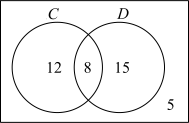
History and Geography are two of the subjects students may decide to study. For a group of 40 students, the following is known.

    • 7 students study neither History nor Geography
    • 20 students study History
    • 18 students study Geography
  1. Draw a Venn diagram that represents the information given, and hence find the number of students that study both History and Geography.   (2 marks)

    --- 6 WORK AREA LINES (style=lined) ---

  2. A student is chosen at random. Determine the probability that the students studies Geography only.   (1 mark)

    --- 3 WORK AREA LINES (style=lined) ---

Show Answers Only

a.    \(\text{Venn diagram:}\)

\(n\text{(study H and G)}= 5\)
 

b.    \(P(\text{study G only}) = \dfrac{13}{40}=32.5\% \)

Show Worked Solution

a.    \(\text{Venn diagram:}\)

\(n\text{(study H and G)}= 5\)
 

b.    \(P(\text{study G only}) = \dfrac{13}{40}=32.5\% \)

Filed Under: Venn Diagrams and Expected/Relative Frequency Tagged With: Band 4, Band 5, smc-6936-10-Venn Diagrams, syllabus-2027

Probability, STD2 EQ-Bank 32

In a workplace of 25 employees, each employee speaks either French or German, or both.

If 36% of the employees speak German, and 20% speak both French and German.

  1. Draw a Venn diagram that represents the information given.   (2 marks)

    --- 6 WORK AREA LINES (style=lined) ---

  2. If one person is chosen at random, what is the probability they can speak French but cannot speak German?   (2 marks)

    --- 4 WORK AREA LINES (style=lined) ---

Show Answers Only

a.   `text(Venn diagram:)`


b.    \(\text{Number who can speak French but not German = 16}\)

\(P(F\ \text{but not}\ G)=\dfrac{16}{25} = 64\%\)

Show Worked Solution

a.   `text(Venn diagram:)`


b.    \(\text{Number who can speak French but not German = 16}\)

\(P(F\ \text{but not}\ G)=\dfrac{16}{25} = 64\%\)

Filed Under: Venn Diagrams and Expected/Relative Frequency Tagged With: Band 4, Band 5, smc-6936-10-Venn Diagrams, syllabus-2027

Probability, STD2 EQ-Bank 22

A survey of 50 students found that:

  • 28 students study Mathematics (set \(M\))
  • 22 students study Physics (set \(P\) )
  • 12 students study both Mathematics and Physics.
  1. Draw a Venn diagram to represent this information.   (2 marks)

    --- 6 WORK AREA LINES (style=lined) ---

  2. How many students study Mathematics but not Physics?   (1 mark)

    --- 2 WORK AREA LINES (style=lined) ---

  3. If a student is chosen at random, what is the probability that they do not study either subject?   (1 mark)

    --- 2 WORK AREA LINES (style=lined) ---

Show Answers Only

a.


b.    \(\text{Using the Venn diagram:}\)

\(\text{Number who study Maths but not physics = 16}\)
 

c.    \(P(\text{study both}) = \dfrac{12}{50}=24\%\)

Show Worked Solution

a.


b.    \(\text{Using the Venn diagram:}\)

\(\text{Number who study Maths but not physics = 16}\)
 

c.    \(P(\text{study neither}) = \dfrac{12}{50}=24\%\)

Filed Under: Venn Diagrams and Expected/Relative Frequency Tagged With: Band 4, smc-6936-10-Venn Diagrams, syllabus-2027

Probability, STD2 EQ-Bank 20

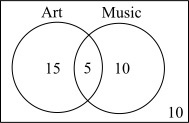
In a group of 60 students, 38 play basketball, 35 play hockey and 5 do not play either basketball or hockey.

  1. Draw a Venn diagram to represent the information given.   (2 marks)

    --- 5 WORK AREA LINES (style=lined) ---

  2. What percentage of students play both basketball and hockey?   (1 mark)

    --- 4 WORK AREA LINES (style=lined) ---

Show Answers Only

a.    

 
b.
    \(\text{From the diagram, 18 students play both sports.}\)

\(\text{Percentage}\ = \dfrac{18}{60} \times 100 = 30\%\)

Show Worked Solution

a.    

 
b.
    \(\text{From the diagram, 18 students play both sports.}\)

\(\text{Percentage}\ = \dfrac{18}{60} \times 100 = 30\%\)

Filed Under: Venn Diagrams and Expected/Relative Frequency Tagged With: Band 4, smc-6936-10-Venn Diagrams, syllabus-2027

Financial Maths, STD2 EQ-Bank 21

Maya uses a buy now, pay later payment option to make a purchase of $120. Her repayments are split across 4 equal payments over 6 weeks. No interest is charged.

Maya misses her final payment on 16 March 2026 and is charged a late fee of $19. Maya's payment schedule is shown, with her balance totalling $49.

\begin{array} {|l|c|c|c|}
\hline \textbf{Payment} & \textbf{Due Date} & \textbf{Amount} & \textbf{Status} \\
\hline \text{1st}  & \text{2 February 2026} & \$30 &  \text{Paid} \\
\hline \text{2nd} & \text{16 February 2026} & \$30 &  \text{Paid}  \\
\hline \text{3rd} & \text{2 March 2026} & \$30 &  \text{Paid} \\
\hline \text{4th} & \text{16 March 2026} & \$30 &  \text{Not Paid} \\
\hline \text{Outstanding Due} & \text{30 March 2026} & \$49\ \text{including late fee} &   \\
\hline \end{array}

  1. Find the total amount Maya pays for her purchase if repaying in full on 30 March 2026.   (1 mark)

    --- 3 WORK AREA LINES (style=lined) ---

  2. Maya's bank offers short-term loans where simple interest is charged at 16% per annum.
  3. Suppose Maya had borrowed $120 from the bank to make this purchase on 2 February 2026 and repaid it in full 8 weeks later.
  4. How much would Maya have saved using this approach instead of the buy now, pay later option?   (2 marks)

    --- 7 WORK AREA LINES (style=lined) ---

Show Answers Only

a.    \($139\)

b.    \($16.05\)

Show Worked Solution

a.    \(\text{If total owing paid on 30 March:}\)

\(\text{Total paid} = 30+30+30+49=$139\)
 

b.    \(r=16\%=0.16,\ \ n=\dfrac{8 \times 7}{365} = \dfrac{56}{365}\)

\(I=Prn=120 \times 0.16 \times \dfrac{56}{365} = 2.945… = $2.95 \)

\(\text{Amount saved} = 19-2.95=$16.05\)

Filed Under: Loans Tagged With: Band 3, Band 4, smc-6926-10-Buy Now Pay Later, syllabus-2027

Algebra, STD2 EQ-Bank 39

The graph of the parabola \(y=a(x+1)(x+7)\) for some value of \(a\) is shown.
 

By first finding the value of \(a\), find the coordinates of the vertex.   (3 marks)

--- 10 WORK AREA LINES (style=lined) ---
Show Answers Only

\(\text{Vertex:}\ (-4,-27)\)

Show Worked Solution

\(\text{Since graph passes through}\ (0,21):\)

\(21\) \(=a(0+1)(0+7)\)
\(21\) \(=7a\)
\(a\) \(=3\)

 
\(\text{Vertex is halfway between \(x\)-intercepts.}\)

\(\Rightarrow \ x=\dfrac{-7+(-1)}{2}=-4\)

\(y\) \(=3(-4+1)(-4+7)\)
  \(=3 \times (-3) \times 3\)
  \(=-27\)

 
\(\therefore\ \text{Vertex at}\ (-4,-27).\)

Filed Under: Non-Linear: Exponential/Quadratics (Std 2-X) Tagged With: Band 5, syllabus-2027

Algebra, STD2 EQ-Bank 38

The graph of the parabola \(y=a(x+2)(x-6)\) for some value of \(a\) is shown.
 

By first finding the value of \(a\), find the coordinates of the vertex.   (3 marks)

--- 10 WORK AREA LINES (style=lined) ---
Show Answers Only

\(\text{Vertex:}\ (2,32)\)

Show Worked Solution

\(\text{Since graph passes through}\ (0,24):\)

\(24\) \(=a(0+2)(0-6)\)
\(24\) \(=-12a\)
\(a\) \(=-2\)

 
\(\text{Vertex is halfway between \(x\)-intercepts.}\)

\(\Rightarrow \ x=\dfrac{-2+6}{2}=2\)

\(y\) \(=-2(2+2)(2-6)\)
  \(=-2 \times 4 \times (-4)\)
  \(=32\)

 
\(\therefore\ \text{Vertex at}\ (2,32).\)

Filed Under: Quadratic Relationships Tagged With: Band 5, smc-6922-10-Find Vertex, syllabus-2027

Algebra, STD2 EQ-Bank 35

The graph of the parabola \(y=k(x-2)(x-8)\) for some value of \(k\) is shown.
 

By first finding the value of \(k\), find the coordinates of the vertex.   (3 marks)

--- 10 WORK AREA LINES (style=lined) ---
Show Answers Only

\(\text{Vertex:}\ (5,-18)\)

Show Worked Solution

\(\text{Since graph passes through}\ (0,32):\)

\(32\) \(=k(0-2)(0-8)\)
\(32\) \(=16k\)
\(k\) \(=2\)

  
\(\text{Vertex is halfway between \(x\)-intercepts.}\)

\(\Rightarrow \ x=\dfrac{2+8}{2}=5\)

\(y\) \(=2(5-2)(5-8)\)
  \(=2 \times 3 \times (-3)\)
  \(=-18\)

 
\(\therefore\ \text{Vertex at}\ (5,-18).\)

Filed Under: Quadratic Relationships Tagged With: Band 5, smc-6922-10-Find Vertex, syllabus-2027

Algebra, STD2 EQ-Bank 25

A local bowling club sold memberships for the new season.

Senior memberships \((s)\) cost $70 each and junior memberships \((j)\) cost $45 each.

On a particular day, a total of 19 memberships were sold, with sales totalling $1030.

  1. Write two equations, in terms of \(s\) and \(j\), to represent this information.   (1 mark)

    --- 2 WORK AREA LINES (style=lined) ---
  2. Determine the exact number of senior and junior memberships sold.   (2 marks)

--- 12 WORK AREA LINES (style=lined) ---
Show Answers Only

a.    \(70s+45j=1030\ …\ (1)\)

\(s+j=19\ …\ (2)\)

b.    \(s=7,\ \ j=12\)

Show Worked Solution

a.    \(70s+45j=1030\ …\ (1)\)

\(s+j=19\ …\ (2)\)
 

b.    \(\text{Rearranging (2) above:}\)

\(s=19-j\)

\(\text{Substitute}\ \ s=19-j\ \ \text{into (1):}\)

\(70(19-j)+45j\) \(=1030\)
\(1330-70j+45j\) \(=1030\)
\(25j\) \(=1330-1030=300\)
\(j\) \(=12\)

 
\(\text{Substitute}\ \ j=12\ \ \text{into (2):}\)

\(s=19-12=7\)

\(\therefore\ \text{7 senior and 12 junior memberships were sold.}\)

Filed Under: Simultaneous Linear Equations Tagged With: Band 4, smc-6920-25-Solve Algebraically, syllabus-2027

Algebra, STD2 EQ-Bank 24

A bookshop sold a number of biographies at a weekend sale.

Hardcover biographies \((h)\) sold for $25 each and paperback biographies \((p)\) sold for $12 each.

A total of 11 biographies were sold, with total sales revenue of $210.

  1. Write two equations, in terms of \(h\) and \(p\), to represent this information.   (1 mark)

    --- 2 WORK AREA LINES (style=lined) ---
  2. Determine the number of hardcover biographies and the number of paperback biographies sold.   (2 marks)

    --- 6 WORK AREA LINES (style=lined) ---
Show Answers Only

\(h=6, \ p=5\)

Show Worked Solution

a.    \(25h+12p=210\ …\ (1)\)

\(h+p=11\ …\ (2)\)
 

b.    \(\text{Rearranging (2) above:}\)

\(h=11-p\)

\(\text{Substitute}\ \ h=9-p\ \ \text{into (1):}\)

\(25(11-p)+12p\) \(=210\)
\(275-25p+12p\) \(=210\)
\(13p\) \(=275-210=65\)
\(p\) \(=5\)

 
\(\text{Substitute}\ \ p=5\ \ \text{into (2):}\)

\(h=11-5=6\)

\(\therefore\ \text{6 hardcover and 5 paperback biographies were sold.}\)

Filed Under: Simultaneous Linear Equations Tagged With: Band 4, smc-6920-25-Solve Algebraically, syllabus-2027

Algebra, STD2 EQ-Bank 32

A school sold tickets to its annual play.

Adult tickets were sold for $8 each and student tickets were sold for $5 each.

A total of 142 tickets were sold, raising $896 in ticket sales.

By writing two equations to represent this information, find the number of adult tickets and the number of student tickets sold.   (3 marks)

--- 12 WORK AREA LINES (style=lined) ---
Show Answers Only

\(\text{Adult tickets}=62, \ \text{Student tickets}=80\)

Show Worked Solution

\(\text{Let}\ x=\text{adult tickets},\ y=\text{student tickets}\)

\(8x+5y=896\ …\ (1)\)

\(x+y=142\ \ \Rightarrow \ y=142-x\ …\ (2)\)

\(\text{Substitute}\ \ y=142-x\ \ \text{into (1):}\)

\(8x+5(142-x)\) \(=896\)
\(8x+710-5x\) \(=896\)
\(3x\) \(=896-710=186\)
\(x\) \(=62\)

 
\(\text{Substitute}\ \ x=62\ \ \text{into (2):}\)

\(y=142-62=80\)

\(\therefore\ \text{62 adult tickets and 80 student tickets were sold.}\)

Filed Under: Simultaneous Linear Equations Tagged With: Band 5, smc-6920-25-Solve Algebraically, syllabus-2027

Algebra, STD2 EQ-Bank 30

Eleni is a farmer who sold chickens and ducks at the local market.

Each chicken was sold for $15 and each duck was sold for $9.

She sold a total of 78 birds for a total of $930.

By writing two equations to represent this information, find the number of chickens and the number of ducks Eleni sold.   (3 marks)

--- 12 WORK AREA LINES (style=lined) ---
Show Answers Only

\(\text{Chickens}=38, \ \text{Ducks}=40\)

Show Worked Solution

\(\text{Let}\ x=\text{chickens},\ y=\text{ducks}\)

\(15x+9y=930\ …\ (1)\)

\(x+y=78\ \ \Rightarrow \ y=78-x\ …\ (2)\)

\(\text{Substitute}\ \ y=78-x\ \ \text{into (1):}\)

\(15x+9(78-x)\) \(=930\)
\(15x+702-9x\) \(=930\)
\(6x\) \(=930-702=228\)
\(x\) \(=38\)

 
\(\text{Substitute}\ \ x=38\ \ \text{into (2):}\)

\(y=78-38=40\)

\(\therefore\ \text{Eleni sold 38 chickens and 40 ducks.}\)

Filed Under: Simultaneous Linear Equations Tagged With: Band 5, smc-6920-25-Solve Algebraically, syllabus-2027

Networks, STD2 EQ-Bank 28

A weighted and directed network diagram is shown.
 

  1. What is the outflow from vertex \(C\) ?   (1 mark)

    --- 2 WORK AREA LINES (style=lined) ---
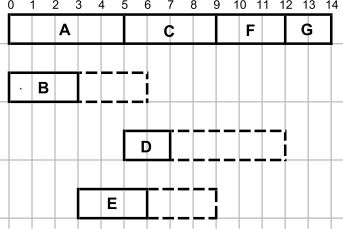
  2. Calculate the maximum flow through the network.   (2 marks)

    --- 5 WORK AREA LINES (style=lined) ---
  3. The capacity of ONE saturated edge is to be increased in order to produce a new network with the maximum possible flow.
  4. State an edge which could have an increased capacity AND find the new maximum flow through this new network.   (2 marks)

    --- 3 WORK AREA LINES (style=lined) ---
Show Answers Only

a.    \(\text{Inflow of \(C\) = Outflow of \(C\) = 14}\)

b.    \(\text{Method 1:}\)

\(\text{Minimum cut through}\ \ sC-Bt-At:\)

\(\text{Maximum flow} = 14+20+11=45\)
 

\(\text{Method 2:}\)


\(sAt\ \ 11\ \text{(leaving an excess flow capacity of } s A=11 \text { )}\)

\(sABt\ \ 11\ \text{(leaving an excess flow capacity of } AB=7 \text { and } B t=9 \text { )}\)

\(sBt\ \ 9\ \text{(leaving an excess flow capacity of } s B=7 \text { )}\)

\(sCt\ \ 14\ \text{(leaving an excess flow capacity of } C t=3)\)

\(\text{Maximum Flow} = 11+11+9+14=45\)
 

c.    \(\text{Answers could include one of the following:}\)

\(\text{B} t \ \text{could be increased (by 7) leading to a maximum flow of 52.}\)

\(\text{A} t \ \text{could be increased (by 11) leading to a maximum flow of 52.}\)

Show Worked Solution

a.    \(\text{Inflow of \(C\) = Outflow of \(C\) = 14}\)

b.    \(\text{Method 1:}\)

\(\text{Minimum cut through}\ \ sC-Bt-At:\)

\(\text{Maximum flow} = 14+20+11=45\)
 

\(\text{Method 2:}\)


\(sAt\ \ 11\ \text{(leaving an excess flow capacity of } s A=11 \text { )}\)

\(sABt\ \ 11\ \text{(leaving an excess flow capacity of } AB=7 \text { and } B t=9 \text { )}\)

\(sBt\ \ 9\ \text{(leaving an excess flow capacity of } s B=7 \text { )}\)

\(sCt\ \ 14\ \text{(leaving an excess flow capacity of } C t=3)\)

\(\text{Maximum Flow} = 11+11+9+14=45\)
 

c.    \(\text{Answers could include one of the following:}\)

\(\text{B} t \ \text{could be increased (by 7) leading to a maximum flow of 52.}\)

\(\text{A} t \ \text{could be increased (by 11) leading to a maximum flow of 52.}\)

Filed Under: Network Flow (Y12) Tagged With: Band 4, Band 5, smc-6915-10-Min Cut/Max Flow, smc-6915-35-Saturated Edges Method, syllabus-2027

Algebra, STD2 EQ-Bank 36

The graph of the parabola \(y=a(x-1)(x-9)\) for some value of \(a\) is shown.
 

By first finding the value of \(a\), find the coordinates of the vertex.   (3 marks)

--- 10 WORK AREA LINES (style=lined) ---
Show Answers Only

\(\text{Vertex:}\ (5,32)\)

Show Worked Solution

\(\text{Since graph passes through}\ (0,-18):\)

\(-18\) \(=a(0-1)(0-9)\)  
\(-18\) \(=9a\)  
\(a\) \(=-2\)  

 
\(\text{Vertex is halfway between \(x\)-intercepts}\ \ \Rightarrow\ \ x=5\)

\(y\) \(=-2(5-1)(5-9)\)  
  \(=-2 \times 4 \times (-4)\)  
  \(=32\)  

 
\(\therefore\ \text{Vertex at}\ (5,32).\)

Filed Under: Quadratic Relationships Tagged With: Band 5, smc-6922-10-Find Vertex, syllabus-2027

Algebra, STD2 EQ-Bank 29

Two friends, Adam and Bertha, sold cupcakes for a fundraising event.

Adam sold \(x\) cupcakes for $3 each. Bertha sold \(y\) cupcakes for $2 each.

Together they sold 113 cupcakes with total sales revenue of $275.

By writing two equations to represent this information, find the number of cupcakes sold by each of the two friends.   (3 marks)

--- 12 WORK AREA LINES (style=lined) ---
Show Answers Only

\(x=49, \ y=64\)

Show Worked Solution

\(3x+2y=275\ …\ (1)\)

\(x+y=113\ \ \Rightarrow \ y=113-x\ …\ (2)\)

\(\text{Substitute}\ \ y=113-x\ \ \text{into (1):}\)

\(3x+2(113-x)\) \(=275\)
\(3x+226-2x\) \(=275\)
\(x\) \(=275-226=49\)

 
\(\text{Substitute}\ \ x=49\ \ \text{into (2):}\)

\(y=113-49=64\)

\(\therefore\ \text{Adam sold 49 and Bertha sold 64.}\)

Filed Under: Simultaneous Linear Equations Tagged With: Band 5, smc-6920-25-Solve Algebraically, syllabus-2027

Statistics, STD2 EQ-Bank 26

The image shows the proportion of people in various categories based on the 2021 census of the Australian population.
 

The number of people in the 2021 Australian census was \(25\,418\,009\).

Of these, \(812\,728\) identified as Aboriginal and/or Torres Strait Islander people.

Of those who identified as Aboriginal and/or Torres Strait Islander people, 51.1% were aged under 25 years and \(243\,818\) were aged 10–24 years.

What percentage of the Gen Alpha category identified as Aboriginal and/or Torres Strait Islander people?   (3 marks)

--- 7 WORK AREA LINES (style=lined) ---
Show Answers Only

\(\text{Of those who identified as Aboriginal and/or Torres Strait Islander people }\)

\(\text{Number of people under 25 years }=812\,728 \times 0.511=415\,304\)

\(\text{Number in Gen Z}=243\,818 \ \text{(given)}\)

\(\text{Number in Gen Alpha}=415\,304-243\,818=171\,486\)
 

\(\text{Total number in Gen Alpha}=25\,418\,009 \times 0.12=3\,050\,161\)

\(\text{Percentage}=\dfrac{171\,486}{3\,050\,161}=5.6 \%\)

Show Worked Solution

\(\text{Of those who identified as Aboriginal and/or Torres Strait Islander people }\)

\(\text{Number of people under 25 years }=812\,728 \times 0.511=415\,304\)

\(\text{Number in Gen Z}=243\,818 \ \text{(given)}\)

\(\text{Number in Gen Alpha}=415\,304-243\,818=171\,486\)
 

\(\text{Total number in Gen Alpha}=25\,418\,009 \times 0.12=3\,050\,161\)

\(\text{Percentage}=\dfrac{171\,486}{3\,050\,161}=5.6 \%\)

Filed Under: Displaying Data - Bar Charts and Histograms Tagged With: Band 5, smc-6310-10-Bar Charts, syllabus-2027

Networks, STD2 EQ-Bank 25

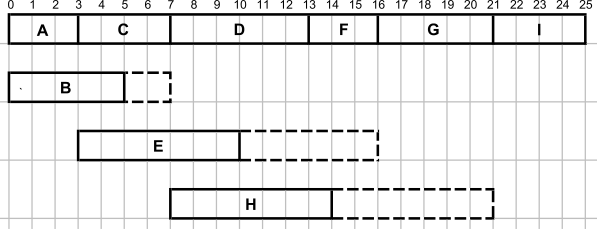
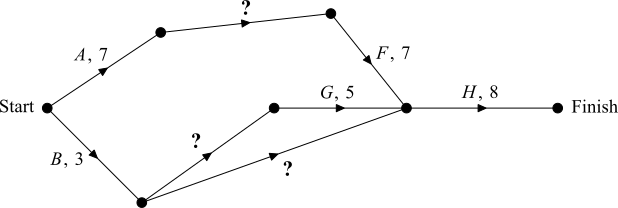
A project requires the completion of 9 activities, \(A\) to \(I\). The project is due to be completed in 13 days.

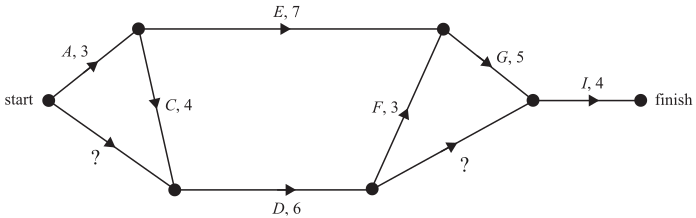
The directed network diagram shows these activities with their completion times in days.


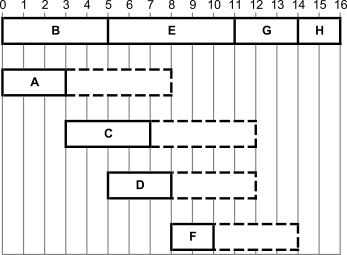
  1. Use the information from the network diagram to complete the Gantt chart, including the critical path and all other activities required for the project.   (3 marks)

    --- 0 WORK AREA LINES (style=lined) ---
       

  2. List all activities, not on the critical path, which could be occurring at midday on day 8.   (1  mark)

    --- 3 WORK AREA LINES (style=lined) ---
Show Answers Only

a.    
     

b.    \(C\ \text{and}\ E\)

Show Worked Solution

a.    


b.
    \(\text{By inspection of the Gantt chart}\)

\(\text{Activities which could be occurring ~7.5 on chart (midday day 8):}

\(C\ \text{and}\ E\)

Filed Under: Critical Path Analysis (Y12) Tagged With: Band 4, Band 5, smc-6916-35-Gantt Charts, syllabus-2027

Probability, STD2 EQ-Bank 24

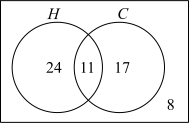
In Year 11 there are 80 students. Of these, 50 play a sport \((S), 25\) are involved in debating ( \(D\) ), and 20 do neither.

  1. Using this information, complete the Venn diagram.   (2 marks)


  1. A Year 11 student is selected at random.
  2. What is the probability that the student plays a sport and is involved in debating?   (1 mark)

    --- 2 WORK AREA LINES (style=lined) ---
  3. Two Year 11 students are selected at random.
  4. What is the probability that both students are involved in debating only?   (2 marks)

    --- 3 WORK AREA LINES (style=lined) ---
Show Answers Only

a.    
 

b.    \(\dfrac{3}{16}\)

c.    \(\dfrac{9}{632} \)

Show Worked Solution

a.    
     

b.    \(\text{Using the Venn diagram:}\)

\(P\text{(plays both)} = \dfrac{15}{80}=\dfrac{3}{16}\)
 

c.    \(P\text{(both students involved in debating only)}\)

\(=\dfrac{10}{80} \times\ \dfrac{9}{79}=\dfrac{9}{632} (\approx 0.0142)\)

Filed Under: Venn Diagrams and Expected/Relative Frequency Tagged With: Band 4, Band 5, smc-6936-10-Venn Diagrams, syllabus-2027

Financial Maths, STD2 EQ-Bank 20

Kimberley uses a buy now, pay later payment option to make a purchase of $100. Her repayments are split across 4 equal payments over 6 weeks. No interest is charged.

Kimberley misses her final payment and is charged a late fee of $17. Kimberley’s payment schedule is shown, with her balance totalling $42.
 

  1. Find the total amount Kimberley pays for her purchase if repaying in full on 27 July 2024.   (1 mark)

    --- 3 WORK AREA LINES (style=lined) ---
  2. Kimberley’s bank offers short-term loans where simple interest is charged at 18% per annum.
  3. Suppose Kimberley had borrowed $100 from the bank to make this purchase on 1 June 2024 and repaid it in full 8 weeks later.
  4. How much would Kimberley have saved using this approach instead of the buy now, pay later option?   (2 marks)

    --- 7 WORK AREA LINES (style=lined) ---

Show Answers Only

a.    \($117\)

b.    \($14.24\)

Show Worked Solution

a.    \(\text{If total owing paid on 27 July:}\)

\(\text{Total paid} = 25+25+25+42=$117\)
 

b.    \(r=18\%=0.18,\ \ n=\dfrac{8 \times 7}{365} = \dfrac{56}{365}\)

\(I=Prn=100 \times 0.18 \times \dfrac{56}{365} = 2.761… = $2.76 \)

\(\text{Amount saved} = 17-2.76=$14.24\)

Filed Under: Loans Tagged With: Band 3, Band 4, smc-6926-10-Buy Now Pay Later, syllabus-2027

Networks, STD2 EQ-Bank 3 MC

A network of pipes is shown.
 

Which vertex in this network represents the sink?

  1. \(V\)
  2. \(X\)
  3. \(Y\)
  4. \(Z\)
Show Answers Only

\(B\)

Show Worked Solution

\(\text{The sink is the vertex where all flow finishes and no flow leaves.}\}

\(\Rightarrow B\)

Filed Under: Network Flow (Y12) Tagged With: Band 3, smc-6915-50-Other Directed Flows, syllabus-2027

Financial Maths, STD2 EQ-Bank 34

Yuki works as a musician and receives royalties from streaming services. A spreadsheet is used to calculate her quarterly royalty earnings.

Total royalty earnings = Number of streams \(\times\) Royalty rate per stream

A spreadsheet showing Yuki's quarterly royalty earnings is shown.


In the following quarter, Yuki's total royalty earnings were $4200. The royalty rate per stream remained at $0.004. Calculate the number of streams Yuki received that quarter.   (2 marks)

--- 5 WORK AREA LINES (style=lined) ---

Show Answers Only

\(1\,050\,000\)

Show Worked Solution

\(\text{Total royalty earnings (B8)} = $4200\)

\(\text{Royalty rate per stream (B5)}=$0.004\)

\(\text{Let the number of streams (B4)}=N\)

\(\text{Total royalty earnings} = \text{Number of streams} \times\text{Royalty rate per stream}\)

\(\text{B8}\) \(=\text{B4}^*\text{B5}\)
\(4200\) \(=N\times 0.004\)
\(N\) \(=\dfrac{4200}{0.004}\)
  \(=1\,050\,000\)

\(\text{Yuki had 1 050 000 streams in the next quarter}\)

Filed Under: Ways of Earning, Ways of Earning Tagged With: Band 5, smc-6276-30-Piecework/Royalties, smc-6276-60-Spreadsheets, smc-6515-30-Piecework/Royalties, smc-6515-60-Spreadsheets, syllabus-2027

Financial Maths, STD2 EQ-Bank 29

Priya works as a sales representative and earns a base wage plus commission. A spreadsheet is used to calculate her weekly earnings.

Total weekly earnings = Base wage + Total sales \(\times\) Commission rate

A spreadsheet showing Priya's weekly earnings is shown.


  1. Write down the formula used in cell B9, using appropriate grid references.   (1 mark)

    --- 1 WORK AREA LINES (style=lined) ---

  2. In the following week, Priya earned total weekly earnings of $1437.50. Her base wage and commission rate remained unchanged. Calculate Priya's total sales for that week.   (2 marks)

    --- 5 WORK AREA LINES (style=lined) ---

  3. Priya's employer increases her commission rate to 4.2% but keeps her base wage the same. If Priya makes $22 000 in sales, calculate her new total weekly earnings.   (2 marks)

    --- 5 WORK AREA LINES (style=lined) ---

Show Answers Only

a.   \(=\text{B4}+\text{B5}^*\text{B6}/100\)

b.    \($22\, 500\)

c.    \($1574\)

Show Worked Solution

a.   \(\text{Total weekly earnings} = \text{Base wage}+\text{Total sales} \times \text{Commission rate}\)

\(\therefore\ \text{Formula:}\ =\text{B4}+\text{B5}^*\text{B6}/100\)
 

b.   \(\text{Total weekly earnings} = \text{Base wage}+\text{Total sales} \times \text{Commission rate}\)

\(\text{Let the Total sales}=S\)

\(1437.50\) \(=650+S\times \dfrac{3.5}{100}\)
\(787.50\) \(=S\times \dfrac{3.5}{100}\)
\(S\) \(=\dfrac{787.50\times 100}{3.5}=$22\,500\)

 
\(\text{The amount of Priya’s total sales was \$22 500.}\)
 

c.    \(\text{Base wage}=650\)

\(\text{Total sales}=$22\,000\)

\(\text{New commission rate}=4.2\%\)

\(\text{Total weekly earnings}\) \(=650+22\,000\times \dfrac{4.2}{100}\)
  \(=650+924=$1574\)

Filed Under: Ways of Earning, Ways of Earning Tagged With: Band 3, Band 4, Band 5, smc-6276-20-Commission, smc-6276-60-Spreadsheets, smc-6515-20-Commission, smc-6515-60-Spreadsheets, syllabus-2027

Financial Maths, STD2 EQ-Bank 20 MC

A company uses a spreadsheet to calculate employees' monthly salaries from their weekly salaries. The spreadsheet is shown below.
 

Which formula has been used in cell B7 to calculate the monthly salary?
 
  1. \(=\text{B4}^*4\)
  2. \(=\text{B4}^*52/12\)
  3. \(=\text{B4}^*12\)
  4. \(=\text{B4}/52^*12\)
Show Answers Only

\(B\)

Show Worked Solution

\(\text{Monthly salary} = \dfrac{\text{weekly salary} \times 52}{12}\)

\(\therefore\ \text{Formula:}\ =\text{B4}^*52/12\)

\(\Rightarrow B\)

Filed Under: Ways of Earning, Ways of Earning Tagged With: Band 4, smc-6276-10-Wages/Salaries, smc-6276-60-Spreadsheets, smc-6515-10-Wages/Salaries, smc-6515-60-Spreadsheets, syllabus-2027

Financial Maths, STD2 EQ-Bank 21

Liam works in a factory assembling electronic components and is paid on a piecework basis. A spreadsheet is used to calculate his weekly earnings.

Weekly earnings = Number of units completed \(\times\) Rate per unit

A spreadsheet showing Liam's earnings for one week is shown.
  

  1. Write down the formula used in cell B8, using appropriate grid references.   (1 mark)

    --- 1 WORK AREA LINES (style=lined) ---

  2. In the following week, Liam earned $2036.25. The rate per unit remained at $3.75. Calculate the number of units Liam completed that week.   (2 marks)

    --- 5 WORK AREA LINES (style=lined) ---

Show Answers Only

a.   \(=\text{B4}^*\text{B5}\)

b.    \(\text{Number of units completed}=543\)

Show Worked Solution

a.   \(\text{Weekly earnings} = \text{Number of units completed} \times \text{Rate per unit}\)

\(\text{Formula:}\ =\text{B4}^*\text{B5}\)
 

b.   \(\text{Weekly earnings} = \text{Number of units completed} \times \text{Rate per unit}\)

\(\text{Let the Weekly earnings}=E\)

\(2036.25\) \(=E\times 3.75 \)
\(E\) \(=\dfrac{2036.25}{3.75}=543\)

Filed Under: Ways of Earning, Ways of Earning Tagged With: Band 3, Band 4, smc-6276-30-Piecework/Royalties, smc-6276-60-Spreadsheets, smc-6515-30-Piecework/Royalties, smc-6515-60-Spreadsheets, syllabus-2027

Financial Maths, STD2 EQ-Bank 26

Maria works as a freelance writer and earns income through royalties. A spreadsheet is used to calculate her monthly royalty earnings.

Royalties = Number of books sold \( \times \) Royalty rate per book

A spreadsheet detailing Maria's royalty earnings is shown below.
  

  1. Write down the formula used in cell B8, using appropriate grid references.   (1 mark)

    --- 1 WORK AREA LINES (style=lined) ---

  2. In April, Maria's total royalty earnings were $8960.40. Her royalty rate remained at $2.85 per book. How many books did Maria sell in April?   (2 marks)

    --- 5 WORK AREA LINES (style=lined) ---

Show Answers Only

a.   \(=\text{B4}^*\text{B5}\)

b.    \(\text{Number of books}=3144\)

Show Worked Solution

a.   \(\text{Total royalty earnings} = \text{Number of books sold} \times \text{Royalty rate per book}\)

\(\text{Formula:}\ =\text{B4}^*\text{B5}\)
 

b.   \(\text{Total royalty earnings} = \text{Number of books sold} \times \text{Royalty rate per book}\)

\(\text{Let the Number of books sold}=N\)

\(8960.40\) \(=N\times 2.85 \)
\(N\) \(=\dfrac{8960.40}{2.85}=3144\)

Filed Under: Ways of Earning, Ways of Earning Tagged With: Band 3, Band 4, smc-6276-30-Piecework/Royalties, smc-6276-60-Spreadsheets, smc-6515-30-Piecework/Royalties, smc-6515-60-Spreadsheets, syllabus-2027

Financial Maths, STD2 EQ-Bank 31

Chen earns an annual salary of $72 800. He is entitled to four weeks annual leave with 17.5% leave loading. A spreadsheet is used to calculate his total holiday pay.

Total holiday pay = 4 × weekly wage + 4 × weekly wage × 17.5%

A spreadsheet showing Chen's holiday pay calculation is shown.

  1. What value from the question should be entered in cell B5?   (1 mark)

    --- 1 WORK AREA LINES (style=lined) ---

  2. Write down the formula used in cell B9 to calculate the weekly wage, using appropriate grid references.   (2 marks)

    --- 2 WORK AREA LINES (style=lined) ---

  3. Verify the amount of Chen's total holiday pay using calculations.   (2 marks)

    --- 5 WORK AREA LINES (style=lined) ---

Show Answers Only

a.   \(4\)

b.   \(=\text{B4}/52\)

c.    \(\text{Total holiday pay}=\text{weekly wage}\times 4 +\ \text{weekly wage}\times 4\ \times 17.5\%\)

\(\text{Total holiday pay}=1400\times 4+1400\times 4\times\dfrac{17.5}{100}=5600+980=$6580\)

Show Worked Solution

a.    \(\text{Chen gets 4 weeks leave }\rightarrow\ 4\)
 

b.    \(\text{Weekly wage }=\dfrac{\text{Annual salary}}{52}\)

\(\text{Formula: }=\text{B4}/52\)
 

c.    \(\text{Total holiday pay}=\text{weekly wage}\times 4 +\ \text{weekly wage}\times 4\ \times 17.5\%\)

\(\text{Total holiday pay}=1400\times 4+1400\times 4\times\dfrac{17.5}{100}=5600+980=$6580\)

Filed Under: Ways of Earning, Ways of Earning Tagged With: Band 2, Band 3, Band 5, smc-6276-10-Wages/Salaries, smc-6276-60-Spreadsheets, smc-6515-10-Wages/Salaries, smc-6515-60-Spreadsheets, syllabus-2027

Financial Maths, STD2 EQ-Bank 9 MC

A company calculates holiday pay for employees entitled to four weeks annual leave with 17.5% leave loading on four weeks pay.

A spreadsheet is used to calculate the total holiday pay.
 

Which formula has been used in cell B9?

  1. \(=\text{B4}^*\text{B5}+\text{B4}^*\text{B5}^*\text{B6}\)
  2. \(=\text{B4}^*\text{B5}+\text{B4}^*\text{B5}^*\text{B6}/100\)
  3. \(=\text{B4}^*\text{B5}^*\text{B6}/100\)
  4. \(=\text{B4}+\text{B5}+\text{B6}\)
Show Answers Only

\(B\)

Show Worked Solution

\(\text{Total holiday pay}=\text{weekly wage}\times 4 +\text{weekly wage}\times 4\ \times 17.5\%\)

\(\text{Formula: }\text{weekly wage}\times 4 +\text{weekly wage}\times 4\ \times \dfrac{17.5}{100}\)

\(\text{Using cell references: }=\text{B4}^*\text{B5}+\text{B4}^*\text{B5}^*\text{B6}/100\)

\(\text{Check: }1450\times 4+1450\times 4\times\dfrac{17.5}{100}=5800+1015=6815\)

\(\Rightarrow B\)

Filed Under: Ways of Earning, Ways of Earning Tagged With: Band 5, smc-6276-10-Wages/Salaries, smc-6276-60-Spreadsheets, smc-6515-10-Wages/Salaries, smc-6515-60-Spreadsheets, syllabus-2027

  • 1
  • 2
  • 3
  • Next Page »

Copyright © 2014–2026 SmarterEd.com.au · Log in