SmarterEd

Aussie Maths & Science Teachers: Save your time with SmarterEd

  • Login
  • Get Help
  • About

Calculus, EXT2 2026 HSC 14b

Consider the region bounded by the curve  \(y=x \sqrt{e^x}\), the \(x\)-axis, and the line  \(x=3\).
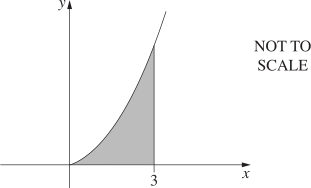
 

Find the volume of the solid of revolution formed when the region is rotated about the \(x\)-axis.   (3 marks)

--- 10 WORK AREA LINES (style=lined) ---

Show Answers Only

\(V=\pi\left(5 e^3-2\right) \ \text{u}^3\)

Show Worked Solution

\(y=x \sqrt{e^x} \ \Rightarrow \ y^2=x^2 e^x\)

\(V=\pi \displaystyle \int_0^3 y^2\,dx=\pi \int_0^3 x^2 e^x\,dx\)

\(\text{Integrate by parts:}\)

\(u=x^2 \ \Rightarrow \ u^{\prime}=2x\)

\(v^{\prime}=e^x \ \Rightarrow \ v=e^x\)

\(\displaystyle \int_0^3 x^2 e^x\,dx\) \(=\Big[x^2 e^x\Big]_0^3-2 \displaystyle \int_0^3 x e^x\,dx\)
  \(=9 e^3-2 \displaystyle \int_0^3 x e^x\,dx\ \ \ldots\ (1)\)

 
\(\text{Integrate by parts again:}\)

\(u=x \ \Rightarrow \ u^{\prime}=1\)

\(v^{\prime}=e^x \ \Rightarrow \ v=e^x\)

\(\displaystyle \int_0^3 x e^x\,dx\) \(=\Big[x e^x\Big]_0^3-\displaystyle \int_0^3 e^x\,dx\)
  \(=3 e^3-\Big[e^x\Big]_0^3\)
  \(=3 e^3-e^3+1\)
  \(=2 e^3+1\)

 
\(\text{Substitute into (1):}\)

\(V\) \(=\pi\left(9 e^3-2\left(2 e^3+1\right)\right)\)
  \(=\pi\left(9 e^3-4 e^3-2\right)\)
  \(=\pi\left(5 e^3-2\right) \ \text{u}^3\)

Filed Under: Integration By Parts Tagged With: Band 4, smc-7435-20-Exponential, smc-7435-60-X-topic

Calculus, EXT2 C1 2022 HSC 15c

Using the substitution  `x=tan^(2)theta`, evaluate

          `int_(0)^(1)sin^(-1)sqrt((x)/(1+x))\ dx`   (4 marks)

--- 12 WORK AREA LINES (style=lined) ---

Show Answers Only

`pi/2-1`

Show Worked Solution

`x=tan^(2)theta`

`dx/(d theta)=2sec^2theta\ tantheta\ \ =>\ \ dx=2sec^2theta\ tantheta\ d theta`

`text{When}\ x=0, \ theta=0`

`text{When}\ x=1, \ theta=pi/4`


Mean mark 55%.
`sin^(-1)sqrt((x)/(1+x))` `=sin^(-1)sqrt((tan^(2)theta)/(1+tan^(2)theta))`  
  `=sin^(-1)sqrt((tan^(2)theta)/(text{sec}^(2)theta))`  
  `=sin^(-1)sqrt((sin^(2)theta))`  
  `=sin^(-1)(sintheta)`  
  `=theta`  


`int_(0)^(1)sin^(-1)sqrt((x)/(1+x))\ dx=int_(0)^(pi/4)\ theta xx 2sec^2theta\ tantheta\ d theta`
 

`text{Integrating by parts:}`

`u` `=theta` `u^{′}` `=1`
`v^{′}` `=2tan theta\ sec^2 theta` `v` `=tan^(2)theta`

 
`int_(0)^(pi/4)\ theta xx 2sec^2theta\ tantheta\ d theta`

`=[theta\ tan^(2)theta]_0^(pi/4)-int_0^(pi/4)tan^(2)theta\ d theta`

`=(pi/4 xx 1 -0)-int sec^(2)theta-1\ d theta`

`=pi/4-[tan theta-theta]_0^(pi/4)`

`=pi/4-[(1-pi/4)-0]`

`=pi/2-1`

Filed Under: Integration By Parts, Integration By Parts Tagged With: Band 4, smc-1055-30-Trig, smc-1055-60-X-topic, smc-5134-30-Trig, smc-7435-30-Trig, smc-7435-60-X-topic

Copyright © 2014–2026 SmarterEd.com.au · Log in