Find the global maximum and minimum values of `y=x^(3)-6x^(2)+8`, where `-1 <= x <= 7`. (4 marks)
--- 8 WORK AREA LINES (style=lined) ---
Aussie Maths & Science Teachers: Save your time with SmarterEd
Find the global maximum and minimum values of `y=x^(3)-6x^(2)+8`, where `-1 <= x <= 7`. (4 marks)
--- 8 WORK AREA LINES (style=lined) ---
A function `f(x)` is defined by `f(x) =2x^2(3-x)`.
--- 6 WORK AREA LINES (style=lined) ---
--- 2 WORK AREA LINES (style=lined) ---
--- 8 WORK AREA LINES (style=lined) ---
--- 2 WORK AREA LINES (style=lined) ---
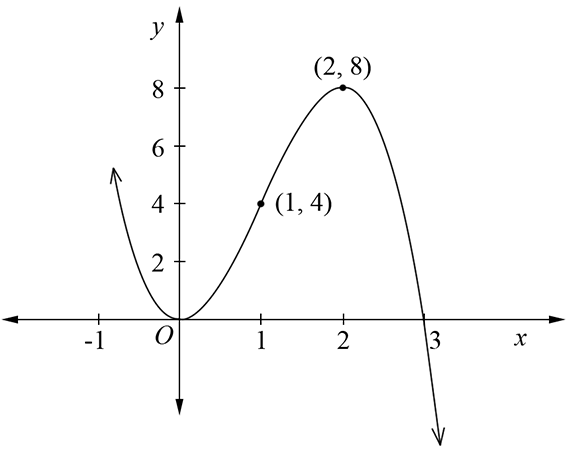
| i. `f(x)` | `= 2x^2 (3-x)` |
| `= 6x^2-2x^3` | |
| `f^{prime} (x)` | `= 12x-6x^2` |
| `f^{″}(x)` | `= 12-12x` |
`text(S.P.’s when)\ f^{′}(x) = 0`
| `12x-6x^2` | `= 0` |
| `6x(2-x)` | `= 0` |
`x = 0 or 2`
`text(When)\ x = 0`
| `f(0)` | `= 0` |
| `f^{″}(0)` | `= 12-0 = 12 > 0` |
| `:.\ text(MIN at)\ (0, 0)` | |
`text(When)\ x = 2`
| `f(2)` | `= 2 xx 2^2 (3-2)` | `= 8` |
| `f^{″}(2)` | `= 12-(12 xx 2)` | `= -12 < 0` |
| `:.\ text(MAX at)\ (2, 8)` | ||
ii. `text(P.I. when)\ f^{″}(x) = 0`
| `12-12x` | `= 0` |
| `12x` | `= 12` |
| `x` | `= 1` |
| `f^{″}(0.5)` | `=6>0` |
| `f^{″}(1.5)` | `=-6<0` |
`text(S)text(ince concavity changes)\ \ =>\ text(P.I. exists)`
| `f(1)` | `= 2 xx 1^2(3-1)` |
| `= 4` |
`:.\ text(P.I. at)\ (1, 4)`
iii. `f(x)\ text(meets)\ x text(-axis when)\ f(x) = 0`
`2x^2 xx (3-x) = 0`
`x = 0 or 3`
(iv) `text(The graph clearly shows that in the given range)`
`-1<= x<=4,\ text(the minimum will occur when)\ x = 4`
| `:.\ text(Minimum` | `= 2 xx 4^2 (3-4)` |
| `= -32` |