Consider the sequence defined by
\(z_1=8\) and \(z_{n+1}=\dfrac{3}{4} i z_n\)
as shown.
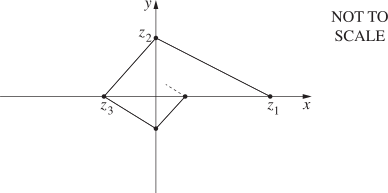
Find the sum of the lengths
\(\abs{z_2-z_1}+\abs{z_3-z_2}+\abs{z_4-z_3}+\cdots\). (3 marks)
--- 12 WORK AREA LINES (style=lined) ---
Aussie Maths & Science Teachers: Save your time with SmarterEd
Consider the sequence defined by
\(z_1=8\) and \(z_{n+1}=\dfrac{3}{4} i z_n\)
as shown.
Find the sum of the lengths
\(\abs{z_2-z_1}+\abs{z_3-z_2}+\abs{z_4-z_3}+\cdots\). (3 marks)
--- 12 WORK AREA LINES (style=lined) ---
\(40\)
| \(z_{n+1}-z_n\) | \(=\dfrac{3}{4} i z_n-z_n\) |
| \(=\left(-1+\dfrac{3}{4} i\right) z_n\) | |
| \(\abs{z_{n+1}-z_n}\) | \(=\abs{-1+\dfrac{3}{4} i} \cdot \abs{z_n}\) |
| \(=\sqrt{1+\dfrac{9}{16}} \cdot \abs{z_n}\) | |
| \(=\dfrac{5}{4}\abs{z_n}\) |
\(\text{Find}\ \abs{z_n}:\)
\(\abs{z_{n+1}}=\abs{\dfrac{3}{4} i z_n}=\abs{\dfrac{3}{4} i} \cdot \abs{z_n}=\dfrac{3}{4}\abs{z_n}\)
\(\Rightarrow \text{Each modulus is}\ \dfrac{3}{4}\ \text{of the previous modulus.}\)
\(\abs{z_1}=8,\ \ \abs{z_2}=8\left(\dfrac{3}{4}\right),\ \ \abs{z_3}=8\left(\dfrac{3}{4}\right)^2,\ \ldots\)
\(\Rightarrow \abs{z_n}\ \text{is a GP with}\ \ a=8,\ \ r=\dfrac{3}{4}\)
\(\Rightarrow \abs{z_n}=8\left(\dfrac{3}{4}\right)^{n-1}\)
\(\Rightarrow \abs{z_{n+1}-z_n}=\dfrac{5}{4} \times 8\left(\dfrac{3}{4}\right)^{n-1}=10\left(\dfrac{3}{4}\right)^{n-1}\)
\(\text{Lengths form a GP where:}\ \ a=10,\ \ r=\dfrac{3}{4}\)
\(S_{\infty}=\dfrac{a}{1-r}=\dfrac{10}{1-\frac{3}{4}}=40\)