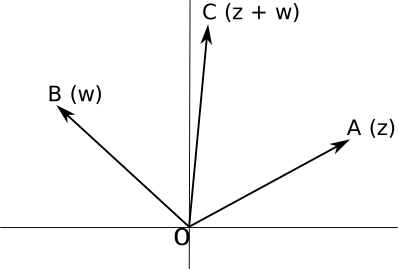
Let \(z\) be the complex number \(z=\text{cis}\dfrac{\pi}{6} \) and \(w\) be the complex number \(w=\text{cis}\dfrac{3\pi}{4} \). --- 9 WORK AREA LINES (style=lined) --- --- 8 WORK AREA LINES (style=lined) --- --- 5 WORK AREA LINES (style=lined) --- i. \(z= \cos\,\dfrac{\pi}{6} + i \,\sin\,\dfrac{\pi}{6} = \dfrac{\sqrt3}{2} + \dfrac{1}{2}i \) \(w= \cos\,\dfrac{3\pi}{4} + i \,\sin\,\dfrac{3\pi}{4} = -\dfrac{1}{\sqrt2} + \dfrac{i}{\sqrt2} \) \(\angle AOB= \arg(w)-\arg(z)=\dfrac{3\pi}{4}-\dfrac{\pi}{6}=\dfrac{7\pi}{12} \) \( |z|=|w|=1\ \Rightarrow AOBC\ \text{is a rhombus.} \) \(\overrightarrow{OC}\ \text{is a diagonal of rhombus}\ AOBC \) \(\Rightarrow \overrightarrow{OC}\ \text{bisects}\ \angle AOB \) \(\therefore \angle AOC= \dfrac{1}{2} \times \dfrac{7\pi}{12}=\dfrac{7\pi}{24} \) iii. \(\text{In}\ \triangle AOC: \) \( \overrightarrow{AC}=\overrightarrow{OC}-\overrightarrow{OA} = \overrightarrow{OB} \) \(\Rightarrow \overrightarrow{OB}\ \text{is represented by}\ w. \) \(\text{Using the cos rule in}\ \triangle AOC: \)
\(|z+w|^2\)
\(=\Bigg{|} \dfrac{\sqrt3}{2}+\dfrac{1}{2}i-\dfrac{1}{\sqrt2}+\dfrac{i}{\sqrt2} \Bigg{|}\)
\(=\Bigg{|} \Bigg{(}\dfrac{\sqrt3}{2}-\dfrac{1}{\sqrt2} \Bigg{)} +\Bigg{(}\dfrac{1}{2}+\dfrac{1}{\sqrt2}\Bigg{)}\,i \Bigg{|}\)
\(=\Bigg{|} \dfrac{\sqrt6-2}{2\sqrt2}+\dfrac{\sqrt2+2}{2\sqrt2}\,i \Bigg{|}\)
\(= \dfrac{(\sqrt6-2)^2+(\sqrt2+2)^2}{(2\sqrt2)^2}\)
\(= \dfrac{6-4\sqrt6+4+2+4\sqrt2+4}{8}\)
\(=\dfrac{16-4\sqrt6+4\sqrt2}{8} \)
\(=\dfrac{4-\sqrt6+\sqrt2}{2} \)
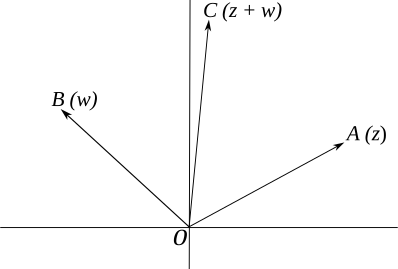
\(\cos\,\dfrac{7\pi}{24}\)
\(=\dfrac{|z|^2+|z+w|^2-|w|^2}{2|z||z+w|}\)
\(=\dfrac{ 1+\frac{4-\sqrt6+\sqrt2}{2}-1}{2 \times 1 \sqrt{\frac{4-\sqrt6+\sqrt2}{2}}} \)
\(=\dfrac{\sqrt{\frac{4-\sqrt6+\sqrt2}{2}} \times 2} {2 \times 2} \)
\(=\dfrac{\sqrt{4( \frac{4-\sqrt6+\sqrt2}{2})}} {4} \)
\(=\dfrac{8-2\sqrt6+2\sqrt2}{4} \)
Complex Numbers, EXT2 N2 2025 HSC 6 MC
The complex numbers \(z\) and \(w\) lie on the unit circle. The modulus of \(z+w\) is \(\dfrac{3}{2}\).
What is the modulus of \(z-w\) ?
- \(\dfrac{1}{8}\)
- \(\dfrac{\sqrt{7}}{2}\)
- \(\dfrac{3}{2}\)
- \(\dfrac{7}{4}\)
Complex Numbers, EXT2 N2 2024 HSC 14c
For the complex numbers \(z\) and \(w\), it is known that \(\arg \left(\dfrac{z}{w}\right)=-\dfrac{\pi}{2}\).
Find \(\left|\dfrac{z-w}{z+w}\right|\). (2 marks) --- 7 WORK AREA LINES (style=lined) ---
Show Worked Solution
\(\arg \left(\dfrac{z}{w}\right)=\arg \, z-\arg \, w=-\dfrac{\pi}{2}\)
\(\text{Graphically, \(\arg \, z\) is a \(90^{\circ}\) anticlockwise rotation from \(\arg \, w\).}\)
♦ Mean mark 49%.
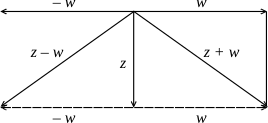
\(\abs{z-w}=\abs{z+w} \ \text{(diagonals of rectangle)}\)
\(\therefore \abs{\dfrac{z-w}{z+w}}=1\)