- Prove that for any complex numbers \(z_1\) and \(z_2\),
- \(\abs{z_1+z_2} \leqslant \abs{z_1}+\abs{z_2}\) (2 marks)
--- 10 WORK AREA LINES (style=lined) ---
- Hence, or otherwise, show that if \(\abs{z-1}+\abs{z+1} \leqslant 4\) for \(z\in C,\)
- \(\abs{z} \leqslant 2\) (2 marks)
--- 6 WORK AREA LINES (style=lined) ---
Complex Numbers, EXT2 N2 2023 14a*
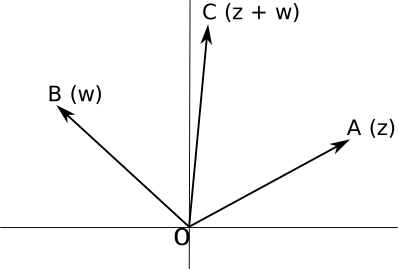
Let \(z\) be the complex number \(z=\text{cis}\dfrac{\pi}{6} \) and \(w\) be the complex number \(w=\text{cis}\dfrac{3\pi}{4} \). --- 9 WORK AREA LINES (style=lined) --- --- 8 WORK AREA LINES (style=lined) --- --- 5 WORK AREA LINES (style=lined) --- i. \(z= \cos\,\dfrac{\pi}{6} + i \,\sin\,\dfrac{\pi}{6} = \dfrac{\sqrt3}{2} + \dfrac{1}{2}i \) \(w= \cos\,\dfrac{3\pi}{4} + i \,\sin\,\dfrac{3\pi}{4} = -\dfrac{1}{\sqrt2} + \dfrac{i}{\sqrt2} \) \(\angle AOB= \arg(w)-\arg(z)=\dfrac{3\pi}{4}-\dfrac{\pi}{6}=\dfrac{7\pi}{12} \) \( |z|=|w|=1\ \Rightarrow AOBC\ \text{is a rhombus.} \) \(\overrightarrow{OC}\ \text{is a diagonal of rhombus}\ AOBC \) \(\Rightarrow \overrightarrow{OC}\ \text{bisects}\ \angle AOB \) \(\therefore \angle AOC= \dfrac{1}{2} \times \dfrac{7\pi}{12}=\dfrac{7\pi}{24} \) iii. \(\text{In}\ \triangle AOC: \) \( \overrightarrow{AC}=\overrightarrow{OC}-\overrightarrow{OA} = \overrightarrow{OB} \) \(\Rightarrow \overrightarrow{OB}\ \text{is represented by}\ w. \) \(\text{Using the cos rule in}\ \triangle AOC: \)
Show Worked Solution
\(|z+w|^2\)
\(=\Bigg{|} \dfrac{\sqrt3}{2}+\dfrac{1}{2}i-\dfrac{1}{\sqrt2}+\dfrac{i}{\sqrt2} \Bigg{|}\)
\(=\Bigg{|} \Bigg{(}\dfrac{\sqrt3}{2}-\dfrac{1}{\sqrt2} \Bigg{)} +\Bigg{(}\dfrac{1}{2}+\dfrac{1}{\sqrt2}\Bigg{)}\,i \Bigg{|}\)
\(=\Bigg{|} \dfrac{\sqrt6-2}{2\sqrt2}+\dfrac{\sqrt2+2}{2\sqrt2}\,i \Bigg{|}\)
\(= \dfrac{(\sqrt6-2)^2+(\sqrt2+2)^2}{(2\sqrt2)^2}\)
\(= \dfrac{6-4\sqrt6+4+2+4\sqrt2+4}{8}\)
\(=\dfrac{16-4\sqrt6+4\sqrt2}{8} \)
\(=\dfrac{4-\sqrt6+\sqrt2}{2} \)
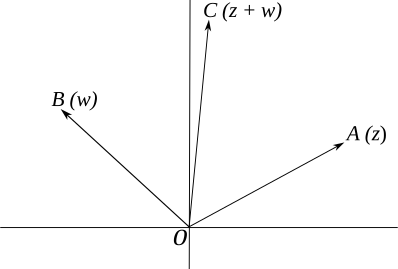
\(\cos\,\dfrac{7\pi}{24}\)
\(=\dfrac{|z|^2+|z+w|^2-|w|^2}{2|z||z+w|}\)
\(=\dfrac{ 1+\frac{4-\sqrt6+\sqrt2}{2}-1}{2 \times 1 \sqrt{\frac{4-\sqrt6+\sqrt2}{2}}} \)
\(=\dfrac{\sqrt{\frac{4-\sqrt6+\sqrt2}{2}} \times 2} {2 \times 2} \)
\(=\dfrac{\sqrt{4( \frac{4-\sqrt6+\sqrt2}{2})}} {4} \)
\(=\dfrac{8-2\sqrt6+2\sqrt2}{4} \)
♦♦ Mean mark (iii) 26%.
Complex Numbers, EXT2 N1 2025 HSC 7 MC
The complex number \(z\) lies on the unit circle.
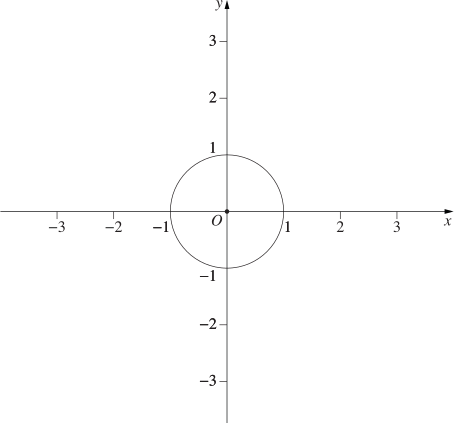
What is the range of \(\operatorname{Arg}(z-2 i)\) ?
- \(\dfrac{\pi}{6} \leq \operatorname{Arg}(z-2 i) \leq \dfrac{5 \pi}{6}\)
- \(\dfrac{\pi}{3} \leq \operatorname{Arg}(z-2 i) \leq \dfrac{2 \pi}{3}\)
- \(-\dfrac{5 \pi}{6} \leq \operatorname{Arg}(z-2 i) \leq-\dfrac{\pi}{6}\)
- \(-\dfrac{2 \pi}{3} \leq \operatorname{Arg}(z-2 i) \leq-\dfrac{\pi}{3}\)
Show Worked Solution
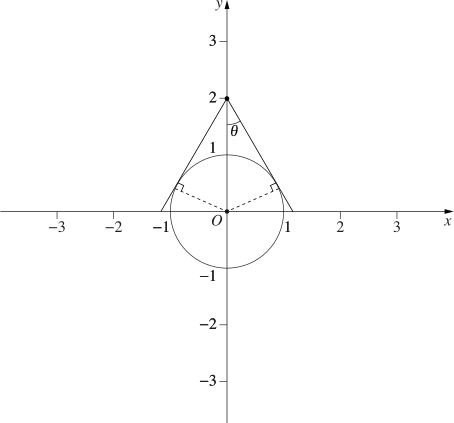
\(\text{The limits of Arg}(z-2i)\ \text{where it intersects the unit circle are:}\)
♦ Mean mark 52%.
\(\sin \theta=\dfrac{1}{2} \ \Rightarrow \ \theta=\dfrac{\pi}{6}\)
\(\text {Range Arg}(z-2 i):\)
\(-\dfrac{\pi}{2}-\dfrac{\pi}{6} \leqslant \operatorname{Arg}(z-2 i) \leqslant-\dfrac{\pi}{2}+\dfrac{\pi}{6}\)
\(-\dfrac{2 \pi}{3} \leqslant \operatorname{Arg}(2-2 i) \leqslant-\dfrac{\pi}{3}\)
\(\Rightarrow D\)
Complex Numbers, EXT2 N2 2025 HSC 6 MC
The complex numbers \(z\) and \(w\) lie on the unit circle. The modulus of \(z+w\) is \(\dfrac{3}{2}\).
What is the modulus of \(z-w\) ?
- \(\dfrac{1}{8}\)
- \(\dfrac{\sqrt{7}}{2}\)
- \(\dfrac{3}{2}\)
- \(\dfrac{7}{4}\)
Complex Numbers, EXT2 N1 2024 VCAA 5 MC
If the point \(z=1+\sqrt{3} i\) is represented on an Argand diagram, the point representing \(-\bar{z}\) can be located by
- reflecting the point representing \(z\) in the real axis.
- rotating the point representing \(z\) anticlockwise about the origin by 90\(^{\circ}\).
- reflecting the point representing \(z\) in the imaginary axis.
- rotating the point representing \(z\) clockwise about the origin by 90\(^{\circ}\).
Complex Numbers, EXT2 N2 2024 HSC 14c
For the complex numbers \(z\) and \(w\), it is known that \(\arg \left(\dfrac{z}{w}\right)=-\dfrac{\pi}{2}\).
Find \(\left|\dfrac{z-w}{z+w}\right|\). (2 marks) --- 7 WORK AREA LINES (style=lined) ---
Show Worked Solution
\(\arg \left(\dfrac{z}{w}\right)=\arg \, z-\arg \, w=-\dfrac{\pi}{2}\)
\(\text{Graphically, \(\arg \, z\) is a \(90^{\circ}\) anticlockwise rotation from \(\arg \, w\).}\)
♦ Mean mark 49%.
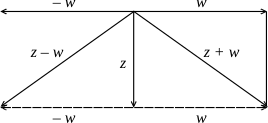
\(\abs{z-w}=\abs{z+w} \ \text{(diagonals of rectangle)}\)
\(\therefore \abs{\dfrac{z-w}{z+w}}=1\)
Complex Numbers, EXT2 N1 2022 HSC 15d
The complex number `z` satisfies `|z-(4)/(z)|=2`.
Using the triangle inequality, or otherwise, show that `|z| <= sqrt5+1`. (3 marks)
--- 8 WORK AREA LINES (style=lined) ---
Show Worked Solution
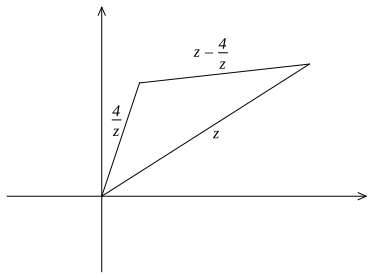
♦♦♦ Mean mark 27%.
`text{Triangle Inequality:}\ \ absx+absy>=abs(x+y)`
| `absz` | `<=abs(z-z/4)+abs(4/z)` | |
| `absz` | `<=2+4/absz\ \ \ (text{using}\ |z-(4)/(z)|=2)` | |
| `absz^2` | `<=2absz+4` | |
| `absz^2-2absz-4` | `<=0` | |
| `absz` | `<=(2+sqrt(2^2+4xx4))/2\ \ \ (absz>=0)` | |
| `absz` | `<=(2+sqrt20)/2` | |
| `absz` | `<=1+sqrt5\ \ text{… as required}` |
Complex Numbers, EXT2 N1 2021 SPEC2 4 MC
For the complex number `z `, if `text(Im)(z) > 0`, then `text(Arg)((zbarz)/(z - barz))` is
- `-pi/2`
- `0`
- `pi/4`
- `pi`
Complex Numbers, EXT2 N1 2004 HSC 2b
Let `alpha = 1 + i sqrt3` and `beta = 1 + i`.
- Find `frac{alpha}{beta}`, in the form `x + i y`. (1 mark)
--- 3 WORK AREA LINES (style=lined) ---
- Express `alpha` in modulus-argument form. (3 marks)
--- 3 WORK AREA LINES (style=lined) ---
- Given that `beta` has the modulus-argument form
`beta = sqrt2 (cos frac{pi}{4} + i sin frac{pi}{4})`.
find the modulus-argument form of `frac{alpha}{beta}`. (1 mark)
--- 3 WORK AREA LINES (style=lined) ---
- Hence find the exact value of `sin frac{pi}{12}` (1 mark)
--- 3 WORK AREA LINES (style=lined) ---
Complex Numbers, EXT2 N1 2008 HSC 2b
- Write `frac{1 + i sqrt3}{1 + i}` in the form `x + iy`, where `x` and `y` are real. (2 marks)
--- 2 WORK AREA LINES (style=lined) ---
- By expressing both `1 + i sqrt3` and `1 + i` in modulus-argument form, write `frac{1 + i sqrt3}{1 + i}` in modulus-argument form. (3 marks)
--- 8 WORK AREA LINES (style=lined) ---
- Hence find `cos frac{pi}{12}` in surd form. (1 mark)
--- 3 WORK AREA LINES (style=lined) ---
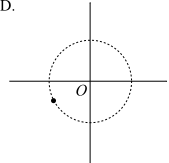
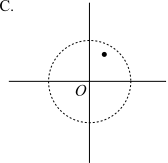
Complex Numbers, EXT2 N1 2020 HSC 4 MC
The diagram shows the complex number `z` on the Argand diagram.
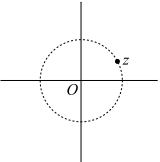
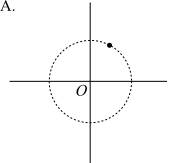
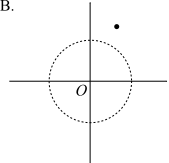
Which of the following diagrams best shows the position of `frac{z^2}{|z|}`?
 |
 |
|
|
|
 |
Complex Numbers, EXT2 N1 2018 HSC 13b
Let `z = 1 - cos2theta + isin2theta`, where `0 < theta <= pi`.
- Show that `|\ z\ | = 2sintheta`. (2 marks)
--- 6 WORK AREA LINES (style=lined) ---
- Show that `text(arg)(z) = pi/2 - theta`. (2 marks)
--- 8 WORK AREA LINES (style=lined) ---
Show Worked Solution
i. `z = 1 – cos2theta + isin2theta`
| `|\ z\ |` | `= sqrt((1 – cos2theta)^2 + sin^2 2theta)` |
| `= sqrt(1 – 2cos2theta + cos^2 2theta + sin^2 2theta)` | |
| `= sqrt(2 – 2cos2theta)` | |
| `= sqrt(2(1 – cos2theta))` | |
| `= sqrt(2(2sin^2theta))` | |
| `= 2sintheta\ \ \ text(… as required)` |
ii. `z= 1 – cos2theta + isin2theta`
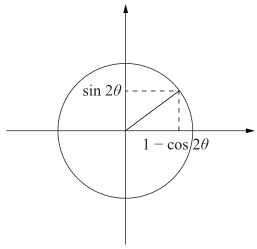
| `text(arg)(z)` | `= tan^(−1)((sin2theta)/(1 – cos2theta))` |
| `= tan^(−1)((2sinthetacostheta)/(2sin^2theta))` | |
| `= tan^(−1)(cottheta)` | |
| `= tan^(−1)(tan(pi/2 – theta))` | |
| `= pi/2 – theta` |
`(text(S)text(ince)\ \ 0 < theta < pi => \ −pi/2 <= pi/2 – theta < pi/2)`
Complex Numbers, EXT2 N1 2017 HSC 11a
Let `z = 1 - sqrt 3 i` and `w = 1 + i`.
- Find the exact value of the argument of `z`. (1 mark)
- Find the exact value of the argument of `z/w`. (2 marks)
Show Worked Solution
i. `z = 1 – i sqrt 3`
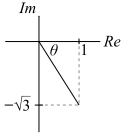
`text(arg)\ z = – pi/3`
ii. `w = 1 + i`
`text(arg)\ w = pi/4`
| `text(arg)\ (z/w)` | `= text(arg)\ (z) – text(arg)\ (w)` |
| `= – pi/3 – pi/4` | |
| `= -(7 pi)/12` |
Complex Numbers, EXT2 N1 2016 HSC 4 MC
The Argand diagram shows the complex numbers `z` and `w`, where `z` lies in the first quadrant and `w` lies in the second quadrant.

Which complex number could lie in the 3rd quadrant?
- `-w`
- `2 iz`
- `bar z`
- `w - z`
Show Worked Solution
`text(Using the parallelogram method:)`

`text(From the graph above,)`
`w-z\ \ text(could lie in 3rd quadrant.)`
`=> D`
Complex Numbers, EXT2 N1 2015 HSC 12a
The complex number `z` is such that `|\ z\ |=2` and `text(arg)(z) = pi/4.`
Plot each of the following complex numbers on the same half-page Argand diagram.
- `z` (1 mark)
--- 6 WORK AREA LINES (style=lined) ---
- `u = z^2` (1 mark)
--- 2 WORK AREA LINES (style=lined) ---
- `v = z^2-bar z` (1 mark)
--- 2 WORK AREA LINES (style=lined) ---
Show Worked Solution
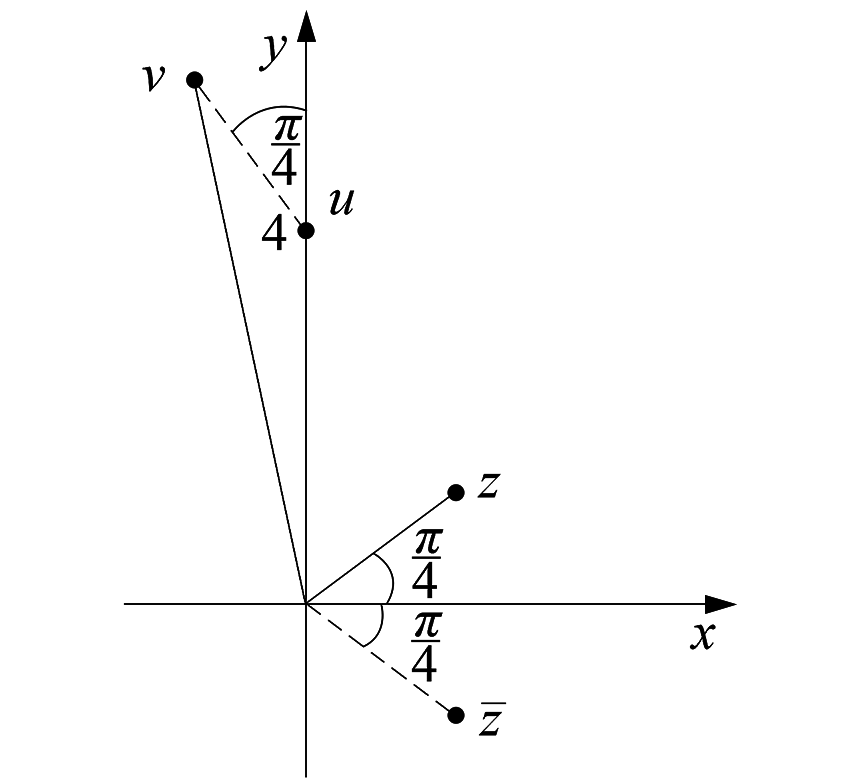
a. `z =2 text(cis) pi/4=sqrt 2 (1 + i)`
b. `u=z^2=4 text(cis)\ pi/2=4i`
COMMENT: Mean mark (c) 55%.
| c. `v ` | `=z^2-bar z` |
| `=4i-sqrt 2 (1-i)` | |
| `=- sqrt 2 + (4 + sqrt 2) i` |
Complex Numbers, EXT2 N1 2015 HSC 11b
Consider the complex numbers `z = -sqrt 3 + i` and `w = 3 (cos\ pi/7 + i sin\ pi/7).`
- Evaluate `|\ z\ |.` (1 mark)
--- 1 WORK AREA LINES (style=lined) ---
- Evaluate `text(arg)(z).` (1 mark)
--- 2 WORK AREA LINES (style=lined) ---
- Find the argument of `z/w.` (1 mark)
--- 2 WORK AREA LINES (style=lined) ---
Complex Numbers, EXT2 N1 2014 HSC 8 MC
The Argand diagram shows the complex numbers `w`, `z` and `u`, where `w` lies in the first quadrant, `z` lies in the second quadrant and `u` lies on the negative real axis.
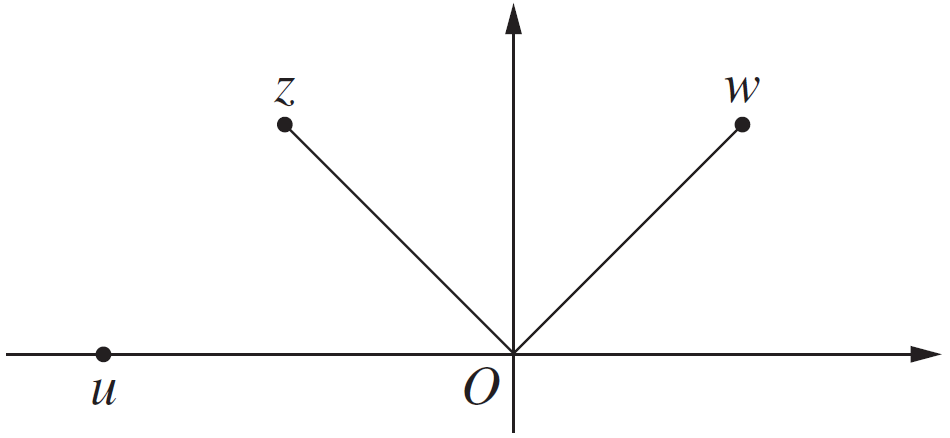
Which statement could be true?
- `u = zw` and `u = z + w`
- `u = zw` and `u = z − w`
- `z = uw` and `u = z + w`
- `z = uw` and `u = z − w`
Show Worked Solution
`text(Using the parallelogram method, it could be true that)`
`u = z-w`
`=>\ text{Eliminate (A) and (C)}`
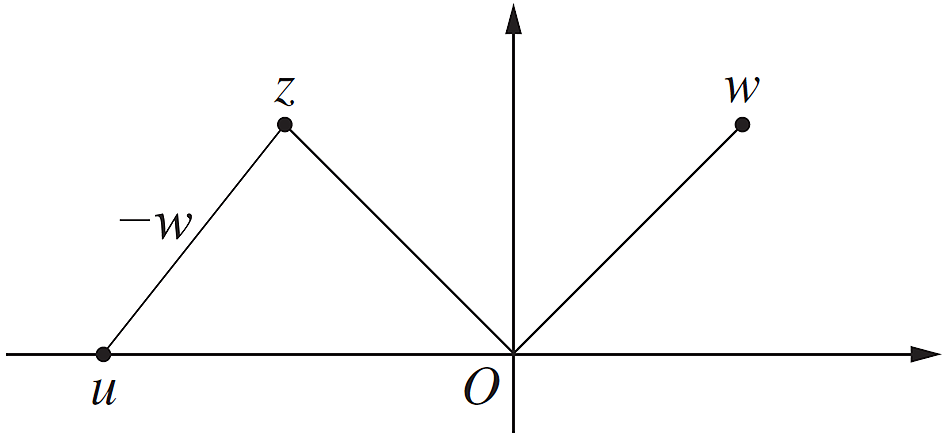
| `text{arg}(u)` | `=\ text{arg}(w) + text{arg}(z)` |
| `u` | ` = zw` |
`=> B`
Complex Numbers, EXT2 N1 2014 HSC 4 MC
Given `z = 2(cos\ pi/3 + i sin\ pi/3)`, which expression is equal to `(bar {:z:})^(−1)`?
- `1/2(cos\ pi/3 − i sin\ pi/3)`
- `2(cos\ pi/3 − i sin\ pi/3)`
- `1/2(cos\ pi/3 + i sin\ pi/3)`
- `2(cos\ pi/3 + i sin\ pi/3)`
Complex Numbers, EXT2 N1 2013 HSC 3 MC
The Argand diagram below shows the complex number `z.`
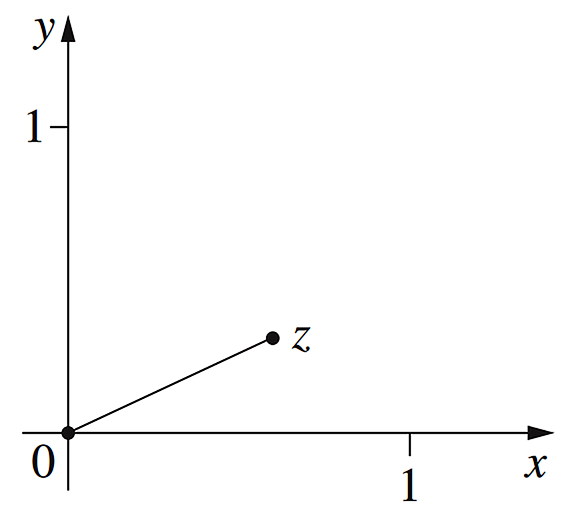
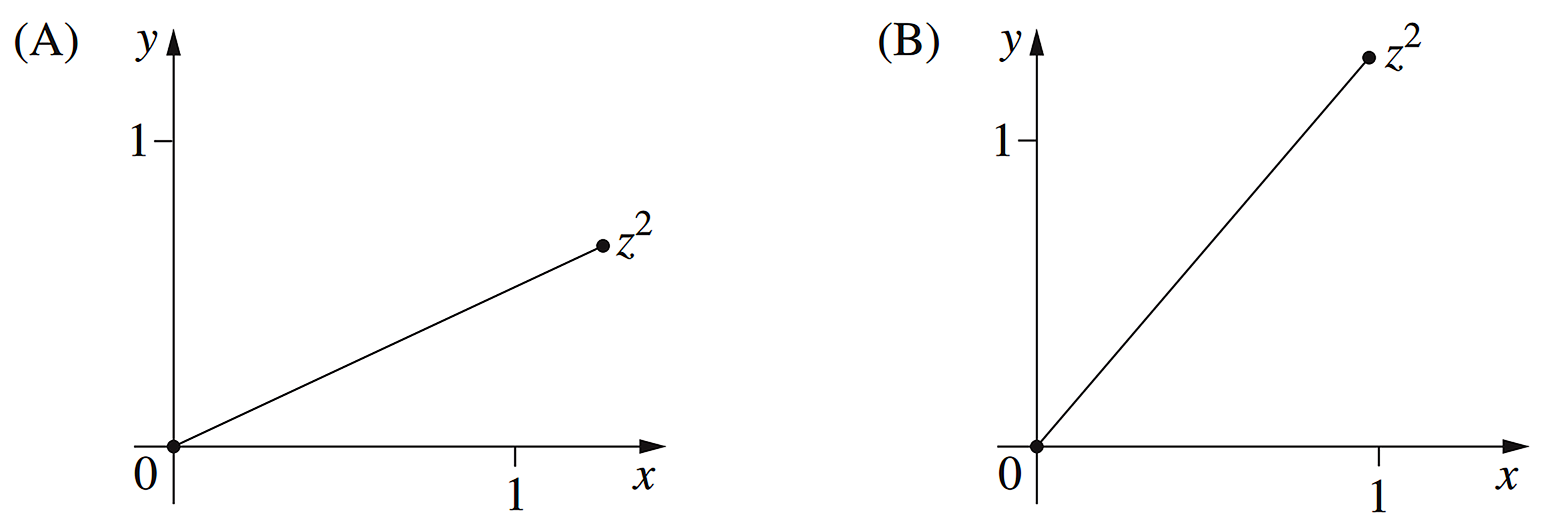
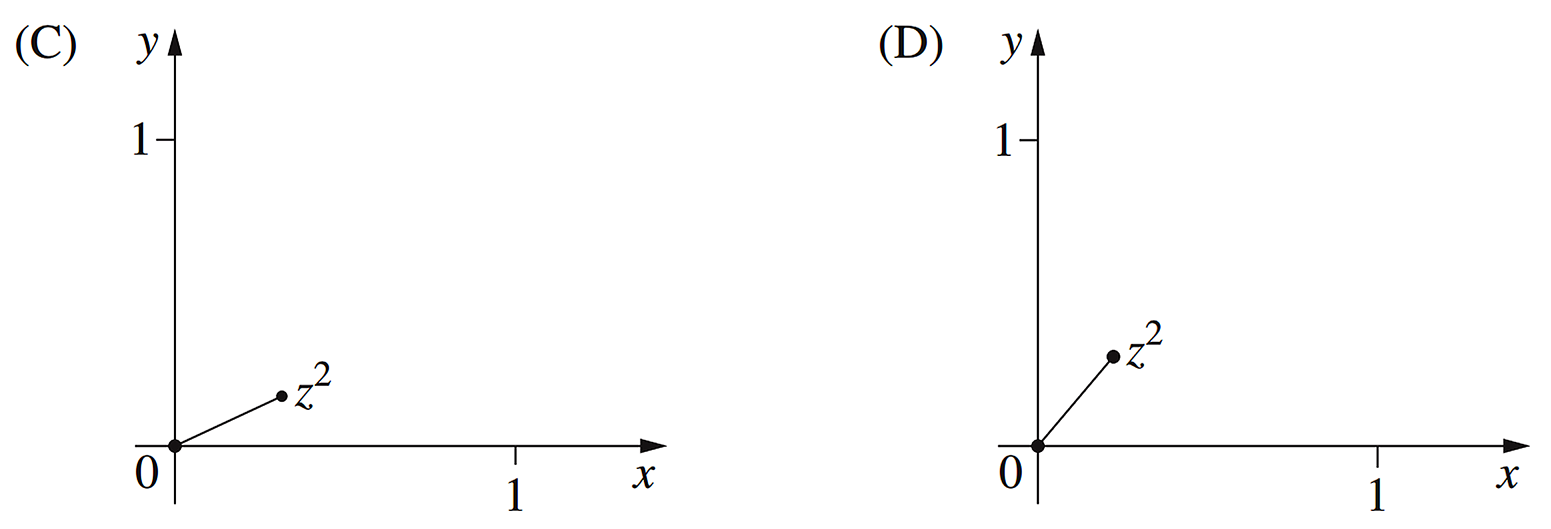
Which diagram best represents `z^2?`
Complex Numbers, EXT2 N1 2012 HSC 11d
- Write `z = sqrt3-i` in modulus-argument form. (2 marks)
--- 4 WORK AREA LINES (style=lined) ---
- Hence express `z^9` in the form `x + iy`, where `x` and `y` are real. (1 mark)
--- 4 WORK AREA LINES (style=lined) ---
Complex Numbers, EXT2 N1 2014 HSC 11a
Consider the complex numbers `z = -2-2i` and `w = 3 + i`.
- Express `z + w` in modulus–argument form. (2 marks)
--- 5 WORK AREA LINES (style=lined) ---
- Express `z/w` in the form `x + iy`, where `x` and `y` are real numbers. (2 marks)
--- 5 WORK AREA LINES (style=lined) ---