Evaluate \(\log _{3} 6\), giving your answer to 2 significant figures. (2 marks)
--- 3 WORK AREA LINES (style=lined) ---
Aussie Maths & Science Teachers: Save your time with SmarterEd
Evaluate \(\log _{3} 6\), giving your answer to 2 significant figures. (2 marks)
--- 3 WORK AREA LINES (style=lined) ---
\(\log _{3} 6=1.6 \ \text{(2 sig fig)}\)
\(\log _{3} 6=\dfrac{\log _e 6}{\log _e 3}=1.6309 \ldots=1.6 \ \text{(2 sig fig)}\)
Solve the following equation for \(a\):
\(a^{\log_e 3}=9\) (3 marks)
--- 5 WORK AREA LINES (style=lined) ---
\(a=e^2\)
| \(a^{\log_e 3}\) | \(=9\) |
| \(\log_e a^{ \log_e 3}\) | \(=\log_e 3^2\) |
| \(\log_e 3 \times \log_e a\) | \(=2 \log_e 3\) |
| \(\log _e a\) | \(=\dfrac{2 \log _e 3}{\log _e 3}\) |
| \(\log _e a\) | \(=2\) |
| \(a\) | \(=e^2\) |
Solve the following equation for \(x\):
\(\log _3(x-4)-\log _3 x=\dfrac{4}{3} \log _3 8\) (3 marks)
--- 7 WORK AREA LINES (style=lined) ---
\(x=-\dfrac{4}{15}\)
| \(\log _3(x-4)-\log _3 x\) | \(=\dfrac{4}{3} \log _3 8\) |
| \(\log _3\left(\dfrac{x-4}{x}\right)\) | \(=\log _3 8^{\frac{4}{3}}\) |
| \(\log _3\left(\dfrac{x-4}{x}\right)\) | \(=\log _3 16\) |
| \(\dfrac{x-4}{x}\) | \(=16\) |
| \(x-4\) | \(=16x\) |
| \(15 x\) | \(=-4\) |
| \(x\) | \(=-\dfrac{4}{15}\) |
Given \(m\) and \(n\) are positive constants, which expression is equal to
\(\log _m x^5=n\)
\(\Rightarrow B\)
\(\log _m x^5=n\)
\(\text{By definition:}\)
| \(x^5\) | \(=m^n\) |
| \(x\) | \(=\left(m^n\right)^{\frac{1}{5}}\) |
| \(=m^{\frac{n}{5}}\) |
\(\Rightarrow B\)
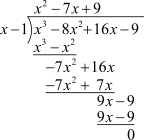
Solve \(2 \log _3(x-4)+\log _3(x)=2\) for \(x\). (4 marks) --- 8 WORK AREA LINES (style=lined) --- \(\dfrac{7 + \sqrt{13}}{2}\) \(1^3-8(1)^2+16(1)-9=0\) \(\therefore\ x-1\ \text{is a factor} \) \((x-1)(x^2-7x+9)=0\) \(\text{Using quadratic formula to solve}\ \ x^2-7x+9=0:\) \( x=1, \dfrac{7- \sqrt{13}}{2}, \dfrac{7 + \sqrt{13}}{2}\) \(\therefore\ \dfrac{7 + \sqrt{13}}{2}\ \text{ is the only possible solution.}\)
\(2\log_3(x-4)+\log_3(x)\)
\(=2\)
\(\log_3x(x-4)^2\)
\(=2\)
\(x(x-4)^2\)
\(=3^2\)
\(x(x^2-8x+16)-9\)
\(=0\)
\(x^3-8x^2+16x-9\)
\(=0\)
\(\text{Find a factor}\ \ \Rightarrow\ \ \text{Test}\ \ x=1:\)
\(x\)
\(=\dfrac{-(-7)\pm\sqrt{(-7)^2-4(1)(9)}}{2(1)}\)
\(=\dfrac{7\pm \sqrt{49-36}}{2}\)
\(=\dfrac{7\pm \sqrt{13}}{2}\)
\(\text{For }\log_3(x-4)\ \text{to exist}\ x>4\)
What is the solution of the equation `log _a x^3=b`, where a and b are positive constants?
`B`
| `log_a x^3` | `=b` | |
| `3log_a x` | `=b` | |
| `log_a x` | `=b/3` | |
| `:.x` | `=a^(b/3)` |
`=>B`
Solve the equation `2 log_2(x + 5)-log_2(x + 9) = 1`. (3 marks)
--- 6 WORK AREA LINES (style=lined) ---
`x = text{−1}`
| `2 log_2(x + 5)-log_2(x + 9)` | `= 1` |
| `log_2(x + 5)^2-log_2(x + 9)` | `= 1` |
| `log_2(((x + 5)^2)/(x + 9))` | `= 1` |
| `((x + 5)^2)/(x + 9)` | `= 2` |
| `x^2 + 10x + 25` | `= 2x + 18` |
| `x^2 + 8x + 7` | `= 0` |
| `(x + 7)(x + 1)` | `= 0` |
`:. x = -1\ \ \ \ (x != text{−7}\ \ text(as)\ \ x > text{−5})`
Solve `log_3(t)-log_3(t^2-4) = -1` for `t`. (3 marks)
--- 6 WORK AREA LINES (style=lined) ---
`4 `
| `log_3(t)-log_3(t^2-4)` | `= -1` |
| `log_3 ({t}/{t^2-4})` | `= -1` |
| `(t)/(t^2-4)` | `= (1)/(3)` |
| `t^2-4` | `= 3t` |
| `t^2-3t-4` | `= 0` |
| `(t-4)(t+ 1)` | `= 0` |
`:. t=4 \ \ \ (t > 0, \ t!= –1)`
Which of the following is equal to `(log_2 9)/(log_2 3)`?
`A`
| `(log_2 9)/(log_2 3)` | `= (log_2 3^2)/(log_2 3)` |
| `= (2 log_2 3)/(log_2 3)` | |
| `= 2` |
`=> A`
It is given that `ln a = ln b-ln c`, where `a, b, c > 0.`
Which statement is true?
`B`
| `ln a` | `= ln b-ln c` |
| `ln a` | `= ln (b/c)` |
| `:. a` | `= b/c` |
`=> B`
Solve the equation `log_e(3x + 5) + log_e(2) = 2`, for `x`. (2 marks)
`x = (e^2-10)/6`
`text(Simplify using log laws:)`
| `log_e(6x + 10)` | `=2` |
| `6x +10` | `=e^2` |
| `:.x` | `= (e^2 – 10)/6` |
Solve `log_2(6-x)-log_2(4-x) = 2` for `x`, where `x < 4`. (2 marks)
--- 5 WORK AREA LINES (style=lined) ---
`10/3`
`text(Simplify using log laws:)`
| `log_2((6-x)/(4-x))` | `= 2` |
| `2^2` | `= (6-x)/(4-x)` |
| `16-4x` | `= 6-x` |
| `3x` | `= 10` |
| `:. x` | `= 10/3` |
Solve the equation `2 log_3(5)-log_3 (2) + log_3 (x) = 2` for `x.` (2 marks)
`18/25`
| `log_3 (5)^2-log_3 (2) + log_3 (x)` | `= 2` |
| `log_3 (25x)-log_3 (2)` | `=2` |
| `log_3 ((25 x)/2)` | `= 2` |
| `(25x)/2` | `= 3^2` |
| `:. x` | `= 18/25` |
The expression
`log_c(a) + log_a(b) + log_b(c)`
is equal to
`B`
`text(Solution 1)`
`text(Using Change of Base:)`
`log_c(a) + log_a(b) + log_b(c)`
`=(log_a(a))/(log_a(c)) + (log_b(b))/(log_b(a)) + (log_c(c))/(log_c(b))`
`=1/(log_a(c)) + 1/(log_b(a)) + 1/(log_c(b))`
`=> B`
`text(Solution 2)`
| `text(Let)\ \ x` | `=log_c(a)` |
| `c^x` | `=a` |
| `x log_a c` | `=log_a a` |
| `x` | `=1/log_a c` |
`text(Apply similarly for the other terms.)`
`=> B`
If `f(x) = 3 log_e (2x),` and `f(5x) = log_e (y),`
then `y` is equal to
`D`
| `f(5x)` | `= 3 log_e (2(5x))` |
| `log_e (y)` | `= 3 log_e (10 x)` |
| `= log_e (10x)^3` | |
| `y` | `= 1000 x^3` |
`=> D`
If `y = log_a (7x - b) + 3`, then `x` is equal to
`C`
| `y – 3` | `= log_a (7x – b)` |
| `a^(y – 3)` | `= 7x – b` |
| `a^(y – 3) + b` | `= 7x` |
| `:. x` | `= 1/7 (a^(y – 3) + b)` |
`=> C`
Write `log 2 + log 4 + log 8 + … + log 512` in the form `a log b` where `a` and `b` are integers greater than `1.` (2 marks)
--- 5 WORK AREA LINES (style=lined) ---
`45 log 2`
`log 2 + log 4 + log 8 + … + log 512`
`= log 2^1 + log 2^2 + log2^3 + … + log 2^9`
`= log 2 + 2 log 2 + 3 log 2 + … + 9 log 2`
`= 45 log 2`
Use the change of base formula to evaluate `log_3 7`, correct to two decimal places. (1 mark)
`1.77\ \ text{(to 2 d.p.)}`
| `log_3 7` | `= (log_10 7)/(log_10 3)` |
| `= 1.771…` | |
| `= 1.77\ \ text{(to 2 d.p.)}` |
What is the solution to the equation `log_2(x-1) = 8`?
`D`
| `log_2 (x-1)` | `= 8` |
| `x-1` | `= 2^8` |
| `x` | `= 257` |
`=> D`
Solve `log_e x-3/log_ex=2` (3 marks)
--- 6 WORK AREA LINES (style=lined) ---
`x=e^3\ \ text(or)\ \ e^-1`
| `log_e x-3/(log_ex)` | `=2` |
| `(log_ex)^2-3` | `=2log_e x` |
| `(log_ex)^2-2log_ex-3` | `=0` |
| `text(Let)\ X=log_ex` | |
| `:.\ X^2-2X-3` | `=0` |
| `(X-3)(X+1)` | `=0` |
| `X` | `=3` | `\ \ \ \ \ \ \ \ \ \ ` | `X` | `=-1` |
| `log_ex` | `=3` | `\ \ \ \ \ \ \ \ \ \ ` | `log_ex` | `=-1` |
| `x` | `=e^3` | `\ \ \ \ \ \ \ \ \ \ ` | `x` | `=e^-1` |
`:.x=e^3\ \ text(or)\ \ e^-1`
Solve the equation `lnx=2`. Give you answer correct to four decimal places. (2 marks)
`7.3891`
| `ln x` | `=2` |
| `log_e x` | `=2` |
| `x` | `=e^2` |
| `=7.38905…` | |
| `=7.3891\ \ text{(to 4 d.p.)}` |
Let `a=e^x`
Which expression is equal to `log_e(a^2)`?
`C`
| `log_e(a^2)` | `=log_e(e^x)^2` |
| `=log_e(e^(2x))` | |
| `=2xlog_ee` | |
| `=2x` |
`=> C`
What is the solution of `5^x=4`?
`C`
| `5^x` | `=4` |
| `log_2 5^x` | `=log_2 4` |
| `x log_2 5` | `=log_2 4` |
| `:.x` | `=(log_2 4)/(log_2 5)` |
`=>C`