SmarterEd

Aussie Maths & Science Teachers: Save your time with SmarterEd

  • Login
  • Get Help
  • About

HMS, HAG 2024 HSC 14 MC

The graph shows the number of deaths of Australian females over time for TWO cancers, X and Y, that resulted in more deaths than for any other forms of cancer.

Which cancer is represented by cancer Y?

  1. Breast
  2. Cervical
  3. Lung
  4. Skin
Show Answers Only

\(C\)

Show Worked Solution
  • C is correct: Cancer Y represents lung cancer, a leading cause of cancer deaths in Australian females, with numbers declining since 2000.

Other Options:

  • A is incorrect: Breast cancer would likely show as the higher line (X).
  • B is incorrect: Cervical cancer has much lower mortality numbers.
  • D is incorrect: Skin cancer mortality is significantly lower than lung cancer.

♦♦♦ Mean mark 34%.

Filed Under: Chronic Conditions, Diseases and Injury Tagged With: Band 5, smc-5477-10-Cancer trends

HMS, HAG 2024 HSC 11 MC

Why do private health insurance providers apply waiting periods for certain procedures and services?

  1. To ensure the policy is suitable for the policyholder
  2. To assess the policyholder's capacity to pay premiums
  3. To maximise eligibility of government rebates for consumers
  4. To prevent immediate claims for pre-existing medical conditions
Show Answers Only

\(D\)

Show Worked Solution
  • D is correct: Waiting periods implemented primarily to prevent people from joining only when they need treatment for pre-existing conditions.

Other Options:

  • A is incorrect: Suitability is determined by policy features, not waiting periods.
  • B is incorrect: This is determined during application, not waiting periods.
  • C is incorrect: Rebates aren’t affected by waiting periods.

♦♦ Mean mark 40%.

Filed Under: Healthcare expenditure Tagged With: Band 5, smc-5482-20-Private insurance

HMS, BM 2024 HSC 7 MC

After training, an elite athlete watches a video recording of their gymnastics routine.

Which TWO types of feedback is the athlete receiving from the video?

  1. Internal feedback and concurrent feedback
  2. External feedback and concurrent feedback
  3. Internal feedback and knowledge of performance
  4. External feedback and knowledge of performance
Show Answers Only

\(D\)

Show Worked Solution
  • D is correct: Provides external feedback (outside athlete) and knowledge of performance (how the skill was performed, not just the result).

Other Options:

  • A and C are incorrect: Video is external feedback, not internal.
  • B is incorrect: The feedback is delayed (after training), not concurrent.

♦♦ Mean mark 42%.

Filed Under: Stages of learning Tagged With: Band 5, smc-5921-90-Identify type of feedback

HMS, TIP 2024 HSC 2 MC

A coach develops a resistance training program where the weight load to be lifted is at 15−20 repetition maximum (15−20 RM).

By following the program's repetition maximum, what is the primary focus the coach is aiming to improve?

  1. Endurance
  2. Hypertrophy
  3. Power
  4. Strength
Show Answers Only

\(A\)

Show Worked Solution
  • A is correct: Primarily targets muscular endurance. Rep range too high for maximum strength or power development.

Other Options:

  • B is incorrect: Hypertrophy training typically uses 8-12 RM.
  • C is incorrect: Power training typically uses 1-5 RM with explosive movements.
  • D is incorrect: Strength training typically uses 1-6 RM.

♦ Mean mark 55%.

Filed Under: Principles of training Tagged With: Band 5, smc-5460-05-Adaptations

v1 Financial Maths, STD2 F4 2005 HSC 13 MC

Two years ago, Jordan bought 200 shares at $3.00 per share. They are now worth $3.75 per share. Jordan receives a dividend of $0.15 per share.

What is the dividend yield?

  1.    `text(3.75%)`
  2.    `text(4%)`
  3.    `text(4.5%)`
  4.    `$30`
Show Answers Only

`B`

Show Worked Solution
`text(Dividend yield)` `= text(Dividend)/text(Share Value)`
  `= 0.15/3.75`
  `= 0.04`
  `= 4 text(%)`

`=> B`

Filed Under: Compound Interest and Shares (Std2-X) Tagged With: Band 5, smc-817-40-Shares/Dividends

HMS, HIC EQ-Bank 52 MC

When conducting research on the meanings of health for young people, what is the primary advantage of using a survey over other data collection methods?

  1. Surveys eliminate all forms of researcher bias.
  2. Surveys can only be administered to large groups.
  3. Surveys are quick to complete and provide easily collectable data.
  4. Surveys provide more in-depth responses than interviews.
Show Answers Only

\(C\)

Show Worked Solution
  • C is correct because surveys are efficient for collecting data and can be completed quickly.

Other options:

  • A is incorrect as researcher bias can still influence survey design and administration.
  • B is incorrect as surveys can be conducted with individuals or small groups.
  • D is incorrect as interviews typically provide more in-depth responses than surveys.

Filed Under: Meanings of health - investigation Tagged With: Band 5, smc-5508-30-Data collection methods

PHYSICS, M2 EQ-Bank 4 MC

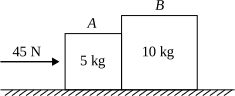
Two blocks, \(A\) and \(B\), are in contact on a horizontal frictionless surface. A 45 \(\text{N}\) constant force is applied to Block \(A\) as shown.
  

What is the magnitude of the force of Block \(B\) on Block \(A\)?

  1. \(0\ \text{N}\)
  2. \(15\ \text{N}\)
  3. \(30\ \text{N}\)
  4. \(45\ \text{N}\)
Show Answers Only

\(C\)

Show Worked Solution
  • Since both blocks are on a frictionless surface and are in contact, they will move together with the same acceleration.
  • Total mass of system \((m_T) = 5 + 10 = 15\ \text{kg}\)
  • Acceleration \(a\) of system \(=\dfrac{F}{m_T} = \dfrac{45}{15} = 3\ \text{ms}^{-2}\)
  • Block \(A\) has a mass of \(5\ \text{kg}\) and is accelerating at \(3\ \text{ms}^{-2}\).
  • It has two horizontal forces acting upon it, the \(45\ \text{N}\) force forwards and the contact force from Block \(B\) pushing back on it \((F_{B → A})\). These forces must sum to the net force acting on Block \(A\).
\(45-F_{B → A}\) \(=5 \times 3\)  
\(F_{B → A}\) \(=45-15=30\ \text{N}\)  

 
\(\Rightarrow C\)

Filed Under: Forces, Acceleration and Energy Tagged With: Band 5, smc-4276-50-F=ma

HMS, HAG 2024 HSC 16 MC

Which cardiovascular condition results in the blood vessels that carry oxygen away from the heart becoming damaged due to losing their elasticity?

  1. Angina
  2. Arteriosclerosis
  3. Carotid artery disease
  4. Deep vein thrombosis
Show Answers Only

\(B\)

Show Worked Solution
  • B is correct: Arteriosclerosis is the condition where blood vessels lose elasticity and become hardened, affecting oxygen delivery from the heart.

Other Options:

  • A is incorrect: Angina is chest pain from reduced blood flow to the heart muscle.
  • C is incorrect: Specifically affects the carotid arteries in the neck.
  • D is incorrect: DVT refers to a blood clot in deep veins, typically in the legs.

♦♦ Mean mark 50%.

Filed Under: Chronic Conditions, Diseases and Injury Tagged With: Band 5, smc-5477-05-Cardiovascular disease

PHYSICS, M2 EQ-Bank 3 MC

A cyclist is moving with a velocity of \(u\) m/s and comes to a complete stop over a distance of \(s\) meters.

If the cyclist’s initial speed was increased to four times the original speed, what would be the new stopping distance (in metres), assuming the braking force remains the same?

  1. \(2s\)
  2. \(4s\)
  3. \(16s\)
  4. \(\dfrac{1}{4}s\)
Show Answers Only

\(C\)

Show Worked Solution
  • Stopping force remains the same  \(\Rightarrow\)  deceleration remains the same \((F=ma)\).
\(v^2\) \(=u^2 + 2as\)  
\(0\) \(=u^2-2as\)  (acceleration is negative)  
\(s\) \(=\dfrac{u^2}{2a}\)  
     
  •  Given \(u \Rightarrow 4u :\)
  • \(s_{\text{new}} =\dfrac{(4u)^2}{2a}=\dfrac{16u^2}{2a}=16 \times \dfrac{u^2}{2a}=16s\)

\(\Rightarrow C\)

Filed Under: Forces, Acceleration and Energy Tagged With: Band 5, smc-4276-50-F=ma

HMS, HIC EQ-Bank 061

Discuss how the relationship between connection to Country and health outcomes can work as a protective factor for Aboriginal and Torres Strait Islander young people.   (5 marks)

--- 15 WORK AREA LINES (style=lined) ---

Show Answers Only

*PEEL – Solution is structured using separate PEEL methods for each side of the argument; [P] Identify the point, [E] expand on the point with a link to question asked, [Ev] apply evidence/examples, [L] linking sentence back to question.

  • [P] On one hand, connection to Country provides holistic health benefits.
  • [E] This approach offers protection across physical, mental, spiritual and social wellbeing simultaneously.
  • [Ev] ABS data shows ATSI youth on traditional Country report better self-rated health outcomes.
  • [L] This demonstrates Country connection as an important protective factor.
     
  • [P] From one perspective, cultural activities on Country strengthen resilience.
  • [E] Young people gain mental health protection through ceremonies, bush tucker gathering and storytelling.
  • [Ev] These practices can reduce psychological distress by providing ATSI youth with identity and belonging.
  • [L] A key advantage is how traditional activities directly support youth wellbeing
     
  • [P] Conversely, barriers to Country such as living in urban areas can create significant negative influences on health.
  • [E] This raises the issue of ATSI youth needing economic necessities such as education and jobs, that are more accessible in cities. This reality separates them from Country.
  • [Ev] Compounding this problem, a majority of ATSI young people now live in cities, limiting their traditional connections.
  • [L] In summary, despite the obvious health benefits of connection to Country, economic realities prevent many ATSI youth from accessing its protective factors.
Show Worked Solution

*PEEL – Solution is structured using separate PEEL methods for each side of the argument; [P] Identify the point, [E] expand on the point with a link to question asked, [Ev] apply evidence/examples, [L] linking sentence back to question.

  • [P] On one hand, connection to Country provides holistic health benefits.
  • [E] This approach offers protection across physical, mental, spiritual and social wellbeing simultaneously.
  • [Ev] ABS data shows ATSI youth on traditional Country report better self-rated health outcomes.
  • [L] This demonstrates Country connection as an important protective factor.
     
  • [P] From one perspective, cultural activities on Country strengthen resilience.
  • [E] Young people gain mental health protection through ceremonies, bush tucker gathering and storytelling.
  • [Ev] These practices can reduce psychological distress by providing ATSI youth with identity and belonging.
  • [L] A key advantage is how traditional activities directly support youth wellbeing
     
  • [P] Conversely, barriers to Country such as living in urban areas can create significant negative influences on health.
  • [E] This raises the issue of ATSI youth needing economic necessities such as education and jobs, that are more accessible in cities. This reality separates them from Country.
  • [Ev] Compounding this problem, a majority of ATSI young people now live in cities, limiting their traditional connections.
  • [L] In summary, despite the obvious health benefits of connection to Country, economic realities prevent many ATSI youth from accessing its protective factors.

Filed Under: Health Status of Young People Tagged With: Band 4, Band 5, smc-5509-40-Protective factors, smc-5509-70-ATSI

HMS, HIC EQ-Bank 060

Explain how Aboriginal Community Controlled Health Organisations (ACCHOs) are addressing barriers to healthcare access for Aboriginal and Torres Strait Islander young people.   (4 marks)

--- 10 WORK AREA LINES (style=lined) ---

Show Answers Only

*PEEL – Solution is structured using an adjusted PEEL method to show cause and effect: [P] State the cause/factor [E] Show how it causes the effect [Ev] Evidence demonstrating why/how [L] Reinforce the causal relationship.

Language highlighting the cause-effect relationship is bolded in the answer below.

  • [P] ACCHOs employ Aboriginal staff who understand cultural needs.
  • [E] This leads to culturally safe healthcare environments.
  • [Ev] As a result, young ATSI people feel comfortable seeking help without fear of judgment or discrimination.
  • [L] This demonstrates why ACCHO’s can utilise cultural alignment to remove access barriers.
     
  • [P] ACCHOs operate in remote communities.
  • [E] This causes reduced travel distances for healthcare.
  • [Ev] This happens when services locate where young people live, eliminating multi-hour trips to cities.
  • [L] In this way, ACCHO’s provide local services that is critical to providing a more equitable access to healthcare.
     
  • [P] Community control creates self-determination..
  • [E] ACCHO’s can effectively promote trust in the healthcare system by taking on the role of health provider.
  • [Ev] In effect, this system allows ATSI communities to make their own health decisions.
  • [L] An important result of this relationship is an increased use of health services by young people.
Show Worked Solution

*PEEL – Solution is structured using an adjusted PEEL method to show cause and effect: [P] State the cause/factor [E] Show how it causes the effect [Ev] Evidence demonstrating why/how [L] Reinforce the causal relationship.

Language highlighting the cause-effect relationship is bolded in the answer below.

  • [P] ACCHOs employ Aboriginal staff who understand cultural needs.
  • [E] This leads to culturally safe healthcare environments.
  • [Ev] As a result, young ATSI people feel comfortable seeking help without fear of judgment or discrimination.
  • [L] This demonstrates why ACCHO’s can utilise cultural alignment to remove access barriers.
     
  • [P] ACCHOs operate in remote communities.
  • [E] This causes reduced travel distances for healthcare.
  • [Ev] This happens when services locate where young people live, eliminating multi-hour trips to cities.
  • [L] In this way, ACCHO’s provide local services that is critical to providing a more equitable access to healthcare.
     
  • [P] Community control creates self-determination..
  • [E] ACCHO’s can effectively promote trust in the healthcare system by taking on the role of health provider.
  • [Ev] In effect, this system allows ATSI communities to make their own health decisions.
  • [L] An important result of this relationship is an increased use of health services by young people.

Filed Under: Health Status of Young People Tagged With: Band 4, Band 5, smc-5509-20-Causes of health issues, smc-5509-40-Protective factors, smc-5509-70-ATSI, smkey-hsc-Explain

PHYSICS, M2 EQ-Bank 2 MC

In a laboratory experiment, students are examining the motion of two blocks, Block \(A\) and Block \(B\). A force of 30 N is applied to move the blocks, while the floor exerts a frictional force of 6 N opposing their motion. Measurements show that both blocks accelerate at a rate of 4 m/s\(^{2}\).
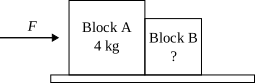
  

What is the mass of Block \(B\)?

  1. \(1\ \text{kg}\)
  2. \(2\ \text{kg}\)
  3. \(3\ \text{kg}\)
  4. \(4\ \text{kg}\)
Show Answers Only

\(B\)

Show Worked Solution
  • Net force on system: \(F_{\text{net}}= 30-6=24\ \text{N}\)
  • The total mass of the system can be calculated using \(F_{\text{net}}=ma\):
  •    \(m=\dfrac{F_{\text{net}}}{a}=\dfrac{24}{4}=6\ \text{kg}\)
  • Mass of Block \(B = 6-4=2\) kg

\(\Rightarrow B\)

Filed Under: Forces, Acceleration and Energy Tagged With: Band 5, smc-4276-50-F=ma

Financial Maths, GEN1 2024 NHT 23 MC

Todd invested $450 000 in an annuity at the start of 2024.

The interest rate for this annuity is 3.75% per annum compounding monthly.

He will receive regular monthly payments for the 15-year life of the annuity.

In which year will the balance of the annuity first fall below $350 000?

  1. 2027
  2. 2028
  3. 2029
  4. 2030
  5. 2031
Show Answers Only

\(B\)

Show Worked Solution

\(\text{Find monthly payment (by TVM Solver):}\)

\(N=15 \times 12 = 180\)

\(I\%=3.75\%\)

\(PV=450\,000\)

\(PMT = \text{SOLVE}\ = -3272.50\)

\(FV=0\)

\(P/Y = C/Y = 12\)
 

\(\text{Find \(N\) when balance = \$350 000 (by TVM Solver):}\)

\(N= \text{SOLVE}\ = 49.61\)

\(I\%=3.75\%\)

\(PV=450\,000\)

\(PMT = -3272.50\)

\(FV= -350\,000 \)

\(P/Y = C/Y = 12\)
 

\(\text{49.61 months = 4.13 years}\ \ \Rightarrow \ \ \text{4 years after 2024 = 2028}\)

\(\Rightarrow B\)

Filed Under: Annuities and Perpetuities Tagged With: Band 5, smc-2512-10-Annuity, smc-2512-50-CAS solver

Recursion, GEN1 2024 NHT 22 MC

The recurrence relation below models the value, \(P_n\), in a financial context after \(n\) time periods.

\(P_0=a, \quad P_{n+1}=R P_n-d\)

All constants, \(a, R\) and \(d\), are greater than 1 .

Four options of what the value of \(P_n\) could represent are listed below.

  • a reducing balance loan
  • an annuity
  • an asset depreciated using the unit cost method
  • a perpetuity

How many of these four options could be represented by the recurrence relation?

  1. 0
  2. 1
  3. 2
  4. 3
  5. 4
Show Answers Only

\(D\)

Show Worked Solution

\(\text{The recurrence relation shows an amount that compounds each}\)

\(\text{year with a fixed amount removed from the growing balance.}\)

\(\text{Possibilities: reducing balance loan, annuity and perpetuity.}\)

\(\Rightarrow D\)

Filed Under: Recursion - Financial Tagged With: Band 5, smc-717-80-Interpret RR

Financial Maths, STD2 F4 EQ-Bank 1

Yolanda purchased a motorcycle for $30 000. She explores two options for predicting the value of the motorcycle after four years.

Option 1:

For the first two years, the value of the motorcycle is depreciated by 10% per annum using flat rate depreciation. For the next two years, the value of the motorcycle is depreciated by 10% per annum using reducing balance depreciation.

Option 2:

The value of the motorcycle is depreciated using reducing balance depreciation with a constant depreciation rate per annum for four years.

For both options to predict the same value after four years, determine the rate per annum used for Option 2, giving your answer as a percentage correct to one decimal place.   (3 marks)

--- 7 WORK AREA LINES (style=lined) ---

Show Answers Only

\(10.3\%\)

Show Worked Solution

\(\text{Let \(V_n\) = Value after \(n\) years}\)

\(\text{Option 1:}\)

\(V_1=30\,000-(10\% \times 30\,000)=27\,000,\ \ V_2=27\,000-3000=24\,000\)

\(V_3=24\,000 \times 0.9=21\,600,\ \ V_4=21\,600 \times 0.9 = 19\,440\)

 
\(\text{Option 2 (predicting the same value):}\)

\(30\,000(1-r)^{4}\) \(=19\,440\)  
\((1-r)^{4}\) \(=\dfrac{19\,440}{30\,000}\)  
\(r\) \(=\left(\dfrac{19\,440}{30\,000}\right)^{\frac{1}{4}}-1\)  
  \(= 0.1027…\)  
  \(=10.3\%\ \text{(to 1 d.p.)}\)  

Filed Under: Depreciation - Declining Balance (Std 2) Tagged With: Band 5, smc-813-20-Find r, smc-813-50-Declining Balance vs Straight Line

Financial Maths, GEN1 2024 NHT 21 MC

Yolanda purchased a motorcycle for $30 000. She explores two options for predicting the value of the motorcycle after four years.

Option 1:

For the first two years, the value of the motorcycle is depreciated by 10% per annum using flat rate depreciation. For the next two years, the value of the motorcycle is depreciated by 10% per annum using reducing balance depreciation.

Option 2:

The value of the motorcycle is depreciated using reducing balance depreciation with a constant depreciation rate per annum for four years.

For both options to predict the same value after four years, the rate per annum used for Option 2 is closest to

  1. 9.4%
  2. 9.7%
  3. 10.0%
  4. 10.3%
  5. 10.6%
Show Answers Only

\(D\)

Show Worked Solution

\(\text{Let \(V_n\) = Value after \(n\) years}\)

\(\text{Option 1}\)

\(V_1=30\,000-(10\% \times 30\,000)=27\,000,\ \ V_2=27\,000-3000=24\,000\)

\(V_3=24\,000 \times 0.9=21\,600,\ \ V_4=21\,600 \times 0.9 = 19\,440\)

\(\text{Option 2}\)

\(30\,000(1-r)^{4}\) \(=19\,440\)  
\((1-r)^{4}\) \(=\dfrac{19\,440}{30\,000}\)  
\(r\) \(=\left(\dfrac{19\,440}{30\,000}\right)^{\frac{1}{4}}-1\approx 0.1027…\)  

 
\(\Rightarrow D\)

Filed Under: Depreciation Tagged With: Band 5, smc-602-40-Comparing methods

Data Analysis, GEN1 2024 NHT 16 MC

Seasonal indices for visitor numbers to a theme park in a particular year are given in the table below. The seasonal index for summer is not given.

\begin{array}{|l|c|c|c|c|}
\hline
\rule{0pt}{2.5ex} \textbf{Season} \rule[-1ex]{0pt}{0pt}& \text{ Spring } & \text{Summer} & \text{Autumn} & \text{ Winter } \\
\hline
\rule{0pt}{2.5ex}\textbf{Seasonal index} \rule[-1ex]{0pt}{0pt}& 0.85 & & 0.96 & 0.45 \\
\hline
\end{array}

In this particular year, 33 120 visitors attended during summer.

The total annual attendance for this particular year is closest to

  1. 73 960
  2. 74 520
  3. 75 820
  4. 76 140
  5. 77 380
Show Answers Only

\(D\)

Show Worked Solution

\(\text{Summer index}\ =4-(0.85+0.96+0.45)=1.74\)

\(\dfrac{33\,120}{\text{Average}}\) \(=1.74\)  
\(\text{Average}\) \(=\dfrac{33\,120}{1.74}\)  
  \(=19\,034.48…\)  

 
\(\text{Total annual attendance}\ = 4 \times 19\,034\approx 76\,140\)

\(\Rightarrow D\)

Filed Under: Time Series Tagged With: Band 5, smc-266-10-Seasonal Index from a Table

Data Analysis, GEN1 2024 NHT 15 MC

The sales revenue, in dollars, from the sale of chocolate eggs is seasonal.

To correct the sales revenue in May for seasonality, the actual sales revenue, to the nearest percent, is decreased by 17 %.

The seasonal index for that month is closest to

  1. 0.77
  2. 0.83
  3. 1.17
  4. 1.20
  5. 1.25
Show Answers Only

\(D\)

Show Worked Solution

\(\text{17% decrease}\ \Rightarrow\ \text{Multiplying factor = 0.83}\)

\(\text{Seasonal index}\ = \dfrac{1}{0.83}=1.204…\)

\(\Rightarrow D\)

Filed Under: Time Series Tagged With: Band 5, smc-266-20-(De)Seasonalising Data

HMS, BM EQ-Bank 954

Evaluate the effectiveness of various hydration strategies for preventing dehydration-related movement inefficiencies across different sporting contexts.   (8 marks)

--- 20 WORK AREA LINES (style=lined) ---

Show Answers Only

Sample Answer

Evaluation Statement

  • Hydration strategies show highly variable effectiveness across different sporting contexts.
    Evaluation criteria include fluid retention, performance maintenance, and practical application.

Pre-Event Hydration

  • Sodium-containing fluids prove highly effective for endurance athletes.
  • Fluid retention improves significantly, delaying dehydration symptoms that compromise movement.
  • Marathon runners using this strategy successfully maintain movement quality longer.
  • Evidence strongly supports pre-event sodium loading for events exceeding 90 minutes.
  • The effectiveness rates as superior for endurance contexts.

Individualised Approaches

  • Personal sweat rate calculations substantially improve hydration outcomes.
  • Athletes lose between 0.5-2.5L per hour, making generic approaches inadequate.
  • Customised plans optimally address individual needs for movement efficiency.
  • Practical implementation remains moderately challenging in team sport environments.

Environmental Adaptations

  • Combined cooling-hydration strategies prove exceptionally effective in hot conditions.
  • Lower body temperature significantly reduces fluid requirements.
  • Cold weather strategies remain insufficiently implemented despite proven needs.
  • Altitude hydration often fails to meet increased physiological demands.

Sport-Specific Timing

  • Soccer’s limited breaks require highly effective pre-game and halftime strategies.
  • Tennis allows superior hydration maintenance through regular changeovers.
  • Continuous sports face considerable challenges in maintaining optimal hydration.
  • Sports drinks containing carbohydrates comprehensively address energy and fluid needs for activities over 60 minutes.

Final Evaluation

  • Pre-event sodium loading and individualised plans prove most effective overall.
  • Environmental conditions strongly influence strategy success rates.
  • While monitoring methods improve outcomes, practical application remains inconsistent.
  • Therefore, context-specific approaches are essential for preventing movement inefficiencies.
Show Worked Solution

Sample Answer 

Evaluation Statement

  • Hydration strategies show highly variable effectiveness across different sporting contexts.
    Evaluation criteria include fluid retention, performance maintenance, and practical application.

Pre-Event Hydration

  • Sodium-containing fluids prove highly effective for endurance athletes.
  • Fluid retention improves significantly, delaying dehydration symptoms that compromise movement.
  • Marathon runners using this strategy successfully maintain movement quality longer.
  • Evidence strongly supports pre-event sodium loading for events exceeding 90 minutes.
  • The effectiveness rates as superior for endurance contexts.

Individualised Approaches

  • Personal sweat rate calculations substantially improve hydration outcomes.
  • Athletes lose between 0.5-2.5L per hour, making generic approaches inadequate.
  • Customised plans optimally address individual needs for movement efficiency.
  • Practical implementation remains moderately challenging in team sport environments.

Environmental Adaptations

  • Combined cooling-hydration strategies prove exceptionally effective in hot conditions.
  • Lower body temperature significantly reduces fluid requirements.
  • Cold weather strategies remain insufficiently implemented despite proven needs.
  • Altitude hydration often fails to meet increased physiological demands.

Sport-Specific Timing

  • Soccer’s limited breaks require highly effective pre-game and halftime strategies.
  • Tennis allows superior hydration maintenance through regular changeovers.
  • Continuous sports face considerable challenges in maintaining optimal hydration.
  • Sports drinks containing carbohydrates comprehensively address energy and fluid needs for activities over 60 minutes.

Final Evaluation

  • Pre-event sodium loading and individualised plans prove most effective overall.
  • Environmental conditions strongly influence strategy success rates.
  • While monitoring methods improve outcomes, practical application remains inconsistent.
  • Therefore, context-specific approaches are essential for preventing movement inefficiencies.

Filed Under: Role of First Aid Tagged With: Band 5, Band 6, smc-5527-20-Dehydration

HMS, BM EQ-Bank 953

Explain the physiological mechanisms by which dehydration affects movement efficiency in athletic performance.   (6 marks)

--- 18 WORK AREA LINES (style=lined) ---

Show Answers Only

Sample Answer

  • Cardiovascular function is compromised because blood volume decreases during dehydration. This leads to increased heart rate but reduced stroke volume per beat. As a result, oxygen delivery to working muscles is limited, causing decreased movement efficiency and earlier fatigue.
  • Body temperature regulation becomes less effective due to reduced fluid availability for sweating. Internal temperature therefore rises rapidly during exercise. Consequently, the central nervous system is affected, which leads to reduced muscle activation and compromised motor control.
  • Muscle function deteriorates as electrolyte imbalances, particularly sodium loss, occur. These imbalances disrupt normal contraction processes in muscle cells. Therefore, movements become less powerful and coordinated, resulting in inefficient biomechanics and wasted energy.
  • Energy production efficiency declines because cellular processes are altered by dehydration. Glycogen stores subsequently deplete faster than normal. Hence, the body must rely on less efficient energy systems, which creates premature fatigue and reduced performance capacity.
  • Movement coordination decreases when nerve signals are affected by dehydration. Poor proprioceptive feedback results in compromised technique execution. Consequently, athletes require more energy to perform the same movements, further reducing efficiency.
  • Perception of effort increases significantly as various physiological stress responses are triggered. Athletes therefore feel movements are more difficult than normal. The outcome is unconsciously reduced intensity, which compounds the negative effects on performance.
Show Worked Solution

Sample Answer

  • Cardiovascular function is compromised because blood volume decreases during dehydration. This leads to increased heart rate but reduced stroke volume per beat. As a result, oxygen delivery to working muscles is limited, causing decreased movement efficiency and earlier fatigue.
  • Body temperature regulation becomes less effective due to reduced fluid availability for sweating. Internal temperature therefore rises rapidly during exercise. Consequently, the central nervous system is affected, which leads to reduced muscle activation and compromised motor control.
  • Muscle function deteriorates as electrolyte imbalances, particularly sodium loss, occur. These imbalances disrupt normal contraction processes in muscle cells. Therefore, movements become less powerful and coordinated, resulting in inefficient biomechanics and wasted energy.
  • Energy production efficiency declines because cellular processes are altered by dehydration. Glycogen stores subsequently deplete faster than normal. Hence, the body must rely on less efficient energy systems, which creates premature fatigue and reduced performance capacity.
  • Movement coordination decreases when nerve signals are affected by dehydration. Poor proprioceptive feedback results in compromised technique execution. Consequently, athletes require more energy to perform the same movements, further reducing efficiency.
  • Perception of effort increases significantly as various physiological stress responses are triggered. Athletes therefore feel movements are more difficult than normal. The outcome is unconsciously reduced intensity, which compounds the negative effects on performance.

Filed Under: Role of First Aid Tagged With: Band 4, Band 5, smc-5527-20-Dehydration

HMS, BM EQ-Bank 952

Discuss the first aid response required for a soccer player showing signs of dehydration during a match in hot conditions.   (5 marks)

--- 15 WORK AREA LINES (style=lined) ---

Show Answers Only

*PEEL – Structure solution using separate PEEL methods for each side of the argument; [P] Identify the point, [E] expand on the point with a link to question asked, [Ev] apply evidence/examples, [L] linking sentence back to question.

Sample Answer

  • [P] Immediate removal from play is essential.
  • E] This prevents further fluid loss through continued exertion in hot conditions.
  • [Ev] Moving the player to a shaded area reduces heat exposure and allows for proper assessment.
  • [L] This initial action protects the player from worsening dehydration.
      
  • [P] Vital signs assessment determines treatment urgency.
  • [E] Checking consciousness level, skin condition and heart rate reveals dehydration severity.
  • [Ev] Severe symptoms like confusion or rapid pulse indicate potential heat illness requiring emergency care.
  • [L] Accurate assessment guides appropriate intervention levels.
      
  • [P] Rehydration requires careful management.
  • [E] Small, frequent sips of electrolyte drinks prevent gastrointestinal distress while replacing lost fluids and salts.
  • [Ev] Sports drinks are preferred over water alone to restore sodium balance.
  • [L] Proper rehydration technique ensures effective recovery.
      
  • [P] Active cooling measures complement rehydration.
  • [E] Cold towels applied to neck, armpits and groin reduce core temperature efficiently.
  • [Ev] Monitoring for symptom improvement like reduced dizziness confirms treatment effectiveness.
  • [L] Combined cooling and hydration optimises recovery.
      
  • [P] Documentation ensures continuity of care.
  • [E] Recording fluid loss estimates, treatments given and player response helps medical decisions.
  • [Ev] This information determines safe return-to-play timing.
  • [L] Thorough documentation prevents premature return and potential relapse.
Show Worked Solution

*PEEL – Structure solution using separate PEEL methods for each side of the argument; [P] Identify the point, [E] expand on the point with a link to question asked, [Ev] apply evidence/examples, [L] linking sentence back to question.

Sample Answer

  • [P] Immediate removal from play is essential.
  • E] This prevents further fluid loss through continued exertion in hot conditions.
  • [Ev] Moving the player to a shaded area reduces heat exposure and allows for proper assessment.
  • [L] This initial action protects the player from worsening dehydration.
      
  • [P] Vital signs assessment determines treatment urgency.
  • [E] Checking consciousness level, skin condition and heart rate reveals dehydration severity.
  • [Ev] Severe symptoms like confusion or rapid pulse indicate potential heat illness requiring emergency care.
  • [L] Accurate assessment guides appropriate intervention levels.
      
  • [P] Rehydration requires careful management.
  • [E] Small, frequent sips of electrolyte drinks prevent gastrointestinal distress while replacing lost fluids and salts.
  • [Ev] Sports drinks are preferred over water alone to restore sodium balance.
  • [L] Proper rehydration technique ensures effective recovery.
      
  • [P] Active cooling measures complement rehydration.
  • [E] Cold towels applied to neck, armpits and groin reduce core temperature efficiently.
  • [Ev] Monitoring for symptom improvement like reduced dizziness confirms treatment effectiveness.
  • [L] Combined cooling and hydration optimises recovery.
      
  • [P] Documentation ensures continuity of care.
  • [E] Recording fluid loss estimates, treatments given and player response helps medical decisions.
  • [Ev] This information determines safe return-to-play timing.
  • [L] Thorough documentation prevents premature return and potential relapse.

Filed Under: Role of First Aid Tagged With: Band 4, Band 5, smc-5527-20-Dehydration

HMS, BM EQ-Bank 946

How does preventative taping affect movement efficiency for an athlete recovering from an ankle sprain?   (5 marks)

--- 15 WORK AREA LINES (style=lined) ---

Show Answers Only

Sample Answer

  • Preventative taping provides proprioceptive feedback to the athlete, which creates sensory awareness around the ankle joint. This enhances neuromuscular control, leading to more efficient movement patterns during recovery.
  • By restricting excessive inversion and eversion movements, taping maintains optimal joint alignment during dynamic activities. Compensatory movements in other joints are prevented, which eliminates energy leaks and improves efficiency.
  • Psychological confidence from taping allows athletes to move more naturally without fear of re-injury. Reduced hesitation in movement execution enables better biomechanical efficiency during performance.
  • Taping stabilises the ankle joint by supporting ligaments and surrounding structures. Effective force transfer through the kinetic chain becomes possible, resulting in more powerful and controlled movements.
  • However, incorrect application can create unnecessary restriction of normal movement patterns. Athletes then compensate with altered mechanics, potentially developing new inefficiencies.
  • Progressive reduction in taping support encourages proper neuromuscular adaptation. Athletes therefore develop intrinsic stability rather than external dependence, ultimately achieving better long-term movement efficiency.
Show Worked Solution

Sample Answer

  • Preventative taping provides proprioceptive feedback to the athlete, which creates sensory awareness around the ankle joint. This enhances neuromuscular control, leading to more efficient movement patterns during recovery.
  • By restricting excessive inversion and eversion movements, taping maintains optimal joint alignment during dynamic activities. Compensatory movements in other joints are prevented, which eliminates energy leaks and improves efficiency.
  • Psychological confidence from taping allows athletes to move more naturally without fear of re-injury. Reduced hesitation in movement execution enables better biomechanical efficiency during performance.
  • Taping stabilises the ankle joint by supporting ligaments and surrounding structures. Effective force transfer through the kinetic chain becomes possible, resulting in more powerful and controlled movements.
  • However, incorrect application can create unnecessary restriction of normal movement patterns. Athletes then compensate with altered mechanics, potentially developing new inefficiencies.
  • Progressive reduction in taping support encourages proper neuromuscular adaptation. Athletes therefore develop intrinsic stability rather than external dependence, ultimately achieving better long-term movement efficiency.

Filed Under: Role of First Aid Tagged With: Band 5, Band 6, smc-5527-15-Inefficient movement

HMS, BM EQ-Bank 941

Evaluate the short-term and long-term consequences of undue stress on the body for marathon runners, and discuss appropriate management strategies that could be implemented during different phases of training.   (8 marks)

--- 25 WORK AREA LINES (style=lined) ---

Show Answers Only

Sample Answer

Evaluation Statement

  • Undue stress has highly detrimental effects on marathon runners both short and long-term.
  • Evaluation criteria include performance impact and health consequences.

Short-term Impact

  • Immediate fatigue affects technique and running performance.
  • Runners show poor movement patterns when trying to maintain pace, reducing efficiency.
  • Energy stores become depleted and muscles experience damage.
  • Recovery time between training sessions increases, limiting training benefits.
  • These effects clearly show why rest days are important.

Long-term Consequences

  • Overtraining syndrome severely affects athletic performance.
  • Chronic tiredness, stress fractures, and hormonal imbalances damage overall health.
  • Mental burnout reduces motivation and enjoyment of running.
  • Athletes may quit the sport entirely, failing to reach their goals.
  • These consequences strongly support the need for proper management.

Management Strategies

  • Base phase requires gradual increases in running distance with adequate rest days.
  • Main phase benefits from alternating hard and easy training days.
  • Peak phase needs careful monitoring of fatigue with reduced training volume.
  • Recovery phase requires complete rest through alternative activities like swimming.
  • This approach successfully prevents stress from building up.

Final Evaluation

  • Short-term stress causes moderate performance problems but can be reversed.
  • Long-term consequences are extremely harmful to health and running career.
  • While hard training is needed for improvement, poor recovery creates serious risks.
  • Therefore, proper training management is essential for marathon runners.
Show Worked Solution

Sample Answer

Evaluation Statement

  • Undue stress has highly detrimental effects on marathon runners both short and long-term.
  • Evaluation criteria include performance impact and health consequences.

Short-term Impact

  • Immediate fatigue affects technique and running performance.
  • Runners show poor movement patterns when trying to maintain pace, reducing efficiency.
  • Energy stores become depleted and muscles experience damage.
  • Recovery time between training sessions increases, limiting training benefits.
  • These effects clearly show why rest days are important.

Long-term Consequences

  • Overtraining syndrome severely affects athletic performance.
  • Chronic tiredness, stress fractures, and hormonal imbalances damage overall health.
  • Mental burnout reduces motivation and enjoyment of running.
  • Athletes may quit the sport entirely, failing to reach their goals.
  • These consequences strongly support the need for proper management.

Management Strategies

  • Base phase requires gradual increases in running distance with adequate rest days.
  • Main phase benefits from alternating hard and easy training days.
  • Peak phase needs careful monitoring of fatigue with reduced training volume.
  • Recovery phase requires complete rest through alternative activities like swimming.
  • This approach successfully prevents stress from building up.

Final Evaluation

  • Short-term stress causes moderate performance problems but can be reversed.
  • Long-term consequences are extremely harmful to health and running career.
  • While hard training is needed for improvement, poor recovery creates serious risks.
  • Therefore, proper training management is essential for marathon runners.

Filed Under: Role of First Aid Tagged With: Band 5, Band 6, smc-5527-10-Undue stress

HMS, BM EQ-Bank 940

Describe how chronic training stress could lead to a deterioration in performance for an elite netball player, and propose strategies to minimise its effects.   (5 marks)

--- 15 WORK AREA LINES (style=lined) ---

Show Answers Only

Sample Answer

  • Chronic training stress develops from inadequate recovery between high-intensity sessions, resulting in accumulated physiological fatigue that affects neuromuscular coordination essential for accurate passing and shooting in netball.
  • As training stress builds, the player’s movement efficiency deteriorates, with energy systems becoming less effective, leading to decreased court coverage and slower reaction times in defensive plays.
  • Poor recovery compromises cognitive function, affecting decision-making and tactical awareness during complex game situations, particularly in final quarters when fatigue is highest.

Strategies:

  • Incorporate systematic monitoring through wellness questionnaires and performance metrics to identify early signs of overtraining, adjusting training loads before performance deteriorates.
  • Implement strategic recovery sessions between high-intensity training days, focusing on skill development, strategy discussions and active recovery methods rather than physiological overload.
Show Worked Solution

Sample Answer

  • Chronic training stress develops from inadequate recovery between high-intensity sessions, resulting in accumulated physiological fatigue that affects neuromuscular coordination essential for accurate passing and shooting in netball.
  • As training stress builds, the player’s movement efficiency deteriorates, with energy systems becoming less effective, leading to decreased court coverage and slower reaction times in defensive plays.
  • Poor recovery compromises cognitive function, affecting decision-making and tactical awareness during complex game situations, particularly in final quarters when fatigue is highest.

Strategies:

  • Incorporate systematic monitoring through wellness questionnaires and performance metrics to identify early signs of overtraining, adjusting training loads before performance deteriorates.
  • Implement strategic recovery sessions between high-intensity training days, focusing on skill development, strategy discussions and active recovery methods rather than physiological overload.

Filed Under: Role of First Aid Tagged With: Band 4, Band 5, smc-5527-10-Undue stress

v1 Financial Maths, STD2 F1 2016 HSC 27a

Alice is researching insurance options before purchasing a car.

Explain what is covered under each of the following types of car insurance:

    • Compulsory third-party insurance (CTP)

    • Optional third-party property insurance. (2 marks)

--- 4 WORK AREA LINES (style=lined) ---

Show Answers Only

`text(CTP Insurance:)`

`text(This insures a driver against liability)`

`text(if their car injures or kills a person)`

`text(in an accident.)`

`text(Non-compulsory TP Insurance:)`

`text(This insurance covers damage to)`

`text(other people’s property in an accident,)`

`text(but does not cover the driver’s own vehicle.)`

Show Worked Solution

`text(CTP Insurance:)`

♦♦♦ Mean mark 13%.
MARKER’S COMMENT: Again, car insurance causes major issues for students.

`text(This insures a driver against liability)`

`text(if their car injures or kills a person)`

`text(in an accident.)`

`text(Non-compulsory TP Insurance:)`

`text(This insurance covers damage to)`

`text(other people’s property in an accident,)`

`text(but does not cover the driver’s own vehicle.)`

Filed Under: Earning Money and Budgeting (Std 2-X) Tagged With: Band 5, smc-1126-40-Insurance, smc-810-40-Insurance

HMS, BM EQ-Bank 937

Explain how damage to different components of the peripheral nervous system would affect an athlete's performance in basketball.   (5 marks)

--- 15 WORK AREA LINES (style=lined) ---

Show Answers Only

Sample Answer

  • Damage to sensory neurons would impair feedback about body position.
  • This prevents accurate sensing of hand position and ball contact.
  • Players couldn’t judge shooting force or dribbling pressure without looking, which shows how sensory damage disrupts movement precision.
      
  • Motor neuron damage would cause muscle weakness or paralysis because signals from brain to muscles become blocked or reduced.
  • Affected players lose jumping ability or shooting arm strength, demonstrating how motor damage prevents movement execution.
      
  • Proprioceptor damage would eliminate spatial awareness.
  • Athletes consequently lose unconscious knowledge of limb positions.
  • Players must visually track their arms when shooting or passing, illustrating how proprioceptive loss affects coordination.
      
  • Autonomic nervous system damage would impair exercise responses.
  • Heart rate and breathing fail to increase with exercise demands, resulting in rapid fatigue.
  • Players cannot sustain game intensity, thus showing how autonomic damage limits physical performance capacity.
Show Worked Solution

Sample Answer

  • Damage to sensory neurons would impair feedback about body position.
  • This prevents accurate sensing of hand position and ball contact.
  • Players couldn’t judge shooting force or dribbling pressure without looking, which shows how sensory damage disrupts movement precision.
      
  • Motor neuron damage would cause muscle weakness or paralysis because signals from brain to muscles become blocked or reduced.
  • Affected players lose jumping ability or shooting arm strength, demonstrating how motor damage prevents movement execution.
      
  • Proprioceptor damage would eliminate spatial awareness.
  • Athletes consequently lose unconscious knowledge of limb positions.
  • Players must visually track their arms when shooting or passing, illustrating how proprioceptive loss affects coordination.
      
  • Autonomic nervous system damage would impair exercise responses.
  • Heart rate and breathing fail to increase with exercise demands, resulting in rapid fatigue.
  • Players cannot sustain game intensity, thus showing how autonomic damage limits physical performance capacity.

Filed Under: Nervous System Tagged With: Band 4, Band 5, smc-5525-20-Peripheral nervous system

HMS, BM EQ-Bank 936

Explain how the peripheral nervous system controls both voluntary and involuntary responses during a 400 metre sprint race.   (5 marks)

--- 15 WORK AREA LINES (style=lined) ---

Show Answers Only

Sample Answer

  • The somatic nervous system controls voluntary skeletal muscle movements.
  • Motor neurons transmit signals to leg and arm muscles causing running technique execution.
  • Sprinters consciously drive knees high and pump arms for maximum speed, which shows how voluntary control enables purposeful movement.
      
  • Sensory neurons provide continuous feedback about body position and track surface.
  • This information allows real-time adjustments to stride and posture.
  • Runners adjust foot placement on curves and maintain lane position, demonstrating how sensory input guides voluntary responses.
      
  • The autonomic nervous system controls involuntary cardiovascular responses.
  • Sympathetic activation increases heart rate and dilates airways automatically.
  • Heart rate rises to 180+ bpm without conscious control during sprinting, illustrating how involuntary responses support intense exercise.
      
  • Temperature regulation occurs through involuntary sweating and vasodilation.
  • The body automatically cools itself as core temperature rises.
  • Blood vessels dilate and sweat glands activate without conscious thought, showing how involuntary mechanisms maintain homeostasis during exercise
Show Worked Solution

Sample Answer

  • The somatic nervous system controls voluntary skeletal muscle movements.
  • Motor neurons transmit signals to leg and arm muscles causing running technique execution.
  • Sprinters consciously drive knees high and pump arms for maximum speed, which shows how voluntary control enables purposeful movement.
      
  • Sensory neurons provide continuous feedback about body position and track surface.
  • This information allows real-time adjustments to stride and posture.
  • Runners adjust foot placement on curves and maintain lane position, demonstrating how sensory input guides voluntary responses.
      
  • The autonomic nervous system controls involuntary cardiovascular responses.
  • Sympathetic activation increases heart rate and dilates airways automatically.
  • Heart rate rises to 180+ bpm without conscious control during sprinting, illustrating how involuntary responses support intense exercise.
      
  • Temperature regulation occurs through involuntary sweating and vasodilation.
  • The body automatically cools itself as core temperature rises.
  • Blood vessels dilate and sweat glands activate without conscious thought, showing how involuntary mechanisms maintain homeostasis during exercise.

Filed Under: Nervous System Tagged With: Band 4, Band 5, smc-5525-20-Peripheral nervous system

HMS, BM EQ-Bank 933

Evaluate the interrelationship between the peripheral nervous system and other body systems in enabling efficient movement during an endurance cycling event.   (8 marks)

--- 28 WORK AREA LINES (style=lined) ---

Show Answers Only

Sample Answer

Judgment Statement

  • The PNS interrelationships prove highly effective for endurance cycling performance.
  • They strongly meet the criteria for movement coordination and adequately meet energy efficiency requirements.

Movement Coordination

  • The PNS-muscular system connection strongly meets coordination needs by sending signals to leg muscles continuously.
  • Feedback about muscle position helps cyclists keep a smooth pedalling rhythm and adjust their power.
  • The PNS-skeletal system partnership works excellently by telling the brain where joints are positioned, helping riders maintain good cycling posture.
  • These relationships work so well that cyclists can pedal efficiently for hours without conscious thought.
  • However, coordination begins to deteriorate when riders become fatigued because nerve signals don’t travel efficiently during ultra-long rides.

Energy Efficiency

  • The PNS-heart and blood vessel connection adequately supports energy use by controlling heart rate and adjusting blood vessel dilation.
  • Oxygen delivery improves but cannot fully prevent fatigue over very long distances.
  • The PNS-respiratory connection partly meets efficiency needs by changing breathing rate, though riders sometimes need to control their breathing manually on steep hills. 
  • Temperature control through the PNS-skin connection works well to prevent overheating by starting sweating and changing blood flow to the skin.
  • The PNS correctly slows down digestion to send more blood to leg muscles, though this can cause stomach upset in very long events.

Final Evaluation

  • The PNS interrelationships highly effectively enable endurance cycling through excellent movement coordination and adequate energy management.
  • While coordination aspects strongly support performance, energy efficiency shows some limitations during extreme efforts.
  • Overall, these integrated systems successfully maintain cycling efficiency because the PNS coordinates multiple body responses simultaneously.
  • Cyclists must supplement these automatic responses with proper nutrition and pacing strategies for optimal performance.
Show Worked Solution

Sample Answer

Judgment Statement

  • The PNS interrelationships prove highly effective for endurance cycling performance.
  • They strongly meet the criteria for movement coordination and adequately meet energy efficiency requirements.

Movement Coordination

  • The PNS-muscular system connection strongly meets coordination needs by sending signals to leg muscles continuously.
  • Feedback about muscle position helps cyclists keep a smooth pedalling rhythm and adjust their power.
  • The PNS-skeletal system partnership works excellently by telling the brain where joints are positioned, helping riders maintain good cycling posture.
  • These relationships work so well that cyclists can pedal efficiently for hours without conscious thought.
  • However, coordination begins to deteriorate when riders become fatigued because nerve signals don’t travel efficiently during ultra-long rides.

Energy Efficiency

  • The PNS-heart and blood vessel connection adequately supports energy use by controlling heart rate and adjusting blood vessel dilation.
  • Oxygen delivery improves but cannot fully prevent fatigue over very long distances.
  • The PNS-respiratory connection partly meets efficiency needs by changing breathing rate, though riders sometimes need to control their breathing manually on steep hills. 
  • Temperature control through the PNS-skin connection works well to prevent overheating by starting sweating and changing blood flow to the skin.
  • The PNS correctly slows down digestion to send more blood to leg muscles, though this can cause stomach upset in very long events.

Final Evaluation

  • The PNS interrelationships highly effectively enable endurance cycling through excellent movement coordination and adequate energy management.
  • While coordination aspects strongly support performance, energy efficiency shows some limitations during extreme efforts.
  • Overall, these integrated systems successfully maintain cycling efficiency because the PNS coordinates multiple body responses simultaneously.
  • Cyclists must supplement these automatic responses with proper nutrition and pacing strategies for optimal performance.

Filed Under: Nervous System Tagged With: Band 5, Band 6, smc-5525-20-Peripheral nervous system

HMS, BM EQ-Bank 932

Explain how the peripheral nervous system facilitates both voluntary and involuntary aspects of a 100-metre sprint performance.   (5 marks)

--- 18 WORK AREA LINES (style=lined) ---

Show Answers Only

Sample Answer

  • The somatic nervous system controls voluntary muscle contractions for sprinting.
  • Motor neurons transmit signals from CNS to skeletal muscles, causing sprinters to consciously drive from blocks and maintain running form.
  • This shows how voluntary PNS pathways enable purposeful movement.
      
  • Sensory neurons provide continuous feedback during the sprint.
  • This information allows real-time adjustments to technique and balance.
  • Runners sense foot contact and adjust stride length for maximum speed, demonstrating how sensory input refines voluntary movement.
      
  • The autonomic nervous system triggers involuntary cardiovascular responses.
  • Sympathetic activation increases heart rate before conscious awareness, resulting in rates rising from 70 to 180+ bpm within seconds.
  • This illustrates how involuntary responses support intense exercise.
      
  • Pre-race sympathetic activation prepares the body for explosive effort.
  • Adrenaline release automatically increases muscle tension and mental alertness.
  • Sprinters experience heightened awareness and energy at the starting line, showing how involuntary preparation enhances voluntary performance.
Show Worked Solution

Sample Answer

  • The somatic nervous system controls voluntary muscle contractions for sprinting.
  • Motor neurons transmit signals from CNS to skeletal muscles, causing sprinters to consciously drive from blocks and maintain running form.
  • This shows how voluntary PNS pathways enable purposeful movement.
      
  • Sensory neurons provide continuous feedback during the sprint.
  • This information allows real-time adjustments to technique and balance.
  • Runners sense foot contact and adjust stride length for maximum speed, demonstrating how sensory input refines voluntary movement.
      
  • The autonomic nervous system triggers involuntary cardiovascular responses.
  • Sympathetic activation increases heart rate before conscious awareness, resulting in rates rising from 70 to 180+ bpm within seconds.
  • This illustrates how involuntary responses support intense exercise.
      
  • Pre-race sympathetic activation prepares the body for explosive effort.
  • Adrenaline release automatically increases muscle tension and mental alertness.
  • Sprinters experience heightened awareness and energy at the starting line, showing how involuntary preparation enhances voluntary performance.

Filed Under: Nervous System Tagged With: Band 5, Band 6, smc-5525-20-Peripheral nervous system

HMS, BM EQ-Bank 931

Compare and contrast the roles of sensory and motor neurons in the peripheral nervous system during a cricket bowling action.   (5 marks)

--- 15 WORK AREA LINES (style=lined) ---

Show Answers Only

Sample Answer

Similarities:

  • Both sensory and motor neurons are essential components of the peripheral nervous system.
  • Both transmit electrical signals rapidly through myelinated axons during the bowling action.
  • Both work together in a continuous feedback loop throughout the bowling sequence.
  • Both are activated simultaneously to coordinate the complex bowling movement.

Differences:

  • Sensory neurons detect stimuli (grip feel, body position, visual cues) while motor neurons cause muscle contractions.
  • Sensory neurons transmit signals from receptors to the CNS; motor neurons transmit from CNS to muscles.
  • Sensory neuron cell bodies are located in dorsal root ganglia; motor neuron cell bodies are within the CNS.
  • Sensory neurons enable proprioception for body awareness; motor neurons enable precise sequential muscle contractions.
  • Sensory neurons provide feedback about execution; motor neurons execute the planned bowling action.
Show Worked Solution

Sample Answer

Similarities:

  • Both sensory and motor neurons are essential components of the peripheral nervous system.
  • Both transmit electrical signals rapidly through myelinated axons during the bowling action.
  • Both work together in a continuous feedback loop throughout the bowling sequence.
  • Both are activated simultaneously to coordinate the complex bowling movement.

Differences:

  • Sensory neurons detect stimuli (grip feel, body position, visual cues) while motor neurons cause muscle contractions.
  • Sensory neurons transmit signals from receptors to the CNS; motor neurons transmit from CNS to muscles.
  • Sensory neuron cell bodies are located in dorsal root ganglia; motor neuron cell bodies are within the CNS.
  • Sensory neurons enable proprioception for body awareness; motor neurons enable precise sequential muscle contractions.
  • Sensory neurons provide feedback about execution; motor neurons execute the planned bowling action.

Filed Under: Nervous System Tagged With: Band 4, Band 5, smc-5525-20-Peripheral nervous system

HMS, BM EQ-Bank 928 MC

A swimmer completes several fast laps in a pool. During this activity, the peripheral nervous system is involved in:

  1. Only voluntary muscle contractions for swimming movements
  2. Only involuntary functions like heart rate regulation
  3. Both voluntary swimming movements and involuntary physiological adjustments
  4. Neither swimming movements nor physiological adjustments
Show Answers Only

\(C\)

Show Worked Solution
  • C is correct: The PNS controls both voluntary muscle movements and involuntary functions during exercise.

Other Options:

  • A is incorrect: The PNS also controls involuntary functions.
  • B is incorrect: The PNS also controls voluntary movements.
  • D is incorrect: The PNS is involved in both aspects.

Filed Under: Nervous System Tagged With: Band 5, smc-5525-20-Peripheral nervous system

v1 Financial Maths, STD2 F1 2004 HSC 27b

Jack is paid at these rates:

\begin{array}{|l|} \hline \text{Weekday rate} & \text{\(\$\)15 per hour}\\ \text{Saturday rate} & \text{Time-and-a-half}\\ \text{Sunday rate} & \text{Double time}\\ \hline \end{array}

His time sheet for last week is:

\begin{array}{|l|l|l|l|} \hline & \textit{Start} & \textit{Finish} & \textit{Unpaid break}\\ \hline \text{Friday} & \text{9.00 am} & \text{4.00 pm} & \text{1 hour} \\ \text{Saturday} & \text{9.00 am} & \text{4.00 pm} & \text{1 hour} \\ \text{Sunday} & \text{9.00 am} & \text{1.00 pm} & \text{30 minutes} \\ \hline \end{array}

  1. Calculate Jack's gross pay for last week.  (3 marks)

    --- 6 WORK AREA LINES (style=lined) ---

  2. Jack decides not to work on Sundays. He wants to keep his weekly gross pay the same. How many extra hours at the weekday rate must he work?  (1 mark)

    --- 2 WORK AREA LINES (style=lined) ---

Show Answers Only
  1. \(\$330\)
  2. \(\text{7 extra hours}\)
Show Worked Solution
i.     \(\text{Pay(Fri)}\) \(=6 \ \text {hours } \times 15.00\)
    \(=\$90.00\)
  \(\text{Pay(Sat)}\) \(=6 \ \text {hours } \times 1.5 \times 15.00\)
    \(=\$135.00\)
  \(\text{Pay(Sun)}\) \(=3.5 \ \text {hours } \times 2 \times 15.00 \)
    \(=\$105.00\)

\(\therefore \text{Gross pay }\) \(=90+135+105\)
  \(=\$330\)


ii.     \(\text{Pay on Sun}=\$105\)

\(\text{Weekly equivalent hours}\) \(=\dfrac{105}{15}\)
  \(=7 \ \text{hours}\)


\(\therefore \ \text{He will have to work 7 extra hours on a weekday}\)

Filed Under: Earning Money and Budgeting (Std 2-X) Tagged With: Band 4, Band 5, num-title-ct-corea, num-title-qs-hsc, smc-1126-10-Wages, smc-4331-10-Wages, smc-810-10-Wages

HMS, BM EQ-Bank 925

Analyse how the central nervous system adapts to improve performance during the various stages of learning a complex skill such as an Olympic weightlifting movement.   (8 marks)

--- 28 WORK AREA LINES (style=lined) ---

Show Answers Only

Sample Answer

Overview Statement

  • The CNS undergoes progressive changes as learners advance from cognitive to automatic stages of skill acquisition.
  • These neural transformations work together to alter conscious, effortful movements into smooth, automatic performance.

Component Relationship 1: Conscious Control to Automation

  • The prefrontal cortex initially dominates processing as beginners think through each movement component.
  • High conscious demands result in learners mentally processing grip width, foot position and lifting sequence separately.
  • As practice continues, the basal ganglia develops automated motor programs that enable movement execution without conscious thought.
  • Elite lifters focus on explosive power because technique runs automatically.
  • This shift reveals how thinking parts of the brain gradually hand over control to automatic movement centres.

Component Relationship 2: Neural Efficiency and Structural Changes

  • Neural pathways strengthen through repeated practice, with myelination increasing signal speed between connections.
  • The snatch movement becomes smoother as pathways between motor regions strengthen.
  • Meanwhile, the cerebellum refines movement timing by comparing intended movements with actual performance.
  • Bar path becomes consistent through cerebellar error correction.
  • Additionally, overall neural activation decreases for the same movement, demonstrating increased efficiency.
  • Brain scans show less activation in skilled lifters compared to beginners.

Implications and Synthesis

  • These adaptations work together to create skilled performance.
  • Structural changes combine with functional shifts to produce neural efficiency.
  • Therefore, complex skill learning depends on multiple CNS adaptations occurring simultaneously, transforming high-effort conscious control into efficient automatic execution.
Show Worked Solution

Sample Answer

Overview Statement

  • The CNS undergoes progressive changes as learners advance from cognitive to automatic stages of skill acquisition.
  • These neural transformations work together to alter conscious, effortful movements into smooth, automatic performance.

Component Relationship 1: Conscious Control to Automation

  • The prefrontal cortex initially dominates processing as beginners think through each movement component.
  • High conscious demands result in learners mentally processing grip width, foot position and lifting sequence separately.
  • As practice continues, the basal ganglia develops automated motor programs that enable movement execution without conscious thought.
  • Elite lifters focus on explosive power because technique runs automatically.
  • This shift reveals how thinking parts of the brain gradually hand over control to automatic movement centres.

Component Relationship 2: Neural Efficiency and Structural Changes

  • Neural pathways strengthen through repeated practice, with myelination increasing signal speed between connections.
  • The snatch movement becomes smoother as pathways between motor regions strengthen.
  • Meanwhile, the cerebellum refines movement timing by comparing intended movements with actual performance.
  • Bar path becomes consistent through cerebellar error correction.
  • Additionally, overall neural activation decreases for the same movement, demonstrating increased efficiency.
  • Brain scans show less activation in skilled lifters compared to beginners.

Implications and Synthesis

  • These adaptations work together to create skilled performance.
  • Structural changes combine with functional shifts to produce neural efficiency.
  • Therefore, complex skill learning depends on multiple CNS adaptations occurring simultaneously, transforming high-effort conscious control into efficient automatic execution.

Filed Under: Nervous System Tagged With: Band 5, Band 6, smc-5525-15-Central nervous system

HMS, BM EQ-Bank 924

Explain how different regions of the brain cooperate during the learning and execution of a new gymnastics routine on a balance beam.   (5 marks)

--- 15 WORK AREA LINES (style=lined) ---

Show Answers Only

Sample Answer

  • The frontal lobe engages in planning and decision-making during initial learning. This helps break down the routine into manageable components and maintain technique focus.
  • Motor cortex regions generate specific neural commands for each movement. This causes dedicated areas to control different body parts needed for the routine. These signals enable precise voluntary control.
  • Proprioceptive information about body position is processed by the parietal lobe. This results in maintained balance on the narrow beam surface. This occurs because spatial awareness is crucial for stability.
  • Timing and precision of movements are coordinated by the cerebellum, which compares intended actions with actual performance. This leads to micro-adjustments during execution for improved accuracy.
  • Auditory cues and coaching instructions are processed by the temporal lobe, contributing to memory formation of the routine sequence. Meanwhile, the basal ganglia facilitate transition from conscious execution to automatic performance as practice continues, thus allocating attention resources more efficiently.
Show Worked Solution

Sample Answer

  • The frontal lobe engages in planning and decision-making during initial learning. This helps break down the routine into manageable components and maintain technique focus.
  • Motor cortex regions generate specific neural commands for each movement. This causes dedicated areas to control different body parts needed for the routine. These signals enable precise voluntary control.
  • Proprioceptive information about body position is processed by the parietal lobe. This results in maintained balance on the narrow beam surface. This occurs because spatial awareness is crucial for stability.
  • Timing and precision of movements are coordinated by the cerebellum, which compares intended actions with actual performance. This leads to micro-adjustments during execution for improved accuracy.
  • Auditory cues and coaching instructions are processed by the temporal lobe, contributing to memory formation of the routine sequence. Meanwhile, the basal ganglia facilitate transition from conscious execution to automatic performance as practice continues, thus allocating attention resources more efficiently.

Filed Under: Nervous System Tagged With: Band 4, Band 5, smc-5525-15-Central nervous system

HMS, BM EQ-Bank 921

Evaluate the importance of the central nervous system in both voluntary and involuntary aspects of movement during a marathon race.   (8 marks)

--- 28 WORK AREA LINES (style=lined) ---

Show Answers Only

Sample Answer

Judgement Statement:

  • The central nervous system proves highly important for marathon performance.
  • It strongly meets criteria for voluntary movement control and adequately fulfils involuntary regulation requirements.

Voluntary Movement Control:

  • The motor cortex strongly meets voluntary control requirements through continuous pacing decisions throughout the race.
  • Frontal lobe planning enables runners to adjust pace based on energy levels and race conditions.
  • Conscious changes to stride length and running rhythm help maintain efficiency over long distances.
  • The brain processes environmental factors like hills, wind and temperature to adapt technique accordingly.
  • Voluntary CNS control proves essential for maintaining good running form over 42.2 kilometres.
  • Mental strategies and motivation also depend on higher brain centres.

Involuntary Regulation:

  • The brain stem adequately fulfils automatic breathing and heart rate control without conscious effort.
  • Temperature regulation through the hypothalamus prevents overheating by triggering sweating and blood vessel changes.
  • Involuntary postural adjustments maintain balance and stability despite increasing fatigue.
  • However, CNS involuntary control shows limitations when energy stores run low in later stages.
  • Automatic functions can struggle during extreme exhaustion, requiring conscious effort to override natural stopping signals.
  • The “wall” at 30-35km partly results from CNS protective mechanisms.

Final Evaluation:

  • The CNS demonstrates high importance for marathon success, with voluntary control being more critical than involuntary regulation.
  • While involuntary functions adequately maintain basic body needs, voluntary decision-making and movement control determine race outcomes.
  • The CNS’s dual role proves essential for marathon completion, managing both conscious strategies and automatic responses.
  • Voluntary control matters more because runners who pace poorly or lose form will struggle regardless of how well their automatic functions work.
Show Worked Solution

Sample Answer

Judgement Statement:

  • The central nervous system proves highly important for marathon performance.
  • It strongly meets criteria for voluntary movement control and adequately fulfils involuntary regulation requirements.

Voluntary Movement Control:

  • The motor cortex strongly meets voluntary control requirements through continuous pacing decisions throughout the race.
  • Frontal lobe planning enables runners to adjust pace based on energy levels and race conditions.
  • Conscious changes to stride length and running rhythm help maintain efficiency over long distances.
  • The brain processes environmental factors like hills, wind and temperature to adapt technique accordingly.
  • Voluntary CNS control proves essential for maintaining good running form over 42.2 kilometres.
  • Mental strategies and motivation also depend on higher brain centres.

Involuntary Regulation:

  • The brain stem adequately fulfils automatic breathing and heart rate control without conscious effort.
  • Temperature regulation through the hypothalamus prevents overheating by triggering sweating and blood vessel changes.
  • Involuntary postural adjustments maintain balance and stability despite increasing fatigue.
  • However, CNS involuntary control shows limitations when energy stores run low in later stages.
  • Automatic functions can struggle during extreme exhaustion, requiring conscious effort to override natural stopping signals.
  • The “wall” at 30-35km partly results from CNS protective mechanisms.

Final Evaluation:

  • The CNS demonstrates high importance for marathon success, with voluntary control being more critical than involuntary regulation.
  • While involuntary functions adequately maintain basic body needs, voluntary decision-making and movement control determine race outcomes.
  • The CNS’s dual role proves essential for marathon completion, managing both conscious strategies and automatic responses.
  • Voluntary control matters more because runners who pace poorly or lose form will struggle regardless of how well their automatic functions work.

Filed Under: Nervous System Tagged With: Band 5, Band 6, smc-5525-15-Central nervous system

HMS, BM EQ-Bank 920

Explain how damage to different regions of the brain would affect an athlete's movement capabilities.   (6 marks)

--- 18 WORK AREA LINES (style=lined) ---

Show Answers Only

Sample Answer

  • Cerebellum damage directly impairs coordination and balance control.
  • This causes athletes to struggle with fine movements and postural adjustments during sport.
  • Basketball players cannot shoot accurately because the cerebellum normally refines these precise movements.
  • As a result, they lose the smooth, coordinated actions essential for performance.
      
  • Motor cortex damage leads to weakness or paralysis in specific body regions.
  • This occurs because the motor cortex has a mapped organisation controlling different body parts.
  • Damage to leg regions prevents running while arm regions result in lost throwing abilities.
  • Therefore, the location of motor cortex damage determines which movements are affected.
      
  • Parietal lobe damage affects spatial awareness and body positioning.
  • This impairs the brain’s ability to integrate sensory information with movement planning.
  • Athletes cannot judge distances accurately which means they struggle to navigate playing fields effectively.
  • Consequently, sports requiring spatial judgment become extremely difficult.
      
  • Brain regions normally work together through neural networks.
  • When damage occurs to one area, it disrupts communication with other regions.
  • Combined deficits appear worse than individual impairments because the integrated brain function is compromised.
  • Thus, athletic performance depends on all movement-related brain regions working together.
Show Worked Solution

Sample Answer

  • Cerebellum damage directly impairs coordination and balance control.
  • This causes athletes to struggle with fine movements and postural adjustments during sport.
  • Basketball players cannot shoot accurately because the cerebellum normally refines these precise movements.
  • As a result, they lose the smooth, coordinated actions essential for performance.
      
  • Motor cortex damage leads to weakness or paralysis in specific body regions.
  • This occurs because the motor cortex has a mapped organisation controlling different body parts.
  • Damage to leg regions prevents running while arm regions result in lost throwing abilities.
  • Therefore, the location of motor cortex damage determines which movements are affected.
      
  • Parietal lobe damage affects spatial awareness and body positioning.
  • This impairs the brain’s ability to integrate sensory information with movement planning.
  • Athletes cannot judge distances accurately which means they struggle to navigate playing fields effectively.
  • Consequently, sports requiring spatial judgment become extremely difficult.
      
  • Brain regions normally work together through neural networks.
  • When damage occurs to one area, it disrupts communication with other regions.
  • Combined deficits appear worse than individual impairments because the integrated brain function is compromised.
  • Thus, athletic performance depends on all movement-related brain regions working together.

Filed Under: Nervous System Tagged With: Band 5, Band 6, smc-5525-15-Central nervous system

HMS, BM EQ-Bank 919

Explain how different areas of the brain interrelate to coordinate a complex gymnastic routine performed on a balance beam.   (5 marks)

--- 16 WORK AREA LINES (style=lined) ---

Show Answers Only
  • The cerebellum coordinates balance and precise timing throughout the routine.
  • It processes proprioceptive feedback and adjusts body position to maintain stability.
  • During spins or jumps, the cerebellum makes micro-adjustments to prevent falling, which enables continuous balance control.
      
  • The motor cortex plans and executes voluntary movements for each skill.
  • This causes specific signals to travel to muscles for planned elements like leaps and turns.
  • Different cortex regions control arms for balance while legs perform movements, demonstrating how motor cortex coordinates complex voluntary actions.
      
  • The parietal lobe processes spatial awareness and body position.
  • This creates a mental map of body location relative to the beam.
  • Gymnasts know their position without looking down during blind landings because spatial processing guides movement accuracy.
      
  • All brain areas work simultaneously through neural connections.
  • Information flows constantly between regions to coordinate the routine.
  • Visual, spatial and motor information combine resulting in seamless performance.
  • Brain integration thus produces coordinated movement.
Show Worked Solution
  • The cerebellum coordinates balance and precise timing throughout the routine.
  • It processes proprioceptive feedback and adjusts body position to maintain stability.
  • During spins or jumps, the cerebellum makes micro-adjustments to prevent falling, which enables continuous balance control.
      
  • The motor cortex plans and executes voluntary movements for each skill.
  • This causes specific signals to travel to muscles for planned elements like leaps and turns.
  • Different cortex regions control arms for balance while legs perform movements, demonstrating how motor cortex coordinates complex voluntary actions.
      
  • The parietal lobe processes spatial awareness and body position.
  • This creates a mental map of body location relative to the beam.
  • Gymnasts know their position without looking down during blind landings because spatial processing guides movement accuracy.
      
  • All brain areas work simultaneously through neural connections.
  • Information flows constantly between regions to coordinate the routine.
  • Visual, spatial and motor information combine resulting in seamless performance.
  • Brain integration thus produces coordinated movement.

Filed Under: Nervous System Tagged With: Band 4, Band 5, smc-5525-15-Central nervous system

HMS, BM EQ-Bank 916 MC

When a tennis player returns a fast serve, several parts of the brain work together. Which function would the parietal lobe of the brain contribute to this action?

  1. Visual perception of the ball's approach
  2. Planning the sequence of movements
  3. Coordination of the muscles used
  4. Touch perception and movement control
Show Answers Only

\(D\)

Show Worked Solution
  • D is correct: The parietal lobe processes touch perception and movement control, critical for returning a serve.

Other Options:

  • A is incorrect: Visual perception is primarily the function of the occipital lobe.
  • B is incorrect: Planning movement sequences is primarily a function of the frontal lobe.
  • C is incorrect: Coordination of muscles is primarily a function of the cerebellum.

Filed Under: Nervous System Tagged With: Band 5, smc-5525-15-Central nervous system

HMS, BM EQ-Bank 913

Analyse how the structure and function of the digestive and endocrine systems affect energy production for an athlete during both anaerobic sprint training and an endurance event.   (8 marks)

--- 25 WORK AREA LINES (style=lined) ---

Show Answers Only

Sample Answer

Overview Statement:

  • The digestive and endocrine systems work together to provide energy for both sprint training and endurance events.
  • Key relationships involve hormone release, nutrient absorption, and blood flow changes that adapt to different exercise demands.

Component Relationship 1:

  • During sprint training, the endocrine system rapidly releases adrenaline and glucagon.
  • Adrenaline increases heart rate for quick oxygen delivery while glucagon mobilises stored glucose from the liver.
  • Blood flow diverts away from digestive organs to working muscles.
  • The pattern shows immediate energy provision for short, intense efforts.
  • Sprint athletes rely on pre-stored energy because digestion stops during high-intensity work.
  • Therefore, quick hormone responses prove essential for explosive movements.

Component Relationship 2:

  • Endurance events require continuous nutrient processing by the digestive system.
  • The small intestine’s long length and villi enable maximum nutrient absorption during exercise.
  • Cortisol helps the liver produce glucose throughout long activities.
  • This interaction allows steady energy supply over extended periods.
  • Athletes can absorb nutrients while exercising at moderate intensity.
  • Consequently, digestive function remains partially active during endurance events.

Implications and Synthesis:

  • Both systems demonstrate flexible responses based on exercise type.
  • Sprint training depends on stored energy and rapid hormone action.
  • Endurance events utilise ongoing digestion and sustained hormone release.
  • The significance is that understanding these differences helps athletes fuel appropriately for their sport.
Show Worked Solution

Sample Answer

Overview Statement:

  • The digestive and endocrine systems work together to provide energy for both sprint training and endurance events.
  • Key relationships involve hormone release, nutrient absorption, and blood flow changes that adapt to different exercise demands.

Component Relationship 1:

  • During sprint training, the endocrine system rapidly releases adrenaline and glucagon.
  • Adrenaline increases heart rate for quick oxygen delivery while glucagon mobilises stored glucose from the liver.
  • Blood flow diverts away from digestive organs to working muscles.
  • The pattern shows immediate energy provision for short, intense efforts.
  • Sprint athletes rely on pre-stored energy because digestion stops during high-intensity work.
  • Therefore, quick hormone responses prove essential for explosive movements.

Component Relationship 2:

  • Endurance events require continuous nutrient processing by the digestive system.
  • The small intestine’s long length and villi enable maximum nutrient absorption during exercise.
  • Cortisol helps the liver produce glucose throughout long activities.
  • This interaction allows steady energy supply over extended periods.
  • Athletes can absorb nutrients while exercising at moderate intensity.
  • Consequently, digestive function remains partially active during endurance events.

Implications and Synthesis:

  • Both systems demonstrate flexible responses based on exercise type.
  • Sprint training depends on stored energy and rapid hormone action.
  • Endurance events utilise ongoing digestion and sustained hormone release.
  • The significance is that understanding these differences helps athletes fuel appropriately for their sport.

Filed Under: Digestive and endocrine systems Tagged With: Band 5, Band 6, smc-5524-15-Structure and function

HMS, BM EQ-Bank 912

Explain how the hormones produced by the adrenal glands influence movement efficiency.   (5 marks)

--- 15 WORK AREA LINES (style=lined) ---

Show Answers Only

Sample Answer

  • The adrenal glands produce adrenaline during physical activity or stress.
  • This hormone increases heart rate and blood pressure to deliver more oxygen to muscles.
  • As a result, athletes experience improved reaction times and explosive power within seconds.
  • Therefore, adrenaline directly enhances movement capacity.
      
  • The adrenal glands also release cortisol during exercise.
  • Cortisol increases blood glucose by breaking down stored nutrients for energy.
  • Consequently, muscles receive immediate fuel for sustained movement during training or competition.
  • This demonstrates how cortisol supports movement by ensuring energy availability.
      
  • Both hormones work together but can conflict during extended exercise.
  • While they support initial performance, excessive cortisol breaks down muscle protein.
  • Long training sessions with high stress can reduce movement efficiency through muscle damage.
  • The significance is that balanced hormone levels prove crucial.
      
  • Timing and amount of these hormones affects overall movement quality.
  • Optimal levels enhance performance, but excess or deficiency impairs efficiency.
  • Well-trained athletes show better hormone regulation, maintaining performance longer.
  • Evidence shows that proper adrenal function proves essential for sustained movement efficiency.
Show Worked Solution

Sample Answer

  • The adrenal glands produce adrenaline during physical activity or stress.
  • This hormone increases heart rate and blood pressure to deliver more oxygen to muscles.
  • As a result, athletes experience improved reaction times and explosive power within seconds.
  • Therefore, adrenaline directly enhances movement capacity.
      
  • The adrenal glands also release cortisol during exercise.
  • Cortisol increases blood glucose by breaking down stored nutrients for energy.
  • Consequently, muscles receive immediate fuel for sustained movement during training or competition.
  • This demonstrates how cortisol supports movement by ensuring energy availability.
      
  • Both hormones work together but can conflict during extended exercise.
  • While they support initial performance, excessive cortisol breaks down muscle protein.
  • Long training sessions with high stress can reduce movement efficiency through muscle damage.
  • The significance is that balanced hormone levels prove crucial.
      
  • Timing and amount of these hormones affects overall movement quality.
  • Optimal levels enhance performance, but excess or deficiency impairs efficiency.
  • Well-trained athletes show better hormone regulation, maintaining performance longer.
  • Evidence shows that proper adrenal function proves essential for sustained movement efficiency.

Filed Under: Digestive and endocrine systems Tagged With: Band 5, Band 6, smc-5524-15-Structure and function

HMS, BM EQ-Bank 911

Describe the structure and function of the small intestine in relation to absorption of nutrients for energy during movement.   (5 marks)

--- 15 WORK AREA LINES (style=lined) ---

Show Answers Only

Sample Answer

  • Structure: The small intestine is a narrow tube about 6-7 metres long. 
  • It consists of the duodenum, jejunum, and ileum working together to absorb nutrients.
  • Surface area features: The inner surface has tiny finger-like projections called villi.
  • These greatly increase the surface area for nutrient absorption.
  • Each villus has even smaller projections that help capture nutrients.
  • Carbohydrate absorption: The digestive system breaks carbohydrates into simple sugars in the small intestine.
  • These sugars pass through the intestinal wall into blood vessels.
  • The absorbed glucose travels to muscles, providing the main energy source for movement during exercise.
  • Protein absorption: Proteins break down into amino acids.
  • These absorb through the intestinal walls for muscle repair after exercise.
  • Fat absorption: Fats break down into smaller molecules that enter special vessels before reaching the bloodstream.
  • During long exercise sessions, these absorbed fats provide backup energy when carbohydrate stores run low.
  • Overall function: The small intestine’s structure perfectly supports its role in fuelling movement.
  • Without proper absorption here, muscles cannot get the energy they need.
Show Worked Solution

Sample Answer

  • Structure: The small intestine is a narrow tube about 6-7 metres long. 
  • It consists of the duodenum, jejunum, and ileum working together to absorb nutrients.
  • Surface area features: The inner surface has tiny finger-like projections called villi.
  • These greatly increase the surface area for nutrient absorption.
  • Each villus has even smaller projections that help capture nutrients.
  • Carbohydrate absorption: The digestive system breaks carbohydrates into simple sugars in the small intestine.
  • These sugars pass through the intestinal wall into blood vessels.
  • The absorbed glucose travels to muscles, providing the main energy source for movement during exercise.
  • Protein absorption: Proteins break down into amino acids.
  • These absorb through the intestinal walls for muscle repair after exercise.
  • Fat absorption: Fats break down into smaller molecules that enter special vessels before reaching the bloodstream.
  • During long exercise sessions, these absorbed fats provide backup energy when carbohydrate stores run low.
  • Overall function: The small intestine’s structure perfectly supports its role in fuelling movement.
  • Without proper absorption here, muscles cannot get the energy they need.

Filed Under: Digestive and endocrine systems Tagged With: Band 4, Band 5, smc-5524-15-Structure and function

HMS, BM EQ-Bank 908

Evaluate the importance of calcium and iron in supporting efficient movement and how deficiencies in these micronutrients could impact athletic performance.   (8 marks)

--- 30 WORK AREA LINES (style=lined) ---

Show Answers Only

Sample Answer

Evaluation Statement:

  • Calcium and iron prove highly important for efficient movement.
  • This evaluation examines their movement support roles and deficiency impacts.

Movement Support Functions:

  • Calcium enables muscle contraction by allowing muscle proteins to interact.
  • Every movement from precise skills to powerful jumps requires calcium.
  • Iron forms part of haemoglobin, carrying oxygen to working muscles.
  • It also helps store oxygen in muscle tissue for immediate use.
  • Athletes with optimal levels show 20-30% better endurance capacity.
  • Both minerals strongly meet criteria for essential movement support.

Deficiency Impacts:

  • Calcium deficiency increases stress fracture risk by 40% in athletes.
  • Low calcium causes muscle cramps and reduced contraction strength.
  • Iron deficiency progresses from low stores to serious anaemia.
  • Early stages reduce endurance before obvious symptoms appear.
  • Advanced deficiency cuts oxygen delivery, causing severe fatigue.
  • These deficiencies substantially fail to support athletic performance needs.

Final Evaluation:

  • Both minerals demonstrate critical importance for movement efficiency.
  • Their roles in muscle function and oxygen transport prove irreplaceable.
  • Female athletes face higher deficiency risks due to menstruation and dietary restrictions.
  • The evaluation confirms that maintaining adequate calcium and iron levels is essential, as deficiencies create compounding problems affecting multiple performance aspects.
  • Athletes must prioritise these minerals through diet or supplementation.
Show Worked Solution

Sample Answer

Evaluation Statement:

  • Calcium and iron prove highly important for efficient movement.
  • This evaluation examines their movement support roles and deficiency impacts.

Movement Support Functions:

  • Calcium enables muscle contraction by allowing muscle proteins to interact.
  • Every movement from precise skills to powerful jumps requires calcium.
  • Iron forms part of haemoglobin, carrying oxygen to working muscles.
  • It also helps store oxygen in muscle tissue for immediate use.
  • Athletes with optimal levels show 20-30% better endurance capacity.
  • Both minerals strongly meet criteria for essential movement support.

Deficiency Impacts:

  • Calcium deficiency increases stress fracture risk by 40% in athletes.
  • Low calcium causes muscle cramps and reduced contraction strength.
  • Iron deficiency progresses from low stores to serious anaemia.
  • Early stages reduce endurance before obvious symptoms appear.
  • Advanced deficiency cuts oxygen delivery, causing severe fatigue.
  • These deficiencies substantially fail to support athletic performance needs.

Final Evaluation:

  • Both minerals demonstrate critical importance for movement efficiency.
  • Their roles in muscle function and oxygen transport prove irreplaceable.
  • Female athletes face higher deficiency risks due to menstruation and dietary restrictions.
  • The evaluation confirms that maintaining adequate calcium and iron levels is essential, as deficiencies create compounding problems affecting multiple performance aspects.
  • Athletes must prioritise these minerals through diet or supplementation.

Filed Under: Digestive and endocrine systems Tagged With: Band 5, Band 6, smc-5524-20-Micro/Macro nutrients

HMS, BM EQ-Bank 907

Compare and contrast the functions of fat-soluble and water-soluble vitamins in supporting movement and recovery from exercise.   (6 marks)

--- 18 WORK AREA LINES (style=lined) ---

Show Answers Only

Sample Answer

Similarities:

  • Both types of vitamins are essential micronutrients that support cellular functions during movement.
  • Neither type provides direct energy but both enable energy production processes.
  • Both groups contain antioxidants that protect against exercise-induced damage.
  • Both must be obtained through diet as the body cannot produce adequate amounts.

Differences:

Storage and availability:

  • Fat-soluble vitamins (A, D, E, K) are stored in body fat for weeks or months.
  • Water-soluble vitamins (B complex, C) are not stored and need daily replacement.

Absorption requirements:

  • Fat-soluble vitamins require dietary fats for absorption in the digestive system.
  • Water-soluble vitamins absorb directly through the intestinal wall without needing fats.

Exercise-specific functions:

  • Fat-soluble vitamin D supports bone strength and muscle contraction for sustained performance.
  • Water-soluble B vitamins directly assist in converting food to energy during exercise.

Recovery roles:

  • Fat-soluble vitamin E provides long-term antioxidant protection for muscle cell membranes.
  • Water-soluble vitamin C supports immediate tissue repair and immune function after exercise.

Risk factors:

  • Fat-soluble vitamins can accumulate to toxic levels with excessive supplementation.
  • Water-soluble vitamins are expelled in urine, requiring consistent intake but posing minimal toxicity risk.
Show Worked Solution

Sample Answer

Similarities:

  • Both types of vitamins are essential micronutrients that support cellular functions during movement.
  • Neither type provides direct energy but both enable energy production processes.
  • Both groups contain antioxidants that protect against exercise-induced damage.
  • Both must be obtained through diet as the body cannot produce adequate amounts.

Differences:

Storage and availability:

  • Fat-soluble vitamins (A, D, E, K) are stored in body fat for weeks or months.
  • Water-soluble vitamins (B complex, C) are not stored and need daily replacement.

Absorption requirements:

  • Fat-soluble vitamins require dietary fats for absorption in the digestive system.
  • Water-soluble vitamins absorb directly through the intestinal wall without needing fats.

Exercise-specific functions:

  • Fat-soluble vitamin D supports bone strength and muscle contraction for sustained performance.
  • Water-soluble B vitamins directly assist in converting food to energy during exercise.

Recovery roles:

  • Fat-soluble vitamin E provides long-term antioxidant protection for muscle cell membranes.
  • Water-soluble vitamin C supports immediate tissue repair and immune function after exercise.

Risk factors:

  • Fat-soluble vitamins can accumulate to toxic levels with excessive supplementation.
  • Water-soluble vitamins are expelled in urine, requiring consistent intake but posing minimal toxicity risk.

Filed Under: Digestive and endocrine systems Tagged With: Band 4, Band 5, smc-5524-20-Micro/Macro nutrients

HMS, BM EQ-Bank 906

Explain the role of B vitamins in the body's ability to extract energy from macronutrients during physical activity.   (5 marks)

--- 18 WORK AREA LINES (style=lined) ---

Show Answers Only

Sample Answer

  • B vitamins act as essential helpers in converting food into usable energy (ATP).
  • This occurs because they enable chemical reactions that break down carbohydrates, fats and proteins.
  • Without B vitamins, these reactions cannot happen properly, resulting in poor energy production.
      
  • Different B vitamins have specific roles in energy pathways.
  • B1 helps convert carbohydrates to energy, while B2 and B3 assist in breaking down fats and proteins.
  • As a result, the body can extract energy from all types of food during exercise.
      
  • B vitamin deficiency causes early fatigue in athletes.
  • The reason for this is their muscles cannot efficiently produce ATP from food.
  • For instance, B6 helps use stored glycogen while B12 supports oxygen transport for aerobic energy.
  • Therefore, low B vitamin levels directly reduce exercise performance.
      
  • All B vitamins work together to support continuous energy supply.
  • This interaction ensures smooth energy production from various food sources throughout physical activity.
  • Consequently, adequate B vitamin intake proves crucial for sustained athletic performance.
Show Worked Solution

Sample Answer

  • B vitamins act as essential helpers in converting food into usable energy (ATP).
  • This occurs because they enable chemical reactions that break down carbohydrates, fats and proteins.
  • Without B vitamins, these reactions cannot happen properly, resulting in poor energy production.
      
  • Different B vitamins have specific roles in energy pathways.
  • B1 helps convert carbohydrates to energy, while B2 and B3 assist in breaking down fats and proteins.
  • As a result, the body can extract energy from all types of food during exercise.
      
  • B vitamin deficiency causes early fatigue in athletes.
  • The reason for this is their muscles cannot efficiently produce ATP from food.
  • For instance, B6 helps use stored glycogen while B12 supports oxygen transport for aerobic energy.
  • Therefore, low B vitamin levels directly reduce exercise performance.
      
  • All B vitamins work together to support continuous energy supply.
  • This interaction ensures smooth energy production from various food sources throughout physical activity.
  • Consequently, adequate B vitamin intake proves crucial for sustained athletic performance.

Filed Under: Digestive and endocrine systems Tagged With: Band 4, Band 5, smc-5524-20-Micro/Macro nutrients

v1 Financial Maths, STD2 F1 2018 HSC 15 MC

Adam was involved in a car accident, and after the investigation, he was found to be the driver at fault.

Which of the following is covered by Adam's compulsory third-party (CTP) insurance?

  1. Cost of repairing a building damaged in the accident
  2. Repairs to Adam's car
  3. Injury to the other driver
  4. Repair cost of the other driver's car
Show Answers Only

`C`

Show Worked Solution

`text(CTP insurance covers liability for death or injury)`

♦♦ Mean mark 34%.

`text(to other people, but does not cover property damage.)`

`=>C`

Filed Under: Earning Money and Budgeting (Std 2-X) Tagged With: Band 5, smc-1126-40-Insurance, smc-810-40-Insurance

v1 Financial Maths, STD2 F1 2018 HSC 8 MC

A gardener charges $12 per hour, or part thereof, for doing yard work.

What does the gardener charge for working from 8 am until 4.20 pm on a particular day?

  1. $105
  2. $108
  3. $110
  4. $120
Show Answers Only

`text(B)`

Show Worked Solution
`text(8 am – 3:20 pm)` `= 8\ text(hrs 20 mins)`


`text(S)text(ince part of an hour is charged as a full hour,)`

`:.\ text(Charge)` `= 9 xx 12`
  `= $108`

 
`=>\ text(B)`

Filed Under: Earning Money and Budgeting (Std 2-X) Tagged With: Band 5, smc-1126-10-Wages, smc-810-10-Wages

v1 Financial Maths, STD2 F1 2013 HSC 11 MC

An enterprise agreement has the following annual salary arrangements:
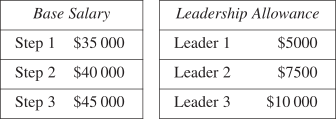
 

Rowan's employer pays 5% more than the enterprise agreement. He is on Step 2 and receives an allowance for Leader 1.

What is Rowan's gross monthly pay?

  1. $3575.50
  2. $3730.00
  3. $3937.50
  4. $4150.00
Show Answers Only

`C`

Show Worked Solution
♦ Mean mark 46%
`text(Gross annual pay)` `=(40\ 000+5000)xx1.05`
  `=$47\ 250`


`:.\ text(Gross monthly pay)` `=(47\ 250)/12`
  `=$3937.50`

 
`=>\ C`

Filed Under: Earning Money and Budgeting (Std 2-X) Tagged With: Band 5, num-title-ct-corea, num-title-qs-hsc, smc-1126-10-Wages, smc-4331-10-Wages, smc-4331-70-% increase/decrease, smc-810-10-Wages

HMS, HIC EQ-Bank 059

Evaluate the extent to which global sporting events influence the physical activity levels and health of young Australians.   (8 marks)

--- 22 WORK AREA LINES (style=lined) ---

Show Answers Only

Evaluation Statement

  • Global sporting events prove partially effective in increasing young Australians’ physical activity levels.
  • This evaluation examines immediate participation impacts and long-term behaviour change sustainability.

Immediate Participation Impact

  • Major sporting events adequately fulfil short-term motivation needs for youth activity.
  • Evidence supporting this includes 30% increases in junior sport registrations following Olympics and World Cups.
  • A critical strength is diverse sport exposure – young people discover activities like archery or skateboarding through global competitions.
  • Community sporting clubs report membership surges lasting 3-6 months post-events.
  • While strong in generating initial enthusiasm, it shows limitations in converting interest to lasting habits as most new participants drop out within one year.

Long-Term Behaviour Change

  • International competitions fail to achieve sustained physical activity improvements among youth.
  • The evidence indicates that inspiration from events rarely translates to permanent lifestyle changes.
  • Although effective for creating temporary motivation, it proves insufficient for addressing underlying barriers like cost and accessibility.
  • Better outcomes require ongoing local programs, not periodic global events. Research shows 80% return to pre-event activity levels within 12 months.

Final Evaluation

  • Weighing these factors shows global events create limited lasting impact on youth health.
  • The weaknesses outweigh strengths because temporary inspiration cannot overcome systematic barriers to participation.
  • The overall evaluation demonstrates need for consistent local initiatives rather than relying on international events to motivate young people.
  • Sustainable youth activity should focus on well funded, year-round community programs, not occasional global sporting spectacles.
Show Worked Solution

Evaluation Statement

  • Global sporting events prove partially effective in increasing young Australians’ physical activity levels.
  • This evaluation examines immediate participation impacts and long-term behaviour change sustainability.

Immediate Participation Impact

  • Major sporting events adequately fulfil short-term motivation needs for youth activity.
  • Evidence supporting this includes 30% increases in junior sport registrations following Olympics and World Cups.
  • A critical strength is diverse sport exposure – young people discover activities like archery or skateboarding through global competitions.
  • Community sporting clubs report membership surges lasting 3-6 months post-events.
  • While strong in generating initial enthusiasm, it shows limitations in converting interest to lasting habits as most new participants drop out within one year.

Long-Term Behaviour Change

  • International competitions fail to achieve sustained physical activity improvements among youth.
  • The evidence indicates that inspiration from events rarely translates to permanent lifestyle changes.
  • Although effective for creating temporary motivation, it proves insufficient for addressing underlying barriers like cost and accessibility.
  • Better outcomes require ongoing local programs, not periodic global events. Research shows 80% return to pre-event activity levels within 12 months.

Final Evaluation

  • Weighing these factors shows global events create limited lasting impact on youth health.
  • The weaknesses outweigh strengths because temporary inspiration cannot overcome systematic barriers to participation.
  • The overall evaluation demonstrates need for consistent local initiatives rather than relying on international events to motivate young people.
  • Sustainable youth activity should focus on well funded, year-round community programs, not occasional global sporting spectacles.

Filed Under: Aspects of young people's lives Tagged With: Band 4, Band 5, smc-5507-20-Family influence

HMS, HIC EQ-Bank 057

Evaluate how cultural influences affect the health and wellbeing of young people in Australia today compared to previous generations.   (8 marks)

--- 22 WORK AREA LINES (style=lined) ---

Show Answers Only

Evaluation Statement

  • Cultural influences prove partially effective in supporting young Australian’s health compared to previous generations.
  • This evaluation examines how living in a multicultural society promotes health and what effect social media has on these cultural influences for the current generation.

Multicultural exposure

  • Today’s multicultural communities offer young Australians access to numerous traditional and modern health practices.
  • Young people are often able to access traditional diets and healing practices alongside Western offerings. For example, young people today can gain exposure to Mediterranean diets, Asian mindfulness practices, and Indigenous connection to country.
  • Previous generations experienced limited cultural health perspectives. 
  • While strong in broadening health understanding, cultural influences can also have a negative influence on mental health wellbeing. An example is the identity confusion for some young people who find managing multiple cultures difficult.

Cultural influences on health and social media

  • Social media platforms are somewhat effective in promoting healthy behaviour through cultural movements.
  • Evidence supporting this includes #fitspo and wellness trends rapidly changing exercise habits among youth. Mental health movements like R U OK? reach millions, normalising help-seeking behaviours impossible for previous generations.
  • Although effective for spreading awareness, it proves less suitable for deep cultural understanding.
  • Previous generations developed deeper connections through direct community involvement. Despite social media’s wider reach, it fails to achieve the depth of authentic cultural interaction.

Final Evaluation

  • Weighing these factors shows cultural influences create mixed outcomes for today’s youth.
  • The strengths however outweigh the weaknesses because increased cultural awareness provides more health resources than previous generations accessed.
  • The overall evaluation demonstrates need for balance between digital exposure and authentic cultural engagement.
  • Young Australians benefit from unprecedented cultural diversity but require guidance to navigate competing influences effectively.
Show Worked Solution

Evaluation Statement

  • Cultural influences prove partially effective in supporting young Australian’s health compared to previous generations.
  • This evaluation examines how living in a multicultural society promotes health and what effect social media has on these cultural influences for the current generation.

Multicultural exposure

  • Today’s multicultural communities offer young Australians access to numerous traditional and modern health practices.
  • Young people are often able to access traditional diets and healing practices alongside Western offerings. For example, young people today can gain exposure to Mediterranean diets, Asian mindfulness practices, and Indigenous connection to country.
  • Previous generations experienced limited cultural health perspectives. 
  • While strong in broadening health understanding, cultural influences can also have a negative influence on mental health wellbeing. An example is the identity confusion for some young people who find managing multiple cultures difficult.

Cultural influences on health and social media

  • Social media platforms are somewhat effective in promoting healthy behaviour through cultural movements.
  • Evidence supporting this includes #fitspo and wellness trends rapidly changing exercise habits among youth. Mental health movements like R U OK? reach millions, normalising help-seeking behaviours impossible for previous generations.
  • Although effective for spreading awareness, it proves less suitable for deep cultural understanding.
  • Previous generations developed deeper connections through direct community involvement. Despite social media’s wider reach, it fails to achieve the depth of authentic cultural interaction.

Final Evaluation

  • Weighing these factors shows cultural influences create mixed outcomes for today’s youth.
  • The strengths however outweigh the weaknesses because increased cultural awareness provides more health resources than previous generations accessed.
  • The overall evaluation demonstrates need for balance between digital exposure and authentic cultural engagement.
  • Young Australians benefit from unprecedented cultural diversity but require guidance to navigate competing influences effectively.

Filed Under: Aspects of young people's lives Tagged With: Band 4, Band 5, smc-5507-40-Cultural influence

HMS, HIC EQ-Bank 056

Evaluate the extent to which family influence serves as both a risk and protective factor for young people's health today compared to previous generations.   (8 marks)

--- 22 WORK AREA LINES (style=lined) ---

Show Answers Only

Evaluation Statement

  • Family influence proves highly significant as both a risk factor and protective factor for youth health across generations.
  • This evaluation examines how families pass on both healthy habits and harmful behaviours.

Protective Health

  • Parents effectively teach healthy habits through their own actions.
  • Evidence supporting this includes declining youth smoking rates matching reduced parental smoking over 30 years.
  • A critical strength is parents’ improved health literacy creating better role models than previous generations. Today’s parents demonstrate superior nutrition knowledge and exercise habits.
  • While strong in physical health modelling, parents exhibit limitations in digital wellbeing guidance where they lack expertise.
  • Although effective for traditional health behaviours, they prove less suitable for modern challenges like social media management.

Harmful Patterns

  • Family dysfunction fails to achieve healthy environments for vulnerable youth.
  • For example, evidence indicates that exposure to domestic violence doubles young people’s risk of perpetrating abuse.
  • Intergenerational trauma patterns persist despite increased awareness and support services. Research shows a majority of young people from abusive homes will develop mental health issues.
  • Family violence rates remain consistent across generations, demonstrating insufficient progress.
  • This reveals comprehensive failure in breaking destructive cycles affecting youth wellbeing.

Final Evaluation

  • Weighing these factors shows family influence remains equally powerful across generations as both protector and risk creator.
  • The overall evaluation demonstrates families’ dual capacity hasn’t fundamentally changed despite societal evolution.
  • Modern families face new challenges but core influence mechanisms persist.
  • Implications suggest targeted family support programs are essential for maximising protective factors while minimising risks.
Show Worked Solution

Evaluation Statement

  • Family influence proves highly significant as both a risk factor and protective factor for youth health across generations.
  • This evaluation examines how families pass on both healthy habits and harmful behaviours.

Protective Health

  • Parents effectively teach healthy habits through their own actions.
  • Evidence supporting this includes declining youth smoking rates matching reduced parental smoking over 30 years.
  • A critical strength is parents’ improved health literacy creating better role models than previous generations. Today’s parents demonstrate superior nutrition knowledge and exercise habits.
  • While strong in physical health modelling, parents exhibit limitations in digital wellbeing guidance where they lack expertise.
  • Although effective for traditional health behaviours, they prove less suitable for modern challenges like social media management.

Harmful Patterns

  • Family dysfunction fails to achieve healthy environments for vulnerable youth.
  • For example, evidence indicates that exposure to domestic violence doubles young people’s risk of perpetrating abuse.
  • Intergenerational trauma patterns persist despite increased awareness and support services. Research shows a majority of young people from abusive homes will develop mental health issues.
  • Family violence rates remain consistent across generations, demonstrating insufficient progress.
  • This reveals comprehensive failure in breaking destructive cycles affecting youth wellbeing.

Final Evaluation

  • Weighing these factors shows family influence remains equally powerful across generations as both protector and risk creator.
  • The overall evaluation demonstrates families’ dual capacity hasn’t fundamentally changed despite societal evolution.
  • Modern families face new challenges but core influence mechanisms persist.
  • Implications suggest targeted family support programs are essential for maximising protective factors while minimising risks.

Filed Under: Aspects of young people's lives Tagged With: Band 4, Band 5, Band 6, smc-5507-20-Family influence

HMS, HIC EQ-Bank 055

Analyse how changes in family structure over generations have affected the health and wellbeing of young people.   (8 marks)

--- 22 WORK AREA LINES (style=lined) ---

Show Answers Only

*PEEL – Solution is structured using an adjusted PEEL method; [P] Identify components and their relationship, [E] explain the interaction/influence between them, [Ev] provide evidence showing the relationship in action, [L] linking sentence back to question.

  • [P] The shift from “nuclear” families to more diverse structures has had an effect on young people’s health choices.
  • [E] Different family structures come with different worldviews and this may entail conflicting health messages for young people.
  • [Ev] Young people in blended families can often receive different dietary rules from multiple households, causing confusion about healthy eating.
  • [L] This interaction demonstrates how structural diversity directly influences an individual’s health and their decision-making.
     
  • [P] Despite structural changes, good family communication is correlated to positive health outcomes.
  • [E] Young members of supportive families typically exhibit less risky behaviours no matter if their families are single-parent, blended, or traditional.
  • [Ev] For example, families with open communication significantly lower substance use across all family types, while poor communication doubles risky behaviours.
  • [L] These elements combine to produce health outcomes determined by relationship quality, not structure.
     
  • [P] Multigenerational living creates dual health impacts.
  • [E] On the positive side, this has improved young people’s access to health supervision and emotional support. However, on the negative side, intergenerational conflicts about health decisions and lifestyle choices can cause stress.
  • [Ev] This means that in practice, youth gain traditional health knowledge but can experience mental health challenges when grandparents oppose modern medical treatments.
  • [L] The broader impact shows intergenerational households influence both directly through care and indirectly through family tension.
     
  • [P] Parental supervision has become more complex with diverse family arrangements.
  • [E] The connection between multiple households and supervision can undermine the effective oversight of young people.
  • [Ev] Split families struggle coordinating aspects of home life like screen time limits, resulting in inconsistent health boundaries.
  • [L] Together, these factors increase the likelihood of unhealthy behaviours developing through supervision gaps.
Show Worked Solution

*PEEL – Solution is structured using an adjusted PEEL method; [P] Identify components and their relationship, [E] explain the interaction/influence between them, [Ev] provide evidence showing the relationship in action, [L] linking sentence back to question.

  • [P] The shift from “nuclear” families to more diverse structures has had an effect on young people’s health choices.
  • [E] Different family structures come with different worldviews and this may entail conflicting health messages for young people.
  • [Ev] Young people in blended families can often receive different dietary rules from multiple households, causing confusion about healthy eating.
  • [L] This interaction demonstrates how structural diversity directly influences an individual’s health and their decision-making.
     
  • [P] Despite structural changes, good family communication is correlated to positive health outcomes.
  • [E] Young members of supportive families typically exhibit less risky behaviours no matter if their families are single-parent, blended, or traditional.
  • [Ev] For example, families with open communication significantly lower substance use across all family types, while poor communication doubles risky behaviours.
  • [L] These elements combine to produce health outcomes determined by relationship quality, not structure.
     
  • [P] Multigenerational living creates dual health impacts.
  • [E] On the positive side, this has improved young people’s access to health supervision and emotional support. However, on the negative side, intergenerational conflicts about health decisions and lifestyle choices can cause stress.
  • [Ev] This means that in practice, youth gain traditional health knowledge but can experience mental health challenges when grandparents oppose modern medical treatments.
  • [L] The broader impact shows intergenerational households influence both directly through care and indirectly through family tension.
     
  • [P] Parental supervision has become more complex with diverse family arrangements.
  • [E] The connection between multiple households and supervision can undermine the effective oversight of young people.
  • [Ev] Split families struggle coordinating aspects of home life like screen time limits, resulting in inconsistent health boundaries.
  • [L] Together, these factors increase the likelihood of unhealthy behaviours developing through supervision gaps.

Filed Under: Aspects of young people's lives Tagged With: Band 5, smc-5507-20-Family influence, smkey-hsc-Analyse

HMS, HIC EQ-Bank 045 MC

How do young people's opinions on core issues typically relate to their parents' opinions?

  1. Young people consistently reject their parents' views on politics and religion.
  2. Young people's opinions often reflect those of their parents on core issues.
  3. The generation gap has eliminated any similarity in opinions between generations.
  4. Young people form opinions independently of their family's influence.
Show Answers Only

\(B\)

Show Worked Solution
  • B is correct as research shows that young people’s opinions often reflect those of their parents on core issues.

Other options:

  • A is incorrect as young people’s opinions often reflect their parents’ views.
  • C is incorrect because it is an overstatement of the generation gap.
  • D is incorrect because research points to the family having significant influence on younger family members.

Filed Under: Aspects of young people's lives Tagged With: Band 5, smc-5507-20-Family influence

HMS, HIC EQ-Bank 054

Compare and contrast how peer influence affects young people's health behaviours today with how it affected previous generations, using specific examples to support your answer.   (6 marks)

--- 18 WORK AREA LINES (style=lined) ---

Show Answers Only

Similarities

  • Both past and present generations rely heavily on peer influence for validating health behaviours (e.g. 1960s youth smoking together at social gatherings vs. today’s youth vaping because of social media trends).
  • Peers remain more influential than parents in both eras (e.g. 1970s teens joining protest movements despite parental disapproval vs. today’s teens following TikTok health challenges).
  • The fundamental need for peer acceptance continues to drive decision-making (e.g. 1980s fashion conformity within school cliques vs. today’s pursuit of social media likes and followers).

Differences

  • Previous generations experienced localised, face-to-face peer influence limited by geographic boundaries, while today’s youth experience global, constant digital influence through social media platforms.
  • Modern peer influence operates 24/7 through digital devices with greater permanence, whereas previous generations had intermittent influence limited to physical interactions.
  • Today, 80% of young people identify peers as their primary health information source (Mission Australia, 2023), whereas previous generations relied more on family and medical authorities.
  • Previous generations experienced greater parental filtering of peer influences, while today’s youth navigate more independent peer relationships online with less parental supervision.
  • Today’s digital focus on unattainable body standards and risky behaviours has intensified negative health impacts beyond what previous generations faced.
Show Worked Solution

Similarities

  • Both past and present generations rely heavily on peer influence for validating health behaviours (e.g. 1960s youth smoking together at social gatherings vs. today’s youth vaping because of social media trends).
  • Peers remain more influential than parents in both eras (e.g. 1970s teens joining protest movements despite parental disapproval vs. today’s teens following TikTok health challenges).
  • The fundamental need for peer acceptance continues to drive decision-making (e.g. 1980s fashion conformity within school cliques vs. today’s pursuit of social media likes and followers).

Differences

  • Previous generations experienced localised, face-to-face peer influence limited by geographic boundaries, while today’s youth experience global, constant digital influence through social media platforms.
  • Modern peer influence operates 24/7 through digital devices with greater permanence, whereas previous generations had intermittent influence limited to physical interactions.
  • Today, 80% of young people identify peers as their primary health information source (Mission Australia, 2023), whereas previous generations relied more on family and medical authorities.
  • Previous generations experienced greater parental filtering of peer influences, while today’s youth navigate more independent peer relationships online with less parental supervision.
  • Today’s digital focus on unattainable body standards and risky behaviours has intensified negative health impacts beyond what previous generations faced.

Filed Under: Aspects of young people's lives Tagged With: Band 4, Band 5, smc-5507-30-Peer influence

HMS, HIC EQ-Bank 053

Describe the changing patterns of youth culture across generations and the effect this has on young people's sense of identity and belonging.   (4 marks)

--- 10 WORK AREA LINES (style=lined) ---

Show Answers Only
  • Youth culture has evolved significantly, from the 1950s-60s rock and roll era, through the 1960s counterculture, 1970s punk movement, 1990s rave scene, to today’s social media-driven communities.
  • Each cultural movement is characterised by distinct music, fashion, and values that provide young people with visible means to express their identity and differentiate themselves from mainstream society.
  • These cultural expressions enable young people to establish connections with like-minded peers, creating a sense of belonging during the challenging adolescent years.
  • Despite changing forms across generations, youth cultures consistently serve as vehicles for identity formation, self-esteem and social belonging. In this way it fulfils the same psychological needs even as its form of expression evolves.
Show Worked Solution
  • Youth culture has evolved significantly, from the 1950s-60s rock and roll era, through the 1960s counterculture, 1970s punk movement, 1990s rave scene, to today’s social media-driven communities.
  • Each cultural movement is characterised by distinct music, fashion, and values that provide young people with visible means to express their identity and differentiate themselves from mainstream society.
  • These cultural expressions enable young people to establish connections with like-minded peers, creating a sense of belonging during the challenging adolescent years.
  • Despite changing forms across generations, youth cultures consistently serve as vehicles for identity formation, self-esteem and social belonging. In this way it fulfils the same psychological needs even as its form of expression evolves.

Filed Under: Aspects of young people's lives Tagged With: Band 5, smc-5507-40-Cultural influence

HMS, HIC EQ-Bank 052

Assess the extent to which technological advances have impacted the health and wellbeing of young Australians compared to previous generations.   (8 marks)

--- 22 WORK AREA LINES (style=lined) ---

Show Answers Only

Judgment Statement

  • Technological advances have produced moderately negative overall impacts on young Australians’ health and wellbeing.
  • This assessment examines mental health outcomes, physical activity levels, and global connectivity effects.

Mental Health Outcomes

  • Technology demonstrates poor effectiveness in supporting youth mental health.
  • Social media shows substantial negative impacts through comparison culture and cyberbullying.
  • Anxiety rates among teens have doubled since 2010, demonstrating a high negative impact compared to pre-digital generations.
  • The results indicate strong links between technology use and psychological distress.

Physical Activity Levels

  • Technology shows limited success in promoting active lifestyles.
  • While fitness apps exist, sedentary screen time dominates behaviour. Gaming disorder affects 10% of young males.
  • Previous generations spent 3 hours outdoors per day versus today’s 45 minutes.
  • Technology achieves minimal positive outcomes, with obesity rates tripling since 1980. This reveals major physical wellbeing deterioration.

Global Connectivity

  • Technology produces mixed results for global engagement.
  • Young Australians access diverse perspectives and educational resources impossible for previous generations.
  • However, constant exposure to global crises creates unprecedented stress.
  • The 24/7 news cycles increases anxiety about global issues like climate change and conflicts.
  • While connectivity offers valuable cultural exchange, information overload can prove moderately harmful to wellbeing.

Overall Assessment

  • On balance, technology proves moderately harmful despite connectivity benefits.
  • When all factors are considered, negative mental and physical impacts outweigh advantages.
  • This assessment highlights an urgent need for digital wellbeing education. Future generations require better technology management to protect health outcomes.
Show Worked Solution

Judgment Statement

  • Technological advances have produced moderately negative overall impacts on young Australians’ health and wellbeing.
  • This assessment examines mental health outcomes, physical activity levels, and global connectivity effects.

Mental Health Outcomes

  • Technology demonstrates poor effectiveness in supporting youth mental health.
  • Social media shows substantial negative impacts through comparison culture and cyberbullying.
  • Anxiety rates among teens have doubled since 2010, demonstrating a high negative impact compared to pre-digital generations.
  • The results indicate strong links between technology use and psychological distress.

Physical Activity Levels

  • Technology shows limited success in promoting active lifestyles.
  • While fitness apps exist, sedentary screen time dominates behaviour. Gaming disorder affects 10% of young males.
  • Previous generations spent 3 hours outdoors per day versus today’s 45 minutes.
  • Technology achieves minimal positive outcomes, with obesity rates tripling since 1980. This reveals major physical wellbeing deterioration.

Global Connectivity

  • Technology produces mixed results for global engagement.
  • Young Australians access diverse perspectives and educational resources impossible for previous generations.
  • However, constant exposure to global crises creates unprecedented stress.
  • The 24/7 news cycles increases anxiety about global issues like climate change and conflicts.
  • While connectivity offers valuable cultural exchange, information overload can prove moderately harmful to wellbeing.

Overall Assessment

  • On balance, technology proves moderately harmful despite connectivity benefits.
  • When all factors are considered, negative mental and physical impacts outweigh advantages.
  • This assessment highlights an urgent need for digital wellbeing education. Future generations require better technology management to protect health outcomes.

Filed Under: Aspects of young people's lives Tagged With: Band 4, Band 5, smc-5507-50-Technology, smkey-hsc-Assess

HMS, BM EQ-Bank 903

Evaluate the interrelationship between the digestive and endocrine systems when an athlete experiences pre-competition anxiety.   (8 marks)

--- 25 WORK AREA LINES (style=lined) ---

Show Answers Only

Sample Answer

Evaluation Statement:

  • The digestive-endocrine interrelationship proves moderately effective during pre-competition anxiety.
  • This evaluation examines stress response activation and digestive function changes.

Stress Response Effectiveness:

  • The endocrine system rapidly releases adrenaline and cortisol during anxiety.
  • These hormones increase heart rate and blood glucose for competition readiness.
  • Blood flow redirects from digestive organs to muscles within seconds.
  • This prepares athletes for explosive performance requirements.
  • Studies show moderate anxiety improves reaction times by 15-20%.
  • The endocrine response strongly meets performance preparation needs.

Digestive System Impact:

  • The digestive system significantly reduces function during anxiety.
  • Decreased enzyme production impairs nutrient breakdown before competition.
  • Dry mouth and nausea affect 70% of anxious athletes.
  • Stomach “butterflies” can distract from mental preparation.
  • Poor pre-competition nutrition absorption may limit energy availability.
  • This partially fulfils athlete needs, creating notable disadvantages.

Final Evaluation:

  • The interrelationship shows mixed effectiveness for athletic performance.
  • While the endocrine system excellently mobilises energy resources, digestive disruption creates real challenges.
  • Athletes who manage anxiety through breathing techniques show better system coordination.
  • The relationship proves most effective when anxiety remains moderate rather than excessive, allowing beneficial arousal without severe digestive problems.
Show Worked Solution

Sample Answer

Evaluation Statement:

  • The digestive-endocrine interrelationship proves moderately effective during pre-competition anxiety.
  • This evaluation examines stress response activation and digestive function changes.

Stress Response Effectiveness:

  • The endocrine system rapidly releases adrenaline and cortisol during anxiety.
  • These hormones increase heart rate and blood glucose for competition readiness.
  • Blood flow redirects from digestive organs to muscles within seconds.
  • This prepares athletes for explosive performance requirements.
  • Studies show moderate anxiety improves reaction times by 15-20%.
  • The endocrine response strongly meets performance preparation needs.

Digestive System Impact:

  • The digestive system significantly reduces function during anxiety.
  • Decreased enzyme production impairs nutrient breakdown before competition.
  • Dry mouth and nausea affect 70% of anxious athletes.
  • Stomach “butterflies” can distract from mental preparation.
  • Poor pre-competition nutrition absorption may limit energy availability.
  • This partially fulfils athlete needs, creating notable disadvantages.

Final Evaluation:

  • The interrelationship shows mixed effectiveness for athletic performance.
  • While the endocrine system excellently mobilises energy resources, digestive disruption creates real challenges.
  • Athletes who manage anxiety through breathing techniques show better system coordination.
  • The relationship proves most effective when anxiety remains moderate rather than excessive, allowing beneficial arousal without severe digestive problems.

Filed Under: Digestive and endocrine systems Tagged With: Band 5, Band 6, smc-5524-10-Stress

HMS, BM EQ-Bank 902

Analyse how chronic stress affects both the digestive and endocrine systems and the subsequent impact on an athlete's performance.   (8 marks)

--- 25 WORK AREA LINES (style=lined) ---

Show Answers Only

Sample Answer

Overview Statement:

  • Chronic stress affects both digestive and endocrine systems through elevated cortisol levels.
  • The main relationships involve hormone disruption, nutrient absorption problems, and metabolic changes.
  • These interactions result in significant performance decline in athletes.

Component Relationship 1:

  • The endocrine system’s cortisol production interacts with digestive function during chronic stress.
  • Elevated cortisol diverts blood flow away from digestive organs to muscles.
  • The pattern shows reduced enzyme production and slower nutrient breakdown.
  • Athletes experience poor vitamin and mineral absorption despite adequate diets.
  • Evidence indicates that stress hormones prioritise immediate survival over digestion.
  • Therefore athletes cannot access nutrients needed for recovery and energy production.

Component Relationship 2:

  • Chronic cortisol elevation influences both growth hormone release and insulin sensitivity.
  • High cortisol prevents muscle protein synthesis while causing muscle breakdown for energy.
  • Research reveals how the endocrine system’s stress response works against recovery.
  • Reduced insulin sensitivity leads to poor glucose uptake by muscles.
  • Consequently, athletes experience fatigue and decreased strength gains.
  • The implication is that hormonal imbalance creates multiple energy problems.

Implications and Synthesis:

  • Both systems work together creating compound effects on performance.
  • Poor nutrient absorption combines with hormonal disruption to impair recovery.
  • Analysis demonstrates how chronic stress affects many body functions at the same time.
  • Therefore, managing stress becomes essential for athletic success.
  • The overall significance is that when systems work together, stress causes more damage than expected.
Show Worked Solution

Sample Answer

Overview Statement:

  • Chronic stress affects both digestive and endocrine systems through elevated cortisol levels.
  • The main relationships involve hormone disruption, nutrient absorption problems, and metabolic changes.
  • These interactions result in significant performance decline in athletes.

Component Relationship 1:

  • The endocrine system’s cortisol production interacts with digestive function during chronic stress.
  • Elevated cortisol diverts blood flow away from digestive organs to muscles.
  • The pattern shows reduced enzyme production and slower nutrient breakdown.
  • Athletes experience poor vitamin and mineral absorption despite adequate diets.
  • Evidence indicates that stress hormones prioritise immediate survival over digestion.
  • Therefore athletes cannot access nutrients needed for recovery and energy production.

Component Relationship 2:

  • Chronic cortisol elevation influences both growth hormone release and insulin sensitivity.
  • High cortisol prevents muscle protein synthesis while causing muscle breakdown for energy.
  • Research reveals how the endocrine system’s stress response works against recovery.
  • Reduced insulin sensitivity leads to poor glucose uptake by muscles.
  • Consequently, athletes experience fatigue and decreased strength gains.
  • The implication is that hormonal imbalance creates multiple energy problems.

Implications and Synthesis:

  • Both systems work together creating compound effects on performance.
  • Poor nutrient absorption combines with hormonal disruption to impair recovery.
  • Analysis demonstrates how chronic stress affects many body functions at the same time.
  • Therefore, managing stress becomes essential for athletic success.
  • The overall significance is that when systems work together, stress causes more damage than expected.

Filed Under: Digestive and endocrine systems Tagged With: Band 4, Band 5, smc-5524-10-Stress

HMS, BM EQ-Bank 895

Explain how the digestive, endocrine and muscular systems work together to produce muscle growth during an 8-week strength training program.   (5 marks)

--- 15 WORK AREA LINES (style=lined) ---

Show Answers Only

Sample Answer

Nutrient processing:

  • The digestive system breaks down dietary protein into amino acids.
  • These amino acids enter the bloodstream for transport to muscles.
  • As a result, building blocks for new muscle tissue become available.
  • Carbohydrates digest into glucose which provides energy for training sessions.

Hormonal control:

  • Weight training triggers the endocrine system to release growth hormone.
  • This hormone signals muscles to use amino acids for protein synthesis.
  • After meals, insulin release facilitates nutrient entry into muscle cells.
  • These hormonal actions enable muscles to repair and grow larger.

Muscle adaptation:

  • Training causes tiny tears in muscle fibres during each session.
  • This damage stimulates the need for repair using available amino acids.
  • Consequently, muscles rebuild stronger and larger over time.
  • The endocrine system controls this rebuilding through hormone release.

System coordination:

  • The interaction shows that muscle growth needs all three systems working together.
  • Digestive system provides materials while endocrine system controls their use.
  • Meanwhile, muscular system responds to training stress and hormonal signals.
  • Therefore, consistent nutrition and training over 8 weeks produces visible muscle growth.
Show Worked Solution

Sample Answer

Nutrient processing:

  • The digestive system breaks down dietary protein into amino acids.
  • These amino acids enter the bloodstream for transport to muscles.
  • As a result, building blocks for new muscle tissue become available.
  • Carbohydrates digest into glucose which provides energy for training sessions.

Hormonal control:

  • Weight training triggers the endocrine system to release growth hormone.
  • This hormone signals muscles to use amino acids for protein synthesis.
  • After meals, insulin release facilitates nutrient entry into muscle cells.
  • These hormonal actions enable muscles to repair and grow larger.

Muscle adaptation:

  • Training causes tiny tears in muscle fibres during each session.
  • This damage stimulates the need for repair using available amino acids.
  • Consequently, muscles rebuild stronger and larger over time.
  • The endocrine system controls this rebuilding through hormone release.

System coordination:

  • The interaction shows that muscle growth needs all three systems working together.
  • Digestive system provides materials while endocrine system controls their use.
  • Meanwhile, muscular system responds to training stress and hormonal signals.
  • Therefore, consistent nutrition and training over 8 weeks produces visible muscle growth.

Filed Under: Body systems working together Tagged With: Band 4, Band 5, smc-5526-10-Muscular/skeletal, smc-5526-25-Digestive/endocrine

HMS, BM EQ-Bank 893

A competitive swimmer has just consumed a pre-race meal two hours before an important race.

Describe how the digestive and endocrine systems work with the nervous and muscular systems to prepare the body for this high-intensity performance.   (5 marks)

--- 16 WORK AREA LINES (style=lined) ---

Show Answers Only

Sample Answer

Meal digestion (first hour):

  • Stomach and intestines break down carbohydrates into glucose
  • Proteins digest into amino acids for muscle support
  • Fats are processed slowly for sustained energy

Nutrient absorption and storage:

  • Blood glucose levels rise as nutrients enter bloodstream
  • Insulin release facilitates glucose uptake into muscles
  • Muscle glycogen stores increase in preparation
  • Amino acids circulate for muscle repair needs

Pre-race nervous activation (approaching race):

  • Nervous system reduces digestive activity
  • Blood flow shifts from stomach to muscles
  • Alertness and focus increase
  • Stress hormones begin releasing

Hormonal preparation:

  • Adrenaline elevates heart rate and breathing
  • Cortisol mobilises additional energy stores
  • Blood glucose rises for immediate use
  • Muscles become more sensitive to nerve signals

System coordination features:

  • Digestive system provides fuel while nervous system times its use
  • Hormones link all systems together
  • Muscles receive nutrients through blood while preparing for action
  • All four systems synchronise for optimal race readiness
Show Worked Solution

Sample Answer

Meal digestion (first hour):

  • Stomach and intestines break down carbohydrates into glucose
  • Proteins digest into amino acids for muscle support
  • Fats are processed slowly for sustained energy

Nutrient absorption and storage:

  • Blood glucose levels rise as nutrients enter bloodstream
  • Insulin release facilitates glucose uptake into muscles
  • Muscle glycogen stores increase in preparation
  • Amino acids circulate for muscle repair needs

Pre-race nervous activation (approaching race):

  • Nervous system reduces digestive activity
  • Blood flow shifts from stomach to muscles
  • Alertness and focus increase
  • Stress hormones begin releasing

Hormonal preparation:

  • Adrenaline elevates heart rate and breathing
  • Cortisol mobilises additional energy stores
  • Blood glucose rises for immediate use
  • Muscles become more sensitive to nerve signals

System coordination features:

  • Digestive system provides fuel while nervous system times its use
  • Hormones link all systems together
  • Muscles receive nutrients through blood while preparing for action
  • All four systems synchronise for optimal race readiness

Filed Under: Body systems working together Tagged With: Band 4, Band 5, smc-5526-10-Muscular/skeletal, smc-5526-15-Nervous, smc-5526-25-Digestive/endocrine

HMS, BM EQ-Bank 891 MC

A tennis player becomes dehydrated during a five-set match on a hot day. How do the digestive, endocrine, and circulatory systems interact in response to this physiological challenge?

  1. The digestive system increases nutrient absorption, the endocrine system decreases water-conserving hormones, and the circulatory system redistributes blood to the skin
  2. The digestive system reduces water absorption, the endocrine system increases water-conserving hormones, and the circulatory system reduces blood flow to working muscles
  3. The digestive system slows peristalsis, the endocrine system increases cortisol production, and the circulatory system increases blood flow to the digestive tract
  4. The digestive system reduces peristalsis, the endocrine system increases water-conserving hormones, and the circulatory system redirects blood flow to vital organs
Show Answers Only

\(D\)

Show Worked Solution
  • D is correct: During dehydration, digestion slows to conserve water, hormones help retain water, and blood flow prioritises vital organs.

Other Options:

  • A is incorrect: Water-conserving hormones increase (not decrease) during dehydration, and blood flow is redirected away from the skin to vital organs.
  • B is incorrect: The digestive system would attempt to maximise (not reduce) water absorption during dehydration.
  • C is incorrect: Blood flow to the digestive tract is reduced (not increased) during dehydration as the body prioritises vital organs.

Filed Under: Body systems working together Tagged With: Band 5, smc-5526-20-Respiratory/circulatory, smc-5526-25-Digestive/endocrine

  • « Previous Page
  • 1
  • …
  • 11
  • 12
  • 13
  • 14
  • 15
  • …
  • 82
  • Next Page »

Copyright © 2014–2025 SmarterEd.com.au · Log in