SmarterEd

Aussie Maths & Science Teachers: Save your time with SmarterEd

  • Login
  • Get Help
  • About

CHEMISTRY, M8 2020 HSC 30

A chemist discovered a bottle simply labelled \( '\ce{C5H10O2}' \).

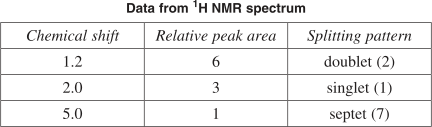
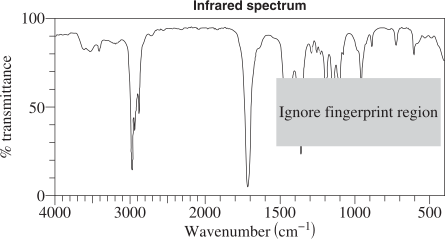
To confirm the molecular structure of the contents of the bottle, a sample was submitted for analysis by infrared spectroscopy and \( \ce{^1H} \)  and \( \ce{^13C NMR} \) spectroscopy. The resulting spectra are shown.


Draw a structural formula for the unknown compound that is consistent with all of the information provided. Justify your answer with reference to the information provided.   (7 marks)

--- 20 WORK AREA LINES (style=lined) ---

Show Answers Only

Infrared Spectrum

  • There’s a signal between 1680 – 1750 cm ¯1, indicating the presence of a  \( \ce{C=O} \)  bond (consistent with carbonyl group).
  • No absorption at 3230 − 3550 cm ¯1 indicates the absence of the  \( \ce{O-H} \)   bond (rules out carboxylic acid\( \ce{-COOH} \)). 
  •    \( \ce{^13C NMR} \):
  • The \( \ce{^13C NMR} \) spectrum has 4 peaks, indicating that there are 4 unique carbon environments in the compound.
  • This is consistent with the proposed structure of the compound.
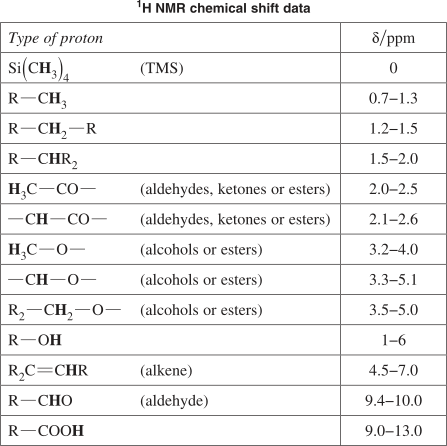
  • The peak at 170 ppm is characteristic of the carbonyl carbon, and the peak at 70 ppm corresponds to a carbon nucleus adjacent to an oxygen, which confirms the presence of an ester group. 

The \( \ce{^1H NMR} \) Spectrum:

  • A septet in the \( \ce{^1H NMR} \) spectrum is consistent with the presence of six neighbouring hydrogen atoms on two \( \ce{CH3} \) groups.
  • A doublet in the spectrum is consistent with one neighbouring hydrogen atom.
  • The combination of a septet and a doublet is consistent with the presence of a  \( \ce{-CH(CH3)2} \)  group in the compound.
  • A singlet in the spectrum is consistent with the absence of neighbouring hydrogen atoms, which would be produced by an isolated methyl group.
Show Worked Solution

Infrared Spectrum

  • There’s a signal between 1680 – 1750 cm ¯1, indicating the presence of a  \( \ce{C=O} \)  bond (consistent with carbonyl group).
  • No absorption at 3230 − 3550 cm ¯1 indicates the absence of the  \( \ce{O-H} \)   bond (rules out carboxylic acid\( \ce{-COOH} \)). 
  •    \( \ce{^13C NMR} \):
  • The \( \ce{^13C NMR} \) spectrum has 4 peaks, indicating that there are 4 unique carbon environments in the compound.
  • This is consistent with the proposed structure of the compound.
  • The peak at 170 ppm is characteristic of the carbonyl carbon, and the peak at 70 ppm corresponds to a carbon nucleus adjacent to an oxygen, which confirms the presence of an ester group. 

The \( \ce{^1H NMR} \) Spectrum:

  • A septet in the \( \ce{^1H NMR} \) spectrum is consistent with the presence of six neighbouring hydrogen atoms on two \( \ce{CH3} \) groups.
  • A doublet in the spectrum is consistent with one neighbouring hydrogen atom.
  • The combination of a septet and a doublet is consistent with the presence of a  \( \ce{-CH(CH3)2} \)  group in the compound.
  • A singlet in the spectrum is consistent with the absence of neighbouring hydrogen atoms, which would be produced by an isolated methyl group.

Mean mark 55%.
Filed Under: Organic Substances Tagged With: Band 4, Band 5, smc-3683-50-Combining Techniques

CHEMISTRY, M6 2020 HSC 28

A chemist used the following method to determine the concentration of a dilute solution of propanoic acid `(pK_(a)=4.88)`.

The chemist weighed out 1.000 g of solid `text{NaOH}` on an electronic balance and then made up the solution in a 250.0 mL volumetric flask.

The chemist then performed titrations, using bromocresol green as the indicator. This indicator is yellow below pH 3.2 and green above pH 5.2.

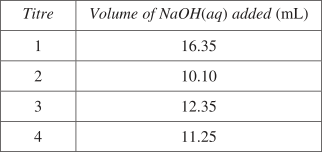
The results are shown in the table.


Explain why this method produces inaccurate and unreliable results.   (3 marks)

--- 8 WORK AREA LINES (style=lined) ---

Show Answers Only
  • `text{NaOH}` is hygroscopic and cannot be accurately used as a primary standard in titration experiments.
  • When the solid `text{NaOH}` is weighed, it will have absorbed water from the atmosphere, which means that the solution made from it will be more dilute than expected.
  • Furthermore, because this is a titration between a weak acid and a strong base which produces a basic salt, the pH at the equivalence point will be greater than 7.
  • Using Bromocresol green as an indicator in this case would not be suitable because it changes colour in the pH range of 3.2–5.2. This is the flat region of the titration curve, before the equivalence point.
  • The results of the titration are also unreliable because the indicator used produces a non-sharp endpoint, resulting in significantly different titres in each titration.
Show Worked Solution
  • `text{NaOH}` is hygroscopic and cannot be accurately used as a primary standard in titration experiments.
  • When the solid `text{NaOH}` is weighed, it will have absorbed water from the atmosphere, which means that the solution made from it will be more dilute than expected.
  • Furthermore, because this is a titration between a weak acid and a strong base which produces a basic salt, the pH at the equivalence point will be greater than 7.
  • Using Bromocresol green as an indicator in this case would not be suitable because it changes colour in the pH range of 3.2–5.2. This is the flat region of the titration curve, before the equivalence point.
  • The results of the titration are also unreliable because the indicator used produces a non-sharp endpoint, resulting in significantly different titres in each titration.

♦ Mean mark 48%.

Filed Under: Quantitative Analysis Tagged With: Band 5, smc-3675-10-Titration

BIOLOGY, M5 2020 HSC 26

One of the genes involved in determining the colour of a species of fish has two alleles: yellow and orange.

The diagram shows a pedigree chart for the inheritance of colour in the fish.
 

  1. Use the pedigree chart to explain why the yellow allele is recessive.   (2 marks)

    --- 5 WORK AREA LINES (style=lined) ---

  2. Explain how a cross between individuals `text{I}` and `text{II}` could be used to determine whether the inheritance of colour in the fish is sex-linked or autosomal.   (4 marks)

    --- 10 WORK AREA LINES (style=lined) ---

Show Answers Only

a.   The Yellow allele is recessive because:

  • Parents are both orange (exhibiting dominant allele).
  • Some offspring are yellow, indicating that the yellow allele is present in the parents but not expressed.
  • Therefore yellow allele must be recessive.

b.   If sex-linked Inheritance:

  • `text{I}` would be `text{X}^text{A}text{Y}` and `text{II}` would be `text{X}^text{a}text{X}^text{a}`.
  • A cross between these individuals will result in all male offspring being yellow (`text{X}^text{a}text{Y}`) and all female offspring being orange (`text{X}^text{A}text{X}^text{a}`), as shown by the punnet square below.

\begin{array} {|l|c|c|}
\hline  & \text{X}^\text{A} & \text{Y} \\
\hline \text{X}^\text{a} & \text{X}^\text{A}\text{X}^\text{a} & \text{X}^\text{a}\text{Y}\\
\hline \end{array}

Autosomal Inheritance

  • If the inheritance it autosomal, then `text{II}` would have genotype aa and `text{I}` either AA or Aa.
  • A cross between Aa and aa would result in 50% yellow and 50% orange fish, and a cross between AA and aa will result in all orange fish.
  • Both crosses will have orange fish offspring, but sex does not have any influence on inheritance.

Therefore, to determine the inheritance:

  • The absence of orange, male fish would be indicative of a sex-linked inheritance style.
  • The appearance of orange, male fish would confirm the inheritance is autosomal.
Show Worked Solution

a.   The Yellow allele is recessive because:

  • Parents are both orange (exhibiting dominant allele).
  • Some offspring are yellow, indicating that the yellow allele is present in the parents but not expressed.
  • Therefore yellow allele must be recessive.

If sex-linked Inheritance:

  • `text{I}` would be `text{X}^text{A}text{Y}` and `text{II}` would be `text{X}^text{a}text{X}^text{a}`.
  • A cross between these individuals will result in all male offspring being yellow (`text{X}^text{a}text{Y}`) and all female offspring being orange (`text{X}^text{A}text{X}^text{a}`), as shown by the punnet square below.

\begin{array} {|l|c|c|}
\hline  & \text{X}^\text{A} & \text{Y} \\
\hline \text{X}^\text{a} & \text{X}^\text{A}\text{X}^\text{a} & \text{X}^\text{a}\text{Y}\\
\hline \end{array}

Autosomal Inheritance

  • If the inheritance it autosomal, then `text{II}` would have genotype aa and `text{I}` either AA or Aa.
  • A cross between Aa and aa would result in 50% yellow and 50% orange fish, and a cross between AA and aa will result in all orange fish.
  • Both crosses will have orange fish offspring, but sex does not have any influence on inheritance.

Therefore, to determine the inheritance:

  • The absence of orange, male fish would be indicative of a sex-linked inheritance style.
  • The appearance of orange, male fish would confirm the inheritance is autosomal.

♦♦ Mean mark (b) 36%.

Filed Under: Genetic Variation / Inheritance Tagged With: Band 4, Band 5, smc-3648-10-Pedigrees, smc-3648-30-Sex Linkage, smc-3648-35-Autosomal

PHYSICS, M6 2018 HSC 22

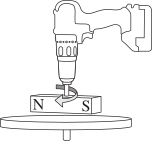
  1. A drill spins a magnet above a non-magnetic metal disc which is free to rotate.


    Explain the effect of the rotating magnet on the disc.   (3 marks)

--- 6 WORK AREA LINES (style=lined) ---

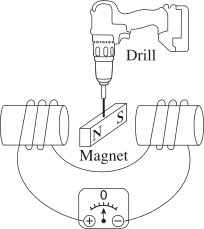
  1. The diagram shows a magnet attached to an electric drill so that it can be rotated between two coils connected to a voltmeter.


    The drill starts from rest and gradually speeds up, reaching its full speed after three revolutions.
     
    Sketch a graph showing the induced emf across the coils during the time that it takes the magnet to reach its full speed.   (3 marks)
     

--- 6 WORK AREA LINES (style=lined) ---

Show Answers Only

a.    Effect of rotating magnet:

  • The rotating magnet causes a changing magnetic flux in the metal disc.
  • This induces eddy currents (Faraday’s Law). By Lenz’s Law, these produce a magnetic field which opposes the change in flux by minimising the relative motion between the disc and the magnet.
  • This will have the effect of the disc rotating in the same direction as the magnet.

b.   


Show Worked Solution

a.    Effect of rotating magnet:

  • The rotating magnet causes a changing magnetic flux in the metal disc.
  • This induces eddy currents (Faraday’s Law). By Lenz’s Law, these produce a magnetic field which opposes the change in flux by minimising the relative motion between the disc and the magnet.
  • This will have the effect of the disc rotating in the same direction as the magnet.

b.   


♦ Mean mark (b) 50%.

Filed Under: Electromagnetic Induction Tagged With: Band 4, Band 5, smc-3705-20-Induced emf, smc-3705-40-Lenz and Faraday

PHYSICS, M5 2018 HSC 21

  1. Compare the force of gravity exerted on the moon by Earth with the force of gravity exerted on Earth by the moon.    (2 marks)

--- 3 WORK AREA LINES (style=lined) ---

  1. The acceleration due to gravity on the moon is `1.6 \ text{m s}^(-2)` and on Earth it is `9.8 \ text{m s}^(-2)`. Quantitatively compare the mass and weight of a 70 kg person on the moon and on Earth.   (2 marks)

--- 4 WORK AREA LINES (style=lined) ---

Show Answers Only

a.   Using Newton’s Third Law:

  • The force of gravity of the Earth on the moon is equal in magnitude and opposite in direction to the force of gravity exerted on Earth by the moon.
     

b.   Comparison of mass:

  • The mass of the person on both Earth and the moon is 70 kg.

Comparison of weight:

  • The weight of the person on Earth is given by  `W_e=mg=70 xx9.8=686\ text{N.}`
  • The weight of the person on the moon is given by  `W_m=mg=70xx1.6=112\ text{N.}`
  • The persons weight on Earth is greater than it is on the moon.
Show Worked Solution

a.   Using Newton’s Third Law:

  • The force of gravity of the Earth on the moon is equal in magnitude and opposite in direction to the force of gravity exerted on Earth by the moon.

♦♦ Mean mark (a) 33%.

b.   Comparison of mass:

  • The mass of the person on both Earth and the moon is 70 kg.

Comparison of weight:

  • The weight of the person on Earth is given by  `W_e=mg=70 xx9.8=686\ text{N.}`
  • The weight of the person on the moon is given by  `W_m=mg=70xx1.6=112\ text{N.}`
  • The persons weight on Earth is greater than it is on the moon.

Filed Under: Forces, Motion in Gravitational Fields Tagged With: Band 3, Band 5, smc-3692-10-Gravity between 2 objects, smc-4275-10-Using Newton's laws, smc-4275-30-Newton's 2nd Law

PHYSICS, M7 2018 HSC 19 MC

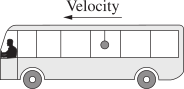
A mass was hanging from the roof of a bus that was travelling forward on a horizontal road at a constant velocity.
 

The string holding the mass was cut. At the same instant, the bus driver applied the brakes, causing the bus to slow down at a rate of `3\ text{m s}^(-2)`.

To an observer outside the bus, the mass follows a parabolic trajectory.

Which statement correctly describes the resulting motion of the mass observed from within the frame of reference of the moving bus?

  1. The mass travelled in a straight line vertically downwards.
  2. The mass travelled in a straight line downwards and towards the front of the bus.
  3. The mass travelled in a parabolic path downwards and towards the back of the bus.
  4. The mass travelled in a parabolic path downwards and towards the front of the bus.
Show Answers Only

`B`

Show Worked Solution
  • From the perspective of an observer on the bus, the ball has both a downwards acceleration due to gravity and a relative forwards acceleration due to the slowdown of the bus.
  • Since the mass has an initial velocity of zero (relative to the observer on the bus), the mass will travel in a straight line in the direction of this acceleration.

`=>B`


♦♦ Mean mark 39%.

Filed Under: Light and Special Relativity Tagged With: Band 5, smc-3699-40-Einstein's Postulates

PHYSICS, M6 2018 HSC 13 MC

An electron moves in a circular path with radius \(r\) in a magnetic field as shown.
 

If the speed of the electron is increased, which row of the table correctly shows the effects of this change?

\begin{align*}
\begin{array}{l}
\rule{0pt}{2.5ex} \ \rule[-1ex]{0pt}{0pt}& \\
\rule{0pt}{2.5ex}\textbf{A.}\rule[-1ex]{0pt}{0pt}\\
\rule{0pt}{2.5ex}\textbf{B.}\rule[-1ex]{0pt}{0pt}\\
\rule{0pt}{2.5ex}\textbf{C.}\rule[-1ex]{0pt}{0pt}\\
\rule{0pt}{2.5ex}\textbf{D.}\rule[-1ex]{0pt}{0pt}\\
\end{array}
\begin{array}{|l|l|}
\hline
\rule{0pt}{2.5ex}\quad \textit{Force on electron}\quad\rule[-1ex]{0pt}{0pt}& \quad \textit{Radius of path} \quad\\
\hline
\rule{0pt}{2.5ex}\text{Increases}\rule[-1ex]{0pt}{0pt}&\text{Decreases}\\
\hline
\rule{0pt}{2.5ex}\text{Increases}\rule[-1ex]{0pt}{0pt}& \text{Increases}\\
\hline
\rule{0pt}{2.5ex}\text{Decreases}\rule[-1ex]{0pt}{0pt}& \text{Decreases} \\
\hline
\rule{0pt}{2.5ex}\text{Decreases}\rule[-1ex]{0pt}{0pt}& \text{Increases} \\
\hline
\end{array}
\end{align*} 

Show Answers Only

\(B\)

Show Worked Solution
  • Using the formula  \(F=qvB\), increasing the speed of the electron increases the force acting on it.
  • The centripetal force acting on the electron is given by the force it experiences due to the magnetic field:
  •    \(\dfrac{m v^2}{r}=q v B \Rightarrow r=\dfrac{m v}{q B} \Rightarrow r \propto v\)
  • Increasing the speed of the electron increases its radius.

\(\Rightarrow B\)


Mean mark 53%.

Filed Under: Charged Particles, Conductors and Electric/Magnetic Fields Tagged With: Band 5, smc-3693-15-Charged Particles in MF, smc-3693-65-Uniform Circular Motion

PHYSICS, M6 2018 HSC 12 MC

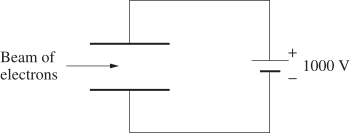
The diagram shows electrons travelling in a vacuum at  `2 × 10^6 \ text{m s}^(-1)`  between two charged metal plates  `1 × 10^-3\ text{m}`  apart.
 

A magnetic field is to be applied to make the electrons continue to travel in a straight line.

What is the magnitude and direction of the magnetic field that is to be applied?

  1. `5 × 10^-1 \ text {T}`  into the page
  2. `5  × 10^-1 \ text {T}`  out of the page
  3. `1 × 10^6 \ text {T}`  into the page
  4. `1 × 10^6 \ text {T}`  out of the page
Show Answers Only

`A`

Show Worked Solution
  • There will be an upwards force (towards the positive plate) on the electrons due to the electric field.
  • Using the right hand palm rule, the magnetic field must be into the page to produce a downwards force and balance the upwards force.
  • Since the magnitudes of electric and magnetic force are equal:
`qE` `=qvB`  
`B` `=(E)/(v)=((1000)/(1xx10^(-3)))/(2xx10^(6))=5xx10^(-1)\ text{T}`  

 
`=>A`


♦ Mean mark 48%.

Filed Under: Charged Particles, Conductors and Electric/Magnetic Fields Tagged With: Band 5, smc-3693-18-Combination EF and MF

PHYSICS, M6 2018 HSC 10 MC

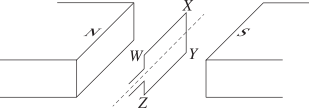
The diagram shows some parts of a simple DC motor.
 

Which row of the table correctly describes the direction of force acting on side \(WX\) and the direction of torque this produces on the coil?
 

\begin{align*}
\begin{array}{l}
\rule{0pt}{1.5ex}\textit{} & \textit{} \\
\textit{}\rule[.5ex]{0pt}{0pt}& \textit{} \\
\rule{0pt}{2.5ex}\textbf{A.}\rule[-1ex]{0pt}{0pt}\\
\rule{0pt}{2.5ex}\textbf{B.}\rule[-1ex]{0pt}{0pt}\\
\rule{0pt}{2.5ex}\textbf{C.}\rule[-1ex]{0pt}{0pt}\\
\rule{0pt}{2.5ex}\textbf{D.}\rule[-1ex]{0pt}{0pt}\\
\end{array}
\begin{array}{|l|l|}
\hline
\rule{0pt}{1.5ex}\textit{Direction of force acting} & \textit{Direction of torque produced on the} \\
\quad \quad \quad \quad \textit{on WX}\rule[.5ex]{0pt}{0pt}& \quad \textit{coil by the force acting on WX} \\
\hline
\rule{0pt}{2.5ex}\text{Remains constant}\rule[-1ex]{0pt}{0pt}&\text{Remains constant}\\
\hline
\rule{0pt}{2.5ex}\text{Remains constant}\rule[-1ex]{0pt}{0pt}& \text{Reverses every 180°}\\
\hline
\rule{0pt}{2.5ex}\text{Reverses every 180°}\rule[-1ex]{0pt}{0pt}& \text{Remains constant} \\
\hline
\rule{0pt}{2.5ex}\text{Reverses every 180°}\rule[-1ex]{0pt}{0pt}& \text{Reverses every 180°} \\
\hline
\end{array}
\end{align*}

Show Answers Only

\(C\)

Show Worked Solution
  • To ensure the motor rotates continuously in one direction, the direction of torque must remain constant.
  • So, the split ring commutator switches the direction of the current through the coil every 180°, reversing the direction of the force on \(WX\) every 180°.

\(\Rightarrow C\)


Mean mark 52%.

Filed Under: Applications of the Motor Effect Tagged With: Band 5, smc-3695-10-Torque, smc-3695-30-DC motor components

PHYSICS, M5 2018 HSC 7 MC

A planet `X` has twice the mass and twice the radius of Earth.

What is the magnitude of the gravitational acceleration close to the surface of planet `X`?

  1. `(1)/(2)  g`
  2. `1\ g`
  3. `2\ g`
  4. `4\ g`
Show Answers Only

`A`

Show Worked Solution

Suppose Earth has a mass of `M` and a radius of `r`:

`F=mg_1=(GMm)/(r^2)\ \ => \ \ g_1=(GM)/(r^2)`
 

If `X` has a mass of `2M` and a radius of `2r`:

`g_2` `=(2GM)/((2r)^2)`  
  `=(2GM)/(4r^2)`  
  `=(GM)/(2r^2)`  
  `=(g_1)/(2)`  

 
`=>A`


Mean mark 53%.

Filed Under: Motion in Gravitational Fields Tagged With: Band 5, smc-3692-15-Gravitational field strength

PHYSICS, M6 2018 HSC 4 MC

A motor, battery and ammeter are connected in series. When the motor is turning at full speed, the ammeter has a reading of 0.1 A. While the motor is spinning, a person holds the shaft of the motor to stop it.

Which row of the table correctly identifies the change in the ammeter reading and an explanation for the change?
 

\begin{align*}
\begin{array}{l}
\rule{0pt}{1.5ex} \ \rule[-0.5ex]{0pt}{0pt}& \\
\rule{0pt}{2.5ex}\textbf{A.}\rule[-1ex]{0pt}{0pt}\\
\rule{0pt}{2.5ex}\textbf{B.}\rule[-1ex]{0pt}{0pt}\\
\rule{0pt}{2.5ex}\textbf{C.}\rule[-1ex]{0pt}{0pt}\\
\rule{0pt}{2.5ex}\textbf{D.}\rule[-1ex]{0pt}{0pt}\\
\end{array}
\begin{array}{|l|l|}
\hline
\rule{0pt}{1.5ex}\ \ \ \textit{Reading on ammeter}\rule[-0.5ex]{0pt}{0pt}& \quad \ \ \textit{Explanation} \\
\hline
\rule{0pt}{2.5ex}\text{Decreases}\rule[-1ex]{0pt}{0pt}&\text{Decrease in back emf}\\
\hline
\rule{0pt}{2.5ex}\text{Increases}\rule[-1ex]{0pt}{0pt}& \text{Increase in back emf}\\
\hline
\rule{0pt}{2.5ex}\text{Decreases}\rule[-1ex]{0pt}{0pt}& \text{Increase in back emf} \\
\hline
\rule{0pt}{2.5ex}\text{Increases}\rule[-1ex]{0pt}{0pt}& \text{Decrease in back emf} \\
\hline
\end{array}
\end{align*}

Show Answers Only

\(D\)

Show Worked Solution

Results of holding the motor still:

  • Decrease in the rate of change of flux through the coil.
  • Decrease in induced back EMF.
  • As this induced back EMF opposes the supplied current (Lenz’s Law), the reading on the ammeter will increase.

\(\Rightarrow D\)


♦ Mean mark 50%.

Filed Under: Applications of the Motor Effect Tagged With: Band 5, smc-3695-20-Back emf

CHEMISTRY, M5 2020 HSC 27

A student makes up a solution of propan-2-amine in water with a concentration of 1.00 mol L ¯1.

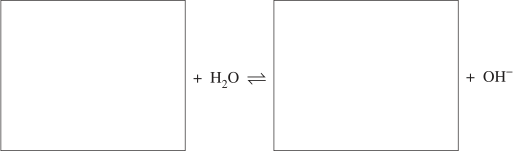
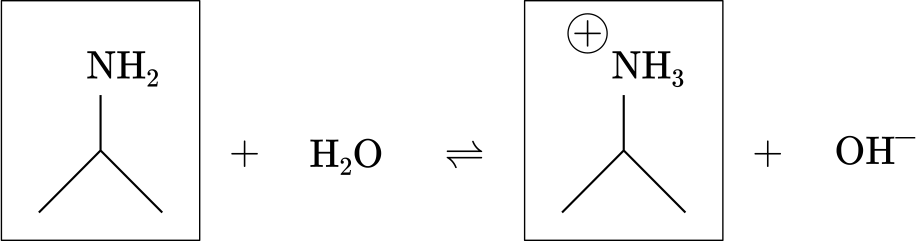
  1. Using structural formulae, complete the equation for the reaction of propan-2-amine with water.   (2 marks)
     
         
  2. The equilibrium constant for the reaction of propan-2-amine with water is  `4.37 xx10^(-4)`.
  3. Calculate the concentration of hydroxide ions in this solution.   (3 marks)

    --- 5 WORK AREA LINES (style=lined) ---

Show Answers Only

a.   


b.   

\begin{array} {|l|c|c|c|}
\hline  & \ce{C3H7NH2} & \ce{C3H7NH3} & \ce{OH–} \\
\hline \text{Initial} & 1.00 & 0 & 0 \\
\hline \text{Change} & -x & +x & +x \\
\hline \text{Equilibrium} & 1.00-x & x & x \\
\hline \end{array}

 
\[ K_b = \ce{\frac{[C3H7NH3+][OH– ]}{[C3H7NH2 ]}} = \frac{x^2}{(1.00-x)} \]

Assume `1.00-x=1.00` because `x` is negligible:

`4.37 xx 10^(−4)` `= x^2 / 1.00`  
`x` `=sqrt(4.37 xx 10^(−4))`  
  `= 0.0209\ text{mol L}^(–1)`  

 
`=> [text{OH}^– ] = 0.0209\ text{mol L}^(–1)`

Show Worked Solution

a.   


♦ Mean mark (a) 48%.

b.   

\begin{array} {|l|c|c|c|}
\hline  & \ce{C3H7NH2} & \ce{C3H7NH3} & \ce{OH–} \\
\hline \text{Initial} & 1.00 & 0 & 0 \\
\hline \text{Change} & -x & +x & +x \\
\hline \text{Equilibrium} & 1.00-x & x & x \\
\hline \end{array}

 
\[ K_b = \ce{\frac{[C3H7NH3+][OH– ]}{[C3H7NH2 ]}} = \frac{x^2}{(1.00-x)} \]

Assume `1.00-x=1.00` because `x` is negligible:

`4.37 xx 10^(−4)` `= x^2 / 1.00`  
`x` `=sqrt(4.37 xx 10^(−4))`  
  `= 0.0209\ text{mol L}^(–1)`  

 
`=> [text{OH}^– ] = 0.0209\ text{mol L}^(–1)`


Mean mark (b) 51%.

Filed Under: Bronsted-Lowry Theory, Equilibrium Constant, Reactions of Organic Acids and Bases Tagged With: Band 5, smc-3671-20-Calcs given K(eq), smc-3671-40-K(eq) and pH, smc-3671-50-Acids and bases, smc-3674-10-Calculations Involving pH, smc-3674-18-Dissociation in Water, smc-3680-60-Reactions of Organic Acids and Bases

CHEMISTRY, M6 2020 HSC 25

Citric acid reacts with sodium hydroxide according to the following chemical equation:

\( \ce{C6H8O7(aq) + 3NaOH(aq) -> Na3C6H5O7(aq) + 3H2O(l)} \)

Various volumes of 1.0 mol L¯1 citric acid solution were mixed with 8.0 mL of a sodium hydroxide solution of unknown concentration and sufficient deionised water added to make the total volume of the resulting solution 14.0 mL. The change in temperature of each solution was measured.

The data are given in the table.


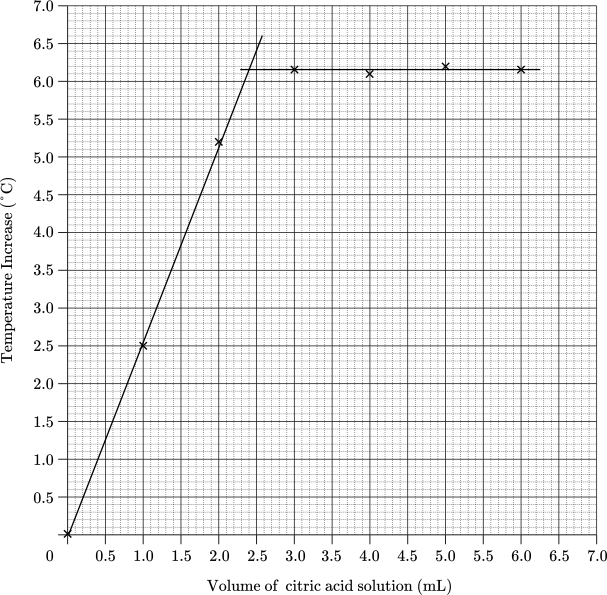
By graphing the data in the table and performing relevant calculations, determine the concentration of the sodium hydroxide solution.   (7 marks)
 

--- 5 WORK AREA LINES (style=lined) ---

Show Answers Only

`text{n(citric acid)} = c xx V = (1.0) xx (2.4 xx 10^(−3))  = 2.4 xx 10^(−3)\ text{mol}`

`text{n(sodium hydroxide)} = 3 xx (2.4 xx 10^(−3)) = 7.2 xx 10^(−3)\ text{mol}`

`text{[sodium hydroxide]} = [7.2 xx 10^(−3)] / [8.0 xx 10^(−3)] = 0.90\ text{mol L}^(–1)`

Show Worked Solution

`text{n(citric acid)} = c xx V = (1.0) xx (2.4 xx 10^(−3))  = 2.4 xx 10^(−3)\ text{mol}`

`text{n(sodium hydroxide)} = 3 xx (2.4 xx 10^(−3)) = 7.2 xx 10^(−3)\ text{mol}`

`text{[sodium hydroxide]} = [7.2 xx 10^(−3)] / [8.0 xx 10^(−3)] = 0.90\ text{mol L}^(–1)`


♦ Mean mark 53%.

Filed Under: Properties of Acids and Bases Tagged With: Band 5, smc-3673-20-Enthalpy of Neutralisation, smc-3673-40-Neutralisation Reactions

CHEMISTRY, M5 2022 HSC 36

Consider the equilibrium system shown.

 \( \ce{H2O(l) \rightleftharpoons H2O(g)} \)

In a laboratory at 23°C, a 100 mL sample of water is held in a beaker and another 100 mL sample is held in a sealed bottle.

Explain the differences in evaporation for these TWO samples. In your answer, consider changes in enthalpy and entropy for this process.   (4 marks)

--- 11 WORK AREA LINES (style=lined) ---

Show Answers Only
  • The evaporation of water absorbs energy, hence is an endothermic reaction and results in a positive change in enthalpy (`ΔH > 0`).
  • Additionally, the process converts a liquid into a gaseous state, and thus increases the disorder of the system, as a result, entropy increases (`ΔS > 0`).
  • Since enthalpy and entropy are both positive, according to `ΔG = ΔH − T ΔS`, the evaporation of water is spontaneous at high temperatures, ie when `ΔG < 0`. 

Beaker sample:

  • The evaporation of water in a beaker represents an open system, where vapour molecules are able to escape the system.
  • As a result, there would be a continuous disturbance to the equilibrium, and according to Le Chatelier’s Principle, the equilibrium will shift to counteract the change, and thus produce more gaseous water until there is no liquid water left.
  • Thus, dynamic equilibrium will not be established in a beaker. 

Sealed bottle sample:

  • On the other hand, the evaporation of water in a sealed bottle represents a closed system where the water vapour cannot escape from the system.
  • In this reaction liquid water would evaporate, shifting the equilibrium to the right until the rate of the forward reaction and the rate of the reverse reaction is equal.
  • At this point, there would be virtually no change in the concentration of liquid water and gaseous water, and thus dynamic equilibrium will be established.
Show Worked Solution
  • The evaporation of water absorbs energy, hence is an endothermic reaction and results in a positive change in enthalpy (`ΔH > 0`).
  • Additionally, the process converts a liquid into a gaseous state, and thus increases the disorder of the system, as a result, entropy increases (`ΔS > 0`).
  • Since enthalpy and entropy are both positive, according to `ΔG = ΔH − T ΔS`, the evaporation of water is spontaneous at high temperatures, ie when `ΔG < 0`. 

Beaker sample:

  • The evaporation of water in a beaker represents an open system, where vapour molecules are able to escape the system.
  • As a result, there would be a continuous disturbance to the equilibrium, and according to Le Chatelier’s Principle, the equilibrium will shift to counteract the change, and thus produce more gaseous water until there is no liquid water left.
  • Thus, dynamic equilibrium will not be established in a beaker. 

Sealed bottle sample:

  • On the other hand, the evaporation of water in a sealed bottle represents a closed system where the water vapour cannot escape from the system.
  • In this reaction liquid water would evaporate, shifting the equilibrium to the right until the rate of the forward reaction and the rate of the reverse reaction is equal.
  • At this point, there would be virtually no change in the concentration of liquid water and gaseous water, and thus dynamic equilibrium will be established.

♦ Mean mark 49%.

Filed Under: Static and Dynamic Equilibrium Tagged With: Band 5, smc-3669-20-Entropy/Enthalpy, smc-3669-30-Open/Closed Systems

ENGINEERING, PPT 2021 HSC 27

In engineering practice, freehand sketching, technical drawing and computer aided drawing are used.

Explain the use of each of these drawing methods in engineering practice. Support your answer with relevant examples.   (8 marks)

--- 16 WORK AREA LINES (style=lined) ---

Show Answers Only

Freehand Sketching:

  • Quick, simple transfer of information
  • Conveys complex ideas visually without complex equipment
  • Only requires paper and pencil
  • Used onsite to resolve issues/explain ideas
  • Examples include concept sketches, illustrating modifications to a design

Technical Drawing:

  • Ensures projects are built to exact standards
  • Technical drawing standards ensure clear communication and no misunderstandings
  • Unambiguous graphical communication can transcend language barriers
  • Gives specific lengths, sizes and tolerances
  • Used for production of formal technical drawings for manufacturers

CAD:

  • Quickly creates technical drawings
  • Allows for quick collaboration and remote access
  • Fast electronic communication of ideas
  • Allows for more detail than technical drawings
  • Can produce 3D models
  • Can perform structural analysis
  • Can quickly create complex shapes
  • Linked to database of material costs to determine cost of project
  • Can be used along with CAM/CNC/3D printing to create prototypes and models
  • Examples include 3D drawing and detailed technical drawing of complex parts
Show Worked Solution

Freehand Sketching:

  • Quick, simple transfer of information
  • Conveys complex ideas visually without complex equipment
  • Only requires paper and pencil
  • Used onsite to resolve issues/explain ideas
  • Examples include concept sketches, illustrating modifications to a design

Technical Drawing:

  • Ensures projects are built to exact standards
  • Technical drawing standards ensure clear communication and no misunderstandings
  • Unambiguous graphical communication can transcend language barriers
  • Gives specific lengths, sizes and tolerances
  • Used for production of formal technical drawings for manufacturers

CAD:

  • Quickly creates technical drawings
  • Allows for quick collaboration and remote access
  • Fast electronic communication of ideas
  • Allows for more detail than technical drawings
  • Can produce 3D models
  • Can perform structural analysis
  • Can quickly create complex shapes
  • Linked to database of material costs to determine cost of project
  • Can be used along with CAM/CNC/3D printing to create prototypes and models
  • Examples include 3D drawing and detailed technical drawing of complex parts

Filed Under: Communication, Communication, Communication, Communication Tagged With: Band 4, Band 5, smc-3716-20-Freehand drawing, smc-3716-40-CAD, smc-3721-25-Freehand drawings, smc-3721-50-CAD, smc-3726-30-Freehand drawings, smc-3726-50-CAD, smc-3731-20-Technical drawings, smc-3731-40-CAD

ENGINEERING, TE 2021 HSC 26d

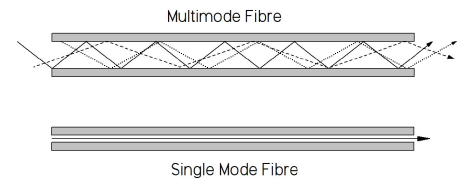
Compare multimode optical fibre and single mode optical fibre in terms of light paths taken and materials used. Drawings may be included to support your answer.   (4 marks)

--- 8 WORK AREA LINES (style=lined) ---

Show Answers Only

Multimode optical fibre:

  • Used to transmit data short distances.
  • It can be manufactured using glass or acrylic and is surrounded by a cladding.
  • Light can take many modes, or paths, through this fibre, including internally refracting/bouncing off the cladding. 

Single mode optical fibre:

  • Has a single central core made of glass, and light can only take one path along the centre.
  • This means single mode fibres do not internally refract along their length, decreasing attenuation (signal loss) as each refraction slightly decreases signal strength.

Show Worked Solution

Multimode optical fibre:

  • Used to transmit data short distances.
  • It can be manufactured using glass or acrylic and is surrounded by a cladding.
  • Light can take many modes, or paths, through this fibre, including internally refracting/bouncing off the cladding. 

Single mode optical fibre:

  • Has a single central core made of glass, and light can only take one path along the centre.
  • This means single mode fibres do not internally refract along their length, decreasing attenuation (signal loss) as each refraction slightly decreases signal strength.


♦♦ Mean mark 38%.

Filed Under: Materials Tagged With: Band 5, smc-3729-25-Fibre optics

ENGINEERING, TE 2021 HSC 26c

Explain how a mobile phone maintains a communication link with the network as the user moves location while making a call.   (3 marks)

--- 8 WORK AREA LINES (style=lined) ---

Show Answers Only
  • A mobile phone transmits an ID code to base stations.
  • The base station that receives the strongest signal then transmits the phones location throughout the network.
  • The network routes received calls from one base station to the next as the user gets closer to a new station.
  • Throughout this process, the phone maintains the strongest possible communication link dynamically as the user changes location.
Show Worked Solution
  • A mobile phone transmits an ID code to base stations.
  • The base station that receives the strongest signal then transmits the phones location throughout the network.
  • The network routes received calls from one base station to the next as the user gets closer to a new station.
  • Throughout this process, the phone maintains the strongest possible communication link dynamically as the user changes location.

♦♦ Mean mark 41%.

Filed Under: Electricity/Electronics Tagged With: Band 5, smc-3730-20-Telephony

ENGINEERING, PPT 2021 HSC 25c

The pins in some truss joints are made from normalised mild steel.

How does the process of normalising affect the material properties of these pins?   (2 marks)

--- 4 WORK AREA LINES (style=lined) ---

Show Answers Only
  • Normalising involves heating mild steel to above red heat (austenitising) and cooling in still air to produce finer, equiaxed grains of pearlite and ferrite.
  • The finer grain structure results in a harder and stronger steel with optimal toughness and tensile strength.
Show Worked Solution
  • Normalising involves heating mild steel to above red heat (austenitising) and cooling in still air to produce finer, equiaxed grains of pearlite and ferrite.
  • The finer grain structure results in a harder and stronger steel with optimal toughness and tensile strength.

♦ Mean mark 50%.

Filed Under: Materials Tagged With: Band 5, smc-3719-30-Normalising

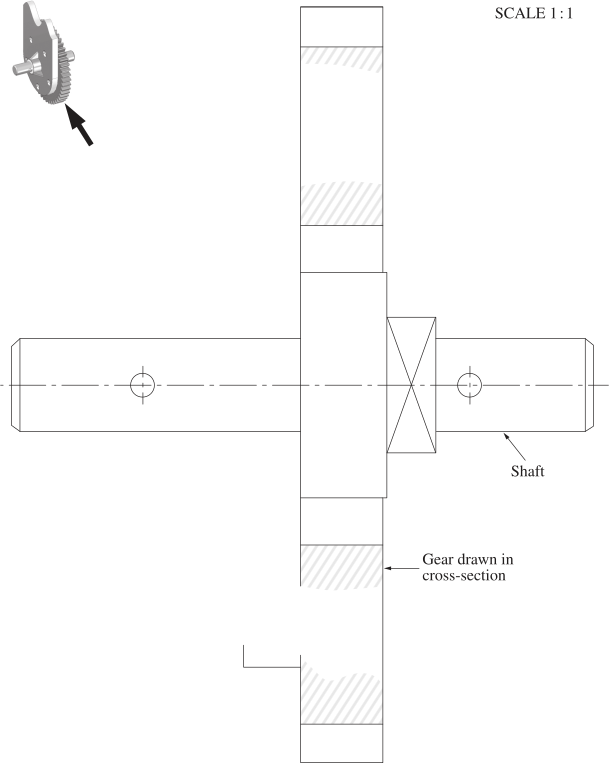
ENGINEERING, PPT 2021 HSC 24d

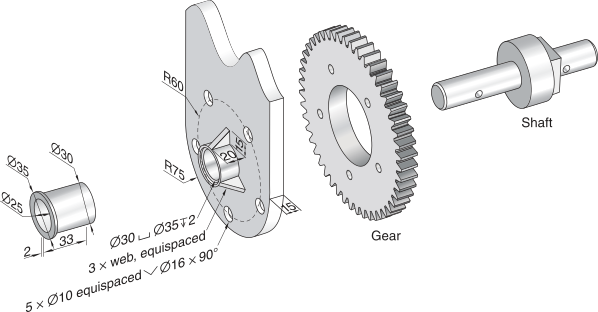
A drive mechanism used to control the satellite dish of a mobile TV transmission van is shown.

Key dimensions of components are given.


The dimensions of each of the five holes in the gear are  \( \phi 10 \vee \phi 16 \times 90°\) on one side.

A partially sectioned drawing of the gear and shaft is provided below.

Complete the sectioned assembly of this drive mechanism to AS 1100 from the direction indicated by the arrow. Include break lines where appropriate.   (6 marks)
 

--- 0 WORK AREA LINES (style=lined) ---

Show Answers Only

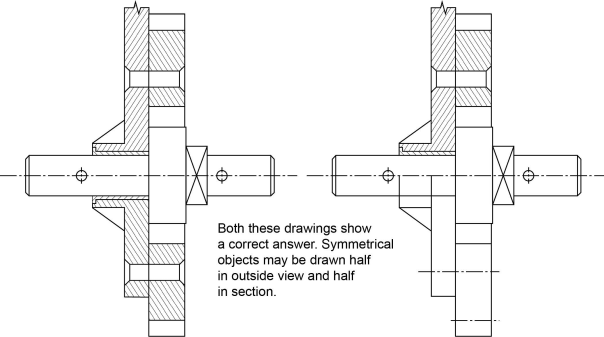
Show Worked Solution

Critical aspects of this drawing:

  • Do not section wedges
  • Do not section counterbores or holes
  • Break line must be included
  • Section lines of adjacent areas should go in different directions
  • Section lines should be at 45° and 3mm apart
  • Answer may be drawn half sectioned as it is symmetrical

♦♦ Mean mark 41%.

Filed Under: Communication Tagged With: Band 5, Band 6, smc-3721-20-Sectional views

ENGINEERING, TE 2021 HSC 24c

Describe the basic principles of low orbit satellite telecommunication systems.   (3 marks)

--- 9 WORK AREA LINES (style=lined) ---

Show Answers Only

Successful answers would cover one of the following:

Low orbit Satellites

  • Low orbit satellites orbit the earth at altitudes below 2000 km.
  • Low orbit telecommunication systems have many satellites that pass overhead as these satellites are not geostationary and move in and out of range of the handset.
  • These satellites take around 90 minutes to orbit earth and are only in range for 5 minutes maximum.
  • When one satellite is about to disappear from the reception range, another comes into range and takes over communication.  

Satellite telephones

  • Satellite telephones broadcast their individual ID numbers to satellites to identify which are in range.
  • Once a satellite receives the signal it is passed onto a base station, then its destination.
  • The phone signal is passed between satellites until one in contact with the base station is in range.
  • The phone signal is modulated using phase shift keying due to long transmission distances.
Show Worked Solution

Successful answers would cover one of the following:

Low orbit Satellites

  • Low orbit satellites orbit the earth at altitudes below 2000 km.
  • Low orbit telecommunication systems have many satellites that pass overhead as these satellites are not geostationary and move in and out of range of the handset.
  • These satellites take around 90 minutes to orbit earth and are only in range for 5 minutes maximum.
  • When one satellite is about to disappear from the reception range, another comes into range and takes over communication.  

Satellite telephones

  • Satellite telephones broadcast their individual ID numbers to satellites to identify which are in range.
  • Once a satellite receives the signal it is passed onto a base station, then its destination.
  • The phone signal is passed between satellites until one in contact with the base station is in range.
  • The phone signal is modulated using phase shift keying due to long transmission distances.

♦ Mean mark 49%.

Filed Under: Electricity/Electronics Tagged With: Band 5, smc-3730-20-Telephony, smc-3730-40-Satellites/GPS

CHEMISTRY, M7 2020 HSC 24

Biodiesel, an alternative fuel to diesel, may be produced from vegetable oil. The chemical reaction which converts oils from biomass into biodiesel is shown. `text{R}_1`, `text{R}_2` and `text{R}_3` are alkyl chains which may vary from 10 to 22 carbons in length.


  1. Which functional group is present in both the oil and the biodiesel?   (1 mark)

    --- 2 WORK AREA LINES (style=lined) ---

  2. Explain why biodiesel `(text{C}_14 text{H}_30 text{O}_2)` produces less soot than diesel `(text{C}_18 text{H}_38)` when combusted under the same conditions. Support your answer with balanced chemical equations.   (3 marks)

    --- 4 WORK AREA LINES (style=lined) ---

  3. The energy densities of biodiesel and diesel are 38 MJ kg ¯1 and 43 MJ kg ¯1 respectively. The densities of biodiesel and diesel are 0.90 kg L¯1 and 0.83 kg L¯1 respectively.

    When 60.0 L of diesel is combusted in a typical engine, 2141 MJ of energy is released.

    What volume of biodiesel would be required to produce the same amount of energy?   (2 marks)

    --- 2 WORK AREA LINES (style=lined) ---

  4. Explain TWO advantages and TWO disadvantages of using bioethanol (ethanol produced from biomass) as an alternative to a fossil fuel.    (4 marks)

    --- 8 WORK AREA LINES (style=lined) ---

Show Answers Only

a.   Ester functional group.
 

b.   \( \ce{C14H30O2(l) + 41/2 O2(g) → 14 CO2(g) + 15 H2O(l)}\)

\( \ce{C18H38(l) + 55/2 O2(g) → 18 CO2(g) + 19 H2O(l)}\)

  • Soot is produced when a fuel source undergoes incomplete combustion due to insufficient oxygen.
  • Since biodiesel already contains oxygen atoms within its structure, it would require less oxygen to undergo complete combustion compared to diesel, and is therefore less likely to produce soot.

c.   `text{m(biodiesel)} = 2141 / 38 = 56.3\ text{kg}`

`text{V(biodiesel)} = 56.3 / 0.90 = 63\ text{L  (nearest L)}`
 

d.    Advantages of bioethanol (two examples needed only):

  • Bioethanol is sustainable because it is produced from renewable resources, whereas petrol is produced from nonrenewable crude oil reserves.
  • Additionally, bioethanol is biodegradable whereas petrol isn’t. As a result, bioethanol would pose less of an environmental threat in comparison to petrol.
  • Ethanol produces less airborne particulates that are associated with lung cancer. 

Disadvantages of bioethanol (two examples needed only):

  • Bioethanol requires a large amount of arable land in order to grow crops to produce bioethanol. Thus, it would lead to soil erosion and environmental pollution.
  • More energy is also required to produce bioethanol because of the requirement for labour, fertilisation, and distillation of ethanol from fermentation.
  • If fossil fuels are used as the energy source within the manufacturing process of biofuel, it will not achieve carbon neutrality and will contribute to global warming.
Show Worked Solution

a.   Ester functional group.
 

b.   \( \ce{C14H30O2(l) + 41/2 O2(g) → 14 CO2(g) + 15 H2O(l)}\)

\( \ce{C18H38(l) + 55/2 O2(g) → 18 CO2(g) + 19 H2O(l)}\)

  • Soot is produced when a fuel source undergoes incomplete combustion due to insufficient oxygen.
  • Since biodiesel already contains oxygen atoms within its structure, it would require less oxygen to undergo complete combustion compared to diesel, and is therefore less likely to produce soot.

♦♦ Mean mark (a) 39%, (b) 49%.

c.   `text{m(biodiesel)} = 2141 / 38 = 56.3\ text{kg}`

`text{V(biodiesel)} = 56.3 / 0.90 = 63\ text{L  (nearest L)}`
 

d.    Advantages of bioethanol (two examples needed only):

  • Bioethanol is sustainable because it is produced from renewable resources, whereas petrol is produced from nonrenewable crude oil reserves.
  • Additionally, bioethanol is biodegradable whereas petrol isn’t. As a result, bioethanol would pose less of an environmental threat in comparison to petrol.
  • Ethanol produces less airborne particulates that are associated with lung cancer. 

Disadvantages of bioethanol (two examples needed only):

  • Bioethanol requires a large amount of arable land in order to grow crops to produce bioethanol. Thus, it would lead to soil erosion and environmental pollution.
  • More energy is also required to produce bioethanol because of the requirement for labour, fertilisation, and distillation of ethanol from fermentation.
  • If fossil fuels are used as the energy source within the manufacturing process of biofuel, it will not achieve carbon neutrality and will contribute to global warming.

♦ Mean mark (d) 55%.
Filed Under: Alcohols, Reactions of Organic Acids and Bases Tagged With: Band 4, Band 5, smc-3679-10-Combustion, smc-3679-60-Biofuels, smc-3680-10-Esters

CHEMISTRY, M8 2020 HSC 22

A 0.1 mol L ¯1 solution of an unknown salt is to be analysed. The cation is one of magnesium, calcium or barium. The anion is one of chloride, acetate or hydroxide.

Outline a sequence of tests that could be performed in a school laboratory to confirm the identity of this salt solution. Include expected observations and a balanced chemical equation in your answer.   (5 marks)

--- 8 WORK AREA LINES (style=lined) ---

Show Answers Only

Cation:

  • The cation can be identified via a flame test. 
  • A pale green flame indicates barium, a brick red flame indicates calcium, and no flame colour observed indicates magnesium.

Anion:

  • To identify anion, add copper nitrate.
  • If a precipitate forms, it indicates the presence of hydroxide ions.
  • Next, add silver nitrate. If a white precipitate forms, this indicates chloride ions present. If no precipiate forms, it indicates acetate ions present.
  •    \( \ce{Ag+(aq) + Cl-(aq) -> AgCl(s)} \)

Other answers

  • Identify anion by testing pH with universal indicator.
  • Interpret result: Neutral (`text{Cl}^-` present), slightly basic (`text{CH}_3text{COO}^-` present), very basic (`text{OH}^-` present).
Show Worked Solution

Cation:

  • The cation can be identified via a flame test. 
  • A pale green flame indicates barium, a brick red flame indicates calcium, and no flame colour observed indicates magnesium.

Anion:

  • To identify anion, add copper nitrate.
  • If a precipitate forms, it indicates the presence of hydroxide ions.
  • Next, add silver nitrate. If a white precipitate forms, this indicates chloride ions present. If no precipiate forms, it indicates acetate ions present.
  •    \( \ce{Ag+(aq) + Cl-(aq) -> AgCl(s)} \)

Other answers

  • Identify anion by testing pH with universal indicator.
  • Interpret result: Neutral (`text{Cl}^-` present), slightly basic (`text{CH}_3text{COO}^-` present), very basic (`text{OH}^-` present).

♦ Mean mark 49%.

Filed Under: Inorganic Substances Tagged With: Band 4, Band 5, smc-3682-10-Tests for Ions in Solution, smc-3682-20-Flame Tests

CHEMISTRY, M5 2020 HSC 20 MC

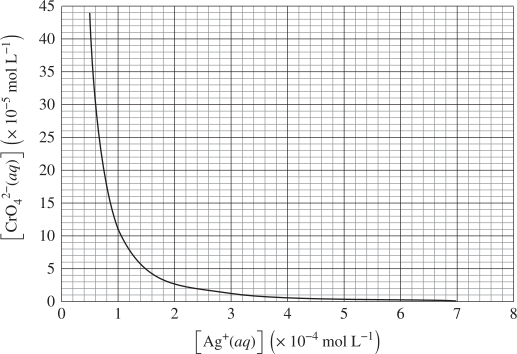
The graph shows the concentration of silver and chromate ions which can exist in a saturated solution of silver chromate.
 

Based on the information provided, what is the `K_{sp}` for silver chromate?

  1. `1.1 xx10^(-8)`
  2. `2.2 xx10^(-8)`
  3. `1.1 xx10^(-12)`
  4. `4.4 xx10^(-12)`
Show Answers Only

`C`

Show Worked Solution

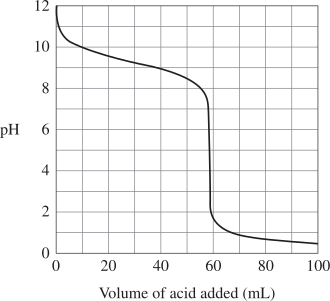
When \(\ce{[Ag+]} = 1 \times 10^{-4}\ \text{mol L}^{-1} \),

\( \ce{CrO4^2–} = 11 \times\ 10^{-5}\ \text{mol L}^{-1} \) 

\begin{align}
K_{sp} &= \ce{[Ag+]^2}\ce{[CrO4^2–]}\\
& =(1 \times 10^{−4})^2(11×10^{−5}) \\
&=1.1×10^{−12}\ \text{mol L}^{–1} \\
\end{align}

`=> C`


♦ Mean mark 43%.

Filed Under: Solution Equilibria Tagged With: Band 5, smc-3672-15-Find K(sp), smc-3672-60-Concentration graphs

CHEMISTRY, M5 2020 HSC 17 MC

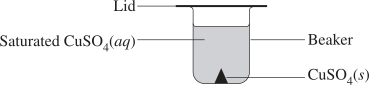
The following apparatus was set up in a temperature-controlled laboratory.


Excess solid sodium hydroxide is added to the beaker.

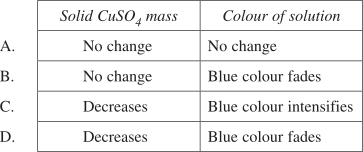
Which row of the table correctly identifies the change in the `text{CuSO}_(4)(s)` mass and the colour of the solution after several days?
 

Show Answers Only

`D`

Show Worked Solution

\(\ce{CuSO4(s) \rightleftharpoons Cu^2+ (aq) + SO4^2– (aq)}\)

  • The addition of \(\ce{NaOH}\) to the solution would result in a precipitate \(\ce{Cu(OH)2}\) and thus decreases the amount of \(\ce{Cu^2+}\) ions.
  • According to Le Chatlelier’s Principle, the system would shift right in an attempt to counteract the change and increase \(\ce{[Cu^2+]}\), thereby decreasing the mass of the precipitate.
  • The blue colour will fade since the \(\ce{[Cu^2+]}\) in the final solution is less.

`=>D`


♦♦ Mean mark 35%.

Filed Under: Solution Equilibria Tagged With: Band 5, smc-3672-10-Mixed ionic solutions, smc-3672-70-Precipitate

BIOLOGY, M5 2020 HSC 25

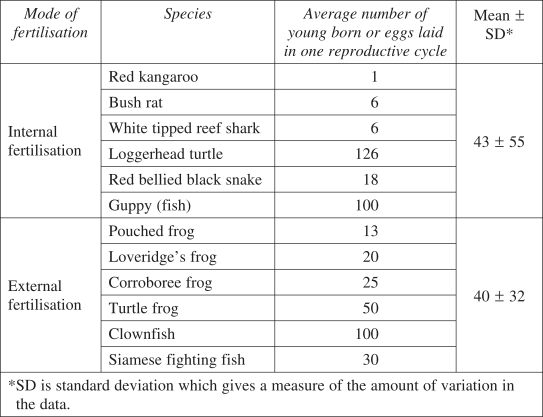
Students tested the hypothesis that the number of eggs/young produced was greater in animals using external fertilisation than those using internal fertilisation. They obtained the following data from secondary sources.
 

  1. What conclusion can be drawn from the data? Justify your answer.   (3 marks)

    --- 6 WORK AREA LINES (style=lined) ---

  2. Justify an improvement to the students' experimental design to test the same hypothesis.   (2 marks)

    --- 5 WORK AREA LINES (style=lined) ---

  3. Explain ONE advantage for animals of using external fertilisation.   (2 marks)

    --- 5 WORK AREA LINES (style=lined) ---

Show Answers Only

a.   Conclusion: There is little difference

  • The numbers of eggs laid/young born between different species was similar in both external and internal animals (43, 40).
  • The standard deviation (variability of the data) was significantly high (55, 32).
  • These two factors mean that students may conclude there is little to no difference between the number of young produced and the mode of fertilisation.

b.   Potential adjustments to improve design

  • Students have selected only twelve species to use in their investigation, which has led to similar results in both internal and external fertilisation.
  • A much larger number of species should be included in a follow up investigation to increase the likelihood of yielding more accurate results.

c.   Successful answers should include one of the following:

  • External fertilisation will expend less energy on gestation, as it occurs outside the body.
  • The large number of young produced in external fertilisation will ensure continuity of the species with minimal parental guidance.
Show Worked Solution

a.   Conclusion: There is little difference

  • The numbers of eggs laid/young born between different species was similar in both external and internal animals (43, 40).
  • The standard deviation (variability of the data) was significantly high (55, 32).
  • These two factors mean that students may conclude there is little to no difference between the number of young produced and the mode of fertilisation.

Mean mark (a) 51%.

b.   Potential adjustments to improve design

  • Students have selected only twelve species to use in their investigation, which has led to similar results in both internal and external fertilisation.
  • A much larger number of species should be included in a follow up investigation to increase the likelihood of yielding more accurate results.

♦♦ Mean mark (b) 38%.

c.   Successful answers should include one of the following:

  • External fertilisation will expend less energy on gestation, as it occurs outside the body.
  • The large number of young produced in external fertilisation will ensure continuity of the species with minimal parental guidance.

Filed Under: Reproduction Tagged With: Band 4, Band 5, smc-3647-05-Human/Mammal, smc-3647-10-Other animal, smc-3647-15-Internal vs. External

BIOLOGY, M8 2020 HSC 24

An indicator of kidney function is the volume of filtrate formed at the glomerulus in 1 minute (GFR).
 

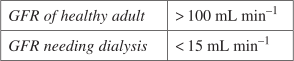
A patient's kidney function was monitored and the following data recorded.

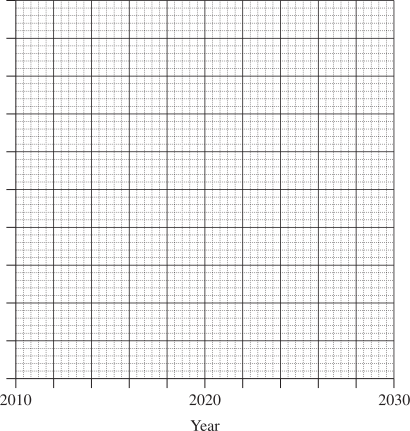
  1. Plot the data on the grid.   (2 marks)


  2. Use the graph to show the year that the patient is predicted to require dialysis. Show your working and answer on the graph.   (2 marks)
  3. Explain how dialysis compensates for the loss of a function of the kidneys.   (3 marks)

    --- 6 WORK AREA LINES (style=lined) ---

Show Answers Only

a. & b.   

c.    Kidneys that lose function cannot remove urea from the blood.

  • In dialysis, blood is passed through a permeable dialysis tube in which fluid around the tube called dialysate, which has a similar composition to blood with no urea present, flows the opposite way. 
  • Through the concentration gradient, urea is removed from the blood (where it has high concentration) to the dialysate (low concentration).
Show Worked Solution

a. & b.    


♦♦ Mean mark (b) 36%.

c.    Kidneys that lose function cannot remove urea from the blood.

  • In dialysis, blood is passed through a permeable dialysis tube in which fluid around the tube called dialysate, which has a similar composition to blood with no urea present, flows the opposite way. 
  • Through the concentration gradient, urea is removed from the blood (where it has high concentration) to the dialysate (low concentration).

♦♦ Mean mark (c) 32%.

Filed Under: Technologies and Disorders Tagged With: Band 3, Band 5, smc-3663-10-Kidneys

BIOLOGY, M6 2020 HSC 23

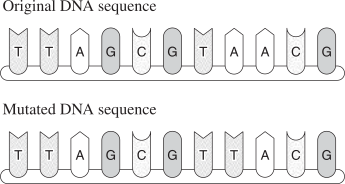
The following diagram shows a mutation.
 

  1. What type of mutation is shown in the diagram?   (1 mark)

    --- 1 WORK AREA LINES (style=lined) ---

  2. Outline another type of mutation.   (2 marks)

    --- 3 WORK AREA LINES (style=lined) ---

Show Answers Only

a.   Point mutation (substitution of adenosine to thymine, base number 8).

b.   Chromosomal mutation:

  • This occurs when there is a change in the number or structure of chromosomes within an individual’s genome.
Show Worked Solution

a.   Point mutation (substitution of adenosine to thymine, base number 8).

b.   Chromosomal mutation:

  • This occurs when there is a change in the number or structure of chromosomes within an individual’s genome.

♦ Mean mark (b) 46%.

Filed Under: Mutation Tagged With: Band 4, Band 5, smc-3652-30-Point Mutations, smc-3652-40-Chromosomal Mutations

CHEMISTRY, M5 2022 HSC 35

A precipitate of strontium hydroxide `\text{Sr}(\text{OH})_2`, (`MM` = 121.63 g mol ¯1) was produced when 80.0 mL of 1.50 mol L ¯1 strontium nitrate solution was mixed with 80.0 mL of 0.855 mol L ¯1 sodium hydroxide solution. The mass of the dried precipitate was 3.93 g.

What is the `K_{sp}` of strontium hydroxide?   (5 marks)

--- 15 WORK AREA LINES (style=lined) ---

Show Answers Only

`3.06 × 10^(−4)`

Show Worked Solution

\( \ce{Sr(NO3)2(aq) + 2NaOH(aq) -> Sr(OH)2(s) + 2NaNO3(aq)} \)

\( \ce{n(Sr(NO3)2) = c \times V = 1.50 \times 0.0800= 0.120\ mol}\)

\( \ce{n(NaOH) = 0.855 \times 0.0800 = 0.0684  \text{mol} }\)

`text{NaOH = limiting reagent}, \ \ \ text{Sr(NO}_3)_2 = text{excess reagent}`

`text{n(Sr(OH)}_2text{) produced}\ = 1 / 2 xx 0.0684= 0.0342  text{mol}`

`text{Thus, 0.0342 moles of Sr(OH)}_2  text{can be produced in solution.}`

`text{n(Sr(OH)}_2\text{)} \ text{precipitate}= text{m} / text{MM}=3.93/121.63=0.0323111  text{mol}`
 

`text{n(Sr(OH)}_2)\ text{in solution}` `=text{n(Sr(OH)}_2)\ text{produced}  –  text{n(Sr(OH)}_2)\ text{precipitate}`
  `=0.0342-0.0323111`
  `= 0.0018889  text{mol}`

 
\( \ce{Sr(OH)2(s) \rightleftharpoons Sr^2+(aq) + 2OH-(aq)} \)

\( \ce{n(Sr(NO3)2)_{init} = 0.120 – \dfrac{1}{2} \times 0.0684 = 0.0858\ \text{mol}} \) 

\begin{array} {|l|c|c|}
\hline  & \text{Sr}^{2+} & \text{OH}^– \\
\hline \text{Initial} & 0.0858 & 0 \\
\hline \text{Change} & +0.0018889 & +2 \times 0.0018889 \\
\hline \text{Equilibrium} & 0.0877 & 0.00378 \\
\hline \end{array}

 
`text{V (total)} = 0.08 + 0.08= 0.16\ text{L}`

`[text{Sr}^(2+)]= text{n} / text{V} = 0.0877 / 0.16 = 0.548  text{mol L}^(–1)`

`[text{OH}^–]=0.00378 / 0.16= 0.0236  text{mol L}^–1`

`K_(sp)= [text{Sr}^(2+)][text{OH}^–]^2= 0.548 xx (0.02362)^2= 3.06 xx 10^(−4)`


♦ Mean mark 43%

Filed Under: Solution Equilibria Tagged With: Band 5, smc-3672-10-Mixed ionic solutions, smc-3672-15-Find K(sp), smc-3672-70-Precipitate

CHEMISTRY, M5 2020 HSC 16 MC

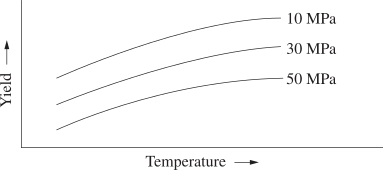
Compounds `text{X}`, `text{Y}` and `text{Z}` are in equilibrium. The diagram shows the effects of temperature and pressure on the equilibrium yield of compound `text{Z}`.


Which equation would be consistent with this data?

  1. `text{X}(g)+3 text{Y}(g) ⇌ 2 text{Z}(g) qquad Delta text{H} > 0`
  2. `text{X}(g)+3 text{Y}(g) ⇌ 2 text{Z}(g) qquad Delta text{H} < 0`
  3. `2 text{X}(g) ⇌ 2 text{Y}(g) + text{Z}(g) qquad Delta text{H} > 0`
  4. `2 text{X}(g) ⇌ 2 text{Y}(g)+ text{Z}(g) qquad Delta text{H} < 0`
Show Answers Only

`C`

Show Worked Solution
  • The yield of `Z` increases as temperature increases, thus, endothermic reaction `Delta text{H} > 0`.
  • The yield of `Z` increases as pressure decreases, thus more gaseous moles on the product side. 

`=> C`


♦ Mean mark 49%.

Filed Under: Factors that Affect Equilibrium Tagged With: Band 5, smc-3670-10-Temperature, smc-3670-29-Pressure, smc-3670-70-Max yield conditions

CHEMISTRY, M8 2020 HSC 15 MC

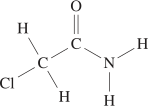
The structure of chloroacetamide is shown.


The common isotopes of chlorine are \( \ce{^{35}Cl} \) and \( \ce{^{37}Cl} \).

The mass spectrum of chloroacetamide contains a peak at m/z = 51.

What is the most likely source of this peak?

  1. `[ text{OCl} ]`
  2. `[ text{NH}_2 ]^+`
  3. `[ text{C}_4 text{H}_3 ]^+`
  4. `[ text{CH}_2 text{Cl} ]^+`
Show Answers Only

`D`

Show Worked Solution

By elimination:

  • `A` has no charge (eliminate)
  • `B` has an m/z = 16 (eliminate)
  • `C` has 4 carbon fragments (eliminate)

`=> D`


Mean mark 51%.

Filed Under: Organic Substances Tagged With: Band 5

CHEMISTRY, M7 2020 HSC 13 MC

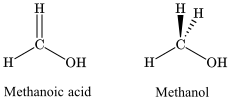
Which of the following conversions results in the formation of a different shape around the carbon atom?

  1. Methanoic acid to methanal
  2. Methanoic acid to methanol
  3. Methanoic acid to methanamide
  4. Methanoic acid to sodium methanoate
Show Answers Only

`B`

Show Worked Solution
  • Methanoic acid is a trigonal planar shape around the carbon atom, whereas methanol is a tetrahedral shape.

`=> B`


♦ Mean mark 45%.

Filed Under: Hydrocarbons and Associated Reactions Tagged With: Band 5, smc-3677-40-Molecular Shape

Statistics, STD1 S1 2022 HSC 13

Kim wants to investigate what students think about the food that is sold at the school's canteen. Kim decides to use a survey to interview a sample group of students to find out their opinions on a number of different issues.

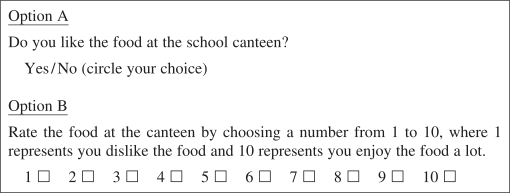
  1. As part of the survey, Kim is thinking about using one of the options listed below.


    Name ONE advantage for each option.  (2 marks)

    --- 4 WORK AREA LINES (style=lined) ---

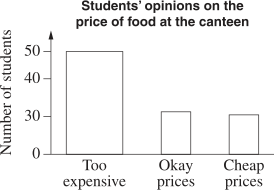
  2. After collecting data, Kim drew the following graph to summarise the opinions related to the price of the food.


    What TWO features of the graph make it misleading?  (2 marks)

    --- 4 WORK AREA LINES (style=lined) ---

Show Answers Only

a.   Advantages

Option A → This option would be very easy to collate as there are only 2 choices.

Option B → This option gives a more detailed idea of the students’ thoughts about the food as they can grade their choice from 1 – 10.


b.   Misleading features:

→ The scale on the vertical axis is not equal. This makes the “Too Expensive” column (at 50) appear to have more than twice the number of responses as “Okay Prices” (~30) and “Cheap Prices” (~30) which is incorrect.

→ The varying column widths are also misleading as the wider column could be interpreted as being having more weight than the other 2.

Show Worked Solution

a.   Advantages

Option A → This option would be very easy to collate as there are only 2 choices.

Option B → This option gives a more detailed idea of the students’ thoughts about the food as they can grade their choice from 1 – 10.
 

b.   Misleading features:

→ The scale on the vertical axis is not equal. This makes the “Too Expensive” column (at 50) appear to have more than twice the number of responses as “Okay Prices” (~30) and “Cheap Prices” (~30) which is incorrect.

→ The varying column widths are also misleading as the wider column could be interpreted as being having more weight than the other 2.


♦♦ Mean mark 32%.

Filed Under: Bar Charts, Histograms and Other Graphs (Std 1), Classifying Data (Std 1) Tagged With: Band 4, Band 5, smc-1127-30-Other, smc-1128-10-Bar Charts

CHEMISTRY, M6 2020 HSC 10 MC

Equimolar solutions of `text{NaCl}(aq), text{NH}_(4) text{Cl}(aq)` and `text{NaCH}_(3) text{COO}(aq)` were prepared.

In which of the following are these salt solutions listed from least to most acidic?

  1. `text{NaCl}(aq), text{NH}_(4) text{Cl}(aq), text{NaCH}_(3) text{COO}(aq)`
  2. `text{NaCl}(aq), text{NaCH}_(3) text{COO}(aq), text{NH}_(4) text{Cl}(aq)`
  3. `text{NH}_(4) text{Cl}(aq), text{NaCl}(aq), text{NaCH}_(3) text{COO}(aq)`
  4. `text{NaCH}_(3) text{COO}(aq), text{NaCl}(aq), text{NH}_(4) text{Cl}(aq)`
Show Answers Only

`D`

Show Worked Solution
  • \( \ce{NaCl} \) is a neutral salt, \( \ce{NH4Cl} \) is an acidic salt and \( \ce{NaCH3COO} \) is a basic salt.
  • Therefore, least to most acidic: \( \ce{NaCH3COO(aq), NaCl(aq), NH4Cl(aq)} \)

`=> D`


♦ Mean mark 42%.

Filed Under: Properties of Acids and Bases Tagged With: Band 5, smc-3673-40-Properties of Common A/B

CHEMISTRY, M6 2020 HSC 8 MC

A weak base is titrated with 1.0 mol L\(^{-1}\) aqueous \(\ce{HCI}\). The \(\ce{pH}\) curve is shown.


At which pH value would the solution be most effective as a buffer?

  1. 5
  2. 7
  3. 8
  4. 9
Show Answers Only

\(D\)

Show Worked Solution
  • The solution would be most effective as a buffer at \(\ce{pH}\) 9 because this corresponds to the half-equivalent point.

\(\Rightarrow D\)


♦♦ Mean mark 37%.

Filed Under: Quantitative Analysis Tagged With: Band 5, smc-3675-20-Titration Curves and Conductivity Graphs, smc-3675-60-Buffers

CHEMISTRY, M7 2020 HSC 7 MC

The structures of four isomers are shown.
 

Which statement is correct?

  1. Compounds 1 and 2 are chain isomers.
  2. Compounds 1 and 4 are chain isomers.
  3. Compounds 2 and 3 are functional group isomers.
  4. Compounds 2 and 4 are positional isomers.
Show Answers Only

`C`

Show Worked Solution

Consider each option:

  • Chain isomers have a different structure of the `text{C}` chain. Compound 1, 2 and 4 have the same `text{C}` chain structure (eliminate A and B).
  • Positional isomers have the same `text{C}` chain but with different allocations of the same functional group (eliminate D).
  • Functional group isomers occur when atoms form different functional groups. Compound 2 has a double bond and an OH group, whereas Compound 3 only contains an ester group (correct).

`=> C`


♦ Mean mark 49%.

Filed Under: Nomenclature Tagged With: Band 5, smc-3676-05-Isomers

CHEMISTRY, M7 2020 HSC 6 MC

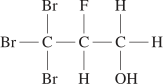
The structure of a compound is shown.


What is the preferred IUPAC name of this compound?

  1. 1,1,1-tribromo-2-fluoropropan-3-ol
  2. 2-fluoro-3,3,3-tribromopropan-1-ol
  3. 2-fluoro-1,1,1-tribromopropan-3-ol
  4. 3,3,3-tribromo-2-fluoropropan-1-ol
Show Answers Only

`D`

Show Worked Solution
  • The hydroxyl functional group has the highest priority and therefore its associated `text{C}` is given the lowest possible number.
  • The substituents are named in alphabetical order.

`=> D`


♦ Mean mark 50%.

Filed Under: Nomenclature Tagged With: Band 5, smc-3676-08-Halogenated Organic Compounds

CHEMISTRY, M6 2022 HSC 34

Sodium hypochlorite `\text{NaOCl}` is the active ingredient in pool chlorine. It completely dissolves in water to produce the hypochlorite ion `(\text{OCl}^(-))`, which undergoes hydrolysis according to the following equilibrium.

\( \ce{OCl-(aq) + H2O(l)  \rightleftharpoons  HOCl(aq) + OH-(aq)} \)

The equilibrium constant for this reaction at 25°C is `3.33 xx 10^(-7)`.

For pool chlorine to be effective the pH is maintained by a different buffer at 7.5 and the hypochlorous acid `(\text{HOCl})` concentration should be `1.3 xx 10^(-4)` mol L ¯1.

Calculate the volume of 2.0 mol L ¯1 sodium hypochlorite solution that needs to be added to a 1.00 × 10⁴ L pool to meet the required conditions.   (4 marks)

--- 18 WORK AREA LINES (style=lined) ---

Show Answers Only

`1.3\ text{L}`

Show Worked Solution

`text{pOH}_(eq) = 14.00-7.5 = 6.5`

`[text{OH}^–]_(eq) = 10^-text{pOH} = 10^(-6.5)\ text{mol L}^(-1)`

`text{K}_(eq) ` `=[[text{HOCl}]_(eq) [text{OH}^–]_(eq)] / [text{OCl}^–]_(eq)`  
`3.33 xx 10^(−7)` `= [(1.3 × 10^(−4)) xx (10^(−6.5))] / [[text(OCl)^–]_(eq)]`  
`[text(OCl)^–]_(eq)` `=[(1.3 × 10^(−4)) xx (10^(−6.5))]/(3.33 xx 10^(−7))`  
  `= 1.246 xx 10^(−4)\ text{mol L}^(–1)`  

 
\begin{array} {|l|c|c|c|}
\hline  & \text{OCl}^– & \text{HOCl} & \text{OH}^– \\
\hline \text{Initial} & x & 0 & – \\
\hline \text{Change} & – 1.3 \times 10^{–4} & +1.3 \times 10^{−4} & – \\
\hline \text{Equilibrium} & x − 1.3 \times 10^{−4} & 1.3 \times 10^{−4} & 10^{−6.5} \\
\hline \end{array}


`x−1.3 xx 10^(−4)` `= 1.246 xx 10^(−4)`  
`x` `= 2.546 xx 10^(−4)`  

 
`[text{OCl}^–]_i = 2.55 xx 10^(−4)\ text{mol L}^(–1)\ \ text{(3 s.f.)}`

\( \ce{[NaOCl] \times V(NaOC)_{req}}\) \( \ce{= [OCl-](pool) \times V(pool)} \)  
\( \ce{V(NaCl)_{req}} \) `=(2.55 xx 10^(−4) xx 10^4)/2`  
  `=1.3\ text{L  (2 s.f.)}`  

♦ Mean mark 46%.

Filed Under: Bronsted-Lowry Theory, Quantitative Analysis Tagged With: Band 5, smc-3674-10-Calculations Involving pH

CHEMISTRY, M8 2022 HSC 33

Analyse how a student could design a chemical synthesis process to be undertaken in the school laboratory. In your response, use a specific process relating to the synthesis of an organic compound, including a chemical equation, and refer to:

  • selection of reagent(s)
  • reaction conditions
  • any potential hazards and any safety precautions to minimise the risk
  • yield and purity of the product(s).   (8 marks)

--- 25 WORK AREA LINES (style=lined) ---

Show Answers Only

Selecting reagents

  • The student could synthesise ethyl ethanoate through esterification between acetic acid and ethanol.
  • Both readily available in the school laboratory and are relatively safe.

Acetic acid + ethanol  ⇌  Ethyl ethanoate + water

  • Concentrated sulfuric acid should be used as the acid catalyst as it is a strong acid that is also readily available. 

Reaction conditions

  • Increasing the temperature of the system increases the reaction rate because it increases the average kinetic energy of the reactant molecules, and thus increases the likelihood of successful collisions, producing more product.
  • Additionally, the addition of reactants would increase the likelihood of successful collisions, thus increasing the reaction rate.
  • The reaction should also be undertaken under reflux allowing vaporised molecules to condense and return back to the reaction vessel, increasing the amount of reactants, and thus increasing the rate of reaction. 
  • Concentrated sulfuric acid should also be utilised as a catalyst in order to speed up the reaction and lower the activation energy. 

Potential hazards and safety precautions

  • The acetic acid and sulfuric acid used is corrosive and may cause skin and eye burns, therefore, appropriate lab coat and safety glasses should be utilised.
  • The organic reactants are highly flammable and may cause fires. The reaction mixture should be heated on a hot plate or heating mantle instead of a bunsen burner.
  • Refluxing may cause pressure build-up, therefore, ensure the reflux condenser is open.
  • Superheating and bumping may occur in apparatus. Boiling chips should be utilised to provide nucleation sites allowing liquids to boil smoothly. 

Yield and purity

  • Concentrated sulfuric acid, used as a catalyst, also acts as a dehydrating agent that removes water from the system and improves yield.
  • When the reaction reaches equilibrium, the ester can be separated from the mixture by adding excess sodium carbonate solution in order to neutralise the acid.
  • Transfer to a separation funnel to separate the organic layer (containing the ester) from the aqueous layer.
  • Then use fractional distillation to separate the ester from the organic layer.
Show Worked Solution

Selecting reagents

  • The student could synthesise ethyl ethanoate through esterification between acetic acid and ethanol.
  • Both readily available in the school laboratory and are relatively safe.

Acetic acid + ethanol  ⇌  Ethyl ethanoate + water

  • Concentrated sulfuric acid should be used as the acid catalyst as it is a strong acid that is also readily available. 

Reaction conditions

  • Increasing the temperature of the system increases the reaction rate because it increases the average kinetic energy of the reactant molecules, and thus increases the likelihood of successful collisions, producing more product.
  • Additionally, the addition of reactants would increase the likelihood of successful collisions, thus increasing the reaction rate.
  • The reaction should also be undertaken under reflux allowing vaporised molecules to condense and return back to the reaction vessel, increasing the amount of reactants, and thus increasing the rate of reaction. 
  • Concentrated sulfuric acid should also be utilised as a catalyst in order to speed up the reaction and lower the activation energy. 

Potential hazards and safety precautions

  • The acetic acid and sulfuric acid used is corrosive and may cause skin and eye burns, therefore, appropriate lab coat and safety glasses should be utilised.
  • The organic reactants are highly flammable and may cause fires. The reaction mixture should be heated on a hot plate or heating mantle instead of a bunsen burner.
  • Refluxing may cause pressure build-up, therefore, ensure the reflux condenser is open.
  • Superheating and bumping may occur in apparatus. Boiling chips should be utilised to provide nucleation sites allowing liquids to boil smoothly. 

Yield and purity

  • Concentrated sulfuric acid, used as a catalyst, also acts as a dehydrating agent that removes water from the system and improves yield.
  • When the reaction reaches equilibrium, the ester can be separated from the mixture by adding excess sodium carbonate solution in order to neutralise the acid.
  • Transfer to a separation funnel to separate the organic layer (containing the ester) from the aqueous layer.
  • Then use fractional distillation to separate the ester from the organic layer.

♦♦ Mean mark 52%.

Filed Under: Chemical Synthesis and Design Tagged With: Band 4, Band 5, Band 6, smc-3679-20-Reactions of Alcohols, smc-3680-10-Esters, smc-3684-20-Reaction conditions, smc-3684-30-Yield and purity

CHEMISTRY, M6 2022 HSC 32

The concentration of citric acid, a triprotic acid, in a carbonated soft drink was to be determined.

Step 1: A solution of \( \ce{NaOH(aq)} \) was standardised by titrating it against 25.00 mL aliquots of a solution of the monoprotic acid potassium hydrogen phthalate \( \ce{(KHP)} \). The \( \ce{(KHP)} \) solution was produced by dissolving 4.989 g in enough water to make 100.0 mL of solution. The molar mass of \( \ce{(KHP)} \) is 204.22 g mol ¯1.

The results of the standardisation titration are given in the table.
 

Step 2: A 75.00 mL bottle of the drink was opened and the contents quantitatively transferred to a beaker. The soft drink was gently heated to remove \( \ce{CO2}\).

Step 3: The cooled drink was quantitatively transferred to a 250.0 mL volumetric flask and distilled water was added up to the mark.

Step 4: 25.00 mL samples of the solution were titrated with the \( \ce{NaOH(aq)}\) solution. The average volume of \( \ce{NaOH(aq)} \) used was 13.10 mL.

  1. Calculate the concentration of the triprotic citric acid in the soft drink.  (6 marks)

--- 20 WORK AREA LINES (style=lined) ---

  1. Explain how your answer to part (a) would be different if the carbon dioxide was not removed from the soft drink.  (2 marks)

--- 5 WORK AREA LINES (style=lined) ---

Show Answers Only

a.  `0.1298  text{mol L}^(–1)`

b.  \( \ce{CO2} \) can dissolve in water to produce \( \ce{H2CO3}\):

\( \ce{CO2(g) + H2O(l) \rightleftharpoons H2CO3(aq)} \)

  • This would enable \( \ce{NaOH} \) to react with \( \ce{H2CO3:} \)
  •    \( \ce{2NaOH(aq) + H2CO3(aq) -> Na2CO3(aq) + 2H2O(l)} \)
  • Therefore, if \( \ce{CO2} \) was not removed, more \( \ce{NaOH} \) would be required to reach the endpoint.
  • This would result in a higher citric acid concentration calculation.
Show Worked Solution

a.   \( \ce{KHP(aq) + NaOH(aq) -> NaKP(aq) + H2O(l)} \)

`text{n(HX)}= 4.989 / 204.22= 0.02443\ text{mol}`

`[text(HX)]= \text{n}/\text{V}= 0.02443 / 0.1000= 0.2443  text{mol L}^(–1)`

`text{n(HX) titrated} =  text{c} xx text{V}= 0.2443 xx 0.02500= 0.0006107\ text{mol}`

 `=>\ text{n(NaOH)}= 0.0006107  text{mol}`
 

Eliminate the first trial because it is an outlier.

`text{V}_(text(avg))text{(NaOH)}= 1 / 3 xx (27.40 + 27.20 + 27.60)= 27.40\ text{mL}`

`text{[NaOH]}= text{n} / text{V}= [6.107 xx 10^−3] / 0.02740 = 0.2229  text{mol L}^(–1)`

\( \ce{H3X(aq) + 3NaOH(aq) -> Na3X(aq) + 3H2O(l)} \)

`text{n(NaOH) titrated}= text{c} xx text{V}=0.2229 xx 0.01310= 2.920 xx 10^(−3)\ text{mol}`

`text{n(H}_3 text{X)}= 1/3 xx 2.920 xx 10^(−3)= 9.733 xx 10^(−4)\ text{mol}`

`text{[H}_3 text{X] diluted} = text{n} / text{V} = (9.733 xx 10^(−4) )/ 0.025= 0.03893 \ text{mol L}^(–1)`

`text{[H}_3 text{X] original}= 250.0 / 75.00 xx 0.03893= 0.1298  text{mol L}^(–1)`

Therefore, the concentration of citric acid in the soft drink is 0.1298 mol L¯1.


♦ Mean mark (a) 48%.

b.   \( \ce{CO2} \) can dissolve in water to produce \( \ce{H2CO3}\):

\( \ce{CO2(g) + H2O(l) \rightleftharpoons H2CO3(aq)} \)

This would enable \( \ce{NaOH} \) to react with \( \ce{H2CO3:} \)

\( \ce{2NaOH(aq) + H2CO3(aq) -> Na2CO3(aq) + 2H2O(l)} \)

  • Therefore, if \( \ce{CO2} \) was not removed, more \( \ce{NaOH} \) would be required to reach the endpoint.
  • This would result in a higher citric acid concentration calculation.

♦♦ Mean mark (b) 28%.

Filed Under: Quantitative Analysis Tagged With: Band 5, Band 6, smc-3675-10-Titration

CHEMISTRY, M5 2022 HSC 31

Silver ions form the following complex with ammonia solution.

\( \ce{Ag+(aq) + 2NH3(aq) \rightleftharpoons [Ag(NH3)2]+(aq)}\)

The equilibrium constant is `1.6 × 10^(7)` at 25°C.

  1. In order to determine the free \( \ce{Ag+}\) concentration in an aqueous ammonia solution, a student carried out a precipitation titration with \( \ce{NaI(aq)}\) as the titrant.
  2. Evaluate the suitability of this method.   (3 marks)

--- 8 WORK AREA LINES (style=lined) ---

  1. If 0.010% of the total silver ions in solution are present as \( \ce{Ag+(aq)}\) at equilibrium, calculate the equilibrium concentration of aqueous ammonia in this solution.   (4 marks)

--- 11 WORK AREA LINES (style=lined) ---

Show Answers Only

a.  The method is not suitable. 

  • Adding \( \ce{NaI}\) would cause the \( \ce{I-}\) ions to precipitate with the \( \ce{Ag+}\) ions to form \( \ce{AgI}\)
  •    \( \ce{AgI(s) \rightleftharpoons  Ag+(aq) + I- (aq)}\)
  • As a result, this would decrease \( \ce{[Ag+]}\), and disturb the equilibrium.
  • According to Le Chatelier’s Principle, the equilibrium will shift to the right in an attempt to counteract the change and increase \( \ce{[Ag+]}\).
  •    \( \ce{Ag+(aq) + 2NH3(aq) \rightleftharpoons [Ag(NH3)2]+(aq)}\)
  • As a result, \( \ce{[Ag(NH3)2]+}\) would shift to the left and increase \( \ce{[Ag+]} \). 

 
b.   
\({K_{eq}=\dfrac{\ce{[[Ag(NH3)2]+]}}{\ce{[Ag+][NH3]^2}}} \)

\[\ce {[[Ag(NH3)2]+] = \frac{99.99%}{0.010%} \times [Ag+] \ \ \ …\ (1)}\]

Substitute (1) into \(\ce {K_{eq}:}\)

`1.6 xx 10^7` `= [(99.99%) xx [text{Ag}^+ ]] / [(0.010%) xx [text{Ag}^+ ][text{NH}_3 ]^2]= [99.99%] / [0.010% [text{NH}_3 ]^2]`
`[text{NH}_3 ]^2` `=(99.99%)/(1.6 xx 10^7 xx 0.010%)`
`[text{NH}_3 ]` `=sqrt((99.99%)/(1.6 xx 10^7 xx 0.010%))= 0.025  text{mol L}^-1`

 
Therefore, the concentration of \(\ce {NH3}\) at equilibrium is 0.025 mol L¯1.

Show Worked Solution

a.  The method is not suitable. 

  • Adding \( \ce{NaI}\) would cause the \( \ce{I-}\) ions to precipitate with the \( \ce{Ag+}\) ions to form \( \ce{AgI}\)
  •    \( \ce{AgI(s) \rightleftharpoons  Ag+(aq) + I- (aq)}\)
  • As a result, this would decrease \( \ce{[Ag+]}\), and disturb the equilibrium.
  • According to Le Chatelier’s Principle, the equilibrium will shift to the right in an attempt to counteract the change and increase \( \ce{[Ag+]}\).
  •    \( \ce{Ag+(aq) + 2NH3(aq) \rightleftharpoons [Ag(NH3)2]+(aq)}\)
  • As a result, \( \ce{[Ag(NH3)2]+}\) would shift to the left and increase \( \ce{[Ag+]} \). 

♦ Mean mark (a) 40%.

b.   \({K_{eq}=\dfrac{\ce{[[Ag(NH3)2]+]}}{\ce{[Ag+][NH3]^2}}} \)

\[\ce {[[Ag(NH3)2]+] = \frac{99.99%}{0.010%} \times [Ag+] \ \ \ …\ (1)}\]

Substitute (1) into \(\ce {K_{eq}:}\)

`1.6 xx 10^7` `= [(99.99%) xx [text{Ag}^+ ]] / [(0.010%) xx [text{Ag}^+ ][text{NH}_3 ]^2]= [99.99%] / [0.010% [text{NH}_3 ]^2]`
`[text{NH}_3 ]^2` `=(99.99%)/(1.6 xx 10^7 xx 0.010%)`
`[text{NH}_3 ]` `=sqrt((99.99%)/(1.6 xx 10^7 xx 0.010%))= 0.025  text{mol L}^-1`

 
Therefore, the concentration of \(\ce {NH3}\) at equilibrium is 0.025 mol L¯1.


♦ Mean mark (b) 40%.

Filed Under: Solution Equilibria Tagged With: Band 5, smc-3672-20-Calcs given K(sp), smc-3672-25-Solubility rules

CHEMISTRY, M8 2022 HSC 30

The following spectra were obtained for an unknown organic compound.
 

In the space provided, draw and name the unknown compound that is consistent with all the information provided. Justify your answer with reference to the information provided.   (7 marks)
 

--- 15 WORK AREA LINES (style=lined) ---

Show Answers Only

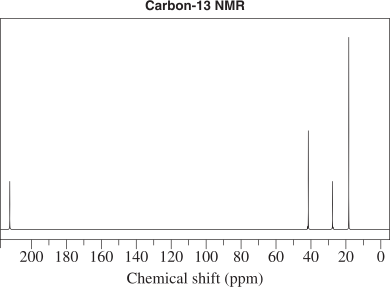
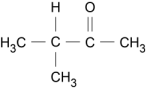
Structure: 3-methylbutan-2-one

Mass spectrum:

  • There is a parent ion peak at m/z = 86, indicating that the compound has a molar mass of 86 g mol¯1.

IR spectrum:

  • There is a strong absorption at 1680 – 1750 cm¯1,  indicating a carbonyl functional group.
  • There isn’t a strong absorption at 2500 – 3000 cm¯1,  indicating an absence of hydroxyl group (consistent with a ketone). 

Proton NMR spectrum:

  • There are 3 signals, indicating 3 unique hydrogen environments:
  • The signal at 1.1 ppm, consists of 6 hydrogens and is a doublet.
  • The signal at 2 ppm, consists of 3 hydrogens and is a singlet.
  • The signal at 2.6 ppm, consists of 1 hydrogen and is a septet. 

Carbon-13 NMR spectrum:

  • There are 4 signals, indicating 4 unique carbon environments.
  • A signal at 19 ppm indicates a carbon atom single bonded to another adjacent carbon atom.
  • A signal at 28 ppm indicates a carbon adjacent to a carbonyl carbon.
  • A signal at 41 ppm indicates a carbon adjacent to a carbonyl carbon and methyl groups.
  • A signal at 210 indicates a ketone carbon.
Show Worked Solution

Structure: 3-methylbutan-2-one

Mass spectrum:

  • There is a parent ion peak at m/z = 86, indicating that the compound has a molar mass of 86 g mol¯1. 

IR spectrum:

  • There is a strong absorption at 1680 – 1750 cm¯1,  indicating a carbonyl functional group.
  • There isn’t a strong absorption at 2500 – 3000 cm¯1,  indicating an absence of hydroxyl group (consistent with a ketone). 

Proton NMR spectrum:

  • There are 3 signals, indicating 3 unique hydrogen environments:
  • The signal at 1.1 ppm, consists of 6 hydrogens and is a doublet.
  • The signal at 2 ppm, consists of 3 hydrogens and is a singlet.
  • The signal at 2.6 ppm, consists of 1 hydrogen and is a septet. 

Carbon-13 NMR spectrum:

  • There are 4 signals, indicating 4 unique carbon environments.
  • A signal at 19 ppm indicates a carbon atom single bonded to another adjacent carbon atom.
  • A signal at 28 ppm indicates a carbon adjacent to a carbonyl carbon.
  • A signal at 41 ppm indicates a carbon adjacent to a carbonyl carbon and methyl groups.
  • A signal at 210 indicates a ketone carbon.

♦ Mean mark 51%.

Filed Under: Organic Substances Tagged With: Band 5, smc-3683-50-Combining Techniques

CHEMISTRY, M7 2022 HSC 29

The enthalpies of combustion of four alcohols were determined in a school laboratory.

The results are shown in the table.
 

  1. Plot the results, including a curved line of best fit, to estimate the enthalpy of combustion of butan-1-ol.   (3 marks)

  1. The published value for the enthalpy of combustion of pentan-1-ol is closer to `-3331\ text{kJ}\ text{mol}^(-1)`.
  2. Justify ONE possible reason for the difference between the school's results and published values.   (2 marks)

--- 4 WORK AREA LINES (style=lined) ---

Show Answers Only

a.    

From interpolating the graph, the enthalpy of combustion of butan-1-ol is –2120 kJ mol ¯1.

b.   Heat loss to the surroundings.

  • The school’s results are lower in magnitude than the published values because heat is lost to the surroundings, making the measured change in temperature smaller.

Other possible answers:

  • Incomplete combustion
  • Temperature change will be reduced if combustion is incomplete as less heat is released. Enthalpy of combustion will be lower as a result.
Show Worked Solution

a.    

From interpolating the graph, the enthalpy of combustion of butan-1-ol is –2120 kJ mol ¯1.
 

b.   Heat loss to the surroundings.

  • The school’s results are lower in magnitude than the published values because heat is lost to the surroundings, making the measured change in temperature smaller.

Other possible answers:

  • Incomplete combustion
  • Temperature change will be reduced if combustion is incomplete as less heat is released. Enthalpy of combustion will be lower as a result.

♦ Mean mark (b) 48%.

Filed Under: Alcohols Tagged With: Band 3, Band 5, smc-3679-10-Combustion

CHEMISTRY, M8 2022 HSC 27

A bottle labelled 'propanol' contains one of two isomers of propanol.

  1. Draw the TWO isomers of propanol.   (2 marks)
     

  1. Describe how \( \ce{^13C NMR}\) spectroscopy might be used to identify which isomer is in the bottle.   (2 marks)

--- 6 WORK AREA LINES (style=lined) ---

  1. Each isomer produces a different product when oxidised.
  2. Write equations to represent the oxidation reactions of the two isomers. Include reaction conditions.   (3 marks)

--- 6 WORK AREA LINES (style=lined) ---

Show Answers Only

a.    Isomer 1:

Isomer 2:

b.   Identifying isomers with \( \ce{^13C NMR} \) spectroscopy:

  • this can be used to identify the isomers in the bottle because they show a different number of signals which helps deduce the carbon environment.
  • Propan-1-ol contains 3 \( \ce{C}\) environments so it would have 3 peaks on a \( \ce{^13C NMR}\) spectrum whereas propan-2-ol only contains 2 \( \ce{C}\) environments (due to symmetry), so it would only have 2 signals on a \( \ce{^13C NMR}\) spectrum.

c.  


Show Worked Solution

a.    Isomer 1:


Isomer 2:


b.   Identifying isomers with \( \ce{^13C NMR} \) spectroscopy:

  • this can be used to identify the isomers in the bottle because they show a different number of signals which helps deduce the carbon environment.
  • Propan-1-ol contains 3 \( \ce{C}\) environments so it would have 3 peaks on a \( \ce{^13C NMR}\) spectrum whereas propan-2-ol only contains 2 \( \ce{C}\) environments (due to symmetry), so it would only have 2 signals on a \( \ce{^13C NMR}\) spectrum.

c.  


♦ Mean mark (c) 52%.

Filed Under: Alcohols, Nomenclature, Organic Substances Tagged With: Band 3, Band 4, Band 5, smc-3676-05-Isomers, smc-3679-30-Oxidation, smc-3679-40-Naming Alcohols, smc-3683-10-C NMR

CHEMISTRY, M6 2022 HSC 26

Students conducted an experiment to determine `Delta H` for the reaction between sodium hydroxide and hydrochloric acid.

The data from one student are shown in the table below.
 

Assume that all the solutions have the same specific heat capacity as water.

  1. Calculate the heat energy released in this experiment.   (2 marks)

--- 5 WORK AREA LINES (style=lined) ---

  1. A second student using the same procedure obtained `2.6 × 10^(3)\ text{J}` for the heat energy released in their experiment.
  2. Use this value to determine the enthalpy of neutralisation, `Delta H`, in `\text{kJ}\ text{mol}^(-1)`, for the reaction shown.
  3.      \( \ce{NaOH(aq) + HCl(aq) -> NaCl(aq) + H2O(l)} \)   (2 marks)

--- 4 WORK AREA LINES (style=lined) ---

Show Answers Only
  1. `2800  text{J}`
  2. `-52\ text{kJ mol}^-1`
Show Worked Solution

a.   `T_(text{avg initial}) = (21.0 + 21.2) / 2 = 21.1 text{°C}`

`q` `= mc DeltaT`
  `= (100.7 + 102.0) (4.18) (24.4 − 21.1)`
  `=2796.04…`
  `= 2800  text{J (to 2 s.f.)}`

 
Therefore, 2800 J of heat energy is released in this experiment (assuming no energy loss).
 

b.   `q = 2600\ text{J}`

`text{n} = 0.1 xx 0.5 = 0.05\ text{mol}`

`DeltaH` `= -q/text{n}`
  `= -2600 / 0.05`
  `= -52\ 000\ text{J mol}^-1`
  `= -52\ text{kJ mol}^-1`

♦ Mean mark (b) 43%.

Filed Under: Properties of Acids and Bases Tagged With: Band 4, Band 5, smc-3673-20-Enthalpy of Neutralisation

CHEMISTRY, M6 2022 HSC 20 MC

Cyanidin is a plant pigment that may be used as a pH indicator. It has four levels of protonation, each with a different colour, represented by these equilibria:
 

The following graph shows the relative amount of each species present at different pH values.
 

What colour would the indicator be if added to a 0.75 mol L\(^{-1}\) solution of hypoiodous acid, \(\text{HIO}\ \left(p K_a=10.64\right)\)?

  1. Red
  2. Colourless
  3. Purple
  4. Blue
Show Answers Only

\(C\)

Show Worked Solution

\(\ce{HIO(aq) + H2O(l) \leftrightharpoons IO^– (aq) + H3O^+ (aq)}\)

\begin{array} {|l|c|c|c|}
\hline  & \text{HIO} & \ \ \text{IO}^– \ \  & \ \  \text{H}_3 \text{O}^+\ \  \\
\hline \text{Initial} & 0.75 & 0 & 0 \\
\hline \text{Change} & -x & +x & +x \\
\hline \text{Equilibrium} & 0.75 − x & x & x \\
\hline \end{array}

 
\(\text{K}_a=\dfrac{\left[ IO ^{-}\right]\left[ H _3 O ^{+}\right]}{[ HIO ]}=\dfrac{x^2}{(0.75-x)}\)

\(\text{K}_a \ \text{is small} \Rightarrow 0.75-x \approx 0.75\)

\(\begin{aligned}
K _a & =\dfrac{x^2}{0.75} \\
10^{-10.64} & =\dfrac{x^2}{0.75} \\
x^2 & =10^{-10.64} \times 0.75 \\
x & =\sqrt{10^{-10.64} \times 0.75} \\
& =4.1 \times 10^{-6} \ \text{mol L}^{-1} \\
\therefore\left[ H _3 O ^{+}\right] & =4.1 \times 10^{-6} \ \text{mol L}^{-1}
\end{aligned}\)

\(\text{pH}=-\log _{10}\left[4.1 \times 10^{-6}\right]=5.38\)

\(\text{The major species at pH (see graph) = 5.38 is purple.}\)

\(\Rightarrow C\)


♦ Mean mark 46%.

Filed Under: Bronsted-Lowry Theory, Quantitative Analysis Tagged With: Band 5, smc-3674-10-Calculations Involving pH, smc-3675-30-Ka/Kb

CHEMISTRY, M5 2022 HSC 19 MC

What is the molar solubility of iron(`text{II}`) hydroxide?

  1. `2.3 × 10^(-6)\ text{mol}\ text{L}^(-1)`
  2. `2.9 × 10^(-6)\ text{mol}\ text{L}^(-1)`
  3. `3.7 × 10^(-6)\ text{mol}\ text{L}^(-1)`
  4. `4.9 × 10^(-9)\ text{mol}\ text{L}^(-1)`
Show Answers Only

`A`

Show Worked Solution

`text{Fe(OH)}_2 (s) ⇌ text{Fe}^(2+) (aq) + 2 text{OH}^– (aq)`

Solids are not included in the `K_(sp)`  expression

\begin{array} {|l|c|c|}
\hline  & \text{Fe}^{2+} & \ \ \text{OH}^– \ \  \\
\hline \text{Initial} & 0 & 0  \\
\hline \text{Change} & + x & + 2x  \\
\hline \text{Equilibrium} & x & 2x \\
\hline \end{array}

`text{K}_(sp)` `= [text{Fe}^(2+)][text{OH}^–]^2`
`4.87 xx 10^(−17) ` `= x xx (2x)^2`
`4.87 xx 10^(−17)` `= 4x^3`
`:.x` `= root3((4.87 xx 10^(−17))/4)`
  `=2.30 xx 10^(−6)  text{mol L}^(–1)`

`=> A`


♦ Mean mark 45%.

Filed Under: Solution Equilibria Tagged With: Band 5, smc-3672-20-Calcs given K(sp), smc-3672-25-Solubility rules

CHEMISTRY, M8 2022 HSC 16 MC

A blue solution of copper(`text{II}`) sulfate was investigated using colourimetry. Orange light (λ = 630 nm) was used and the pathlength was 1.00 cm.

Which change would result in a higher absorbance value?

  1. Diluting the solution
  2. Using a higher intensity lamp
  3. Using blue light (λ = 450 nm)
  4. Setting the pathlength to 2.00 cm
Show Answers Only

`D`

Show Worked Solution
  • Consider Beer-Lambert law, `A = epsilonlc`.
  • As the pathlength (`l`) increases, the absorbance (`A`) increases.

`=> D`


♦ Mean mark 45%.

Filed Under: Inorganic Substances Tagged With: Band 5, smc-3682-60-Colourimetry UV-Vis and AAS

CHEMISTRY, M5 2022 HSC 14 MC

Nitrogen dioxide can react with itself to produce dinitrogen tetroxide.

\( \ce{2NO2(g)  \rightleftharpoons  N2O4(g)\ \ \ \ \ \ $K_{eq}$ = 0.010} \)

In an experiment, 100.0 cm³ of \( \ce{NO2}\) is placed in a syringe. The plunger is then pushed in until the volume is 50.0 cm³, while maintaining a constant temperature. The system is allowed to return to equilibrium.

Which statement is true for the system at equilibrium?

  1. The value of `K_{eq}` has increased.
  2. The ratio `([\text{NO}_2])/([\text{N}_2\text{O}_4])` has decreased.
  3. The concentration of `\text{N}_2\text{O}_4` has decreased.
  4. The concentrations of `\text{NO}_2` and `\text{N}_2\text{O}_4` have doubled.
Show Answers Only

`B`

Show Worked Solution
  • As the volume is decreased, the pressure increases. According to Le Chatelier’s Principle, the equilibrium will shift toward the right with fewer moles of gas in order to counteract the change in equilibrium (ie decrease pressure).
  • As a result, \( \ce{[N2O4]} \) will increase and \( \ce{[NO2]} \) will decrease.
  • Therefore, `([\text{NO}_2])/([\text{N}_2\text{O}_4])` will decrease.

`=> B`


♦♦ Mean mark 35%.

Filed Under: Factors that Affect Equilibrium Tagged With: Band 5, smc-3670-29-Pressure, smc-3670-30-Concentration, smc-3670-35-Volume

CHEMISTRY, M8 2022 HSC 12 MC

Which isomer of \(\ce{C6H14}\) would have the fewest signals in \(\ce{^13C NMR}\)?


Show Answers Only

`D`

Show Worked Solution
  • Structure D only contains two unique carbon environments, and thus would only contain two signals on a \(\ce{^13C NMR}\) spectrum.
  • Structure A contains 3 `text{C}` signals, structure B contains 5 `text{C}` signals, and structure C contains 4 `text{C}` signals.

`=> D`


♦ Mean mark 49%.

Filed Under: Organic Substances Tagged With: Band 5, smc-3683-10-C NMR

Complex Numbers, EXT2 N2 2022 HSC 13c

Consider the equation  `z^5+1=0`, where `z` is a complex number.

  1. Solve the equation  `z^5+1=0`  by finding the 5th roots of `-1`.  (2 marks)

    --- 4 WORK AREA LINES (style=lined) ---

  2. Show that if `z` is a solution of  `z^5+1=0`  and  `z !=-1`, then  `u=z+(1)/(z)`  is a solution of  `u^2-u-1=0`.  (2 marks)

    --- 6 WORK AREA LINES (style=lined) ---

  3. Hence find the exact value of  `cos\ (3pi)/(5)`.  (3 marks)

    --- 7 WORK AREA LINES (style=lined) ---

Show Answers Only
  1. `z=e^(i(pi)/5), e^(i(3pi)/5), e^(-i(pi)/5), -1, e^(-i(3pi)/5)`
  2. `text{Proof (See Worked Solutions)}`
  3. `(1-sqrt5)/4`
Show Worked Solution

i.   `z^5+1=0\ \ =>\ \ z^5=-1`

`z=e^(i((2k+1)/5)),\ \ kin{0,1,-1,2,-2}`

`:.z=e^(i(pi)/5), e^(i(3pi)/5), e^(-i(pi)/5), -1, e^(-i(3pi)/5)`
  

ii.   `z^5+1=(z+1)(z^4-z^3+z^2-z+1)`

`text{Given}\ \ z!=-1,`

`z^4-z^3+z^2-z+1=0`
 

`text{Divide by}\ z^2\ \ (z!=0)`

`z^2-z+1-1/z+1/z^2` `=0`  
`z^2+1/z^2-(z+1/z)+1` `=0`  
`z^2+2+1/z^2-(z+1/z)-1` `=0`  
`(z+1/z)^2-(z-1/z)-1` `=0`  

 
`text{Let}\ \ u=z+1/z:`

`:.u^2-u-1=0`


Mean mark (ii) 53%.

iii.  `u^2-u-1=0`

`text{By quadratic formula:}`

`u` `=(1+-sqrt(1-4xx1xx(-1)))/(2)`  
  `=(1+-sqrt5)/2`  

♦ Mean mark (iii) 43%.
`z+1/z` `=(1+-sqrt5)/2`  
`e^(i(3pi)/5)+e^(-i(3pi)/5)` `=(1-sqrt5)/2,\ \ (cos\ (3pi)/5 <0)`  
`2cos((3pi)/5)` `=(1-sqrt5)/2`  
`cos((3pi)/5)` `=(1-sqrt5)/4`  

Filed Under: Solving Equations with Complex Numbers Tagged With: Band 3, Band 4, Band 5, smc-1050-10-Quadratic roots, smc-1050-30-Roots > 3

Proof, EXT2 P2 2022 HSC 13b

The numbers `a_(n)`, for integers `n >= 1`, are defined as
 

               `{:[a_(1)=sqrt2],[a_(2)=sqrt(2+sqrt2)],[a_(3)=sqrt(2+sqrt(2+sqrt2)) \ text{, and so on.}]:}`
 

These numbers satisfy the relation  `a_(n+1)^(2)=2+a_(n)`, for  `n >= 1`.     (Do NOT prove this)

Use mathematical induction to prove that  `a_(n)=2cos\ pi/(2^(n+1))`, for all integers  `n >= 1`.  (4 marks)

Show Answers Only

`text{Proof (See Worked Solution)}`

Show Worked Solution

`text{Prove}\ \ a_(n)=2cos(pi/(2^(n+1)))\ \ text{for}\ \ n >= 1`

`text{If}\ \ n=1:`

`a_1=2cos((pi)/(2^2))=2xx1/sqrt2=sqrt2`

`:.\ text{True for}\ n=1.`


Mean mark 58%.

`text{Assume true for}\ \ n=k:`

`a_(k)= =2cos(pi/(2^(k+1)))`
 

`text{Prove true for}\ \ n=k+1:`

`text{i.e.}\ \ a_(k+1)= 2cos(pi/(2^(k+2)))`

`text{LHS}` `=sqrt(2+a_k)`  
  `=sqrt(2+2cos(pi/(2^(k+1)))`  
  `=sqrt(2+2 cos(2 xx (pi/(2^(k+2)))))\ \ \ text{(using}\ \ cos(2theta)=2cos^2theta-1text{)}`  
  `=sqrt(2+2(2cos^2(pi/(2^(k+2)))-1)`  
  `=sqrt(2+4cos^2(pi/(2^(k+2)))-2)`  
  `=sqrt(4cos^2(pi/(2^(k+2)))`  
  `=2cos(pi/(2^(k+2)))`  
  `=\ text{RHS}`  


Filed Under: Induction, P2 Induction (Ext2) Tagged With: Band 5, smc-1044-30-Trig, smc-1044-60-Recursive, smc-5115-30-Trig, smc-5115-60-Recursive

Measurement, STD1 M1 2022 HSC 1 MC

What is 650 000 000 expressed in standard form?

  1. `6.5 xx10^(7)`
  2. `6.5 xx10^(8)`
  3. `65 xx10^(6)`
  4. `65 xx10^(7)`
Show Answers Only

`B`

Show Worked Solution

`650\ 000\ 000 = 6.5 xx 10^8`

`=>B`


♦ Mean mark 45%.

Filed Under: Identify and Convert Between Units (Std1-2027), Identify and Convert Between Units (Std2-2027), Units and Measurement Error (Std 1) Tagged With: Band 5, smc-1120-20-Scientific Notation, smc-6303-40-Scientific Notation, smc-6519-40-Scientific Notation

CHEMISTRY, M7 2022 HSC 7 MC

The name 2-ethyl-3-chlorohexane does not follow IUPAC conventions.

What is the systematic name of this organic compound?

  1. 3-chloro-2-ethylhexane
  2. 4-chloro-3-methylheptane
  3. 4-chloro-5-ethylhexane
  4. 5-methyl-4-chloroheptane
Show Answers Only

`B`

Show Worked Solution
  • When drawn, the organic compound contains a carbon chain of 7 carbon atoms.
  • The methyl group should be numbered with the lower carbon number. Thus, the correct name IUPAC name is 4-chloro-3-methylheptane.

`=> B`


♦ Mean mark 43%.

Filed Under: Hydrocarbons and Associated Reactions, Nomenclature Tagged With: Band 5, smc-3676-08-Halogenated Organic Compounds, smc-3676-60-Branched Chains, smc-3677-10-Formulae

CHEMISTRY, M8 2022 HSC 6 MC

A UV-visible spectrometer was used to obtain the spectra of solutions of substances `P` and `Q`. The absorbance spectra are shown.
 

Which wavelength would be appropriate to determine the concentration of `Q` in a mixture of the two solutions?

  1. 410 nm
  2. 475 nm
  3. 550 nm
  4. 630 nm
Show Answers Only

`D`

Show Worked Solution
  • The most appropriate wavelength would be a wavelength that is mostly absorbed by `Q` but minimally interfered with by `P`.
  • Thus, the best wavelength is 630 nm because is a significant absorbance by `Q`, and an insignificant absorbance by `P`.

`=> D`


♦ Mean mark 41%.

Filed Under: Inorganic Substances Tagged With: Band 5, smc-3682-60-Colourimetry UV-Vis and AAS

CHEMISTRY, M6 2022 HSC 2 MC

When a solution of a primary standard is prepared for titration, which of the following is required?

  1. A burette
  2. A balance
  3. An indicator
  4. A condenser
Show Answers Only

`B`

Show Worked Solution
  • A primary standard is a solution that is required to be accurately prepared with an accurately known concentration.
  • It is prepared by adding an accurately measured mass of solute into a solvent. This solute is weighed out using an electronic balance.

`=> B`


♦ Mean mark 40%.

Filed Under: Quantitative Analysis Tagged With: Band 5, smc-3675-45-Standard Solutions

CHEMISTRY, M6 2021 HSC 35

A manufacturer requires that its product contains at least 85% v/v ethanol.

The concentration of ethanol in water can be determined by a back titration. Ethanol is first oxidised to ethanoic acid using an excess of acidified potassium dichromate solution.

\(\ce{3C2H5OH($aq$) + 2Cr2O7^2-($aq$) + 16H^+($aq$) ->3CH3COOH($aq$) + 4Cr^3+($aq$) + 11H2O($l$)}\)   

The remaining dichromate ions are reacted with excess iodide ions to produce iodine \(\ce{(I2)}\)

\(\ce{Cr2O7^2-($aq$) + 14H^+($aq$) + 61^-($aq$) -> 2Cr^3+($aq$) + 7H2O($l$) + 3I2($aq$)}\)

The iodine produced is then titrated with sodium thiosulfate \(\ce{(Na2S2O3)}\).

\(\ce{I2($aq$) + 2S2O3^2-($aq$) -> 2I^-($aq$) + S4O6^2-($aq$)}\)   

A 25.0 mL sample of the manufacturer's product was diluted with distilled water to 1.00 L. A 25.0 mL aliquot of the diluted solution was added to 20.0 mL of 0.500 mol L¯1 acidified potassium dichromate solution in a conical flask. Potassium iodide (5.0 g) was added and the solution titrated with 0.900 mol L¯1 sodium thiosulfate. This was repeated three times.

The following results were obtained.


The density of ethanol is 0.789 g mL¯1.

Does the sample meet the manufacturer's requirements? Support your answer with calculations.   (7 marks)

--- 22 WORK AREA LINES (style=lined) ---

Show Answers Only
\( \text{V}_\text{avg}\  (\ce{Na2S2O3}) \) `= (28.7 + 28.4 + 28.6) / 3`
  `= 28.5666…  text{mL}`
  `= 0.0285666…  text{L}`
   
  •  The first titration is an outlier and so is excluded from the average.

`text{n(Na}_2 text{S}_2 text{O}_3text{)}=\ text{c} xx text{V}= 0.900 xx 0.0285666…= 0.02571  text{mol}`

\( \ce{n(S2O3^2-) = n(Na2S2O3) = 0.02571\ \text{mol}} \)
 

`text{I}_2  text{and S}_2 text{O}_3  ^(2-)\ text{are in a}\ 1 : 2\ text{ratio:}`

`text{n(I}_2text{)} = 1/2 xx  text{n(S}_2 text{O}_3^( 2-) text{)}= 1/2 xx 0.02571= 0.012855\ text{mol}`
 

`text{Excess Cr}_2 text{O}_7^(\ \ 2-)  text{and I}_2  text{are in}\ 1:3\ text{ratio:}`

`text{n(Cr}_2 text{O}_7^(\ \ 2-) text{) excess}= 1/3 xx  text{n(I}_2 text{)}= 1/3 xx 0.012855= 0.004285\ text{mol}`

`text{n(Cr}_2 text{O}_7^(\ \ 2-) text{) initial}= text{c} xx text{V}= 0.500 xx 20/1000= 0.01\ text{mol}`

`text{n(Cr}_2 text{O}_7^(\ \ 2-) text{) reacted with ethanol}`

`= text{n(Cr}_2 text{O}_7^(\ \ 2-) text{) initial}-text{n(Cr}_2 text{O}_7^(\ \ 2-) text{) excess}`

`= 0.01-0.004285`

`= 0.005715\ text{mol}`
 

`text{n(C}_2 text{H}_5 text{OH)}= 3/2 xx text{n(Cr}_2 text{O}_7^(\ \ 2-) text{)}= 3/2 xx 0.005715= 0.0085725\ text{mol}`

`text{m(C}_2 text{H}_5 text{OH)}= text{n} xx text{MM}=0.0085725 xx (2 xx 12.01 + 6 xx 1.008 + 16.00)= 0.3949\ text{g}`
 

  • Thus, 0.3949 g of ethanol is in a diluted 25 mL solution.

Find the mass of ethanol in the original solution:

`text{m(C}_2 text{H}_5 text{OH) original}= 0.3949… xx 1000/25= 15.796…\ text{g}`

`text{D}= text{m} / text{V}\ \ =>\ \ text{V}= text{m} / text{D}`

`text{V(C}_2 text{H}_5 text{OH)}= 15.796 / 0.789= 20.021\ text{mL}`

`text{% (C}_2text{H}_5text{OH)}= text{V(ethanol)} / text{V(sample)}= 20.021 / 25.0= 80.08… %\ text{v}//text{v}`
 

  • Therefore, the product doesn’t meet the manufacturer’s requirement as the concentration is less than 85%.
Show Worked Solution
\( \text{V}_\text{avg}\  (\ce{Na2S2O3}) \) `= (28.7 + 28.4 + 28.6) / 3`
  `= 28.5666…  text{mL}`
  `= 0.0285666…  text{L}`
   
  •  The first titration is an outlier and so is excluded from the average.

`text{n(Na}_2 text{S}_2 text{O}_3text{)}=\ text{c} xx text{V}= 0.900 xx 0.0285666…= 0.02571  text{mol}`

\( \ce{n(S2O3^2-) = n(Na2S2O3) = 0.02571\ \text{mol}} \)
 

`text{I}_2  text{and S}_2 text{O}_3  ^(2-)\ text{are in a}\ 1 : 2\ text{ratio:}`

`text{n(I}_2text{)} = 1/2 xx  text{n(S}_2 text{O}_3^( 2-) text{)}= 1/2 xx 0.02571= 0.012855\ text{mol}`
 

`text{Excess Cr}_2 text{O}_7^(\ \ 2-)  text{and I}_2  text{are in}\ 1:3\ text{ratio:}`

`text{n(Cr}_2 text{O}_7^(\ \ 2-) text{) excess}= 1/3 xx  text{n(I}_2 text{)}= 1/3 xx 0.012855= 0.004285\ text{mol}`

`text{n(Cr}_2 text{O}_7^(\ \ 2-) text{) initial}= text{c} xx text{V}= 0.500 xx 20/1000= 0.01\ text{mol}`

`text{n(Cr}_2 text{O}_7^(\ \ 2-) text{) reacted with ethanol}`

`= text{n(Cr}_2 text{O}_7^(\ \ 2-) text{) initial}-text{n(Cr}_2 text{O}_7^(\ \ 2-) text{) excess}`

`= 0.01-0.004285`

`= 0.005715\ text{mol}`
 

`text{n(C}_2 text{H}_5 text{OH)}= 3/2 xx text{n(Cr}_2 text{O}_7^(\ \ 2-) text{)}= 3/2 xx 0.005715= 0.0085725\ text{mol}`

`text{m(C}_2 text{H}_5 text{OH)}= text{n} xx text{MM}=0.0085725 xx (2 xx 12.01 + 6 xx 1.008 + 16.00)= 0.3949\ text{g}`
 

  • Thus, 0.3949 g of ethanol is in a diluted 25 mL solution.

Find the mass of ethanol in the original solution:

`text{m(C}_2 text{H}_5 text{OH) original}= 0.3949… xx 1000/25= 15.796…\ text{g}`

`text{D}= text{m} / text{V}\ \ =>\ \ text{V}= text{m} / text{D}`

`text{V(C}_2 text{H}_5 text{OH)}= 15.796 / 0.789= 20.021\ text{mL}`

`text{% (C}_2text{H}_5text{OH)}= text{V(ethanol)} / text{V(sample)}= 20.021 / 25.0= 80.08… %\ text{v}//text{v}`
 

  • Therefore, the product doesn’t meet the manufacturer’s requirement as the concentration is less than 85%.

♦♦♦ Mean mark 39%.

Filed Under: Alcohols, Quantitative Analysis Tagged With: Band 5, Band 6, smc-3675-10-Titration, smc-3679-30-Oxidation

CHEMISTRY, M6 2021 HSC 34

Gaseous `text{HCl}` was bubbled into water and two solutions, `X` and `Y`. Solutions `X` and `Y` contain the same type of ions. The pH of each was monitored over time and recorded in the graph shown.
 

Explain the observed pH of the water and each of the solutions at `t_0, t_1` and `t_2`. Include a relevant balanced chemical equation in your answer.   (5 marks)

--- 16 WORK AREA LINES (style=lined) ---

Show Answers Only

When `text{HCl}` is added to water, hydronium ions are produced:

`text{HCl} (aq) + text{H}_2 text{O} (l) → text{Cl}^- (aq) + text{H}_3 text{O}^+ (aq).`

At  `t_0`:

  • pH (water) = 7, pH (`X`) = pH (`Y`) = 4.9

At  `t_1:`

  • the pH of water significantly decreases, this is due to `text{HCl}` reacting with `text{H}_2text{O}` to produce `text{H}_3 text{O}^+` ions.
  • However, the pH of `X` and `Y` only slightly decreases. This indicates that `X` and `Y` are buffer solutions, ie contain a mixture of a weak acid or base and resist changes in pH when acids or bases are added.
  • Therefore, when `text{HCl}` is added, `text{H}_3 text{O}^+` increases, and thus disturbs the equilibrium.
  • According to Le Chatelier’s Principle, the system will shift to decrease the `text{H}_3 text{O}^+` concentration, and therefore the pH change is minimised.
  •    `text{HA} (aq) +  text{H}_2 text{O} (l)  ⇋  text{A}^- (aq) + text{H}_3 text{O}^+ (aq)`

At  `t_2:`

  • the decrease in pH of water becomes more gradual because pH is calculated on a `text{log}_10` scale, and thus requires a greater amount of change in `text{[H}_3 text{O}^+]` to result in a significant change in pH.
  • The pH of `X` and `Y` begin to significantly decrease as they have reached their buffer capacity.
  • The pH is lower for `X` because it was initially a less concentrated buffer and thus had a lower buffer capacity.
Show Worked Solution

When `text{HCl}` is added to water, hydronium ions are produced:

`text{HCl} (aq) + text{H}_2 text{O} (l) → text{Cl}^- (aq) + text{H}_3 text{O}^+ (aq).`

At  `t_0`:

  • pH (water) = 7, pH (`X`) = pH (`Y`) = 4.9

At  `t_1:`

  • the pH of water significantly decreases, this is due to `text{HCl}` reacting with `text{H}_2text{O}` to produce `text{H}_3 text{O}^+` ions.
  • However, the pH of `X` and `Y` only slightly decreases. This indicates that `X` and `Y` are buffer solutions, ie contain a mixture of a weak acid or base and resist changes in pH when acids or bases are added.
  • Therefore, when `text{HCl}` is added, `text{H}_3 text{O}^+` increases, and thus disturbs the equilibrium.
  • According to Le Chatelier’s Principle, the system will shift to decrease the `text{H}_3 text{O}^+` concentration, and therefore the pH change is minimised.
  •    `text{HA} (aq) +  text{H}_2 text{O} (l)  ⇋  text{A}^- (aq) + text{H}_3 text{O}^+ (aq)`

At  `t_2:`

  • the decrease in pH of water becomes more gradual because pH is calculated on a `text{log}_10` scale, and thus requires a greater amount of change in `text{[H}_3 text{O}^+]` to result in a significant change in pH.
  • The pH of `X` and `Y` begin to significantly decrease as they have reached their buffer capacity.
  • The pH is lower for `X` because it was initially a less concentrated buffer and thus had a lower buffer capacity.

♦ Mean mark 48%.

Filed Under: Quantitative Analysis Tagged With: Band 5, smc-3675-60-Buffers

CHEMISTRY, M5 2021 HSC 33

The relationships between `Delta H` and `TDelta S` with temperature for a chemical system are displayed in the graph.


  1. Calculate `Delta G` for this system at 300 K.   (2 marks)

    --- 4 WORK AREA LINES (style=lined) ---

  2. What can be deduced about the system when the temperature is `T_1`, `T_2` and `T_3`? Support your answer with reference to the graph.  (4 marks)

    --- 8 WORK AREA LINES (style=lined) ---

Show Answers Only

a.  `-15\ text{kJ/mol}`

b.    System at `T_1, T_2` and `T_3:`

  • For all three reactions `ΔH < 0` (all are exothermic).
  • The entropy of the reaction, `ΔS` is negative as `TΔS` is negative (`T>0`).
  • From the relationship `ΔG = ΔH − TΔS`, we can deduce whether the reaction will be spontaneous (`ΔG<0`) or non-spontaneous (`ΔG>0`). 
  • At `text{T}_1`:  `ΔH` is more negative than `– TΔS`, and so `ΔG<0`. Thus the reaction is spontaneous.
  • At `text{T}_2`: `ΔH` is equal to `– TΔS`, and so `ΔG=0`. Thus the system is in equilibrium.
  • At `text{T}_3`: `ΔH` is less negative than `– TΔS`, and so `ΔG<0`. Thus the reaction is non-spontaneous. 
Show Worked Solution

a.    At Temperature = 300K:

  `TΔS = – 78\ text{kJ/mol},  ΔH = –93\ text{kJ/mol}`

  `ΔG=ΔH-TΔS=-93-(-78)=-15\ text{kJ/mol}`
 

b.    System at `T_1, T_2` and `T_3:`

  • For all three reactions `ΔH < 0` (all are exothermic).
  • The entropy of the reaction, `ΔS` is negative as `TΔS` is negative (`T>0`).
  • From the relationship `ΔG = ΔH − TΔS`, we can deduce whether the reaction will be spontaneous (`ΔG<0`) or non-spontaneous (`ΔG>0`). 
  • At `text{T}_1`:  `ΔH` is more negative than `– TΔS`, and so `ΔG<0`. Thus the reaction is spontaneous.
  • At `text{T}_2`: `ΔH` is equal to `– TΔS`, and so `ΔG=0`. Thus the system is in equilibrium.
  • At `text{T}_3`: `ΔH` is less negative than `– TΔS`, and so `ΔG<0`. Thus the reaction is non-spontaneous.

Mean mark (b) 55%.
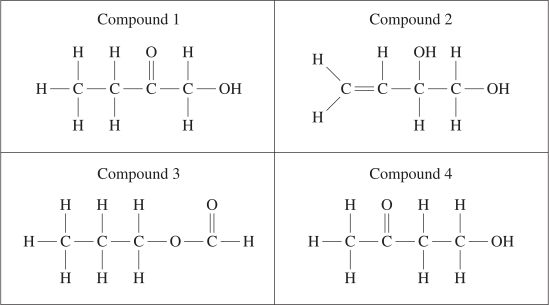
Filed Under: Static and Dynamic Equilibrium Tagged With: Band 4, Band 5, smc-3669-20-Entropy/Enthalpy

CHEMISTRY, M6 2021 HSC 32

The molar enthalpies of neutralisation of three reactions are given.

Reaction 1:

\(\ce{HCl($aq$) + KOH($aq$) -> KCl($aq$) + H2O($l$)}\)                \(\ce{Δ$H$}\) \(\pu{=-57.6 kJ mol-1}\)

Reaction 2:

\(\ce{HNO3($aq$) + KOH($aq$) -> KNO3($aq$) + H2O($l$)}\)       \(\ce{Δ$H$}\) \(\pu{=-57.6 kJ mol-1}\)

Reaction 3:

\(\ce{HCN($aq$) + KOH($aq$) -> KCN($aq$) + H2O($l$)}\)            \(\ce{Δ$H$}\) \(\pu{=-12.0 kJ mol-1}\)

 
Explain why the first two reactions have the same enthalpy value but the third reaction has a different value.   (4 marks)

--- 10 WORK AREA LINES (style=lined) ---

Show Answers Only
  • Reaction 1 and reaction 2 are both neutralisation reactions between strong acids and strong bases. These reactions completely ionise in solution when added to water.
  • Both reactions have the same net ionic equation:
  •   `text{H}^+ (aq) + text{OH}^-  (aq) →  text{H}_2 text{O} (l)`
  • Therefore, the enthalpy values obtained are the same for both reactions.
  • In reaction 3, `text{HCN}` is a weak acid that only partially ionises in an equilibrium reaction with water.
  •   `text{HCN} (aq) + text{H}_2 text{O} (l)  ⇋  text{CN}^-  (aq) + text{H}_3 text{O}^+ (aq).`
  • As the reaction continues, `text{HCN}` will further ionise as the equilibrium shifts to the right.
  • The bond-breaking is an endothermic process and thus will consume energy to break the bonds. As a result, the overall reaction is less exothermic than reaction 1 and reaction 2.
Show Worked Solution
  • Reaction 1 and reaction 2 are both neutralisation reactions between strong acids and strong bases. These reactions completely ionise in solution when added to water.
  • Both reactions have the same net ionic equation:
  •   `text{H}^+ (aq) + text{OH}^-  (aq) →  text{H}_2 text{O} (l)`
  • Therefore, the enthalpy values obtained are the same for both reactions.
  • In reaction 3, `text{HCN}` is a weak acid that only partially ionises in an equilibrium reaction with water.
  •   `text{HCN} (aq) + text{H}_2 text{O} (l)  ⇋  text{CN}^-  (aq) + text{H}_3 text{O}^+ (aq).`
  • As the reaction continues, `text{HCN}` will further ionise as the equilibrium shifts to the right.
  • The bond-breaking is an endothermic process and thus will consume energy to break the bonds. As a result, the overall reaction is less exothermic than reaction 1 and reaction 2.

♦ Mean mark 44%.
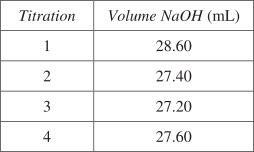
Filed Under: Bronsted-Lowry Theory, Properties of Acids and Bases, Quantitative Analysis Tagged With: Band 5, Band 6, smc-3673-20-Enthalpy of Neutralisation, smc-3674-20-Strong/Weak Acids & Bases, smc-3675-40-Strong/Weak Acids

CHEMISTRY, M5 2021 HSC 31

Ammonia is produced according to the following equilibrium equation.
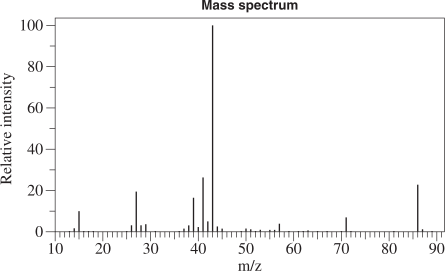
   \(\ce{N2($g$) + 3H2($g$)\rightleftharpoons 2NH3($g$)}\)

There are 4.50 moles of nitrogen gas, 1.00 mole of hydrogen gas and 5.80 moles of ammonia in a 10.0 L vessel. The system is at equilibrium at 298 K. The value of `K_{eq}` at this temperature is 748 .

How many moles of nitrogen gas need to be added to the vessel to increase the amount of ammonia by 0.050 moles?   (4 marks)

Show Answers Only
  `text{N}_2`  `\ \ +\ \ `   `3 text{H}_2`   `⇋`   `\ \ 2 text{NH}_3`
Initial `(4.5 + x)\ text{moles}`   `1.0\ text{moles}`   `5.8\ text{moles}`
Change `− 0.025\ text{moles}`   `− 0.075\ text{moles}`   `+ 0.05\ text{moles}`
Equilibrium   `(4.475 + x)\ text{moles}`   `0.925\ text{moles}`   `5.85\ text{moles}`
Equilibrium 
concentration  
`[4.475 + x] / 10\ text{mol L}^ (–1)`    `0.0925\ text{mol L}^(–1)`   `0.585\ text{mol L}^(–1)`

 
`K_(eq) = [NH_3]^2 / [[N_2] [H_2]^3] `

`748 = 0.585^2 / [(4.475 + x) / 10 xx 0.0925^3]`

`748 xx (4.475 + x) / 10 xx 0.0925^3 = 0.585^2`

`(4.475 + x)/10` `= 0.585^2 / [748 xx 0.0925^3]`  
`4.475+x` `=[10 xx 0.585^2] / [748 xx 0.0925^3]`  
`x` `=[10 xx 0.585^2] / [748 xx 0.0925^3]-4.475`  
  `=1.3\ text{moles (1 d.p.)}`  

 
∴ 1.3 moles of nitrogen must be added to the equilibrium mixture.

Show Worked Solution
  `text{N}_2`  `\ \ +\ \ `   `3 text{H}_2`   `⇋`   `\ \ 2 text{NH}_3`
Initial `(4.5 + x)\ text{moles}`   `1.0\ text{moles}`   `5.8\ text{moles}`
Change `− 0.025\ text{moles}`   `− 0.075\ text{moles}`   `+ 0.05\ text{moles}`
Equilibrium   `(4.475 + x)\ text{moles}`   `0.925\ text{moles}`   `5.85\ text{moles}`
Equilibrium 
concentration  
`[4.475 + x] / 10\ text{mol L}^ (–1)`    `0.0925\ text{mol L}^(–1)`   `0.585\ text{mol L}^(–1)`

 
`K_(eq) = [NH_3]^2 / [[N_2] [H_2]^3] `

`748 = 0.585^2 / [(4.475 + x) / 10 xx 0.0925^3]`

`748 xx (4.475 + x) / 10 xx 0.0925^3 = 0.585^2`

`(4.475 + x)/10` `= 0.585^2 / [748 xx 0.0925^3]`  
`4.475+x` `=[10 xx 0.585^2] / [748 xx 0.0925^3]`  
`x` `=[10 xx 0.585^2] / [748 xx 0.0925^3]-4.475`  
  `=1.3\ text{moles (1 d.p.)}`  

 
∴ 1.3 moles of nitrogen must be added to the equilibrium mixture.


♦ Mean mark 44%.

Filed Under: Equilibrium Constant Tagged With: Band 5, smc-3671-20-Calcs given K(eq), smc-3671-35-Chemical equation given

  • « Previous Page
  • 1
  • …
  • 39
  • 40
  • 41
  • 42
  • 43
  • …
  • 82
  • Next Page »

Copyright © 2014–2025 SmarterEd.com.au · Log in