SmarterEd

Aussie Maths & Science Teachers: Save your time with SmarterEd

  • Login
  • Get Help
  • About

BIOLOGY, M5 EQ-Bank 25

A student plans to investigate whether the development of insulin has affected the prevalence of Type 1 diabetes in the human population and subsequently influenced human evolution. She has access to data on Australians with diabetes extending back to 1973 .

  1. Propose a suitable hypothesis for this investigation.   (2 marks)

    --- 4 WORK AREA LINES (style=lined) ---

  2. Identify TWO variables that need to be controlled for this investigation and explain their importance.   (4 marks)

    --- 10 WORK AREA LINES (style=lined) ---
Show Answers Only

a.   Two possible hypotheses include:

  • The development of insulin has led to a decrease in the prevalence of Type 1 diabetics.
  • The use of insulin by people who have Type 1 diabetes has increased the prevalence of Type 1 diabetes in the human population.
     

b.  Variables to be controlled:

  • The growth of the Australian population in general will statistically lead to a bias in more recent years, where higher a number of individuals with Type 1 diabetes is to be expected.
  • To control this variable, the investigation should be measured using a fixed rate such as ‘per 100 000’.
  • The time of diagnosis and length of time an individual has used insulin can impact the trend of the obtained data.
  • This data must be obtained and accounted for to be able to increase the validity of findings.
Show Worked Solution

a.   Two possible hypotheses include:

  • The development of insulin has led to a decrease in the prevalence of Type 1 diabetics.
  • The use of insulin by people who have Type 1 diabetes has increased the prevalence of Type 1 diabetes in the human population.

b.  Variables to be controlled

  • The growth of the Australian population in general will statistically lead to a bias in more recent years, where higher a number of individuals with Type 1 diabetes is to be expected.
  • To control this variable, the investigation should be measured using a fixed rate such as ‘per 100 000’.
  • The time of diagnosis and length of time an individual has used insulin can impact the trend of the obtained data.
  • This data must be obtained and accounted for to be able to increase the validity of findings.

Filed Under: Genetic Variation / Inheritance Tagged With: Band 4, Band 5, smc-3648-75-Inheritance Patterns

BIOLOGY, M5 EQ-Bank 26

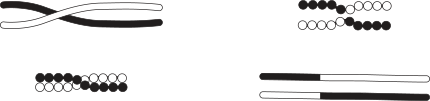
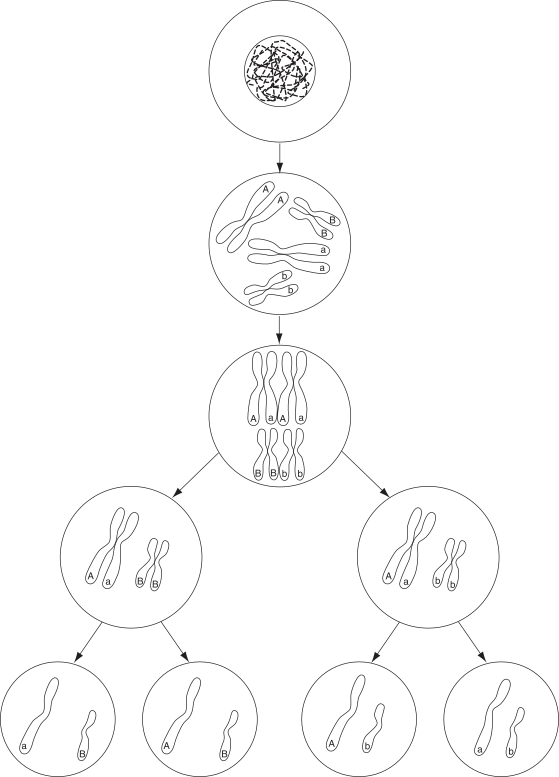
The diagram shows a model developed in the early 20th century of crossing over of homologous chromosomes.
 

Explain how the difference between this model and our current model of crossing over reflects an increased understanding of the way in which new combinations of genotypes are produced. Support your answer with a diagram.  (4 marks)

Show Answers Only
  • The model shows that crossing over occurs between homologous chromosomes before DNA replication. This means that when sister chromatids are formed, they will contain the post-crossing over sequence.
  • In the new model, DNA replication occurs prior to crossing over, where crossing over only occurs when replicated homologous chromosomes line up in tetrads, and only 2 homologous pairs exchange information. 
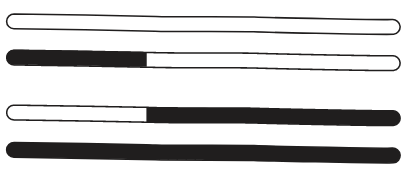
  • In this way, the new model will produce 4 unique chromatids while the old model will produce only 2. Therefore new model produces a wider range of genetic variability in offspring.
  • Possible unique chromatids:

Show Worked Solution
  • The model shows that crossing over occurs between homologous chromosomes before DNA replication. This means that when sister chromatids are formed, they will contain the post-crossing over sequence.
  • In the new model, DNA replication occurs prior to crossing over, where crossing over only occurs when replicated homologous chromosomes line up in tetrads, and only 2 homologous pairs exchange information. 
  • In this way, the new model will produce 4 unique chromatids while the old model will produce only 2. Therefore new model produces a wider range of genetic variability in offspring.
  • Possible unique chromatids:

Filed Under: Genetic Variation / Inheritance Tagged With: Band 5, smc-3648-50-Meiosis

BIOLOGY, M5 EQ-Bank 28

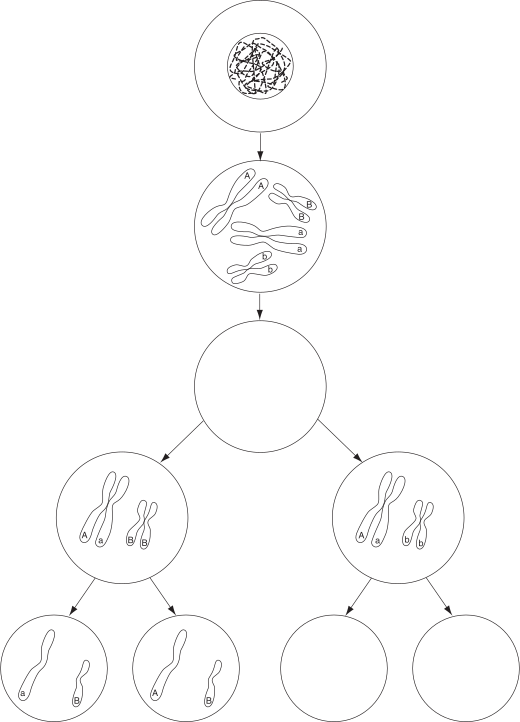
  1. Complete the following diagram to show the process by which gametes are formed.   (3 marks)


  2. How does the segregation of chromosomes during meiosis lead to a wide variety of gametes being produced?   (2 marks)

    --- 5 WORK AREA LINES (style=lined) ---

Show Answers Only

a.   


b.    Process creating wide variety of gametes

  • Independent assortment is the process by which homologous pairs are separated during meiosis into daughter cells.
  • During this process, daughter cell orientation and the cell they are separated into is random and not dependent on any factors.
  • This leads to a great variety in gametes due to the numerous combinations of chromosomes.
Show Worked Solution

a.   


b.    Process creating wide variety of gametes

  • Independent assortment is the process by which homologous pairs are separated during meiosis into daughter cells.
  • During this process, daughter cell orientation and the cell they are separated into is random and not dependent on any factors.
  • This leads to a great variety in gametes due to the numerous combinations of chromosomes.

Filed Under: Cell Replication Tagged With: Band 5, Band 6, smc-3649-20-Meiosis

BIOLOGY, M5 EQ-Bank 23

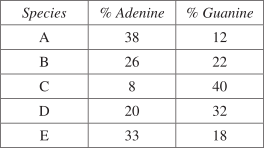
Students conducted preliminary experiments to analyse the DNA base composition of five different individuals.

The table shows the experimental data collected.
 

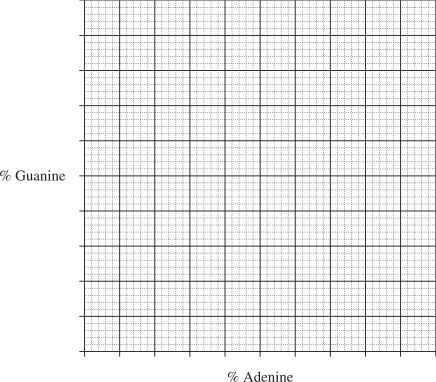
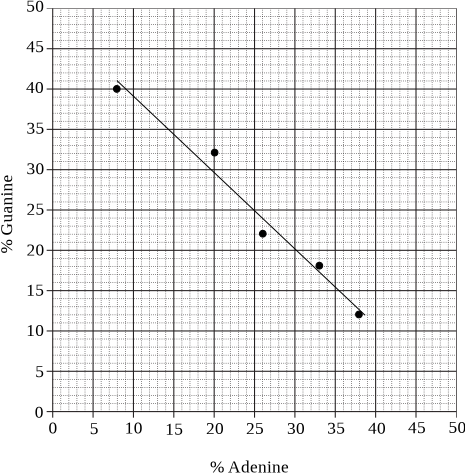
  1. On the grid provided, plot the % Guanine against % Adenine of the individuals analysed and draw a suitable line of best fit.   (3 marks)


  2. Identify the relationship shown by the data.   (1 mark)

    --- 2 WORK AREA LINES (style=lined) ---

  3. Explain the relationship shown by the data.   (3 marks)

    --- 8 WORK AREA LINES (style=lined) ---

Show Answers Only

a.   
       

b.  Relationship: As the % of Adenine increases, the % of Guanine decreases.

c.   Adenine/Guanine relationship

→ Because Adenine pairs with Thymine and Cytosine pairs with Guanine occurring to DNA base pairing rules, each should directly correlate to each other and account for the same % within the DNA composition of any species.

→ There are the only 4 components that make up all DNA composition. This also means that when comparing % of bases that do not pair, such as Adenine and Guanine, they must combine to form 50% of all DNA. This is evident when looking at individuals A and B, as well as C, D and E which are only off by 1-2%, most likely due to human error.

→ This always explains the relationship where an increase in Adenine (and Thymine) % will result in a decrease in Guanine (and Cytosine) % as the A and T pairs now occupy more space in the genome.

Show Worked Solution

a.   
       

b.  Relationship: As the % of Adenine increases, the % of Guanine decreases.

c.   Adenine/Guanine relationship

→ Because Adenine pairs with Thymine and Cytosine pairs with Guanine occurring to DNA base pairing rules, each should directly correlate to each other and account for the same % within the DNA composition of any species.

→ There are the only 4 components that make up all DNA composition. This also means that when comparing % of bases that do not pair, such as Adenine and Guanine, they must combine to form 50% of all DNA. This is evident when looking at individuals A and B, as well as C, D and E which are only off by 1-2%, most likely due to human error.

→ This always explains the relationship where an increase in Adenine (and Thymine) % will result in a decrease in Guanine (and Cytosine) % as the A and T pairs now occupy more space in the genome.

Filed Under: Uncategorized Tagged With: Band 3, Band 4, Band 5, smc-3649-10-DNA Structure

BIOLOGY, M5 EQ-Bank 27

Explain why internal fertilisation is a more robust process than external fertilisation in maintaining a species generation after generation.   (5 marks)

--- 10 WORK AREA LINES (style=lined) ---
Show Answers Only
  • In order for a species to successfully continue and avoid extinction, a sufficient number of offspring must be able to survive until gestational maturity and produce offspring themselves, hence continuing the cycle.
  • External fertilisation is used mainly in sea animals such as fish where the survival rate of offspring is low due to the plentiful numbers of predators in such a vast environment.
  • In response to this environment, external fertilisation methods must produce large numbers of sperm and eggs to increase the number of fertilised embryos. This process requires of a significant amount of energy.
  • Fertilised embryos typically experience minimal or no parental care, further lowering the survival rate of offspring. Therefore, external fertilisation has numerous disadvantages to overcome in achieving the continuity of the species.
  • Internal fertilisation is generally more common amongst varying species (such as humans). Despite often only producing one child at a time, internal fertilisation as a process protects the developing embryo inside the female uterus.
  • Although the number of fertilised embryos is lower, greater parental care throughout most of early life and a significant decrease in predation creates a higher survival rate.
  • In this way, internal fertilisation is more advantageous to ensure the continuity of a species.
Show Worked Solution
  • In order for a species to successfully continue and avoid extinction, a sufficient number of offspring must be able to survive until gestational maturity and produce offspring themselves, hence continuing the cycle.
  • External fertilisation is used mainly in sea animals such as fish where the survival rate of offspring is low due to the plentiful numbers of predators in such a vast environment.
  • In response to this environment, external fertilisation methods must produce large numbers of sperm and eggs to increase the number of fertilised embryos. This process requires of a significant amount of energy.
  • Fertilised embryos typically experience minimal or no parental care, further lowering the survival rate of offspring. Therefore, external fertilisation has numerous disadvantages to overcome in achieving the continuity of the species.
  • Internal fertilisation is generally more common amongst varying species (such as humans). Despite often only producing one child at a time, internal fertilisation as a process protects the developing embryo inside the female uterus.
  • Although the number of fertilised embryos is lower, greater parental care throughout most of early life and a significant decrease in predation creates a higher survival rate.
  • In this way, internal fertilisation is more advantageous to ensure the continuity of a species.

Filed Under: Reproduction Tagged With: Band 4, Band 5, smc-3647-15-Internal vs. External

BIOLOGY, M5 EQ-Bank 16 MC

A student conducted a survey to determine the phenotype prevalence of cats that had long hair in comparison to the number that had short hair in a population of cats.

She asked her classmates to describe the coat length of their cats and tallied the results. Out of 26 cats that were counted, she found that 42% of the cats had long hair and 58% had short hair, and that the trait did not follow a Mendelian ratio.

Which of the following best explains why the results did not follow a Mendelian ratio?

  1. The student tallied the numbers incorrectly.
  2. The length of cat hair may be determined by more than one gene.
  3. The student cannot determine the genotype from the phenotype alone.
  4. The students were unclear about whether their cat had long or short hair.
Show Answers Only

`B`

Show Worked Solution

By Elimination

  • A and D relate to human error and cannot be deemed a valid reason for an experiment not appealing to a hypothesis (Eliminate A and D).
  • Many characteristics (phenotypes) are controlled by a variety of genes, including standard Mendelian alleles, sex-linked genes, multiple alleles and incomplete dominance/co-dominace. A combination of these may relate to the length of hair in cats, and is the best explanation of the results.

`=>B`

Filed Under: Genetic Variation / Inheritance Tagged With: Band 5, smc-3648-75-Inheritance Patterns

BIOLOGY, M5 EQ-Bank 15 MC

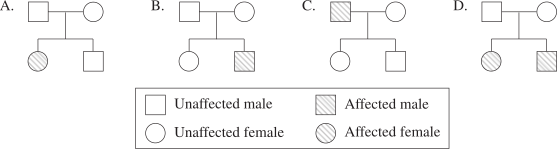
It is suspected that a child has a recessive, sex-linked condition. An initial pedigree was developed.

Which of the following is most likely to depict this initial pedigree?
 

Show Answers Only

`B`

Show Worked Solution

By Elimination

  • Pedigree C displays no information related to the question as no children are affected (Eliminate C).
  • Both pedigree A and D display crosses which are inaccurate and impossible to occur as daughters cannot be affected if the mother does not have recessive sex-linked traits (Eliminate A and D).

`=>B`

Filed Under: Genetic Variation / Inheritance Tagged With: Band 5, smc-3648-10-Pedigrees, smc-3648-30-Sex Linkage

BIOLOGY, M5 EQ-Bank 13 MC

Haemophilia A is a blood clotting disorder that arises from a defect in the gene which is carried on the `text{X}` chromosome.

A couple is considering starting a family. However, the father suffers from Haemophilia A. The mother is healthy with no family history of the disease.

What is the probability that a potential grandson will have Haemophilia A if they have a daughter who partners with an unaffected man?

  1. 0%
  2. 50%
  3. 75%
  4. 100%
Show Answers Only

`B`

Show Worked Solution
  • The probability can be explained by the cross below, where the daughter has a heterozygous phenotype (mother was homozygous recessive and father had haemophilia).
  • Daughter : `text{X}^text{A}text{X}^text{a}`   Husband : `text{X}^text{a}text{Y}`

\begin{array} {|l|c|c|}
\hline  & \text{X}^\text{a} & \text{Y} \\
\hline \text{X}^\text{A} & \text{X}^\text{A}\text{X}^\text{a} & \text{X}^\text{A}\text{Y}\\
\hline \text{X}^\text{a} & \text{X}^\text{a}\text{X}^\text{a} & \text{X}^\text{a}\text{Y} \\
\hline \end{array}

  • This shows that 1 in 2 grandsons will have haemophilia and 1 in 2 granddaughters will have haemophilia, therefore there is a 50% likelihood of grandchildren being affected.

`=>B`

Filed Under: Genetic Variation / Inheritance Tagged With: Band 5, smc-3648-30-Sex Linkage

BIOLOGY, M5 EQ-Bank 12 MC

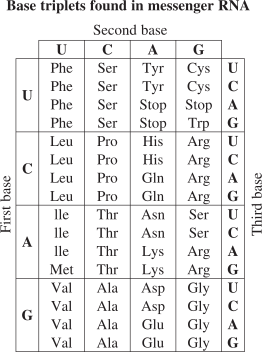
The table shows the base triplets in mRNA for amino acids.

From the table, the amino acid Tryptophan (Trp) can be coded for by the base triplet `text{UGG}`.
 

Which base triplet could code for the amino acid Arginine (Arg)?

  1. `text{AAU}`
  2. `text{UGC}`
  3. `text{GCC}`
  4. `text{CGG}`
Show Answers Only

`D`

Show Worked Solution
  • `text{CGG}` is the only correct combination for Arginine from options given.

`=>D`

Filed Under: DNA and Polypeptide Synthesis Tagged With: Band 5, smc-3650-20-Translation

BIOLOGY, M5 EQ-Bank 14 MC

Haemophilia A is a blood clotting disorder that arises from a defect in the gene F8 which is carried on the X chromosome. The disorder affects the production of a glycoprotein that is one of many components needed to form the platelets which form blood clots when a bleed occurs. It is typically treated with infusions of FVIII product, an inactive single chain polypeptide of 2332 amino acids, which is manufactured using DNA technology on human endothelial cells.

Why is the inactive FVIII polypeptide chain used in the treatment of Haemophilia A?

  1. It will prevent bleeds from occurring.
  2. It can take the place of platelets in clotting blood.
  3. It can be used to manufacture the glycoprotein that is affected by the defective F8 gene.
  4. It is used as a gene therapy to help the patient manufacture FVIII in their own endothelial cells.
Show Answers Only

`C`

Show Worked Solution
  • An inactive single chain polypeptide that has been manufactured by DNA technology from endothelial cells (the single cell layer of blood vessels) would imply that it is the mRNA strand which codes for the glycoprotein.
  • Haemophilia A is a mutation of the F8 which codes for the glycoprotein (or part of it), and therefore injections of this mRNA strand will ‘bypass’ the mutation and allow the body to manufacture the protein itself.

`=>C`

Filed Under: DNA and Polypeptide Synthesis Tagged With: Band 5, smc-3650-11-RNA, smc-3650-20-Translation

PHYSICS, M8 EQ-Bank 26

Observations and mathematical ideas are critical to the improvement of scientific models.

Discuss this statement with reference to scientific discoveries that have contributed to our understanding of the atom.   (8 marks)

--- 22 WORK AREA LINES (style=lined) ---

Show Answers Only
  • [P] Observations have been critical in advancing atomic models.
  • [E] When experiments reveal unexpected results, scientists must revise their models to match reality.
  • [Ev] The Geiger-Marsden experiment showed alpha particles bouncing back from gold foil, contradicting the plum pudding model. This led Rutherford to propose a dense nucleus.
  • [L] This demonstrates how observations drive scientific progress in understanding atoms.
     
  • [P] Mathematical ideas provide essential frameworks for atomic models.
  • [E] Mathematics allows scientists to make precise predictions and test theories quantitatively.
  • [Ev] Bohr developed a mathematical model explaining the specific wavelengths emitted which relies on Rydberg’s equation: `(1)/(lambda)=R((1)/(n_(f)^2)-(1)/(n_(i)^2))`.
  • [Ev] This model was limited as it was only able to explain the hydrogen atom. De Broglie built upon it by postulating that electrons behaved as a wave, eventually describing the equation `\lambda=h/{mv}` which helped explain electron wave behaviour.
  • [L] These mathematical models transformed vague ideas into testable predictions about atomic structure.
     
  • [P] However, observations and mathematics alone have limitations.
  • [E] Models based purely on observations can miss underlying principles without theoretical insight.
  • [Ev] Bohr’s model perfectly matched hydrogen spectra but failed for other atoms because it lacked deeper quantum understanding.
  • [L] This shows that observation and mathematics need theoretical frameworks to truly advance atomic understanding.
     
  • [P] Nevertheless, observations and mathematical ideas remain fundamental to atomic theory development.
  • [E] Despite limitations, these tools work together to progressively refine scientific understanding.
  • [Ev] The progression from Rutherford to Bohr to de Broglie shows each model building on previous observations and mathematical frameworks, creating increasingly accurate atomic models.
  • [L] Therefore, the statement is valid as both elements are critical for advancing our understanding of the atom.

Answers could also reference:

  • Thomson’s discovery of the electron.
  • Further contributions from Davisson-Germer as well as Schrodinger and Heisenberg.
Show Worked Solution
  • [P] Observations have been critical in advancing atomic models.
  • [E] When experiments reveal unexpected results, scientists must revise their models to match reality.
  • [Ev] The Geiger-Marsden experiment showed alpha particles bouncing back from gold foil, contradicting the plum pudding model. This led Rutherford to propose a dense nucleus.
  • [L] This demonstrates how observations drive scientific progress in understanding atoms.
     
  • [P] Mathematical ideas provide essential frameworks for atomic models.
  • [E] Mathematics allows scientists to make precise predictions and test theories quantitatively.
  • [Ev] Bohr developed a mathematical model explaining the specific wavelengths emitted which relies on Rydberg’s equation: `(1)/(lambda)=R((1)/(n_(f)^2)-(1)/(n_(i)^2))`.
  • [Ev] This model was limited as it was only able to explain the hydrogen atom. De Broglie built upon it by postulating that electrons behaved as a wave, eventually describing the equation `\lambda=h/{mv}` which helped explain electron wave behaviour.
  • [L] These mathematical models transformed vague ideas into testable predictions about atomic structure.
     
  • [P] However, observations and mathematics alone have limitations.
  • [E] Models based purely on observations can miss underlying principles without theoretical insight.
  • [Ev] Bohr’s model perfectly matched hydrogen spectra but failed for other atoms because it lacked deeper quantum understanding.
  • [L] This shows that observation and mathematics need theoretical frameworks to truly advance atomic understanding.
     
  • [P] Nevertheless, observations and mathematical ideas remain fundamental to atomic theory development.
  • [E] Despite limitations, these tools work together to progressively refine scientific understanding.
  • [Ev] The progression from Rutherford to Bohr to de Broglie shows each model building on previous observations and mathematical frameworks, creating increasingly accurate atomic models.
  • [L] Therefore, the statement is valid as both elements are critical for advancing our understanding of the atom.

Answers could also reference:

  • Thomson’s discovery of the electron.
  • Further contributions from Davisson-Germer as well as Schrodinger and Heisenberg.

Filed Under: Quantum Mechanical Nature of the Atom, Structure of the Atom Tagged With: Band 4, Band 5, smc-3701-40-Rutherford, smc-3702-10-Bohr's Model, smc-3702-40-De Broglie

PHYSICS, M8 EQ-Bank 27

Explain how the analysis of quantitative observations contributed to the development of the concept that certain matter and energy are quantised.   (9 marks)

--- 18 WORK AREA LINES (style=lined) ---

Show Answers Only

Experiments such as Millikan’s oil drop experiment and others testing the photoelectric effect have demonstrated that certain quantities of matter and energy are quantised which means they are multiples of some fundamental value.

Millikan’s Oil Drop Experiment

  • Millikan’s oil drop experiment was able to show that charge is quantised. 
  • Millikan levitated oil drops in an electric field by balancing the electric and gravitational forces on them. This allowed him to find the electric force acting on each oil drop, and using the mass of the oil drop he found its charge.
  • Analysing his results, he found that the charge on every oil drop was an integer multiple of `1.602 xx10^(-19) C`. This was determined to be the fundamental charge on an electron.
  • Further, with Thompson’s later discovery of the charge to mass ratio of an electron, its mass could be determined. 

Photoelectric Effect

  • Photoelectric effect experiments showed the quantum properties of light which seemingly contradicted the view of light as a wave.
  • It was found that there was a minimum frequency (energy) of light that would cause photoemission when it was incident upon a metal plate, and no photoemission occurred with light lower than this frequency, regardless of intensity.
  • As one photon would strike one electron on the metal surface, the electron would receive a discrete amount of energy from that photon determined by its frequency `E=hf`. If a photon didn’t have enough energy, an electron couldn’t be removed.
  • This experimental evidence changed the conceptual understanding of energy within physics and provided a basis for the quantisation of the energy of light. 

Other quantitative experiments that could be explored include:

  • Bohr’s analysis of emission spectra to demonstrate the existence of quantised energy levels in atoms.
  • Cathode ray experiments showing the particle nature of electrons.
  • Blackbody radiation experiments. 
Show Worked Solution

Experiments such as Millikan’s oil drop experiment and others testing the photoelectric effect have demonstrated that certain quantities of matter and energy are quantised which means they are multiples of some fundamental value.

Millikan’s Oil Drop Experiment

  • Millikan’s oil drop experiment was able to show that charge is quantised. 
  • Millikan levitated oil drops in an electric field by balancing the electric and gravitational forces on them. This allowed him to find the electric force acting on each oil drop, and using the mass of the oil drop he found its charge.
  • Analysing his results, he found that the charge on every oil drop was an integer multiple of `1.602 xx10^(-19) C`. This was determined to be the fundamental charge on an electron.
  • Further, with Thompson’s later discovery of the charge to mass ratio of an electron, its mass could be determined. 

Photoelectric Effect

  • Photoelectric effect experiments showed the quantum properties of light which seemingly contradicted the view of light as a wave.
  • It was found that there was a minimum frequency (energy) of light that would cause photoemission when it was incident upon a metal plate, and no photoemission occurred with light lower than this frequency, regardless of intensity.
  • As one photon would strike one electron on the metal surface, the electron would receive a discrete amount of energy from that photon determined by its frequency `E=hf`. If a photon didn’t have enough energy, an electron couldn’t be removed.
  • This experimental evidence changed the conceptual understanding of energy within physics and provided a basis for the quantisation of the energy of light. 

Other quantitative experiments that could be explored include:

  • Bohr’s analysis of emission spectra to demonstrate the existence of quantised energy levels in atoms.
  • Cathode ray experiments showing the particle nature of electrons.
  • Blackbody radiation experiments. 

Filed Under: Light: Quantum Model, Structure of the Atom Tagged With: Band 4, Band 5, Band 6, smc-3698-10-Photoelectric Effect, smc-3698-80-Wave/Particle models, smc-3701-20-Millikan

PHYSICS, M8 EQ-Bank 22

Einstein's equation `E = mc^(2)`  is one of the most important equations in the history of physics.

Justify this statement.   (7 marks)

--- 14 WORK AREA LINES (style=lined) ---

Show Answers Only

Position Statement

  • Einstein’s equation `E=mc^2` is among physics’ most important equations because it reveals mass-energy equivalence and explains fundamental processes from atomic to cosmic scales.

Nuclear Applications

  • The equation explains energy from nuclear fission and fusion processes. It shows how tiny amounts of matter convert to enormous energy in nuclear reactions.
  • The mass defect in atoms directly relates to binding energy through `E=mc^2` and this principle drives nuclear reactors that power cities and nuclear weapons.
  • These applications are responsible for revolutionising both energy production and global politics.

Cosmic and Particle Physics

  • Stars produce energy by converting mass to energy through fusion reactions. The Sun converts 4 million tonnes of mass to energy every second using this principle
  • Particle accelerators create new particles by converting kinetic energy into mass. This allows scientists to study fundamental matter structure and discover new particles.
  • Furthermore, mass dilation near light speed also follows from this mass-energy relationship.

Reinforcement

  • While other equations like Newton’s gravity law are important, they lack the broad applicability of `E=mc^2`.
  • No other single equation explains phenomena from subatomic particles to stellar processes.
  • The equation unified our understanding of matter and energy as different forms of the same thing.
  • This justifies calling `E=mc^2` one of history’s most important physics equations.
Show Worked Solution

Position Statement

  • Einstein’s equation `E=mc^2` is among physics’ most important equations because it reveals mass-energy equivalence and explains fundamental processes from atomic to cosmic scales.

Nuclear Applications

  • The equation explains energy from nuclear fission and fusion processes. It shows how tiny amounts of matter convert to enormous energy in nuclear reactions.
  • The mass defect in atoms directly relates to binding energy through `E=mc^2` and this principle drives nuclear reactors that power cities and nuclear weapons.
  • These applications are responsible for revolutionising both energy production and global politics.

Cosmic and Particle Physics

  • Stars produce energy by converting mass to energy through fusion reactions. The Sun converts 4 million tonnes of mass to energy every second using this principle
  • Particle accelerators create new particles by converting kinetic energy into mass. This allows scientists to study fundamental matter structure and discover new particles.
  • Furthermore, mass dilation near light speed also follows from this mass-energy relationship.

Reinforcement

  • While other equations like Newton’s gravity law are important, they lack the broad applicability of `E=mc^2`.
  • No other single equation explains phenomena from subatomic particles to stellar processes.
  • The equation unified our understanding of matter and energy as different forms of the same thing.
  • This justifies calling `E=mc^2` one of history’s most important physics equations.

Filed Under: Light and Special Relativity, Origins of Elements, Properties of the Nucleus Tagged With: Band 3, Band 4, Band 5, smc-3699-80-E = mc^2, smc-3700-60-Mass-Energy Equivalence, smc-3703-20-Conservation of Mass-Energy

PHYSICS, M8 EQ-Bank 23

A patient is given an injection containing `6.0 × 10^(-18)` kg of radioactive technetium-99m which has a half-life of 6 hours.

How much remains undecayed when a scan is taken 3 hours later?   (3 marks)

Show Answers Only

`4.2 xx10^(-18)\ text{kg}`

Show Worked Solution

Calculating the decay constant:

   `lambda=(ln2)/(t_((1)/(2)))=(ln2)/(6)=0.1155\ text{hour}^(-1)`

Amount remaining undecayed:

`N` `=N_(0)e^(-lambdat)`  
  `=6.0 xx10^(-18) xxe^(-0.1155 xx3)`  
  `=4.2429… xx10^(-18)`  
  `=4.2 xx10^(-18)\ text{kg}`  

Filed Under: Properties of the Nucleus Tagged With: Band 5, smc-3703-40-Radioactive Decay

PHYSICS, M8 EQ-Bank 17 MC

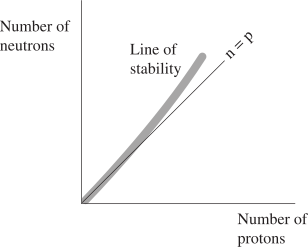
The graph shown plots isotopes in terms of their numbers of protons and neutrons. When an isotope undergoes nuclear decay, it will move to a different location on the graph. The movement can be represented with an arrow.
 

Which arrow would correctly describe beta negative `(beta^(-))` decay on the graph?
 

Show Answers Only

`A`

Show Worked Solution
  • In `beta^(-)` decay, a neutron is converted into a proton and an electron.
  • The number of neutrons decreases by one and the number of protons increase by one.
  • This corresponds to a movement downwards and to the right on the graph.

`=>A`

Filed Under: Properties of the Nucleus Tagged With: Band 5, smc-3703-30-Types of Radiation

PHYSICS, M8 EQ-Bank 24

The table shows the quantum numbers of the four lowest states of the hydrogen atom, together with the energies of those states.

\begin{array}{|c|c|}
\hline \rule{0pt}{2.5ex}\textit{Quantum number,} \ n \rule[-1ex]{0pt}{0pt}& \quad \textit{Energy}\ \text{(joules)} \quad  \\
\hline \rule{0pt}{2.5ex}1 \text { (ground state) } \rule[-1ex]{0pt}{0pt}& 0 \\
\hline \rule{0pt}{2.5ex}2 \rule[-1ex]{0pt}{0pt}& 1.63 \times 10^{-18} \\
\hline \rule{0pt}{2.5ex}3 \rule[-1ex]{0pt}{0pt}& 1.94 \times 10^{-18} \\
\hline \rule{0pt}{2.5ex}4 \rule[-1ex]{0pt}{0pt}& 2.04 \times 10^{-18} \\
\hline
\end{array}

Using appropriate calculations, explain a quantum transition that will absorb a photon of wavelength 102 nm?   (3 marks)

Show Answers Only

See Worked Solutions

Show Worked Solution

Calculating the energy of the photon:

\(E\) \(=h f\)  
  \(=\dfrac{h c}{\lambda}\)  
  \(=\dfrac{\left(6.626 \times 10^{-34}\right)\left(3 \times 10^8\right)}{1.02 \times 10^{-7}}\)  
  \(=1.949 \times 10^{-18} \  \text{J}\)  
     
  •  When a photon with wavelength 102 nm strikes an electron in the ground state of the hydrogen atom, it will transfer its energy to the electron causing it to occupy a shell with greater energy. 
  • The electron absorbing the photon will therefore transition between shells one (ground state) and three, which is approximately the energy difference between these levels as shown in the table.

Filed Under: Quantum Mechanical Nature of the Atom Tagged With: Band 5, smc-3702-20-Electron Transitions, smc-3702-30-Photon Energy

PHYSICS, M5 EQ-Bank 27

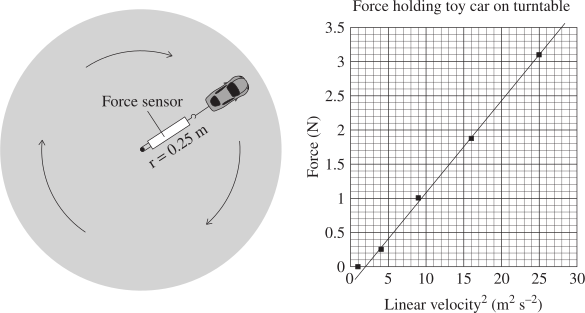
A toy car was placed facing outwards on a rotating turntable. The car was held in place by a force sensor connected to the centre of the turntable. The centre of mass of the car was 0.25 metres from the centre of the turntable. The reading from the force sensor was recorded at varying speeds of rotation. A stopwatch was used to time the rotation of the turntable. The linear velocity was calculated from the period of rotation. The graph shows the force on the car versus the square of the linear velocity of the car.


  1. Use the graph to determine the mass of the car.   (3 marks)

--- 0 WORK AREA LINES (style=lined) ---

  1. Identify possible errors in the data and outline how to reduce their effects on the estimation of the mass of the car.   (4 marks)

--- 10 WORK AREA LINES (style=lined) ---
Show Answers Only

a.   0.034 kg

b.   Errors and reduction strategies:

  • If the sensor does not produce accurate readings then systemic errors will result. 
  • Inaccurate readings can be minimised by calibrating the sensor. This can be done against a known force such as the force of gravity on a 1 kg mass.
  • If the stopwatch used to time rotations is manually operated, then error due to human inaccuracy and varying reaction times is introduced. Inaccurate calculations of the motion’s period (i.e. timing of one rotation) makes linear velocity estimations (`v=romega`) less accurate.
  • A strategy for mitigating this inaccuracy is by using the stopwatch to measure several rotations at a time and then dividing the result by the total number of rotations.
Show Worked Solution

a.   Graph passes through `(2,0)` and `(25, 3.1)`:

`text{Gradient}` `=(3.1-0)/(25-2)=0.135`  
`text{Gradient}` `=(F)/(v^2)=0.135`  

 
Since the car is undergoing uniform circular motion:

`F_(c)` `=(mv^2)/(r)`  
`(F_(c))/(v^2)` `=(m)/(r)`  
`0.135` `=(m)/(r)`  
`:. m` `=0.135 xx 0.25=0.03375=0.034\ text{kg}`  


b.   Errors and reduction strategies:

  • If the sensor does not produce accurate readings then systemic errors will result. 
  • Inaccurate readings can be minimised by calibrating the sensor. This can be done against a known force such as the force of gravity on a 1 kg mass.
  • If the stopwatch used to time rotations is manually operated, then error due to human inaccuracy and varying reaction times is introduced. Inaccurate calculations of the motion’s period (i.e. timing of one rotation) makes linear velocity estimations (`v=romega`) less accurate.
  • A strategy for mitigating this inaccuracy is by using the stopwatch to measure several rotations at a time and then dividing the result by the total number of rotations.

Filed Under: Circular Motion Tagged With: Band 4, Band 5, smc-3691-10-Centripetal Forces, smc-3691-40-Angular Velocity

PHYSICS, M5 EQ-Bank 26

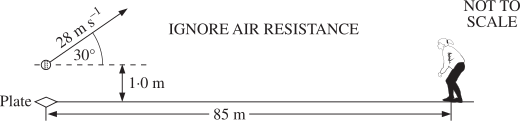
A baseball is hit with a velocity of 28 m s ¯1 at an angle of 30° to the horizontal at an initial height of 1.0 m above the plate. Ignore air resistance in your calculations.
 

  1. How long does it take the ball to return to the initial height above the ground?   (3 marks)

--- 6 WORK AREA LINES (style=lined) ---

  1. The ball is hit directly towards a stationary outfielder who is 85 m from the plate. At the instant the ball is hit, the outfielder begins to run towards the plate with constant acceleration.
  2. What is the magnitude of her acceleration if she catches the ball when it is 0.50 m above the ground?   (4 marks)

--- 8 WORK AREA LINES (style=lined) ---

Show Answers Only

a.   `t=2.9\ text{seconds}`

b.   `a=3.6  text{m s}^(-2)`

Show Worked Solution

a.   At initial height: `s_y=0`

Initial vertical velocity:  `u_y=28sin30°=14\ text{m s}^(-1)`

Vertical acceleration: `-9.8\ text{m s}^(-2)`

`s_(y)` `=u_(y)t+(1)/(2)a_(y)t^2`  
`0` `=14 t+(1)/(2)xx(-9.8)xxt^(2)`  
`0` `=14 t-4.9 xxt^(2)`  
`0` `=t(14-4.9 t)`  
`t` `=(14)/(4.9)=2.9\ text{seconds},\ \ (t>0)`  


b.   At  `s_y=0.50\ text{m}`:

`v_(y)^2` `=u_(y)^2+2a_(y)s_(y)`  
`v_(y)^2` `=14^(2)+2(-9.8)(-0.50)`  
`v_(y)` `=sqrt(205.8)~~14.3457\ text{m s}^(-1)`  

 
Using  `v_y=u_(y)+a_(y)t:`

`-14.3457` `=14-9.8t`  
`t` `=(14+14.3457)/(9.8)=2.892\ text{s}`  

 
Horizontal range travelled (`s_x`):

`s_(x)=u_(x)t=28 cos 30^{\circ} xx 2.892=70.127\ text{m}`
 

COMMENT: Note `v_y` and `u_y` are in opposite directions and have opposite signs.

  Distance fielder travelled `=85-70.127 = 14.873\ text{m}`

`s` `=ut+(1)/(2)at^(2)`  
`14.873` `=0+(1)/(2)xx a xx2.892^(2)`  
`:.a` `=(2 xx 14.873)/2.892^(2)`  
  `=3.6\ text{m s}^(-2)\ \ text{(to 1 d.p.)}`  

Filed Under: Projectile Motion Tagged With: Band 4, Band 5, smc-3690-25-Range, smc-3690-45-Time of Flight

PHYSICS, M5 EQ-Bank 17 MC

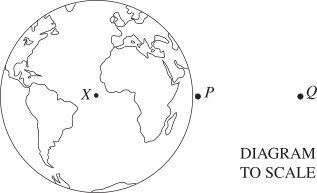
Two identical masses are placed at points `P` and `Q`. The escape velocity and circular orbital velocity of the mass at point `P` are `v_{P_(esc)}` and `v_{P_{o rb}}`. The escape velocity and circular orbital velocity of the mass at point `Q` are `v_{Q_(e s c)}` and `v_{Q_{o rb}}`. The diagram is drawn to scale and `X` denotes the centre of Earth.
 

The velocity for a body in circular orbit is given by  `v_{o rb} = sqrt((GM)/r`.

What is the value of `(v_{Q_(e s c)})/v_{P_{o rb}}`?

  1. `0.5`
  2. `1`
  3. `sqrt(2)`
  4. `2`
Show Answers Only

`B`

Show Worked Solution
  • The escape velocity of an object is given by `v_(esc)=sqrt((2GM)/(r))`
  • As the diagram is to scale, it can be measured that the distance from `Q` to `X` is twice that from `P` to `X`.
  • Let  `r` = distance from `P` to `X`  and  `2r` = distance from `Q` to `X`:
  • `v_(Q_(esc))=sqrt((2GM)/(2r))=sqrt((GM)/(r))`
  • `v_(p_(text{orb}))=sqrt((GM)/(r))` 
  • Hence, `v_(Q_(esc))=v_(P_(text{orb}))` → `(v_(Q_(esc)))/(v_(p_(text{orb})))=1`

`=>B`

Filed Under: Motion in Gravitational Fields Tagged With: Band 5, smc-3692-30-Orbital Velocity/Period/Radius, smc-3692-70-Escape Velocity

PHYSICS, M5 EQ-Bank 15 MC

The table shows data about the solar system.

\begin{array} {|l|c|c|}
\hline  \rule{0pt}{2.5ex} \quad\textit{Planet} \quad  & \textit{Average distance} & \textit{Period (days)} \\
\quad\textit{} \quad  \rule[-1ex]{0pt}{0pt}& \textit{from the sun (AU)} & \textit{} \\
\hline \rule{0pt}{2.5ex} \text{Venus} \rule[-1ex]{0pt}{0pt}& 0.72 & 224.7 \\
\hline \rule{0pt}{2.5ex} \text{Earth} \rule[-1ex]{0pt}{0pt}& 1 & 365 \\
\hline \rule{0pt}{2.5ex} \text{Mars} \rule[-1ex]{0pt}{0pt}& 1.54 & 686.2 \\
\hline \end{array}

What would be the period of another planet if it orbited the Sun at an average distance of 4.5 AU ?

  1. \(7.9 \times 10^2\) days
  2. \(1.5 \times 10^3\) days
  3. \(1.6 \times 10^3\) days
  4. \(6.6 \times 10^3\) days
Show Answers Only

\(B\)

Show Worked Solution
  • \(  \dfrac{r^3}{T^2}=\dfrac{G M}{4 \pi^2}\)
  • \( \text{Since all planets are orbiting the same central body with mass, \(M, G\) and \(4 \pi^2\) are constants.}\)
  • \( \text{The ratio \(\dfrac{r^3}{T^2}\) will be the same for all planets in the solar system.}\)

\(\begin{aligned}
\rule{0pt}{2.5ex} \dfrac{r^3}{T^2} \rule[-1ex]{0pt}{0pt}& =\dfrac{r_e^3}{T_e^2} \\
\rule{0pt}{2.5ex} \dfrac{4.5^3}{T^2} \rule[-1ex]{0pt}{0pt}& =\dfrac{1^3}{365^2} \\
\rule{0pt}{2.5ex} T^2 \rule[-1ex]{0pt}{0pt}& =\dfrac{365^2}{4.5^3} \\
\rule{0pt}{2.5ex} \therefore T \rule[-1ex]{0pt}{0pt}& =\sqrt{\frac{365^2}{4.5^3}} \\
\rule{0pt}{2.5ex} \rule[-1ex]{0pt}{0pt}& =1462 \ \text{days} \\
\rule{0pt}{2.5ex}  \rule[-1ex]{0pt}{0pt}& \approx 1.5 \times 10^3 \text {days}
\end{aligned}\)

\(\Rightarrow B\)

Filed Under: Motion in Gravitational Fields Tagged With: Band 5, smc-3692-30-Orbital Velocity/Period/Radius

PHYSICS, M5 EQ-Bank 9 MC

A satellite is orbiting a planet at a fixed altitude.

Which row of the table correctly identifies the magnitude of the work done by the forces on the satellite and the reason for this being the case?

\begin{align*}
\begin{array}{l}
\rule{0pt}{2.5ex}\textit{}& \textit{} \\
\textit{}\rule[-2ex]{0pt}{0pt}& \textit{} \\
\rule{0pt}{2.5ex}\textbf{A.}\rule[-1ex]{0pt}{0pt}\\
\rule{0pt}{2.5ex}\textbf{B.}\rule[-1ex]{0pt}{0pt}\\
\textbf{}\rule[-1ex]{0pt}{0pt}\\
\rule{0pt}{2.5ex}\textbf{C.}\rule[-1ex]{0pt}{0pt}\\
\textbf{}\rule[-1ex]{0pt}{0pt}\\
\rule{0pt}{2.5ex}\textbf{D.}\rule[-1ex]{0pt}{0pt}\\
\textbf{}\rule[-1ex]{0pt}{0pt}\\
\end{array}
\begin{array}{|c|l|}
\hline
\rule{0pt}{2.5ex}\textit{Magnitude of}&  \quad \quad \quad \quad \quad \quad \quad \quad \quad \quad\textit{Reason} \\
\textit{work done}\rule[-1ex]{0pt}{0pt}& \textit{} \\
\hline
\rule{0pt}{2.5ex}\text{Zero}\rule[-1ex]{0pt}{0pt}&\text{The net force on the satellite is zero.}\\
\hline
\rule{0pt}{2.5ex}\text{Zero}& \text{Gravity acts at 90 degrees to the direction of motion of the}\\
\text{}\rule[-1ex]{0pt}{0pt}& \text{satellite} \\
\hline
\rule{0pt}{2.5ex}\text{Greater than}& \text{The work done equals the kinetic energy of the satellite.} \\
\text{zero}\rule[-1ex]{0pt}{0pt}& \text{} \\
\hline
\rule{0pt}{2.5ex}\text{Greater than}& \text{The work done equals the gravitational force multiplied by} \\
\text{zero}\rule[-1ex]{0pt}{0pt}& \text{the length of the orbital path of the satellite.} \\
\hline
\end{array}
\end{align*}

Show Answers Only

`B`

Show Worked Solution
  • The work done by a force on an object is the product of the displacement of the object and the magnitude of the force in the direction of the displacement.
  • The satellite is orbiting the planet in uniform circular motion, so the force of gravity acts perpendicular to the direction of motion of the satellite.
  • So, zero work is done on the satellite.

`=>B`

Filed Under: Motion in Gravitational Fields Tagged With: Band 5, smc-3692-40-Satellites

Calculus, EXT1 C3 EQ-Bank 29

Find the particular solution to the initial value problem  `(dy)/(dx)=(2y+1)(x-3)`  that passes through the point `(2,-1)`.   (4 marks)

--- 12 WORK AREA LINES (style=lined) ---

Show Answers Only

`y=-1/2(e^((x-2)(x-4))+1)`

Show Worked Solution
`(dy)/(dx)` `=(2y+1)(x-3)`  
`dy/(2y+1)` `=x-3\ dx`  
`int 1/(2y+1)\ dy` `=int x-3\ dx`  
`1/2ln|2y+1|` `=x^2/2-3x+c`  

 
`text{Passes through}\ (2,-1):`

`1/2ln|-1|=2-6+c\ \ =>\ \ c=4`
 

`1/2ln|2y+1|` `=x^2/2-3x+4`  
`ln|2y+1|` `=x^2-6x+8`  
`ln|2y+1|` `=(x-4)(x-2)`  
`2y+1` `=+-e^((x-2)(x-4))`  
`2y` `=-e^((x-2)(x-4))-1,\ \ (text{passes through}\ ( 2,-1))`  
`y` `=-1/2(e^((x-2)(x-4))+1)`  

Filed Under: Equations and Slope Fields, Equations and Slope Fields Tagged With: Band 5, smc-1197-20-Differential Equations, smc-1197-30-\(\dfrac{dy}{dx}=f(x y)\), smc-7296-20-Differential Equations, smc-7296-30-\(\dfrac{dy}{dx}=f(x y)\), smc-7296-70-IVP Terminology

Vectors, EXT2 V1 EQ-Bank 31

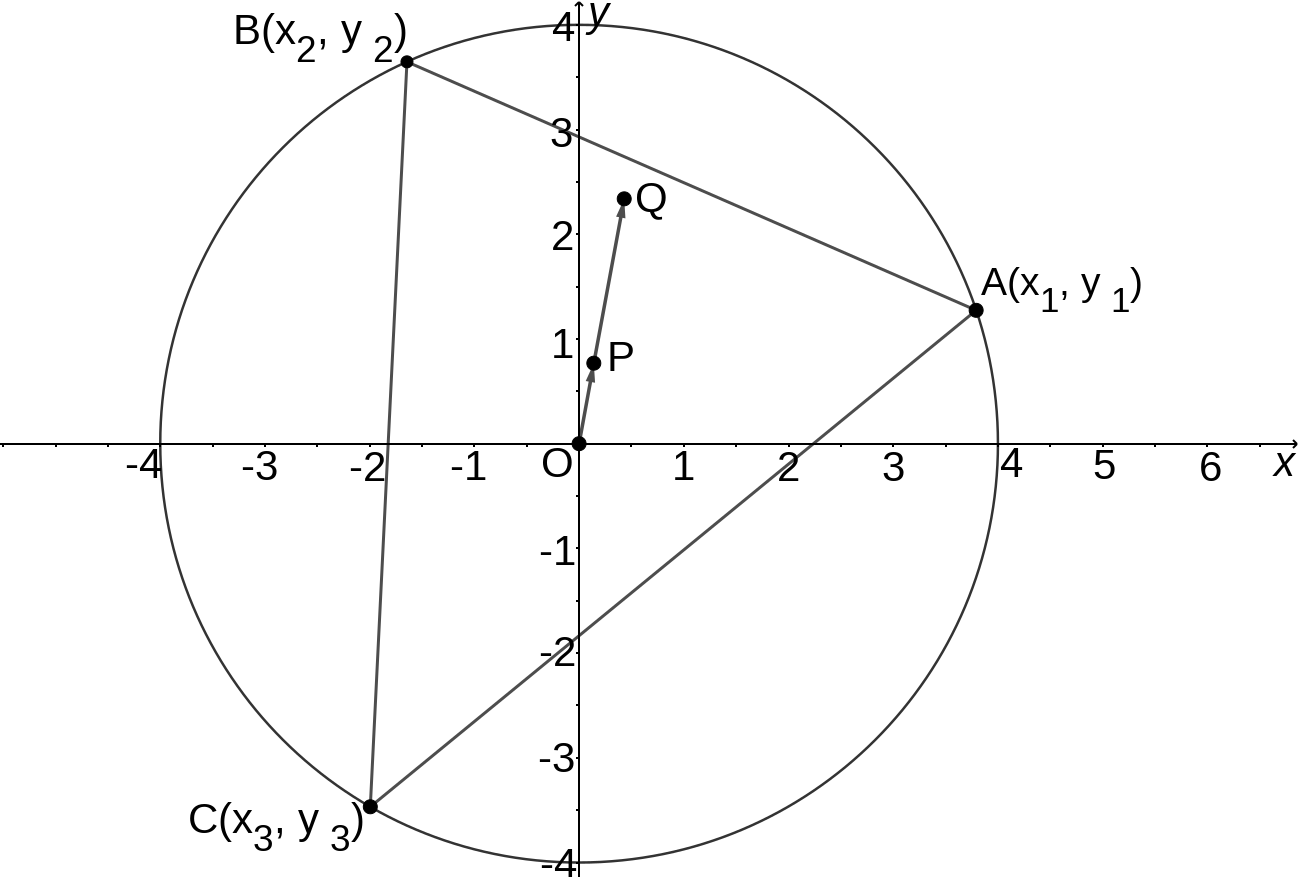
Point `O` is the circumcentre of triangle `ABC` which is the centre of the circle that passes through each of its vertices.

Point `P` is the centroid of triangle `ABC` where the bisectors of each angle within the triangle intersect.

Point `Q` is such that  `vec(OQ)=3vec(OP)`.
 

Prove that  `vec(CQ) ⊥ vec(AB)`   (5 marks)

--- 16 WORK AREA LINES (style=lined) ---

Show Answers Only

`text{See Worked Solution}` 

Show Worked Solution

`vec(OP)=(vec(OA)+vec(OB)+vec(OC))/3`

`vec(OQ)` `=3\ vec(OP)`  
  `=3((vec(OA)+vec(OB)+vec(OC))/3)`  
  `=vec(OA)+vec(OB)+vec(OC)`  
  `=((x_1+x_2+x_3),(y_1+y_2+y_3))`  


`vec(CQ)` `=vec(OQ)-vec(OC)`  
  `=((x_1+x_2+x_3),(y_1+y_2+y_3))-((x_3),(y_3))`  
  `=((x_1+x_2),(y_1+y_2))`  

 
`vec(AB)=vec(OB)-vec(OA)=((x_2),(y_2))-((x_1),(y_1))=((x_2-x_1),(y_2-y_1))`
 

`text{Test}\ \ vec(CQ)*vec(AB)=0:`

`text{LHS}` `=((x_1+x_2),(y_1+y_2))((x_2-x_1),(y_2-y_1))`  
  `=(((x_1+x_2)(x_2-x_1)),((y_1+y_2)(y_2-y_1)))`  
  `=(x_2)^2-(x_1)^2+(y_2)^2-(y_1)^2`  
  `=(x_2)^2+(y_2)^2-((x_1)^2+(y_1)^2)`  
  `=abs(vec(OB))^2-abs(vec(OA))^2`  
  `=OB^2-OA^2\ \ \ text{(radii)}`  
  `=0`  
 
`:.vec(CQ) ⊥ vec(AB)\ \ text{… as required}` 

Filed Under: Vectors and Geometry, Vectors and Geometry Tagged With: Band 5, smc-1210-50-Circle/Sphere, smc-1210-60-2D problems, smc-7426-50-Circle/Sphere, smc-7426-60-2D problems

Proof, EXT2 P2 EQ-Bank 27

Using mathematical induction and integration by parts, show

  `int_0^pi sin^nx\ dx=(n-1)/n int_0^pi sin^(n-2)x\ dx`  for  `n>=2.`   (4 marks)

Show Answers Only
  1. `text{Proof (See Worked Solution)`
Show Worked Solution

`text{Prove}\ \ int_0^pi sin^nx\ dx=(n-1)/n int_0^pi sin^(n-2)x\ dx\ \ text{for}\ \ n>=2.`

`text{If}\ \ n=2:`

`text{LHS}` `=int_0^pi sin^(2)x\ dx`  
  `=1/2 int_0^pi (1-cos (2x))\ dx`  
  `=1/2 [x-1/2sin(2x)]_0^pi`  
  `=1/2[(pi-1/2sin(2pi))-0]`  
  `=pi/2`  


`text{RHS}` `=(2-1)/2 int_0^pi sin^0 x\ dx`  
  `=1/2int_0^pi 1\ dx`  
  `=1/2[x]_0^pi`  
  `=pi/2`  
  `=\ text{LHS}`  

 
`:.\ text{True for}\ \ n=2`
 

`text{Assume true for}\ \ n=k`

`text{i.e.}\ int_0^pi sin^kx\ dx=(k-1)/k int_0^pi sin^(k-2)x\ dx`
 

`text{Prove true for}\ \ n=k+1`

`text{i.e.}\ int_0^pi sin^(k+1)x\ dx=(k)/(k+1) int_0^pi sin^(k-1)x\ dx`

`text{Let}\ \ I=\ text{LHS} = int_0^pi sin^(k+1)x\ dx=int_0^pi sinx * sin^(k)x\ dx`

`text{Using IBP:}`

`u` `=sin^k x` `v^(′)=sinx`
`u^(′)` `=kcosx*sin^(k-1)x`     `v=-cosx`


`I` `=[uv]_0^pi-int_0^pi u^(′)v\ dx`  
  `=[-sin^kx*cosx]_0^pi-int_0^pi -kcosx*sin^(k-1)x*cosx\ dx`  
  `=[(-sin^k pi*cos pi)-(-sin^k 0*cos 0)+kint cos^2x*sin^(k-1)x\ dx`  
  `=0+kint (1-sin^2x)*sin^(k-1)x\ dx`  
  `=kint_0^pi sin^(k-1)x\ dx-kint_0^pi sin^(k+1)x\ dx`  
`I` `=kint_0^pi sin^(k-1)x\ dx-kI`  
`I+kI` `=kint_0^pi sin^(k-1)x\ dx`  
`I(k+1)` `=kint_0^pi sin^(k-1)x\ dx`  
`I` `=k/(k+1) int_0^pi sin^(k-1)x\ dx`  
  `=\ text{RHS}`  

 
`:.\ text{True for}\ \ n=k+1`

`:.\ text{Since true for} \ n=2,\ text{by PMI, true for integers} \ n>=2.`

Filed Under: Induction, Induction, P2 Induction Tagged With: Band 5, smc-1044-50-Calculus, smc-5115-50-Calculus, smc-7424-50-Calculus

Calculus, EXT1 C3 EQ-Bank 26

A tank initially contains 300 grams of salt that is dissolved in 50 L of water. A solution containing 15 grams of salt per litre of water is poured into the tank at a rate of 2 litres per minute and the mixture in the tank is kept well stirred.

At the same time, 2 litres of the mixture flows out of the tank per minute.

  1. Find the differential equation, `(dm)/(dt)`, where `m` represents the mass, in grams, of salt in the tank at time `t` minutes.   (2 marks)

    --- 4 WORK AREA LINES (style=lined) ---

  2. Express `m` in terms of `t`.   (3 marks)

    --- 8 WORK AREA LINES (style=lined) ---

  3. Find the concentration of salt in the liquid in the longer term.   (1 mark)

    --- 4 WORK AREA LINES (style=lined) ---

Show Answers Only

a.    `(dm)/(dt) = 30-m/25`

b.    `m=750-450e^(-t/25)`

c.    `15\ text{g/L}`

Show Worked Solution

a.    `V = 50\ text{L}`

`(dm)/(dt) text{(in)} = 15 xx 2 = 30\ text(g/min)`

`(dm)/(dt) text{(out)} = 2 xx m/50 = m/25\ text(g/min)`

`:. (dm)/(dt) = 30-m/25`
 

b.    `(dm)/(dt)=(750-m)/25`

`(dt)/(dm)` `=25/(750-m)`  
`t` `=int 25/(750-m)\ dm=-25ln(750-m)+c`  

 
`text{When}\ \ t=0, m=300:`

`0=-25ln(750-300)+c\ \ =>\ \ c=25ln450`

`t` `=25ln450-25ln(750-m)`  
`t` `=25ln(450/(750-m))`  
`t/25` `=ln(450/(750-m))`  
`e^(t/25)` `=450/(750-m)`  
`750-m` `=450e^(-t/25)`  
`m` `=750-450e^(-t/25)`  


c.    `text{Method 1}`

`text{As}\ t->oo:`

`m->750-450e^(-oo)=750`

`text{Concentration} (m/V)->750/50=15\ text{g/L}`
 

`text{Method 2}`

`text{Concentration}\ -> (dm)/(dt) text{(in)} = 15\ text{g/L}`

Filed Under: Applications of Differential Equations, Applications of Differential Equations Tagged With: Band 4, Band 5, smc-1198-10-Mixing, smc-7297-10-Mixing

Calculus, EXT1 C3 EQ-Bank 24

A researcher estimates the number of brumbies in a National Park after `t` years can be modelled by the equation

`B(t)=(18\ 000)/(1+4e^(-t))`

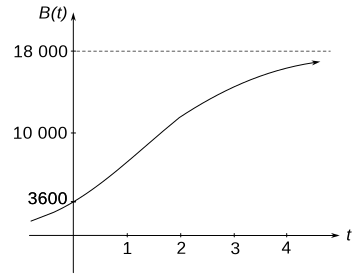
  1. Sketch the function `B(t)` over the first four years of the research.   (2 marks)

    --- 8 WORK AREA LINES (style=lined) ---

  2. Calculate when the brumby population should reach 13 000, giving your answer to 2 decimal places.   (1 mark)

    --- 6 WORK AREA LINES (style=lined) ---

  3. Show that  `B^(′)(t)=(72\ 000e^t)/(e^t+4)^2`   (2 marks)

    --- 6 WORK AREA LINES (style=lined) ---

  4. What is the maximum growth rate of the brumby population?   (3 marks)

    --- 10 WORK AREA LINES (style=lined) ---
Show Answers Only

 a.    
       

b.    `2.34\ text{years}`

c.    `text{Proof (See Worked Solutions}`

d.    `4500\ text{brumbies per year}`

Show Worked Solution

a.   

b.    `text {Find}\ t\ text{when}\ \ B(t)=13\ 000`

`13\ 000` `=(18\ 000)/(1+4e^(-t))`  
`13\ 000(1+4e^(-t))` `=18\ 000`  
`1+4e^(-t)` `=18/13`  
`4e^(-t)` `=5/13`  
`e^(-t)` `=5/52`  
`-t` `=ln(5/52)`  
`t` `=2.34\ text{years (2 d.p.)}`  


c.    `text{Show}\ \ B^(′)(t)=(72\ 000e^t)/(e^t+4)^2`

`B(t)=18\ 000(1+4e^(-t))^(-1)`

`B^(′)(t)` `=-1*-1*4e^(-t)*18\ 000(1+4e^(-t))^-2`  
  `=(72\ 000)/(e^t(1+4e^(-t))^2)`  
  `=(72\ 000)/(e^t(1+4/e^t)^2)`  
  `=(72\ 000)/(e^t((e^t+4)/e^t)^2)`  
  `=(72\ 000)/(e^t/(e^t)^2*(e^t+4)^2)`  
  `=(72\ 000e^t)/(e^t+4)^2\ \ text{… as required}`  


d.    `B^(′)(t)=72\ 000e^t(e^t+4)^(-2)`

`text{Using product rule:}`

`B^(″)(t)` `=72\ 000e^t(e^t+4)^(-2)+(-2e^t)(e^t+4)^(-3)72\ 000e^t`  
  `=72\ 000e^t(1/(e^t+4)^2-(2e^t)/(e^t+4)^3)`  
  `=72\ 000e^t((e^t+4-2e^t)/(e^t+4)^3)`  
  `=72\ 000e^t((4-e^t)/(e^t+4)^3)`  

 
`text{Find}\ t\ text{when}\ \ B^(′′)(t)=0:`

`4-e^t` `=0`  
`e^t` `=4`  
`t` `=ln4`  
  `=1.386…\ text{years}`  

 
`text{Checking concavity changes:}`

`text{Since}\ e^t>0, (e^t+4)^3>0\ \ text{for all}\ t:`

`text{At}\ t=1, 4-e^1=1.28>0\ \ =>\ \ B^(″)(1)>0`

`text{At}\ t=2, 4-e^2=-3.4<0\ \ =>\ \ B^(″)(2)<0`

 
`B^(′)(ln4)=\ text{Max growth rate}`

`B^(′)(ln4)` `=(72\ 000e^(ln4))/(e^(ln4)+4)^2`  
  `=(72\ 000xx4)/((4+4)^2)`  
  `=4500\ text{brumbies per year}`  

Filed Under: Applications of Differential Equations, Applications of Differential Equations Tagged With: Band 3, Band 4, Band 5, smc-1198-30-Quantity, smc-7297-30-Quantity

Proof, EXT2 P2 EQ-Bank 22

`n` lines are drawn in a 2-dimensional plane such that no three lines are concurrent and no two lines are parallel.

`S_n` is the number of regions into which these lines divide the plane with the diagram illustrating that `S_3=7`
 

  1. In a similar way, draw diagrams that illustrate `S_1, S_2` and `S_4`.  (1 mark)

    --- 10 WORK AREA LINES (style=lined) ---
  2. Using the results in part (i), make a conjecture about the general formula for `S_n`.  (2 marks)

    --- 8 WORK AREA LINES (style=lined) ---
  3. Use mathematical induction to prove the formula from part (ii).  (3 marks)

    --- 12 WORK AREA LINES (style=lined) ---
Show Answers Only

a.    `text{See Worked Solutions}`

b.    `S_n=(n^2+n+2)/2`

c.    `text{See Worked Solutions}`

Show Worked Solution

a.       `S_1=2`                        `S_2=4`


   `S_4=11`


b.    `text{Consider the pattern above:}`

`S_1=2,\ \ S_2=S_1+2`

`S_3=S_2+3,\ …\ , S_n=S_(n-1)+n`

`S_n` `=S_(n-1)+n`  
  `=S_(n-2)+(n-1)+n`  
  `=S_(n-3)+(n-2)+(n-1)+n`  
  `vdots`  
  `=S_1+(2+3+…+(n-1)+n)`  
  `=S_0+(1+2+…+(n-1)+n)`  
  `=1+(1+2+…+(n-1)+n)`  

 
`=>text{AP where}\ \ a=1, l=n, n=n`

`S_n` `=1+n/2(1+n)`  
  `=(2+n(n+1))/2`  
  `=(n^2+n+2)/2`  


c.    `text{Prove}\ \ S_n=(n^2+n+2)/2\ \ text{for}\ \ n>=0`

`text{If}\ \ n=1`

`text{LHS}\ =S_1=2`

`text{RHS}\ = (1^2+1+2)/2=2=\ text{LHS}`

`:.\ text{True for}\ n=1.`
 

`text{Assume true for}\ \ n=k:`

`text{i.e.}\ S_k=(k^2+k+2)/2`

`text{Prove true for}\ \ n=k+1:`

`text{i.e.}\ S_(k+1)=((k+1)^2+(k+1)+2)/2=(k^2+3k+4)/2`
 

`text{Consider the line}\ d_4\ text{added below that crosses 3 existing lines}`

`text{and creates 4 new regions.}`

`text{Similarly, the line}\ d_(k+1)\ text{will cross}\ k\ text{existing lines and}`

`text{create}\ (k+1)\ text{new regions.}`

`S_(k+1)` `=S_k+k+1`  
  `=(k^2+k+2)/2+k+1`  
  `=(k^2+k+2+2k+2)/2`  
  `=(k^2+3k+4)/2`  
  `=\ text{RHS}`  

 
`:.\ text{True for}\ \ n=k+1`

`:.\ text{Since true for}\ n=1,\ text{by PMI, true for integers}\ n>=1`

Filed Under: Induction, Induction, P2 Induction Tagged With: Band 3, Band 4, Band 5, smc-1044-65-Geometry, smc-5115-65-Geometry, smc-7424-65-Geometry

Calculus, EXT1 C3 EQ-Bank 32

The maximum speed that a hammer can reach after falling vertically from the top of a skyscraper is `u\ text{ms}^(-1)`.

The hammer's  speed, `v\ text{ms}^(-1)`, after falling `x` metres, is given by the differential equation 

`(dv)/(dx)=c(u^2-v^2)/v`  where `c` is a positive constant.

Find an expression of `v` in terms of `x`.   (4 marks)

--- 12 WORK AREA LINES (style=lined) ---
Show Answers Only

`v=u(1-e^(-2cx))^(1/2)`

Show Worked Solution
`(dv)/(dx)` `=c((u^2-v^2)/v)`  
`v/(u^2-v^2)\ dv` `=c\ dx`  
`int v/(u^2-v^2)\ dv` `=int c\ dx`  
`-1/2ln(u^2-v^2)` `=cx+C`  

 
`text{When}\ \ x=0, v=0:`

`-1/2ln\ u^2=c xx 0+C\ \ =>\ \ C=-ln\ u`
 

`-1/2ln(u^2-v^2)` `=cx-ln\ u`  
`ln(u^2-v^2)` `=-2cx+2ln\ u`  
`ln(u^2-v^2)` `=-2cx+ln\ u^2`  
`u^2-v^2` `=e^(-2cx+ln\ u^2)`  
`u^2-v^2` `=e^(-2cx)*e^(ln\ u^2)`  
`u^2-v^2` `=u^2e^(-2cx)`  
`v^2` `=u^2-u^2e^(-2cx)`  
  `=u^2(1-e^(-2cx))`  
`v` `=+-u(1-e^(-2cx))^(1/2)`  
  `=u(1-e^(-2cx))^(1/2),\ \ (v>0)`  

Filed Under: Applications of Differential Equations, Applications of Differential Equations Tagged With: Band 5, smc-1198-40-Motion, smc-7297-40-Motion

Proof, EXT2 P2 EQ-Bank 26

Using mathematical induction, prove that the sum of the external angles of an `n`-sided plane convex polygon equals 360° for  `n>=3`.   (4 marks)

Show Answers Only

`text{See Worked Solutions}`

Show Worked Solution

`text{Prove true for}\ \ n=3:`


`text{Let}\ \ S_3=\ text{sum of exterior angles for a 3-sided polynomial (triangle)}`

`S_3=angleACF+angleCBE+angleBAD`

`angleACF+angleACB=180°\ \ (angleFCB\ text{is a straight angle})`

`angleCBE+angleCBA=180°\ \ (angleABE\ text{is a straight angle})`

`angleBAD+angleBAC=180°\ \ (angleDAC\ text{is a straight angle})`

`angleACF+angleACB+angleCBE+angleCBA+angleBAD+angleBAC=540°`

 
`text{Internal angle sum of}\ ΔABC=180°:`

`angleACF+angleCBE+angleBAD+180°` `=540°`  
`angleACF+angleCBE+angleBAD` `=360°`  

 
`:.\ text{True for}\ \ n=3`
 

`text{Assume true for}\ \ n=k`

`text{i.e.}\ \ S_k=360°`

`text{Prove true for}\ \ n=k+1:`

`text{i.e.}\ \ S_(k+1)=360°`

`text{Let}\ ktext{-sided polygon be defined by points}\ P_1,P_2,…,P_k`

`text{Let}\ (k+1)text{-sided polygon be defined by points}\ P_1,P_2,…,P_k,P_(k+1)`
 

`S_k` `=theta_1+theta_2+ … +theta_(k-1)+theta_k`  
  `=theta_1+theta_2+ … +theta_(k-1)+alpha+beta`  

 
`S_(k+1)=mu+theta_2+ … +theta_(k-1)+beta+delta`

`theta_1=mu+phi\ \ text{(vertically opposite)}`

`=>\ \ mu=theta_1-phi\ …\ (1)`

`delta=alpha+phi\ …\ (2)\ \  text{(exterior angle of triangle)}`

  
`text{Substitute (1) and (2) into}\ S_(k+1):`

`S_(k+1)` `=theta_1-phi+theta_2+ … +theta_(k-1)+beta+alpha+phi`  
  `=theta_1+theta_2+ … +theta_(k-1)+alpha+beta`  
  `=S_k`  


`:.\ text{True for}\ \ n=k+1`

`:.\ text{Since true for}\ n=3,\ text{true for integers}\ n>=3.`

Filed Under: Induction, Induction, P2 Induction Tagged With: Band 5, smc-1044-65-Geometry, smc-5115-65-Geometry, smc-7424-65-Geometry

Calculus, EXT1 C3 EQ-Bank 31

The rate of fuel running out of a leaking tank can be modelled by the following equation

`(dh)/(dt)=-Ae^(-0.2t)`  where `h` is the height of the fuel in the tank after `t` hours?

Initially, the height of the fuel in the tank is  4 metres and after 1.5 hours, it has fallen to 3 metres.

At what height of fuel in the tank will it eventually stabilise, giving your answer to the nearest centimetre?   (4 marks)

--- 12 WORK AREA LINES (style=lined) ---
Show Answers Only

`text{14 centimetres.}`

Show Worked Solution
`(dh)/(dt)` `=-Ae^(-0.2t)`  
`h` `=int-Ae^(-0.2t)\ dt=5Ae^(-0.2t)+C`  

 
`text{As}\ \ t->oo, 5Ae^(-0.2t)->0`

`text{i.e.}\ h\ text{eventually stabilises at}\ C.`

`text{Find}\ A:`

`text{When}\ \ t=0,\ \ h=4`

`4=5Ae^(-0.2t)+C\ \ =>\ \ A=(4-C)/5`
 

`text{When}\ \ t=1.5,\ \ h=3`

`3` `=5xx(4-C)/5 e^(-0.2xx1.5)+C`  
`3` `=4/e^0.3-C/e^0.3+C`  
`(3e^0.3-4)/e^0.3` `=C(1-1/e^0.3)`  
`(3e^0.3-4)/e^0.3` `=C((e^0.3-1)/e^0.3)`  
`C` `=(3e^0.3-4)/e^0.3 xx e^0.3/(e^0.3-1)`  
  `=0.1417…\ text{m}`  
  `=14\ text{cm (nearest cm)`  


`:.\ text{Height of fuel in the tank will stabilise at 14 centimetres.}`

Filed Under: Applications of Differential Equations, Applications of Differential Equations Tagged With: Band 5, smc-1198-45-Flow in/out, smc-7297-45-Flow in/out

BIOLOGY, M7 EQ-Bank 24

Scientific advances have resulted in new methods of managing plant diseases and insect pests.

Describe how TWO of these methods have changed the management of plant diseases and/or insect pests.   (5 marks)

Show Answers Only

Transgenic Organisms

  • The development transgenic organisms has lead to the creation of GMO’s with ‘built-in’ pesticides. 
  • The modified plant contains a gene from another genus which allows it to be partially or fully resistant to a pest or disease.
  • For example, Bt Cotton is a type of transgenic cotton which has been modified with a gene which makes it almost immune to Bollworm, the number one burden of cotton plant death globally. This means that pesticides for Bollworm do not have to be used, saving time and expense.

Quarantine

  • The knowledge behind the transmission of specific disease has allowed societies to take adequate measures which will have the best chance for reducing the spread of said disease.
  • Quarantine is the process of isolating any imported crops for a certain amount of time dependent on the infection period of a given disease. This significantly reduces the chances of international diseases spreading into Australia.
Show Worked Solution

Transgenic Organisms

  • The development transgenic organisms has lead to the creation of GMO’s with ‘built-in’ pesticides. 
  • The modified plant contains a gene from another genus which allows it to be partially or fully resistant to a pest or disease.
  • For example, Bt Cotton is a type of transgenic cotton which has been modified with a gene which makes it almost immune to Bollworm, the number one burden of cotton plant death globally. This means that pesticides for Bollworm do not have to be used, saving time and expense.

Quarantine

  • The knowledge behind the transmission of specific disease has allowed societies to take adequate measures which will have the best chance for reducing the spread of said disease.
  • Quarantine is the process of isolating any imported crops for a certain amount of time dependent on the infection period of a given disease. This significantly reduces the chances of international diseases spreading into Australia.

Filed Under: Prevention, Treatment and Control Tagged With: Band 4, Band 5, smc-3658-30-Procedures to Prevent Spread

ENGINEERING, AE 2016 HSC 11 MC

Which aircraft engine incorporates bypass air to create thrust?

  1. Scramjet
  2. Turbojet
  3. Turbofan
  4. Turboprop
Show Answers Only

`C`

Show Worked Solution

`=>C`


♦ Mean mark 46%.

Filed Under: Mechanics and Hydraulics Tagged With: Band 5, smc-3724-60-Propulsion

ENGINEERING, PPT 2016 HSC 3 MC

Four points `A, B, C` and `D` are plotted in orthogonal projection.
 

How many lines are shown as true length?

  1. 1
  2. 2
  3. 3
  4. 4
Show Answers Only

`B`

Show Worked Solution

`=>B`


♦ Mean mark 55%.

Filed Under: Communication Tagged With: Band 5, smc-3721-10-Orthogonal diagrams

BIOLOGY, M6 2014 HSC 33d

The data compare a segment of the eye control gene in mice to the equivalent gene segment in a range of different species. The expression of these genes is necessary for eye development to begin.
 

Note: grey highlighted bases are the same as those in the mouse gene.

  1. With reference to the data in the table, explain why it is possible for different gene sequences to produce the same protein.   (2 marks)

    --- 5 WORK AREA LINES (style=lined) ---
  2. Discuss ONE strength and ONE limitation of using the data shown to determine the evolutionary relationships between these species.   (4 marks)

    --- 8 WORK AREA LINES (style=lined) ---

Show Answers Only

i.    Different gene sequences → same protein

  • Differences in base sequences can still code for the same amino acid, and therefore the same protein will be produced. This is often referred to as a silent change.
  • A change producing a different amino acid can have no effect on the protein if the amino acids are chemically similar. For example leucine and isoleucine are so similar that a change in DNA sequence resulting in this change will have no effect on the protein it codes for. This is called a neutral change.

ii.   Strengths could include:

  • Despite having different sequences, each polypeptide chain/protein it is a part of will go on to initiate eye development.
  • This provides evidence that a once common ancestor had the eye development gene similar to that of all species, providing evidence of their close ancestry.
  • The average rate of mutation can also be used as a measure of time since divergence from the common ancestor. For example, species 2 may have more recently diverted as it has a genetic similarity of 85% when compared to species 4, which only has 71.66% similarity.  

Limitations could include:

  • The study only shows the relationship of one gene which is very small in comparison to the whole genome. This is a weak comparison as the rest of the genome may have intense variation and just studying this gene could provide false information.
  • Studying only one gene also increases the risk of encountering back mutations, mutations of a variation which revert back to the original sequence, making the species seem more closely related. This can also give false information about evolutionary relationships and ancestry.
Show Worked Solution

i.    Different gene sequences → same protein

  • Differences in base sequences can still code for the same amino acid, and therefore the same protein will be produced. This is often referred to as a silent change.
  • A change producing a different amino acid can have no effect on the protein if the amino acids are chemically similar. For example leucine and isoleucine are so similar that a change in DNA sequence resulting in this change will have no effect on the protein it codes for. This is called a neutral change.

♦♦ Mean mark (i) 40%.

ii.   Strengths could include:

  • Despite having different sequences, each polypeptide chain/protein it is a part of will go on to initiate eye development.
  • This provides evidence that a once common ancestor had the eye development gene similar to that of all species, providing evidence of their close ancestry.
  • The average rate of mutation can also be used as a measure of time since divergence from the common ancestor. For example, species 2 may have more recently diverted as it has a genetic similarity of 85% when compared to species 4, which only has 71.66% similarity.  

Limitations could include:

  • The study only shows the relationship of one gene which is very small in comparison to the whole genome. This is a weak comparison as the rest of the genome may have intense variation and just studying this gene could provide false information.
  • Studying only one gene also increases the risk of encountering back mutations, mutations of a variation which revert back to the original sequence, making the species seem more closely related. This can also give false information about evolutionary relationships and ancestry.

♦♦ Mean mark (ii) 41%.

Filed Under: Mutation Tagged With: Band 5, smc-3652-10-Mechanisms of Change/Variation, smc-3652-30-Point Mutations

BIOLOGY, M6 2014 HSC 32e

The text summarises an ethical framework for decision-making related to the use of biotechnologies.

\begin{array} {|l|}
\hline
\ \rule{0pt}{4ex} \textit{Utilitarian Ethics}\\
\ \text{An ethical activity is one that provides the greatest balance of good over} \quad \\
\ \text{harm for society and the environment.}\\
\text{}\\
\ \textit{The Precautionary Principle}\\
\ \text {If there is doubt about the harm that may be caused by an activity, the}\\
\ \text {proposers of the activity must prove the harm is not significant for society}\\
\ \text {and the environment.}\rule[-3ex]{0pt}{0pt} \\
\hline
\end{array}

Evaluate the ethics of the use of ONE specific biotechnology in relation to this framework.   (7 marks)

--- 16 WORK AREA LINES (style=lined) ---

Show Answers Only
  • Transgenic organisms are those in which a gene from another species has been inserted into their genome to provide a favourable characteristic to them.
  • The ‘Super Salmon’ is a genetically modified Atlantic salmon which contains genes from the Chinook salmon and Ocean Pout fish which allow it to grow to market size in colder conditions and therefore faster than wild type Atlantic salmon. This has the potential to increase the availability of salmon and therefore providing a benefit to society. However, the transgenic salmon are unnatural and the addition of the gene may effect other parts of the genome, potentially making the salmon unhealthy or harmful for consumption, providing no benefit to society.
  • Roundup-ready soybeans have an implemented gene which allows them to be immune to roundup, a herbicide sprayed onto the crops which kills weeds. While this will increase yield of soybeans as they will be unaffected by roundup, it is toxic to humans and residue could be on the soybeans at sale, providing harm to consumers. The mass use of roundup may also leak and drift into soils, and overtime ecosystems, harming surrounding environments.
  • In the cases above, the adverse effects on society and the environment of both transgenic organisms as stated above should be studied and compared to the positives to decide which has greater influence (Utilitarian Ethics).
  • The companies and groups responsible for development, distribution and sale of the transgenic organisms are also obligated to provide proof that their product does not induce any harm to society or the environment (The Precautionary Principle).
  • Since there is little evidence for short and long term safety of transgenic organisms for the environment and society, a valid case for ethical use of transgenic organisms has not yet been developed. 
Show Worked Solution
  • Transgenic organisms are those in which a gene from another species has been inserted into their genome to provide a favourable characteristic to them.
  • The ‘Super Salmon’ is a genetically modified Atlantic salmon which contains genes from the Chinook salmon and Ocean Pout fish which allow it to grow to market size in colder conditions and therefore faster than wild type Atlantic salmon. This has the potential to increase the availability of salmon and therefore providing a benefit to society. However, the transgenic salmon are unnatural and the addition of the gene may effect other parts of the genome, potentially making the salmon unhealthy or harmful for consumption, providing no benefit to society.
  • Roundup-ready soybeans have an implemented gene which allows them to be immune to roundup, a herbicide sprayed onto the crops which kills weeds. While this will increase yield of soybeans as they will be unaffected by roundup, it is toxic to humans and residue could be on the soybeans at sale, providing harm to consumers. The mass use of roundup may also leak and drift into soils, and overtime ecosystems, harming surrounding environments.
  • In the cases above, the adverse effects on society and the environment of both transgenic organisms as stated above should be studied and compared to the positives to decide which has greater influence (Utilitarian Ethics).
  • The companies and groups responsible for development, distribution and sale of the transgenic organisms are also obligated to provide proof that their product does not induce any harm to society or the environment (The Precautionary Principle).
  • Since there is little evidence for short and long term safety of transgenic organisms for the environment and society, a valid case for ethical use of transgenic organisms has not yet been developed. 

♦ Mean mark 55%.

Filed Under: Biotechnology Tagged With: Band 5, smc-3653-20-Evaluating Genetic Technology

ENGINEERING, PPT 2016 HSC 19 MC

A locating block is sectioned by an offset cutting plane labelled `text{X–X}`.


Which front view is sectioned to AS 1100 standards?

Show Answers Only

`A`

Show Worked Solution

`=>A`


♦♦ Mean mark 38%.

Filed Under: Communication Tagged With: Band 5, smc-3721-20-Sectional views

BIOLOGY, M5 2014 HSC 32a

  1. Name the process for the synthesis of a polypeptide chain from a messenger-RNA base sequence.   (1 mark)

    --- 2 WORK AREA LINES (style=lined) ---
  2. Outline the steps in the formation of a functional enzyme from polypeptide chains.   (3 marks)

    --- 6 WORK AREA LINES (style=lined) ---
Show Answers Only

i.    Translation

ii.   Formation of a functional enzyme from polypeptide chains

  • A polypeptide will fold in a certain three-dimensional shape dependent on the amino acids, such as a sheet or a coil.
  • Multiple polypeptide chains will then link together to form a more specific shape. This shape will then go on to do a specific task as a protein.

Note: The following point is old syllabus knowledge.

  • One type of protein is an enzyme, which acts as a biological catalyst on certain substrates, primarily in metabolic reactions. The certain shape an enzyme makes due to the polypeptide chains within it is what dictates which substrate it will act on. 
Show Worked Solution

i.    Translation

ii.   Formation of a functional enzyme from polypeptide chains

  • A polypeptide will fold in a certain three-dimensional shape dependent on the amino acids, such as a sheet or a coil.
  • Multiple polypeptide chains will then link together to form a more specific shape. This shape will then go on to do a specific task as a protein.

Note: The following point is old syllabus knowledge.

  • One type of protein is an enzyme, which acts as a biological catalyst on certain substrates, primarily in metabolic reactions. The certain shape an enzyme makes due to the polypeptide chains within it is what dictates which substrate it will act on. 

♦♦ Mean mark (ii) 31%.

Filed Under: DNA and Polypeptide Synthesis Tagged With: Band 5, Band 6, smc-3650-11-RNA, smc-3650-60-Proteins

BIOLOGY, M8 2014 HSC 31a

The biological structure shown is part of one of the systems in the body.
 

  1. Name the biological structure.   (1 mark)

    --- 1 WORK AREA LINES (style=lined) ---
  2. Outline the steps involved in this system's response to a stimulus.   (3 marks)

    --- 6 WORK AREA LINES (style=lined) ---
Show Answers Only

i.   Nerve cell/neuron

ii.   Steps involved in system’s response to a stimulus

  • A stimulus is detected by a receptor nerve cell which convert the stimulus to an electrochemical impulse, which is then carried by sensory cells to the brain.
  • The signal reaches a certain segment on the brain depending on what signal was received, where an action is determined to be carried out.
  • Motor neurons carry the signal to an effector, which carries out the response
Show Worked Solution

i.   Nerve cell/neuron

ii.   Steps involved in system’s response to a stimulus

  • A stimulus is detected by a receptor nerve cell which convert the stimulus to an electrochemical impulse, which is then carried by sensory cells to the brain.
  • The signal reaches a certain segment on the brain depending on what signal was received, where an action is determined to be carried out.
  • Motor neurons carry the signal to an effector, which carries out the response.

♦ Mean mark (ii) 48%.

Filed Under: Uncategorized Tagged With: Band 4, Band 5, smc-3659-60-Coordination Systems

BIOLOGY, M6 2014 HSC 29

Scientists have tried to achieve a viable embryo by fusing two ova (eggs) from the same female.

Explain whether the offspring produced using this process would be a clone of the female whose two ova were used. Use your knowledge of gamete formation and sexual reproduction to support your answer.   (5 marks)

--- 10 WORK AREA LINES (style=lined) ---
Show Answers Only
  • Despite coming from the same female, meiosis and processes within it cause the genetic material within each ova to be different, and thus the offspring will not be a clone.
  • During meiosis, a germ line cell will replicate, split, then split again, resulting in 4 genetically unique daughter gametes.
  • The processes of independent assortment, the random splitting of each chromosome during each stage, as well as crossing over, where like segments of homologous chromosomes can be exchanged creating new combinations, also contribute to the variability amongst daughter cells.
  • When two of these ova (gametes) are fused, the genetic material of each are contributed to the offspring, with some genes being expressed or suppressed depending on the combinations of alleles from each. In this way, the offspring will be genetically different from the female rather than a clone.
Show Worked Solution
  • Despite coming from the same female, meiosis and processes within it cause the genetic material within each ova to be different, and thus the offspring will not be a clone.
  • During meiosis, a germ line cell will replicate, split, then split again, resulting in 4 genetically unique daughter gametes.
  • The processes of independent assortment, the random splitting of each chromosome during each stage, as well as crossing over, where like segments of homologous chromosomes can be exchanged creating new combinations, also contribute to the variability amongst daughter cells.
  • When two of these ova (gametes) are fused, the genetic material of each are contributed to the offspring, with some genes being expressed or suppressed depending on the combinations of alleles from each. In this way, the offspring will be genetically different from the female rather than a clone.

♦♦ Mean mark 36%.

Filed Under: Genetic Technologies Tagged With: Band 5, smc-3654-70-Whole Organism Cloning

BIOLOGY, M7 2014 HSC 18 MC

Two people were exposed to pathogen `P` on the same day. The graph shows the blood antibody levels for that pathogen over the following 28 days for each person.
 

Which of the following best explains these results?

  1. Person 1 had not been previously exposed to pathogen `P` but had a recent organ transplant.
  2. Person 1 had been previously exposed to pathogen `P`.
  3. Person 2 had already been vaccinated against pathogen `P`.
  4. Person 2 had recent contact with a person infected with a similar pathogen.
Show Answers Only

`B`

Show Worked Solution

By Elimination

  • Being vaccinated against a pathogen or being exposed to a similar pathogen would lead to higher antibody counts, not lower. (Eliminate C and D).
  • Person 1’s previous exposure to the pathogen means that memory B cells can quickly and rapidly differentiate into plasma B cells, leading to higher counts of antibodies in a shorter time. An organ transplant is not relevant in this scenario. (Eliminate A).

`=>B`


♦ Mean mark 50%.

Filed Under: Immunity and Responses to Pathogens Tagged With: Band 5, smc-3657-25-Antibodies

BIOLOGY, M7 2014 HSC 17 MC

When B cells are activated they divide to form a large number of antibody-secreting cells.

How is this best explained?

  1. Mitosis and gene expression produce cytotoxic cells.
  2. Mitosis and differentiation produce B cells that repair tissues.
  3. Mitosis and cell specialisation produce cells that maintain health.
  4. Mitosis and differentiation produce cells for growth and development.
Show Answers Only

`C`

Show Worked Solution
  • Mitosis allows B cells to divide into identical plasma B cells.
  • Plasma B cells are specialised cells particular to one pathogen, allowing individuals to be protected against it.

`=>C`


♦ Mean mark 56%.

Filed Under: Immunity and Responses to Pathogens Tagged With: Band 5, smc-3657-10-Antibody Mediated

BIOLOGY, M6 2014 HSC 16 MC

What is the best explanation for the successful development of transgenic species?

  1. Artificial pollination works across the plant kingdom.
  2. Nuclear transplantation from cell to cell is easily achieved.
  3. DNA in the biosphere is composed of the same chemical components.
  4. Genes from different animals within the one species are easily combined.
Show Answers Only

`C`

Show Worked Solution
  • The development of transgenic species is only possible since all nucleotides in all of the worlds’ life is chemically identical.

`=>C`


♦♦ Mean mark 35%.

Filed Under: Genetic Technologies Tagged With: Band 5, smc-3654-05-Transgenic Organisms

BIOLOGY, M5 2014 HSC 15 MC

Goltz Syndrome is a condition in humans that adversely affects the skin. It is inherited as a dominant gene carried on the X chromosome.

A man with Goltz Syndrome and a woman who does NOT have the trait have two children, a boy and a girl.

Which of the following is correct about the inheritance of Goltz Syndrome in these children?

  1. Both children have the syndrome.
  2. The girl has the syndrome and the boy does not.
  3. The girl has the syndrome and the boy is a carrier.
  4. The girl has a 50% chance of having the syndrome and the boy has a 0% chance.
Show Answers Only

`B`

Show Worked Solution
  • A woman with the genotype XgXg will not have Goltz and a male with XGY will have Goltz.
  • A cross between these individuals will mean that all girls will have Goltz as they have to have the XG allele from the father, and no boys will have Goltz, as they have to inherit the Y chromosome from the father, and both X chromosomes from the mother do not have the gene for Goltz.

`=>B`


♦ Mean mark 48%.

Filed Under: Genetic Variation / Inheritance Tagged With: Band 5, smc-3648-30-Sex Linkage

BIOLOGY, M7 2014 HSC 12-13 MC

Refer to the following information to answer Questions 12 and 13.

A student conducted a first-hand investigation using nutrient broth, beakers and an S-shaped delivery tube in an attempt to model Pasteur's experiment.

The equipment and data collected are shown.
 

Question 12

The data collected by the student are

  1. quantitative because data were collected for fourteen days.
  2. qualitative because the appearance of the broth is described.
  3. qualitative because this is a model of a past scientific experiment.
  4. quantitative because the results were recorded for two different beakers.

 
Question 13

The student's results were different from Pasteur's results.

Which of the following provides the best explanation for the difference?

  1. The nutrient broth was different from Pasteur's.
  2. The nutrient broth always goes cloudy as it ages.
  3. The nutrient broth was not boiled thoroughly on Day 1 .
  4. The nutrient broths were both exposed to oxygen from the outside air.
Show Answers Only

Question 12: \(B\)

Question 13: \(C\)

Show Worked Solution

Question 12

By Elimination

  • Quantitative data is one in which numerical values are obtained for comparison. (Eliminate A and D).
  • The data then must be qualitative as it includes a description of the broth’s appearance.

\(\Rightarrow B\)
 

Question 13

  • The apparatus matches that of Pasteur’s, so the best explanation for flask 2 also going cloudy would be due to not thoroughly boiling the broth before the experiment, and therefore not eliminating any bacteria already present.

\(\Rightarrow C\)


♦ Mean mark Q13 53%.

Filed Under: Causes of Infectious Disease Tagged With: Band 4, Band 5, smc-3655-60-Louis Pasteur

ENGINEERING, TE 2017 HSC 16 MC

Television programs that show high levels of activity often have lower picture quality.

This is because television signals are transmitted using

  1. digital modulation at low compression levels.
  2. digital modulation at high compression levels.
  3. analogue modulation at low compression levels.
  4. analogue modulation at high compression levels.
Show Answers Only

`B`

Show Worked Solution
  • Modern television signals are transmitted using digital modulation, so the answer must be A or B.
  • The lower picture quality is the result of the TV being unable to decompress the highly compressed signal quickly.

`=>B`


♦♦ Mean mark 39%.

Filed Under: Electricity/Electronics Tagged With: Band 5, smc-3730-15-Television, smc-3730-28-Analogue/Digital properties

ENGINEERING, AE 2017 HSC 11 MC

The properties of some aluminium-magnesium-silicon alloys can be altered using the following procedure.
 

What type of hardening process is this?

  1. Case hardening
  2. Flame hardening
  3. Induction hardening
  4. Precipitation hardening
Show Answers Only

`D`

Show Worked Solution
  • This is the process of precipitation hardening as outlined in the course.

`=>D`


Mean mark 55%.

Filed Under: Materials Tagged With: Band 5, smc-3725-20-Metal alloys, smc-3725-30-Change in properties

ENGINEERING, CS 2017 HSC 10 MC

Which of the following statements describes Hooke's Law?

  1. Pressure acting on an object varies proportionally with depth.
  2. Pressure acting on an object in a confined fluid is uniform in all directions.
  3. Force induced in an object by stretching it is initially proportional to its extension.
  4. Force acting on an object is equal to the stress divided by the cross-sectional area.
Show Answers Only

`C`

Show Worked Solution
  • Hooke’s Law states that when an object is extended or stretched in the elastic range the extension is proportional to the force applied.
  • That is, stress is proportional to strain below the elastic limit.

`=>C`


♦ Mean mark 45%.

Filed Under: Engineering Mechanics Tagged With: Band 5

ENGINEERING, PPT 2017 HSC 8 MC

Which row of the table correctly identifies how the properties of a cold worked metal are changed after annealing?
 

Show Answers Only

`B`

Show Worked Solution
  • Generally, annealing is the heat treating of a metal to produce a soft (decrease in hardness), stress reduced (decrease in internal residual stress) state.
  • By decreasing the hardness and internal stress, the ductility will increase as well.

`=>B`


♦ Mean mark 49%.

Filed Under: Materials Tagged With: Band 5, smc-3719-20-Annealing

ENGINEERING, TE 2017 HSC 7 MC

Wireless networks operate in two distinct frequency bands: 2.4 GHz and 5 GHz.

Which of the following statements is correct?

  1. 5 GHz waves experience lower attenuation and have a lower bandwidth
  2. 5 GHz waves experience higher attenuation and have a higher bandwidth
  3. 2.4 GHz waves experience lower attenuation and have a higher bandwidth
  4. 2.4 GHz waves experience higher attenuation and have a lower bandwidth
Show Answers Only

`B`

Show Worked Solution
  • Lower frequencies (2.4GHz) are characterised by lower bandwidth but also good range coverage due to their lower attenuation.
  • Higher frequencies such as 5GHz are subject to higher attenuation especially when they encounter solid objects.

`=>B`


♦♦ Mean mark 38%.

Filed Under: Materials Tagged With: Band 5, smc-3729-10-Testing

ENGINEERING, PPT 2016 HSC 27b

The table compares the \(\ce{CO2}\) emissions of three transport systems - car, train and aircraft.
 

For each transport system shown in the \(\ce{CO2}\) emissions table, explain how an engineering innovation in that transport system has affected the environment.   (7 marks)

--- 16 WORK AREA LINES (style=lined) ---
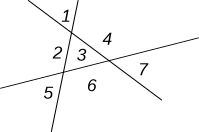
Show Answers Only

Innovations in car transport include:

  • Fuel injection, turbo engines, power to weight ratio, tyre variants, engine management systems, ABS breaks, regenerative braking and reduction in drive train losses.

Environmental Impacts

  • Improved power to weight ratios have led to greater fuel efficiency (less consumption).
  • This has resulted from innovations in the strength of aluminium alloys and the use of carbon fibre composite components both of which make the car lighter.
  • Cars with more aerodynamic shapes are also being routinely produced, which reduces drag.
  • Therefore, modern cars that are more aerodynamically designed and built with lighter materials, have considerably less drag, and thus \(\ce{CO2}\) emissions are reduced.

Innovations in rail transport include:

  • Turbo driven diesel engines, magnetic levitation braking, disc brakes, electric trains with AC versus DC motors and efficient track alignment.

Environmental Impacts

  • The use of AC motors in the drive train, rather than DC, has been the most positive modern innovation in rail transport.
  • VVVF (variable voltage variable frequency) drives, control the voltage and torque on modern AC machines, creating greater efficiencies, as DC machines lose electricity as heat.
  • Regenerative braking can be employed by AC machines as a train descends or slows down.
  • These improved efficiencies result in less diesel fuel on country trains and less electricity on city trains, leading to a reduction in \(\ce{CO2}\) emissions.

Innovations in air transport include:

  • The use of composites to create more aerodynamic shapes and reduced weight, improved efficiency in turbofans, reduced drag and the removal of rivet-induced turbulence through the use of adhesives.

Environmental Impacts

  • Fuel efficiency is greatly improved through the use of modern turbofan engines that optimise the entrainment of by bypass air, which produces 90% of the total thrust of the engine.
  • The use of flow control devices and winglets on wings, minimise wing tip vortices, improving lift and reducing drag.
  • Efficiency is therefore improved leading to reduced fuel consumption and a consequent reductions in \(\ce{CO2}\) emissions.
Show Worked Solution

Innovations in car transport could include:

  • Fuel injection, turbo engines, power to weight ratio, tyre variants, engine management systems, ABS breaks, regenerative braking and reduction in drive train losses.

Environmental Impacts

  • Improved power to weight ratios have led to greater fuel efficiency (less consumption).
  • This has resulted from innovations in the strength of aluminium alloys and the use of carbon fibre composite components both of which make the car lighter.
  • Cars with more aerodynamic shapes are also being routinely produced, which reduces drag.
  • Therefore, modern cars that are more aerodynamically designed and built with lighter materials, have considerably less drag, and thus \(\ce{CO2}\) emissions are reduced.

Innovations in rail transport could include:

  • Turbo driven diesel engines, magnetic levitation braking, disc brakes, electric trains with AC versus DC motors and efficient track alignment.

Environmental Impacts

  • The use of AC motors in the drive train, rather than DC, has been the most positive modern innovation in rail transport.
  • VVVF (variable voltage variable frequency) drives, control the voltage and torque on modern AC machines, creating greater efficiencies, as DC machines lose electricity as heat.
  • Regenerative braking can be employed by AC machines as a train descends or slows down.
  • These improved efficiencies result in less diesel fuel on country trains and less electricity on city trains, leading to a reduction in \(\ce{CO2}\) emissions.

Innovations in air transport could include:

  • The use of composites to create more aerodynamic shapes and reduced weight, improved efficiency in turbofans, reduced drag and the removal of rivet-induced turbulence through the use of adhesives.

Environmental Impacts

  • Fuel efficiency is greatly improved through the use of modern turbofan engines that optimise the entrainment of by bypass air, which produces 90% of the total thrust of the engine.
  • The use of flow control devices and winglets on wings, minimise wing tip vortices, improving lift and reducing drag.
  • Efficiency is therefore improved leading to reduced fuel consumption and a consequent reductions in \(\ce{CO2}\) emissions.

♦ Mean mark 51%.

Filed Under: Historical and Societal Influences Tagged With: Band 5, Band 6, smc-3717-20-Innovation, smc-3717-40-Environment

ENGINEERING, PPT 2016 HSC 22c

An electrical connector is screwed onto a threaded rod. A flat plate is then secured to the connector by a bolt screwed into a threaded hole.
 

Complete the scaled sectioned front view with the parts assembled.   (6 marks)
 

--- 0 WORK AREA LINES (style=lined) ---
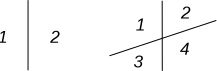
Show Answers Only

The image below should be adjusted to the appropriate scale.

Show Worked Solution

The image below should be adjusted to the appropriate scale.

Key points for this drawing:

  • Do not dimension unless asked
  • Section lines should be at 45 degrees and 3 mm apart
  • No not section threads/bolts
  • Ensure correct bolts dimensions used for the bolt
  • The gap in the middle shows that the pieces DO NOT sit flush
  • Swap direction of section lines for adjoining areas

♦♦ Mean mark 43%.

Filed Under: Communication Tagged With: Band 5, Band 6, smc-3721-20-Sectional views

ENGINEERING, CS 2016 HSC 21ai

The reinforced concrete modules shown are designed for public seating. A typical use would be as a bus shelter.
 

Outline benefits of using this type of modular seating system.   (3 marks)

--- 6 WORK AREA LINES (style=lined) ---
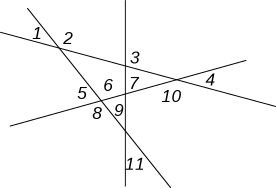
Show Answers Only
  • Reusable moulds can be used to manufacture the modules off-site and then delivered to the site.
  • The completed modules can then be delivered to the site, resulting in fewer site disruptions.
  • More modules can be added as required.
Show Worked Solution
  • Reusable moulds can be used to manufacture the modules off-site and then delivered to the site.
  • The completed modules can then be delivered to the site, resulting in fewer site disruptions.
  • More modules can be added as required.

Mean mark 54%.

Filed Under: Engineering Materials Tagged With: Band 5, smc-3715-30-Concrete

ENGINEERING, PPT 2016 HSC 26c

Structural steel `text{I}`-beams are used to make a crane were hot-rolled then normalised.

Explain why normalising was chosen as the heat treatment process. Support your answer with a labelled sketch of the resulting microstructure.   (4 marks)

--- 8 WORK AREA LINES (style=lined) ---
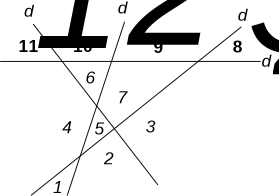


--- 0 WORK AREA LINES (style=lined) ---
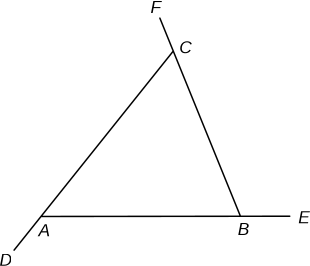
Show Answers Only

Advantages of normalising:

  • An increase in strength. Grain size strengthening is achieved due to the fine uniform grain structure produced by normalising.
  • When compared to other strengthening methods it is relatively economical.
  • Normalising relieves stress.
     

Show Worked Solution

Advantages of normalising:

  • An increase in strength. Grain size strengthening is achieved due to the fine uniform grain structure produced by normalising.
  • When compared to other strengthening methods it is relatively economical.
  • Normalising relieves stress.


♦ Mean mark 43%.

Filed Under: Materials Tagged With: Band 5, smc-3719-30-Normalising, smc-3719-40-Macro/microstructure

ENGINEERING, CS 2016 HSC 26b

What are redundant truss members?   (2 marks)

--- 4 WORK AREA LINES (style=lined) ---
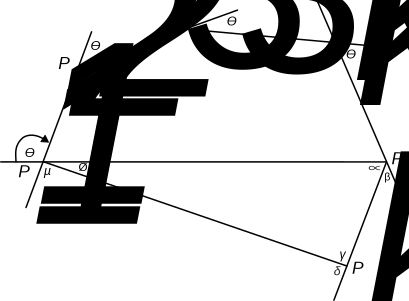
Show Answers Only

Redundant truss members:

  • A truss that carries no load under the conditions present.
  • It is important to note that as load conditions change, the truss may not actually remain redundant. 
Show Worked Solution

Redundant truss members:

  • A truss that carries no load under the conditions present.
  • It is important to note that as load conditions change, the truss may not actually remain redundant. 

♦ Mean mark 46%.

Filed Under: Engineering Mechanics Tagged With: Band 5, smc-3714-10-Truss analysis

ENGINEERING, CS 2016 HSC 26a

A simplified diagram of a pin jointed truss of a hammerhead crane is shown. It is lifting a load of 54 kN.
 

  1. Calculate the reactions at supports \(A\) and \(B\).   (4 marks)

--- 8 WORK AREA LINES (style=lined) ---
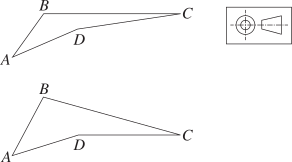
  1. Determine the magnitude and nature of the force in member \(M\).   (2 marks)

--- 4 WORK AREA LINES (style=lined) ---
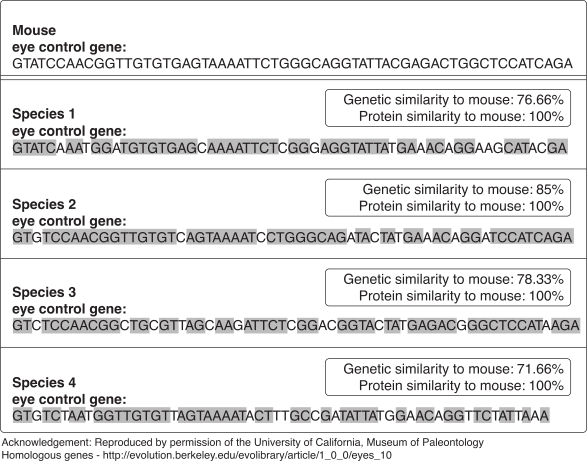
Show Answers Only

i.     \(\text{Reaction at} \ \ A=249 \ \text{kN}\uparrow\)

\(\text{Reaction at} \ \ B=123 \ \text{kN @ 12.7}^{\circ} \ \text{acting down and to the right.}\)

ii.    \(\text{Force in} \ \ M=121 \ \text{kN (Compression)}\)

Show Worked Solution

i.

\(R _{B H}-27=0\)

\(R _{B H}=27\)

\(\text{From the diagram,} \ \ R_{B H}=27 \ \text{kN} \rightarrow\)

\(+\circlearrowleft \sum M_B\) \(=0\)  
\(0\) \(=27 \times 2+54 \times 5-75 \times 1-R_A \times 1\)  
\(R_A\) \(=54+270-75=249 \ \text{kN} \uparrow\)  
     
\(+\uparrow \sum F_V\) \(=0\)  
\(0\) \(=249-75-54+R_B\)  
\(R_B\) \(=129-249=-120 \ \text{kN}=120 \ \text{kN} \downarrow\)  


\(R_A=249 \ \text{kN @} \ 0^{\circ} \uparrow\)

\(\text{Reaction at} \ B:\)
 

\(\text{Reaction at}\ A = 249\ \text{kN acting vertically, up}\)

\(\text{Reaction at}\ B = 123\ \text{kN @ 12.7° acting down and to the right.}\)


Mean mark (i) 52%.

ii.  \(\theta=\tan ^{-1}\left(\dfrac{20}{40}\right)=26.6^{\circ}\)


\(F=\sqrt{108^2+54^2}=\sqrt{14580}=120.747 \ldots\)

\(\text{Force in}\ M=121\ \text{kN (Compression)}\)


♦ Mean mark (ii) 49%.

Filed Under: Engineering Mechanics Tagged With: Band 5, smc-3714-10-Truss analysis

ENGINEERING, AE 2016 HSC 25b

Aircraft flight control systems use either cables or 'fly-by-wire' systems.

Contrast these flight control systems.   (3 marks)

--- 6 WORK AREA LINES (style=lined) ---
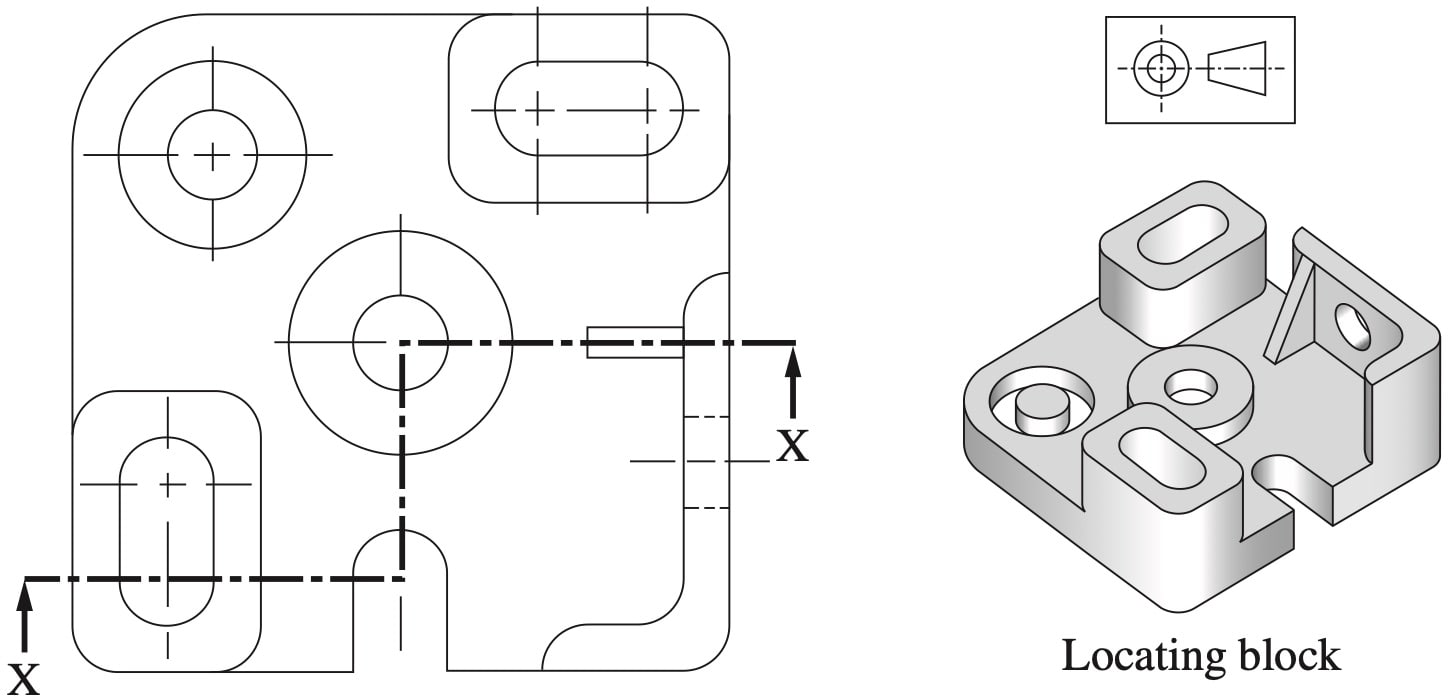
Show Answers Only

Show Worked Solution


♦♦ Mean mark 38%.

Filed Under: Scope, Historical and Societal Influences Tagged With: Band 5, smc-3722-40-Historical development

ENGINEERING, AE 2016 HSC 25aii

An image of a small drone is shown.


Nylon propellers are used on drones whereas carbon fibre composite propellers are used on commercial aircraft.

Describe a suitable manufacturing method for each type of propeller.   (3 marks)

--- 6 WORK AREA LINES (style=lined) ---
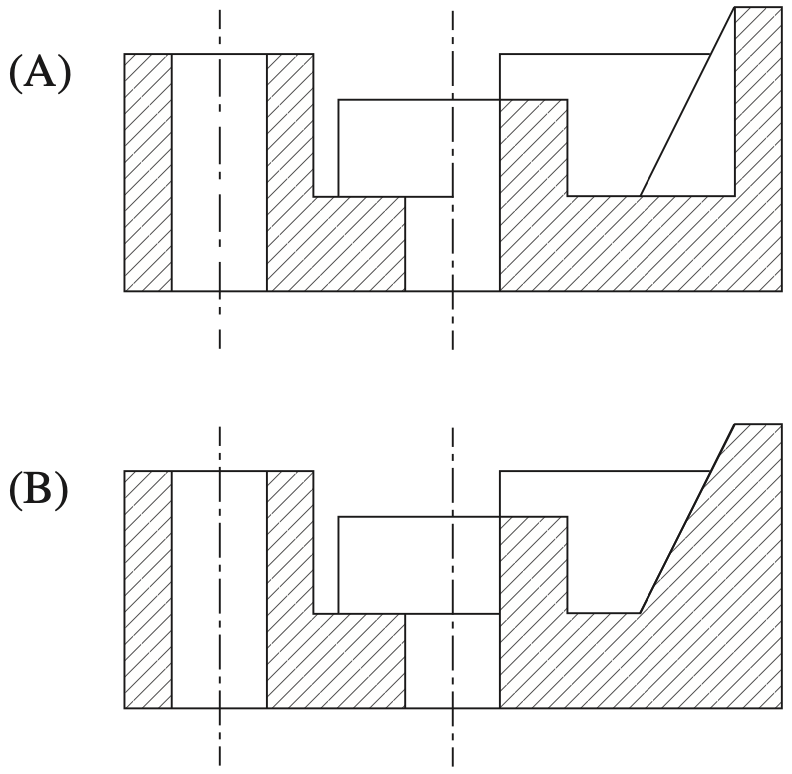
Show Answers Only

Nylon propellers

  • Injection moulded
  • A screw feeds nylon pellets into a heat chamber.
  • As the screw rotates, a combination of pressure, friction and external heat melts the nylon.
  • Molten nylon is pumped into multi-cavity moulds for setting.  

Carbon fibre composite propellers

  • A mould is laid with an impregnated carbon fibre sheet and placed into a vacuum bag.
  • An autoclave is used to evacuate the bag so the assembly can be heated and then allowed to set.
Show Worked Solution

Nylon propellers

  • Injection moulded
  • A screw feeds nylon pellets into a heat chamber.
  • As the screw rotates, a combination of pressure, friction and external heat melts the nylon.
  • Molten nylon is pumped into multi-cavity moulds for setting.  

Carbon fibre composite propellers

  • A mould is laid with an impregnated carbon fibre sheet and placed into a vacuum bag.
  • An autoclave is used to evacuate the bag so the assembly can be heated and then allowed to set.

♦♦ Mean mark 36%.

Filed Under: Materials Tagged With: Band 5, smc-3725-40-Composites

ENGINEERING, AE 2016 HSC 25ai

An image of a small drone is shown.


Explain how this drone achieves flight.   (3 marks)

--- 6 WORK AREA LINES (style=lined) ---
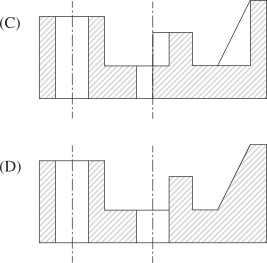
Show Answers Only
  • The weight of the drone is counteracted by rotating propellers that produce vertical thrust (lift).
  • The drone will achieve flight if the vertical thrust exceeds the weight.
  • Controlled climb or descent is achieved by varying the speed of the motor.
  • The direction of flight or thrust can be affected by a change in the rotational speed of the propellers.
  • Power for flight is supplied by battery systems.
Show Worked Solution
  • The weight of the drone is counteracted by rotating propellers that produce vertical thrust (lift).
  • The drone will achieve flight if the vertical thrust exceeds the weight.
  • Controlled climb or descent is achieved by varying the speed of the motor.
  • The direction of flight or thrust can be affected by a change in the rotational speed of the propellers.
  • Power for flight is supplied by battery systems.

Mean mark 54%.

Filed Under: Mechanics and Hydraulics Tagged With: Band 5, smc-3724-10-Lift/Drag, smc-3724-20-Key forces

ENGINEERING, PPT 2016 HSC 24d

A mild steel nut and bolt is used to hold a bumper bar onto the chassis of a truck. The bolt needs to withstand a maximum shear load of 2 kN.
 

If the maximum shear stress of the material is 56 MPa and the factor of safety is 2, calculate the minimum bolt diameter.   (3 marks)

--- 6 WORK AREA LINES (style=lined) ---
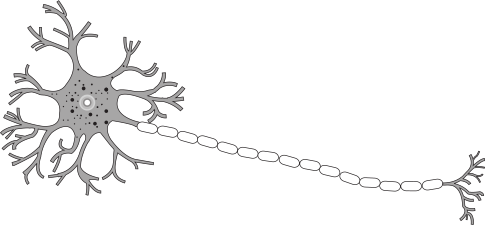
Show Answers Only

`9.5\ text{mm}`

Show Worked Solution

`text{Max load = 2000 N,  Max Shear = 56 MPa}`

`text{Factor of Safety = 2}`

`sigma_A = sigma/2 = 28\ text{MPa}`

`sigma_A` `=P/A`  
`A` `=P/sigma_A`  
`(pid^2)/4` `=P/sigma_A`  
`d^2` `=(4P)/(pi sigma_A)=(4 xx 2000)/(pi xx 28\ 000\ 000)=9.09 xx 10^(-5)`  
`d` `=9.53 xx 10^(-3)=9.5\ text{mm (min)}`  

Mean mark 55%.

Filed Under: Engineering Mechanics Tagged With: Band 5, smc-3714-60-Shear stress

ENGINEERING, PPT 2016 HSC 24b

Give reasons for selecting an aluminium alloy for the side panel of the truck.   (2 marks)

--- 4 WORK AREA LINES (style=lined) ---
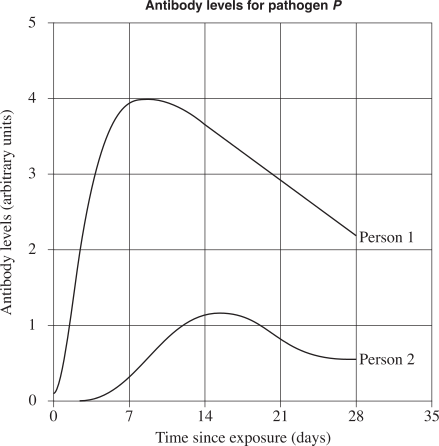
Show Answers Only

Reasons for using aluminium alloy:

  • Easily shaped, fabricated and installed.
  • Good strength to weight ratio.
  • Waterproof and resistant to corrosion.
Show Worked Solution

Reasons for using aluminium alloy:

  • Easily shaped, fabricated and installed.
  • Good strength to weight ratio.
  • Waterproof and resistant to corrosion.

♦ Mean mark 49%.

Filed Under: Materials Tagged With: Band 5, smc-3719-15-Manufacturing - Non-Ferrous
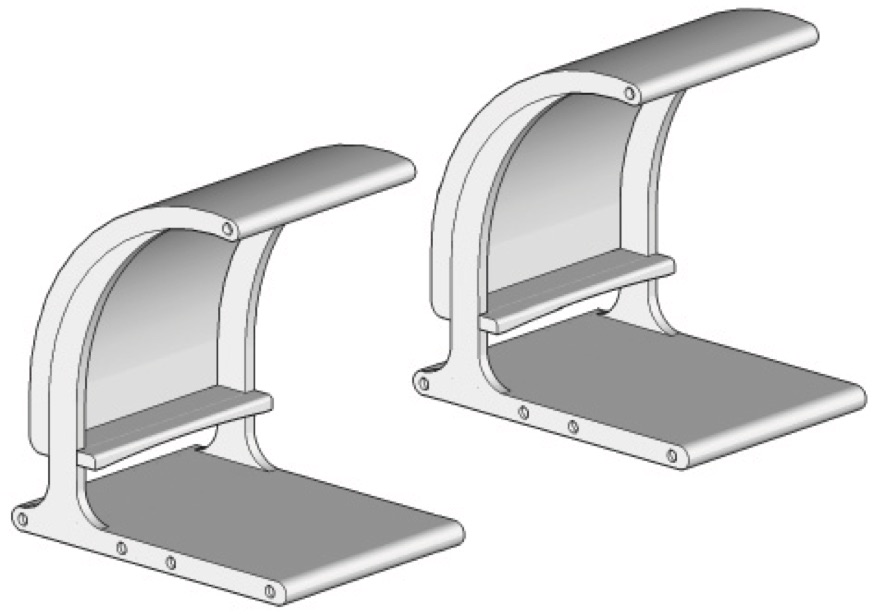
  • « Previous Page
  • 1
  • …
  • 40
  • 41
  • 42
  • 43
  • 44
  • …
  • 88
  • Next Page »

Copyright © 2014–2026 SmarterEd.com.au · Log in