Damon buys 25 kilograms of salt for his pool for $33.75.
The salt can be purchased in 1 kilogram bags.
How much does 9 kilograms of salt cost? (2 marks)
--- 4 WORK AREA LINES (style=lined) ---
Aussie Maths & Science Teachers: Save your time with SmarterEd
Damon buys 25 kilograms of salt for his pool for $33.75.
The salt can be purchased in 1 kilogram bags.
How much does 9 kilograms of salt cost? (2 marks)
--- 4 WORK AREA LINES (style=lined) ---
\($12.15\)
\(\text{C}\text{ost of 1 kilogram}\)
\(=\dfrac{33.75}{25}\)
\(= $1.35\)
\(\therefore\ \text{C}\text{ost of 9 kilograms}\)
\(= 9\times 1.35\)
\(= $12.15\)
Tony is making a fruit cake.
The recipe says he needs 3 cups of sultanas for every 5 cups of flour.
If 2.5 cups of flour are used, how many cups of sultanas are needed?
\(B\)
\(\text{Strategy 1:}\)
\(2.5\ \text{ is half of }\ 5\ \text{cups of flour, therefore half of}\)
\(3\ \text{cups of sultanas is required.}\)
\(\rightarrow\ 1.5\text{ cups of sultanas needed.}\)
\(\text{Strategy 2:}\)
\(\text{Let}\ \ n = \text{cups of sultanas needed}\)
| \(\dfrac{n}{2.5}\) | \(=\dfrac{3}{5}\) |
| \(\therefore \ n\) | \(=\dfrac{3\times 2.5}{5}\) |
| \(=1.5\ \text{cups}\) |
\(\Rightarrow\ B\)
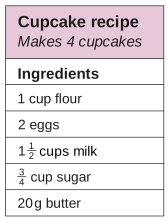
\(3\dfrac{3}{4}\ \text{cups}\)
\(\text{From the recipe:}\)
\(\dfrac{3}{4}\ \text{cups} = 4\ \text{cupcakes}\)
| \(\therefore\ \text{Sugar in 20 cupcakes}\) | \(=\dfrac{3}{4}\times 5\) |
| \(=\dfrac{15}{4}\) | |
| \(=3\dfrac{3}{4}\ \text{cups}\) |
The actual body length of a beetle Brad has caught is 24 mm.
A scale drawing of the beetle is shown below.
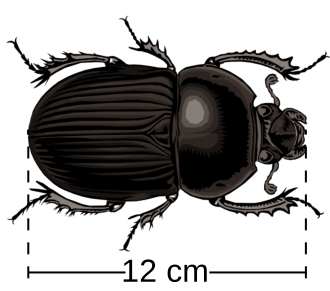
What scale is used in the drawing?
\(B\)
\(\text{Scale:}\)
| \(12\ \text{cm}: 24\ \text{mm}\) | \(=120\ \text{mm}: 24\ \text{mm}=5:1\) |
\(\text{In the options given, the ratio of}\ 5 : 1\ \text{occurs when}\)
\(\text{10 mm represents 2 mm}\ \textbf{OR}\ \text{when 1 cm represents 2 mm}\)
\(\Rightarrow B\)
This picture shows a stone vase.
The picture is 2 cm high. The actual vase is 40 cm high.
What scale is used in the picture?
\(D\)
\(\text{Scale:}\ \ 2\ \text{cm}\ :\ 40\ \text{cm}\)
\(\rightarrow \text{Divide both sides by }2\)
\(\text{Scale:}\ \ 1\ \text{cm}\ :\ 20\ \text{cm}\)
\(\Rightarrow D\)
Two places are 5.4 cm apart on a map.
On the map 1 cm represents 4 km.
What is the actual distance between the two places?
\(C\)
| \(\text{Actual distance}\) | \(=5.4\times 4\) |
| \(=21.6\ \text{km}\) |
\(\Rightarrow C\)
Shelley and Carly collect dolls.
The ratio of the number of dolls Shelley owns compared to Carly is 3 : 2.
Shelley owns 12 dolls.
How many dolls does Carly own?
\(C\)
\(\text{Shelley’s dolls represents 3 parts}\)
| \(3\ \text{parts}\) | \(=12\) |
| \(1\ \text{part}\) | \(=\dfrac{12}{3}=4\) |
\(\text{Carly’s dolls represents 2 parts}\)
\(=2\times 4=8\)
\(\therefore\ \text{There Carly owns}\ 8\ \text{dolls.}\)
\(\Rightarrow C\)
Jordan has 4 times as many blue pencils as black pencils.
Altogether he has 90 pencils.
How many blue pencils does he have? (2 marks)
--- 4 WORK AREA LINES (style=lined) ---
\(72\ \text{blue pencils}\)
\(\text{Method 1}\)
\(\text{Ratio of blue to black}=4:1\)
\(\text{Total parts}=4+1=5\)
\(\text{Fraction blue}=\dfrac{4}{5}\)
\(\text{Number of blue pencils}=\dfrac{4}{5}\times 90=72\)
\(\text{Method 2 (Advanced)}\)
\(\text{Let}\ \ x = \text{the number of black pencils}\)
\(\text{Then the number of blue pencils}=4x\)
| \(\text{Total pencils }= x + 4x\) | \(=5x\) |
| \(\rightarrow\ 5x\) | \(= 90\) |
| \(x\) | \(=\dfrac{90}{5}= 18\) |
\(\therefore \ \text{The number of blue pencils}\)
\(=90-18= 72\)
A school has 360 students.
The ratio of boys to girls is 4 to 6.
How many boys attend the school?
\(B\)
\(\text{Total students}=4+6=10\)
\(\text{Fraction of boys}=\dfrac{4}{10}=\dfrac{2}{5}\)
\(\text{Boys}=\dfrac{2}{5}\times 360=144\)
\(\Rightarrow B\)
A television broadcasting tower is 800 metres high.
A model of the tower is built with a scale of 1 : 4000.
What is the height of the model?
\(B\)
| \(\text{Model height}\) | \(=\dfrac{800}{4000}\) |
| \(= 0.2\ \text{m}\) | |
| \(= 20\ \text{cm}\) |
\(\Rightarrow B\)
A little athletics club is established in a town.
In the first week, 5 girls and 6 boys joined the club.
In the second week, another 4 boys and some more girls joined the club.
The number of girls in the club was now double the number of boys.
How many girls joined the club in the second week?
\(B\)
\(\text{1st week}\rightarrow 6\ \text{boys.}\)
\(\text{2nd week }\rightarrow 6+4 = 10\ \text{boys.}\)
\(\text{Total girls in 2nd week.}\)
\(= 2\times 10\)
\(= 20\)
\(\therefore\ \text{Girls joining in 2nd week.}\)
\(= 20-5\)
\(= 15\)
\(\Rightarrow B\)
Muriel made a batch of cookies.
Each cookie had 4 chocolate chips and 3 jelly snakes on it.
Muriel used 39 jelly snakes in the batch of cookies.
How many chocolate chips did she use?
\(C\)
\(\text{Number of cookies made}\)
\(=\dfrac{39}{3}\)
\(=13\)
\(\therefore\ \text{Chocolate chips used}\)
\(=13\times 4\)
\(=52\)
\(\Rightarrow C\)
It is known that one of the angles in a triangle is \(120^{\circ}\).
Calculate the size of the other 2 angles if they are in the ratio \(2:3\). (3 marks)
--- 6 WORK AREA LINES (style=lined) ---
\(24^{\circ}\ \text{and}\ 36^{\circ}\)
\(\text{Angle sum of a triangle}=180^{\circ}\)
\(\therefore\ \text{Remaining angles}=180-120=60^{\circ}\)
\(\text{Total parts remaining angles}=2+3=5\)
\(\text{1st angle}=\dfrac{2}{5}\times 60=24\)
\(\text{2nd angle}=\dfrac{3}{5}\times 60=36\)
\(\therefore\ \text{The remaining angles are}\ 24^{\circ}\ \text{and}\ 36^{\circ}.\)
The ratio of the angles in a triangle is 1:2:5.
Calculate the sizes of all three angles? (2 marks)
\(22.5^{\circ}, 45^{\circ} \text{ and}\ 112.5^{\circ}\)
\(\text{Total parts}=1+2+5=8\ \text{and the angle sum of a triangle}=180^{\circ}\)
| \(\dfrac{1}{8}\times 180\) | \(=22.5\) |
| \(\dfrac{2}{8}\times 180\) | \(=45\) |
| \(\dfrac{5}{8}\times 180\) | \(=112.5\) |
\(\therefore\ \text{The angles in the triangle are }22.5^{\circ}, 45^{\circ} \text{ and}\ 112.5^{\circ}\)
Joe and Andrew are cleaning fish. For every 4 fish that Joe cleans, Andrew cleans 7.
If Joe cleaned 36 fish, how many did Andrew clean? (2 marks)
--- 4 WORK AREA LINES (style=lined) ---
\(63 \text{ fish}\)
\(\text{Joe’s cleaned fish represents 4 parts}\)
| \(4\ \text{parts}\) | \(=36\) |
| \(1\ \text{part}\) | \(=\dfrac{36}{4}=9\) |
\(\text{Andrew’s cleaned fish represents 7 parts}\)
\(=9\times 7=63\)
\(\therefore\ \text{Andrew cleaned}\ 63\ \text{fish.}\)
This year there are 108 students in Year 8 and the ratio of Year 7 students to Year 8 students is 8:9.
Use this information to calculate the number of students in Year 7 this year. (2 marks)
--- 4 WORK AREA LINES (style=lined) ---
\(96 \text{ students in Year 7}\)
\(\text{Year 8 represents 9 parts}\)
| \(9\ \text{parts}\) | \(=108\) |
| \(1\ \text{part}\) | \(=\dfrac{108}{9}=12\) |
\(\text{Year 7 represents 8 parts}\)
\(=12\times 8=96\)
\(\therefore\ \text{There are}\ 96\ \text{students in Year 7.}\)
Divide $420 in the ratio 1:3:2. (2 marks)
\($70, $210 \text{ and } $140\)
\(\text{Total number of parts}=1+3+2=6\)
| \(\dfrac{1}{6}\times 420\) | \(=70\) |
| \(\dfrac{3}{6}\times 420\) | \(=210\) |
| \(\dfrac{2}{6}\times 420\) | \(=140\) |
\(\therefore\ $420\ \text{divided in the ratio }\ 1:3:2\ \text{ is }\ $70, $210\ \text{and } $140.\)
Divide 84 days in the ratio 3:4. (2 marks)
\(36\ \text{days and } 48\ \text{days}\)
\(\text{Total number of parts}=3+4=7\)
| \(\dfrac{3}{7}\times 84\) | \(=36\) |
| \(\dfrac{4}{7}\times 84\) | \(=48\) |
\(\therefore\ 84\ \text{days divided in the ratio }3:4\ \text{is }36\ \text{days and } 48\ \text{days.}\)
Divide 480 tonnes in the ratio 1:5. (2 marks)
\(80\ \text{tonnes and}\ 400\ \text{tonnes}\)
\(\text{Total number of parts}=1+5=6\)
| \(\dfrac{1}{6}\times 480\) | \(=80\) |
| \(\dfrac{5}{6}\times 480\) | \(=400\) |
\(\therefore\ 480\ \text{tonnes divided in the ratio }1:5\ \text{is }80\ \text{tonnes and } 400\ \text{tonnes.}\)
Divide $130 in the ratio 5:8. (2 marks)
\($50\ \text{and}\ $80\)
\(\text{Total number of parts}=5+8=13\)
| \(\dfrac{5}{13}\times 130\) | \(=50\) |
| \(\dfrac{8}{13}\times 130\) | \(=80\) |
\(\therefore\ \$130\ \text{divided in the ratio }5:8\ \text{is }$50\ \text{and}\ $80.\)
The ratio of kilograms of bananas to apples at the fruit shop is \(11:5\).
--- 1 WORK AREA LINES (style=lined) ---
--- 2 WORK AREA LINES (style=lined) ---
a. \(\dfrac{11}{16}\)
b. \(88\ \text{kg of bananas}\)
a. \(\text{Total fruits}=11+5=16\)
\(\text{Fraction bananas}=\dfrac{11}{16}\)
| b. |
\(\text{Kilograms of bananas}\) | \(=\dfrac{11}{16}\times 128\) |
| \(=88\) |
\(\therefore\ \text{There are }88\ \text{kgs of bananas.}\)
The ratio of dogs to cats in an animal rescue shelter is \(5:4\).
--- 1 WORK AREA LINES (style=lined) ---
--- 2 WORK AREA LINES (style=lined) ---
a. \(\dfrac{5}{9}\)
b. \(\dfrac{4}{9}\)
c. \(20\ \text{dogs}\)
a. \(\text{Total animals}=5+4=9\)
\(\text{Fraction dogs}=\dfrac{5}{9}\)
b. \(\text{Fraction cats}=\dfrac{4}{9}\)
| c. |
\(\text{Number of dogs}\) | \(=\dfrac{5}{9}\times 36\) |
| \(=20\) |
\(\therefore\ \text{There are }20\ \text{dogs in the shelter.}\)
Maude has 55 cents in coins and Will has $2.70 in coins.
--- 1 WORK AREA LINES (style=lined) ---
--- 2 WORK AREA LINES (style=lined) ---
a. \(55:270\)
b. \(11:54\)
| a. | \(55\ \text{cents to}\ $2.70\) | \(=55:270\) |
| b. | \(55:270\) | \(=\dfrac{55}{5}:\dfrac{270}{5}\) |
| \(=11:54\) |
Change these ratios to the same units and then write in simplest form.
--- 2 WORK AREA LINES (style=lined) ---
a. \(1:3\)
b. \(6:1\)
c. \(5:7\)
| a. | \(40\ \text{cm}:1.2\ \text{m}\) | \(=40\ \text{cm}:120\ \text{cm}\) |
| \(=40:120\) | ||
| \(=1:3\) |
| b. | \(4\ \text{hours}:20\ \text{minutes}\) | \(=240\ \text{minutes}:40\ \text{minutes}\) |
| \(=240:40\) | ||
| \(=6:1\) |
| c. | \(15\ \text{days}:3\ \text{weeks}\) | \(=15\ \text{days}:21\ \text{days}\) |
| \(=15:21\) | ||
| \(=5:7\) |
Fully simplify the following ratios.
--- 3 WORK AREA LINES (style=lined) ---
a. \(10:33\)
b. \(5:14\)
| a. | \(\dfrac{5}{12}:\dfrac{11}{8}\) | \(=\bigg(\dfrac{5}{12}\times 24\bigg):\bigg(\dfrac{11}{8}\times 24\bigg)\) | \(\ \ \text{Multiply by LCM of 12 and 8.}\) |
| \(=10:33\) |
| b. | \(1\dfrac{1}{4}:3\dfrac{1}{2}\) | \(=\dfrac{5}{4}:\dfrac{7}{2} \ \ \ \text{Convert to improper fractions }\) |
| \(=\bigg(\dfrac{5}{4}\times 4\bigg):\bigg(\dfrac{7}{2}\times 4\bigg)\ \ \ \ \text{Multiply by LCM of 4 and 2. }\) | ||
| \(=5:14\) |
Fully simplify the following ratios.
--- 2 WORK AREA LINES (style=lined) ---
--- 3 WORK AREA LINES (style=lined) ---
a. \(1:6\)
b. \(3:4\)
| a. | \(\dfrac{1}{2}:3\) | \(=\Bigg(\dfrac{1}{2}\times 2\Bigg):\Bigg(3\times 2\Bigg)\) | \(\ \ \text{Multiply by LCM of 2 and 1.}\) |
| \(=1:6\) |
| b. | \(\dfrac{1}{4}:\dfrac{1}{3}\) | \(=\Bigg(\dfrac{1}{4}\times 12\Bigg):\Bigg(\dfrac{1}{3}\times 12\Bigg)\) | \(\ \ \text{Multiply by LCM of 3 and 4. }\) |
| \(=3:4\) |
Fully simplify the following ratios.
--- 1 WORK AREA LINES (style=lined) ---
a. \(5:16\)
b. \(12:5\)
c. \(6:3:11\)
| a. | \(10:32\) | \(=\dfrac{10}{2}:\dfrac{32}{2}\) | \(\ \ \text{(Divide by HCF of 10 and 32.)}\) |
| \(=5:16\) |
| b. | \(144:60\) | \(=\dfrac{144}{12}:\dfrac{60}{12}\) | \(\ \ \text{(Divide by HCF of 144 and 60.)}\) |
| \(=12:5\) |
| c. | \(36:18:66\) | \(=\dfrac{36}{6}:\dfrac{18}{6}:\dfrac{66}{6}\) | \(\ \ \text{(Divide by HCF of 36, 18 and 66.) }\) |
| \(=6:3:11\) |
Fully simplify the following ratios.
--- 1 WORK AREA LINES (style=lined) ---
a. \(4:3\)
b. \(20:9\)
c. \(2:7:8\)
| a. | \(24 :18\) | \(=\dfrac{24}{6}:\dfrac{18}{6}\) | \(\ \ \text{(Divide by HCF of 24 and 18.)}\) |
| \(=4:3\) |
| b. | \(180 :81\) | \(=\dfrac{180}{9}:\dfrac{81}{9}\) | \(\ \ \text{(Divide by HCF of 180 and 81.)}\) |
| \(=20:9\) |
| c. | \(14 :49:56\) | \(=\dfrac{14}{7}:\dfrac{49}{7}:\dfrac{56}{7}\) | \(\ \ \text{(Divide by HCF of 14, 49 and 56.)}\) |
| \(=2:7:8\) |
Which of the following ratios is not in simplest form?
\(B\)
| \(9 :63\) | \(=\dfrac{9}{9}:\dfrac{63}{9}\) | \(\ \ \text{Divide by HCF of 9 and 63. }\) |
| \(=1:7\) |
\(\Rightarrow B\)
Which of the following ratios is not in simplest form?
\(C\)
| \(1 :0.5\) | \(=1:\dfrac{1}{2}\) | \(\ \ \ \text{(Multiply by 2 to remove fraction.)}\) |
| \(=2:1\) |
\(\Rightarrow C\)
Complete each pair of equivalent ratios. (3 marks)
| a. |
\(16:12=\) |
|
\(:3\) |
| b. |
\(18:24=\) |
|
\(:4\) |
| c. | \(54:9=\) |
|
\(:1\) |
--- 0 WORK AREA LINES (style=lined) ---
a. \(4:3\)
b. \(3:4\)
c. \(6:1\)
| a. \(16 :12\) | \(=(16÷4):(12÷4)\) |
| \(=4:3\) |
| b. \(18 :24\) | \(=(18÷6):(24÷6)\) |
| \(=3:4\) |
| c. \(54 :9\) | \(=(54÷9):(9÷9)\) |
| \(=6:1\) |
Complete each pair of equivalent ratios. (3 marks)
| a. \(3:4\) | \(=9:\) |
|
| b. \(2:5\) |
\(=8:\) |
|
| c. \(10:3\) |
\(=30:\) |
|
--- 0 WORK AREA LINES (style=lined) ---
a. \(9:12\)
b. \(8:20\)
c. \(30:9\)
| a. \(3 :4\) | \(=3\times 3:4\times 3\) |
| \(=9:12\) |
| b. \(2 :5\) | \(=2\times 4:5\times 4\) |
| \(=8:20\) |
| c. \(10 :3\) | \(=10\times 3:3\times 3\) |
| \(=30:9\) |
At the Year 7 camp, there were 20 teachers and 180 students.
What is the ratio of students to the total number of people at the camp?
\(C\)
| \(\text{students}\ :\ \text{total}\) | \(=180:(20+180)\) |
| \(=180:200\) | |
| \(=9:10\) |
\(\Rightarrow C\)
In a boarding kennel, there are 15 dogs and 10 cats.
What is the ratio of cats to dogs?
\(A\)
| \(\text{cats}\ :\ \text{dogs}\) | \(=10:15\) |
| \(=2:3\) |
\(\Rightarrow A\)
In a hospital, there are 40 nurses and 600 patients.
What is the ratio of nurses to patients?
\(B\)
| \(\text{Nurses : Patients}\) | \(=40:600=1:15\) |
\(\Rightarrow B\)
James was building a lego house and has the pieces below left over.
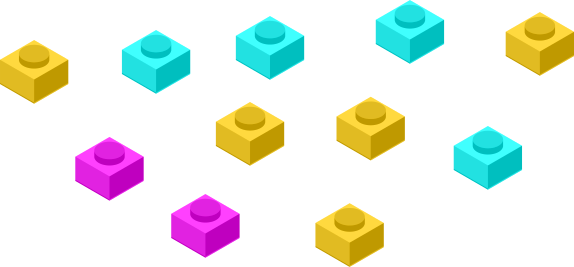
Calculate:
--- 1 WORK AREA LINES (style=lined) ---
a. \(4:5\)
b. \(2:11\)
c. \(5:6\)
a. \(\text{Blue}:\text{Yellow}=4:5\)
b. \(\text{Total Bricks}=2+4+5=11\)
\(\text{Pink}:\text{Total}=2:11\)
c. \(\text{Total other bricks}=2+4=6\)
\(\text{Yellow}:\text{Other}=5:6\)
A fruit bowl contains 8 apples, 7 bananas, 1 pear and 13 oranges.
Calculate:
--- 1 WORK AREA LINES (style=lined) ---
a. \(8:13\)
b. \(13:29\)
c. \(1:28\)
a. \(\text{Apples}:\text{Oranges}=8:13\)
b. \(\text{Total Fruit}=8+7+1+13=29\)
\(\text{Oranges}:\text{Total}=13:29\)
c. \(\text{Total other fruit}=8+7+13=28\)
\(\text{Pear}:\text{Other}=1:28\)
A bag contains 3 red marbles, 4 blue marbles and 8 white marbles.
Calculate:
--- 1 WORK AREA LINES (style=lined) ---
a. \(3:4\)
b. \(8:15\)
c. \(4:11\)
a. \(\text{Red}:\text{Blue}=3:4\)
b. \(\text{Total marbles}=3+4+8=15\)
\(\text{White}:\text{Total}=8:15\)
c. \(\text{Total other marbles}=3+8=11\)
\(\text{Blue}:\text{Other}=4:11\)
Calculate the percentage discount on an item having a cost price of $45 and a sale price of $30.15. (2 marks)
--- 5 WORK AREA LINES (style=lined) ---
\(33\text{%}\)
| \(\text{Discount}\) | \(=\text{Cost Price}-\text{Sale Price}\) |
| \(=45-30.15\) | |
| \(=$14.85\) |
| \(\text{Percentage Discount}\) | \(= \dfrac{\text{Discount}}{\text{Cost price}}\times 100\text{%}\) |
| \(=\dfrac{14.85}{45}\times 100\text{%}\) | |
| \(=33\text{%}\) |
Calculate the percentage profit on an item having a cost price of $25 and a sale price of $46.25. (2 marks)
--- 5 WORK AREA LINES (style=lined) ---
\(85\text{%}\)
| \(\text{Profit}\) | \(=\text{Sale Price}-\text{Cost Price}\) |
| \(=46.25-25\) | |
| \(=$21.25\) |
| \(\text{Percentage Profit}\) | \(= \dfrac{\text{Profit}}{\text{Cost price}}\times 100\text{%}\) |
| \(=\dfrac{21.25}{25}\times 100\text{%}\) | |
| \(=85\text{%}\) |
Iggy bought an e-bike for $3500 in 2022 and sold it in 2023 for $2450 to pay for an overseas holiday.
--- 1 WORK AREA LINES (style=lined) ---
--- 2 WORK AREA LINES (style=lined) ---
a. \($1050\)
b. \(30\%\)
| a. \(\text{Loss}\) | \(=3500-2450=$1050\) |
| b. \(\text{Percentage Loss}\) | \(= \dfrac{\text{loss}}{\text{original price}}\times 100\text{%}\) |
| \(=\dfrac{1050}{3500}\times 100\text{%}\) | |
| \(=30\%\) |
Janice bakes cupcakes for the local market. The ingredients she uses in each of the cupcakes cost $1.90.
Last weekend she sold the cupcakes for $3.99 each.
--- 1 WORK AREA LINES (style=lined) ---
--- 2 WORK AREA LINES (style=lined) ---
a. \($2.09\ \text{per cupcake}\)
b. \(110\%\)
| a. \(\text{Profit}\) | \(=3.99-1.90\) |
| \(=$2.09\) |
| b. \(\text{Percentage Profit}\) | \(= \dfrac{\text{Profit}}{\text{Cost of ingredients}}\times 100\%\) |
| \(=\dfrac{2.09}{1.90}\times 100\%\) | |
| \(=110\%\) |
Mavis bought an original artwork as an investment. She paid \($15\ 400\) in 2018 and sold it in 2023 for \($24\ 024\).
--- 1 WORK AREA LINES (style=lined) ---
--- 2 WORK AREA LINES (style=lined) ---
a. \($8624\)
b. \(56\text{%}\)
| a. \(\text{Profit}\) | \(=24\ 024-15\ 400\) |
| \(=$8624\) |
| b. \(\text{Percentage Profit}\) | \(= \dfrac{\text{Profit}}{\text{Original price}}\times 100\text{%}\) |
| \(=\dfrac{8624}{15\ 400}\times 100\text{%}\) | |
| \(=56\text{%}\) |
Jeffrey bought a new car for \($35\ 000\) in 2021 and sold it in 2023 for \($21\ 000\).
--- 1 WORK AREA LINES (style=lined) ---
--- 2 WORK AREA LINES (style=lined) ---
a. \($14\ 000\)
b. \(40\%\)
a. \(\text{Loss}=35\ 000-21\ 000=$14\ 000\)
| b. \(\text{Percentage Loss}\) | \(= \dfrac{\text{loss}}{\text{original price}}\times 100\%\) |
| \(=\dfrac{14\ 000}{35\ 000}\times 100\%\) | |
| \(=40\%\) |
Jock is a real estate agent who is paid 2.5% commission on all house sales.
Last month he sold houses to the value of \($2.5\ \text{million}\).
How much pay did Jock receive in the form of commission last month? (2 marks)
\($62\ 500\)
| \(\text{Commission}\) | \(= 2.5\text{%}\times 2\ 500\ 000\) |
| \(=\dfrac{25}{1000}\times 2\ 500\ 000\) | |
| \(=$62\ 500\) |
\(\therefore\ \text{Jock earned }$62\ 500\ \text{in commission.}\)
Louella is a boat broker who is paid 6.5% commission on all boat sales.
Last quarter she sold boats to the value of \($443\ 000\).
How much pay did Louella receive in the form of commission last quarter? (2 marks)
\($28\ 795\)
| \(\text{Commission}\) | \(= 6.5\text{%}\times 443\ 000\) |
| \(=\dfrac{65}{1000}\times 443\ 000\) | |
| \(=$28\ 795\) |
\(\therefore\ \text{Louella earned }$28\ 795\ \text{in commission.}\)
Hendry is a salesperson who is paid 5% commission on all sales.
Last month he sold goods to the value of \($45\ 300\).
How much commission did Hendry receive last month? (2 marks)
\($2265\)
| \(\text{Commission}\) | \(= 5\%\times 45\ 300=\dfrac{5}{100}\times 45\ 300\) |
| \(=$2265\) |
\(\therefore\ \text{Hendry earned }$2265\ \text{in commission.}\)
The sale price of a parrot is $400.
The pet store gives Albert 25% off the sale price.
Albert has a pet store discount voucher that gives him a further $60 off the sale price.
What percentage of the original price does Albert pay for the parrot? (2 marks)
--- 2 WORK AREA LINES (style=lined) ---
\(60\text{%}\)
| \(\text{Sale Price}\) | \(= \$400-(25\text{%}\times 400)\) |
| \(=400-100\) | |
| \(=$300\) |
\(\text{Purchase price}=300-60=$240\)
| \(\text{Percentage of original price}\) | \(=\dfrac{240}{400}\times 100\) |
| \(=\dfrac{6}{10}\times 100\) | |
| \(=60\text{%}\) |
A family ticket to Taronga Zoo in Sydney reduced in price from $90 to $73.80.
What is the percentage decrease in the price? (2 marks)
\(18\text{%}\)
\(\text{Price decrease}=90-73.80=$16.20\)
| \(\text{Percentage decrease}\) | \(= \dfrac{16.2}{90}\times 100\) |
| \(=0.18\times 100\) | |
| \(=18\text{%}\) |
A coffee shop increases the price of a caramel latte from $4.80 to $6.00.
What is the percentage increase in the price? (2 marks)
\(25\text{%}\)
\(\text{Price increase}=6-4.80=$1.20\)
| \(\text{Percentage increase}\) | \(= \dfrac{1.2}{4.8}\times 100\) |
| \(=0.25\times 100\) | |
| \(=25\text{%}\) |
A loaf of bread is on sale with a 15% discount.
In the last hour of trading, the bread is reduced a further 20% on the already discounted price.
What is the overall percentage discount on the bread? (2 marks)
--- 5 WORK AREA LINES (style=lined) ---
\(32\%\)
\(\text{Strategy 1}\)
\(\text{Assume the bread costs }$1.00.\)
\(\text{Cost after }15\text{% discount}=$0.85\)
| \(\text{Cost after further }20\text{% discount}\) | \(= 0.85-(20\%\times 0.85)\) |
| \(=0.85-0.17\) | |
| \(=$0.68\) |
\(\therefore\ \text{Overall discount} =(1.00-0.68)\times 100 =32\text{%}\)
\(\text{Strategy 2}\)
| \(\text{Overall discount}\) | \(=1-(1\times 0.85\times 0.80)\) |
| \(=1.00-0.68\) | |
| \(=0.32\) | |
| \(=32\%\) |
A farmer sells a box of oranges to a supermarket with a 15% markup.
The supermarket then adds a further 20% on the already increased price.
What is the overall percentage markup on the box of oranges? (2 marks)
--- 5 WORK AREA LINES (style=lined) ---
\(38\%\)
\(\text{Strategy 1}\)
\(\text{Assume the box of oranges costs }$1.00.\)
\(\text{Cost after }15\text{% markup}=$1.15\)
| \(\text{Cost after further }20\text{% increase}\) | \(= 1.15+(20\%\times 1.15)\) |
| \(=1.15+0.23=$1.38\) |
\(\therefore\ \text{Overall markup} =(1.38-1.00)\times 100 =38\%\)
\(\text{Strategy 2}\)
| \(\text{Overall markup}\) | \(=(1\times 1.15\times 1.20)-1\) |
| \(=1.38-1.00=0.38=38\%\) |
A car dealer decreases the price of a car from $50 000 to $45 000.
What is the percentage decrease in the price? (2 marks)
\(10\text{%}\)
\(\text{Price decrease}= 50\ 000-45\ 000=$5\ 000\)
| \(\therefore\ \text{Percentage Decrease}\) | \(= \dfrac{5\ 000}{50\ 000}\times 100\) |
| \(=0.10\times 100\) | |
| \(= 10\text{%}\) |
Lucia is saving her money to buy a jet ski.
After 3 months, she had saved 40% of the cost of the jet ski.
After 5 months, she had saved another $1200 and now had 60% of the cost of the jet ski.
How much does the jet ski cost? (2 marks)
--- 4 WORK AREA LINES (style=lined) ---
\($6000\)
| \(60\%-40\%\) | \(= $1200\) |
| \(\therefore 20\%\) | \(= $1200\) |
| \(\therefore\ 1\%\) | \(= $60\) |
| \(\therefore\ \text{The cost of the jet ski}\) | \(= 100\times 60= $6000\) |
Which of these percentages is closest in value to \(\dfrac{4}{7}\)?
\(D\)
| \(\dfrac{4}{7}\) | \(= 57.14\ldots\%= 57\text{% (nearest %)}\) |
\(\Rightarrow D\)
Which of these percentages is closest in value to \(\dfrac{5}{9}\)?
\(C\)
| \(\dfrac{5}{9}\) | \(= 55.55\ldots\%= 56\text{% (nearest %)}\) |
\(\Rightarrow C\)
Lancelot bought a new round table for $2810.50 inclusive of 10% GST.
What was the price of the round table before the GST was added? (2 marks)
\($2555\)
\(\text{Round table has had 10% added to the price.}\)
\(\therefore\ $2810.50\ \text{represents}\ 110\text{%}\ \text{of the original price}\)
| \(\therefore\ \dfrac{110}{100}\ \times\ \text{Original price}\) | \(=$2810.50\) |
| \(\therefore\ \text{Original price}\) | \(=\dfrac{$2810.50\times 10}{11}\) |
| \(=$2555\) |
Mickey bought a plane ticket to London for $1716 inclusive of 10% GST.
What was the price of the ticket before the GST was added? (2 marks)
\($1560\)
\(\text{Plane ticket has had 10% added to the price.}\)
\(\therefore\ $1716\ \text{represents}\ 110\text{%}\ \text{of the original price}\)
| \(\therefore\ \dfrac{110}{100}\ \times\ \text{Original price}\) | \(=$1716\) |
| \(\therefore\ \text{Original price}\) | \(=\dfrac{$1716\times 10}{11}\) |
| \(=$1560\) |
James purchased a pair of football boots for $358.05.
This price included 10% GST.
What was the price of the shoes before the GST was added? (2 marks)
\($325.50\)
\(\text{Football boots have had 10% added to the price.}\)
\(\therefore\ $358.05\ \text{represents}\ 110\text{%}\ \text{of the original price}\)
| \(\therefore\ \dfrac{110}{100}\ \times\ \text{Original price}\) | \(=$358.05\) |
| \(\therefore\ \text{Original price}\) | \(=\dfrac{358.05\times 10}{11}\) |
| \(=$325.50\) |
Minerva purchased a book online and a discount of 35% was applied at checkout.
If Minerva paid $29.90 with the discount, what was the original price of the book. (2 marks)
\($46\)
\(\text{Book price discounted by 35%.}\)
\(\therefore\ $29.90\ \text{represents}\ \dfrac{65}{100}\ \text{of the original price}\)
| \(\therefore\ \dfrac{65}{100}\ \times\ \text{Original price}\) | \(=$29.90\) |
| \(\therefore\ \text{Original price}\) | \(=\dfrac{29.90\times 100}{65}=$46\) |