Fred owns a property which is currently experiencing a drought.
Fred's dam is currently 30% below its maximum capacity.
Calculate the capacity of the dam when full if it currently holds \(280\ 000\) litres? (2 marks)
Aussie Maths & Science Teachers: Save your time with SmarterEd
Fred owns a property which is currently experiencing a drought.
Fred's dam is currently 30% below its maximum capacity.
Calculate the capacity of the dam when full if it currently holds \(280\ 000\) litres? (2 marks)
\(400\ 000\ \text{litres}\)
\(\text{Capacity has decreased by 30%.}\)
\(\therefore\ 280\ 000\ \text{litres represents}\ \dfrac{70}{100}\ \text{of the full capacity}\)
| \(\therefore\ \dfrac{7}{10}\ \times\ \text{Full capacity}\) | \(=280\ 000\) |
| \(\therefore\ \text{Full capacity}\) | \(=\dfrac{280\ 000\times 10}{7}=400\ 000\ \text{litres}\) |
Asti bought a formal dress that was on sale at a 75% discount.
Calculate the original price of the formal dress if the sale price was $60? (2 marks)
\($240\)
\(\text{Dress has been discounted by 75%.}\)
\(\therefore\ $60\ \text{represents}\ \dfrac{1}{4}\ \text{of the original price.}\)
| \(\therefore\ \dfrac{1}{4}\ \times\ \text{Original Price}\) | \(=60\) |
| \(\therefore\ \text{Original Price}\) | \(=60\times 4=$240\) |
Sachin's cricket bat is pictured below.
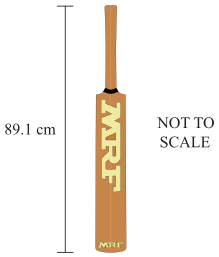
The handle of the bat is 29 cm in length.
What is the length of the handle as a percentage of the total length of the bat, to the nearest whole percentage? (2 marks)
\(33\%\)
| \(\text{Length of the handle as a percentage:}\) | \(=\dfrac{29}{89.1}\times 100\) |
| \(= 32.54\ldots\%\) | |
| \(\approx 33\%\) |
Bec is buying 40 kilograms of dry dog food for her bullmastiff.
The table below lists the original price and the amount of discount on a 40 kilogram bag of dry dog food at four different pet stores.
| 40 kg Dry Dog Food Prices | ||
| Shop | Original price | Discount |
| A. | \($220\) | \(18\text{%}\) |
| B. | \($245\) | \(25\text{%}\) |
| C. | \($250\) | \(\dfrac{1}{5}\) |
| D. | \($230\) | \($35\text{ off}\) |
Which shop has the lowest sale price for the jeans?
\(A\)
\(\text{Consider the sale price at each shop:}\)
| \(\text{A}\) | \(= 220-(18\text{%}\times 220)=220-39.60= $180.40\) |
| \(\text{B}\) | \(= 245-(25\text{%}\times 245) = 245-61.25 =$183.75\) |
| \(\text{C}\) | \(= 250-(\dfrac{1}{5}\times 250) = 250-50= $200\) |
| \(\text{D}\) | \(= 230-35 = $195\) |
\(\therefore\ \text{Shop }A\text{ has the lowest sale price.}\)
\(\Rightarrow A\)
Jye was checking his phone battery usage and found he spent his time listening to music, using social media and viewing YouTube videos.
Last week he spent 25 hours in total using his phone and the pie chart below shows the breakdown of his usage.
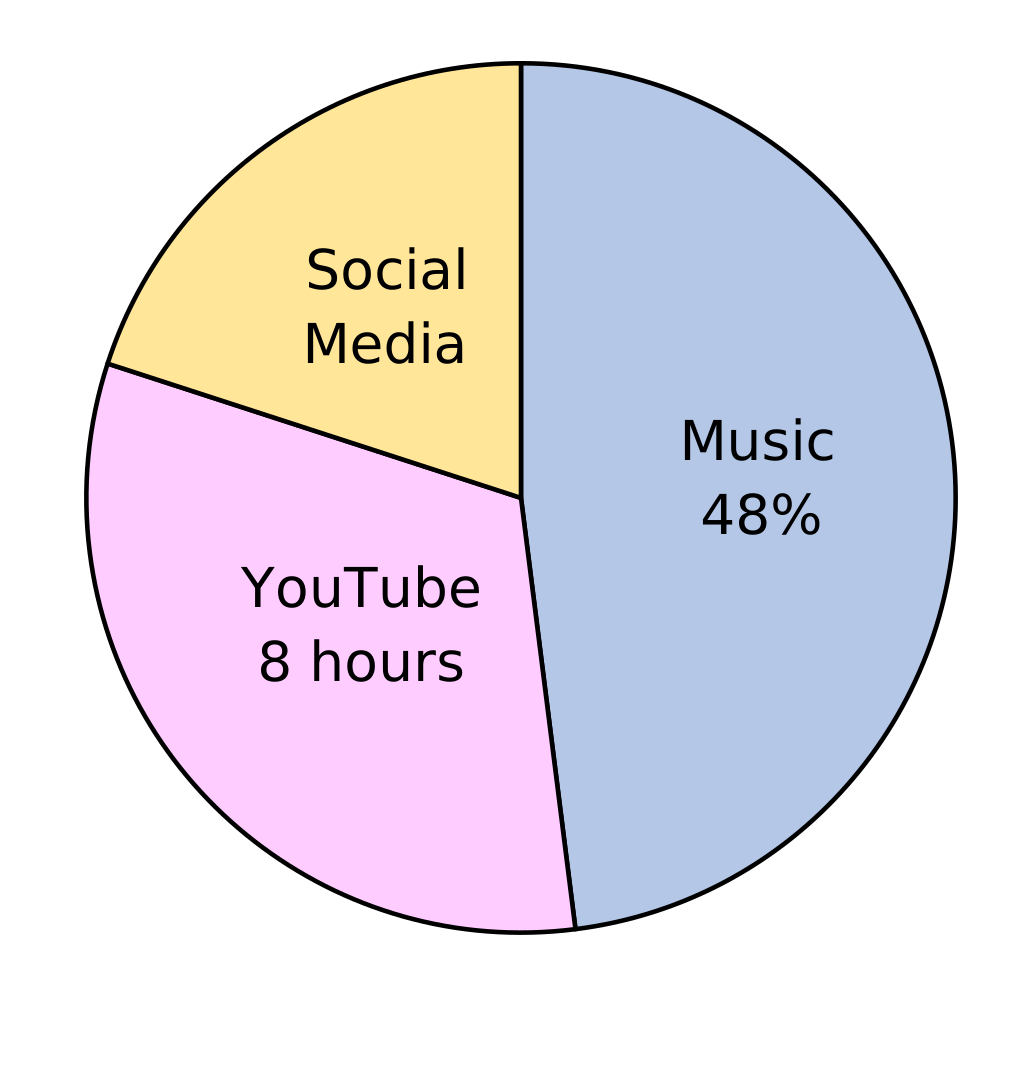
How much time did Jye spend on social media? (2 marks)
--- 4 WORK AREA LINES (style=lined) ---
\(5\ \text{hours}\)
| \(\text{Percentage watching YouTube videos}\) | \(=\dfrac{8}{25} \times 100\) |
| \(=32\text{%}\) |
\(\text{Percentage on social media}=100-(48+32)=20\text{%}\)
| \(\therefore\ \text{Amount of usage on social media}\) | \(=20\text{%}\times 25\) |
| \(=5\ \text{hours}\) |
Joy set up a cardio gym in her garage and purchased a treadmill, a rowing machine and a spin bike.
She spent $6000 in total and the pie chart below shows how she spent it.
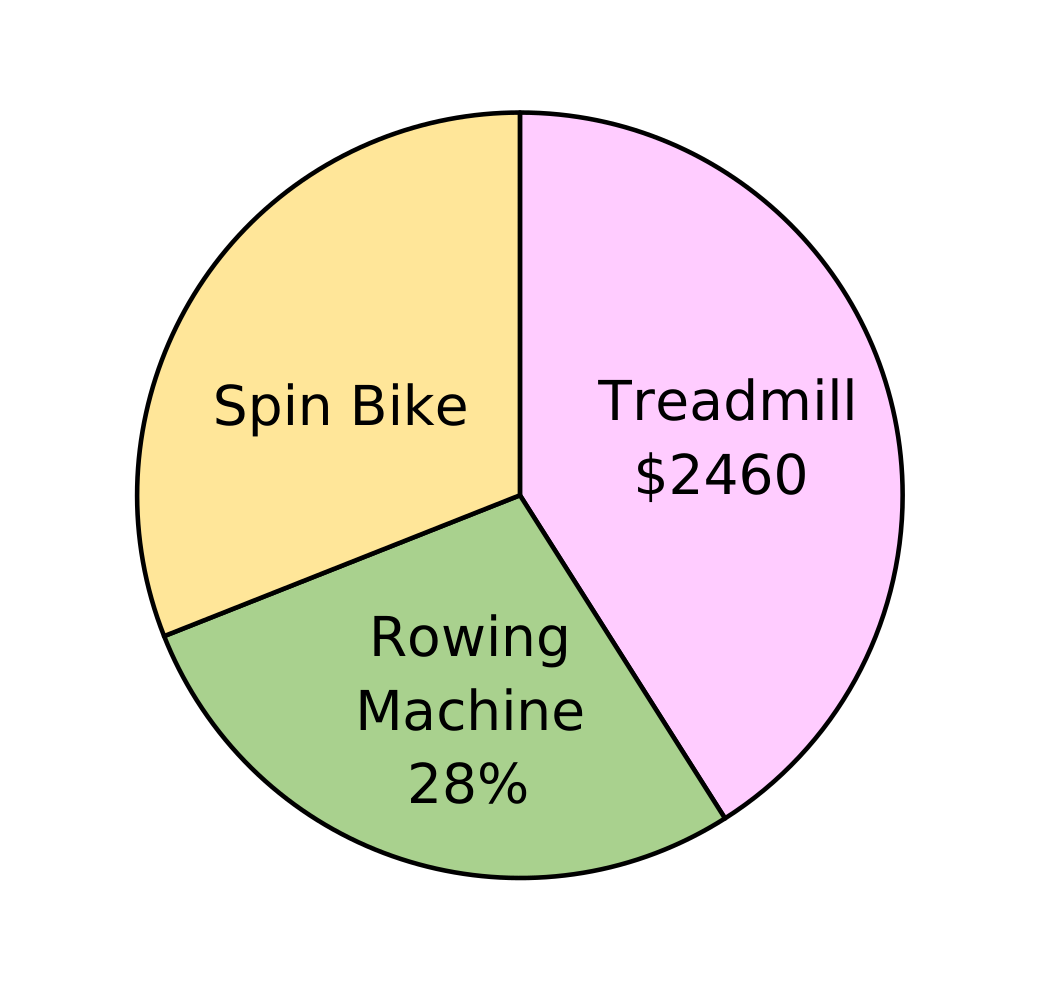
How much money did Joy spend on the spin bike? (2 marks)
--- 5 WORK AREA LINES (style=lined) ---
\($1860\)
| \(\text{Percentage spent on the treadmill}\) | \(=\dfrac{2460}{6000} \times 100\) |
| \(=41\text{%}\) |
\(\text{Percentage on spin bike}=100-(41+28)=31\text{%}\)
| \(\therefore\ \text{Amount spent on spin bike}\) | \(=31\text{%}\times 6000\) |
| \(=31\times 60\) | |
| \(=$1860\) |
A ring has a normal price tag of $320.
At sale time, it is reduced by 30%.
What it the sale price of the ring? (2 marks)
--- 3 WORK AREA LINES (style=lined) ---
\($224\)
\(\text{Method 1}\)
| \(\text{Sale price of ring}\) | \(=320-320\times 30\text{%}\) |
| \(=320-32\times 3\) | |
| \(=320-96\) | |
| \(=$224\) |
\(\text{Method 2 (Advanced)}\)
| \(\text{Sale price of ring}\) | \(=320\times (100-30)\text{%}\) |
| \(=320\times 70\text{%}\) | |
| \(=32\times 7\) | |
| \(=$224\) |
A watch has a normal price tag of $240.
At sale time, it is reduced by 25%.
What it the sale price of the watch? (2 marks)
--- 2 WORK AREA LINES (style=lined) ---
\($180\)
\(\text{Method 1}\)
| \(\text{Sale price of watch}\) | \(=240-240\times 25\text{%}\) |
| \(=240-60\) | |
| \(=$180\) |
\(\text{Method 2 (Advanced)}\)
| \(\text{Sale price of watch}\) | \(=240\times (100-25)\text{%}\) |
| \(=240\times 75\text{%}\) | |
| \(=240\times \dfrac{3}{4}\) | |
| \(=$180\) |
A tree was 15 metres tall two years ago.
It was measured this year and its height had increased by 64%.
How tall is the tree now? (2 marks)
--- 2 WORK AREA LINES (style=lined) ---
\(24.6\ \text{metres}\)
\(\text{Method 1}\)
| \(\text{Height of tree}\) | \(=15 + 15\times 64\%=15+9.6\) |
| \(=24.6\ \text{metres}\) |
\(\text{Method 2 (Advanced)}\)
| \(\text{Height of tree}\) | \(=15\times 164\%=15\times 1.64\) |
| \(=24.6\ \text{metres}\) |
The price of computer A is $500 and the price of computer B is 300% more than the price of computer A. What is the price of computer B?
\(A\)
| \(\text{Price of Computer B}\) | \(=500 + 500\times 300\%\) |
| \(=500+500\times 3\) | |
| \(=$2000\) |
\(\Rightarrow A\)
A fishing boat returns with 16 flathead, 7 bream and 9 flounder.
About what percentage of the fish are bream?
\(C\)
| \(\text{Percentage of bream}\) | \(=\dfrac{\text{number of bream}}{\text{total fish}}\) |
| \(=\dfrac{7}{16+7+9}\) | |
| \(=\dfrac{7}{32}\) | |
| \(=0.21875=21.875\%\) | |
| \(\approx 22\%\) |
\(\Rightarrow C\)
In a classroom there are 24 boys and 36 girls.
What percentage of the students in the classroom are girls? (2 marks)
\(60\%\)
| \(\text{Percentage of girls}\) | \(=\dfrac{\text{number of girls}}{\text{total students}}=\dfrac{36}{24+36}\) |
| \(=\dfrac{36}{60}=0.6=60\%\) |
Barry weighed 80 kg and started doing triathlons.
He lost 2.8 kg in the 1st month, 3 kg in the 2nd month and 2.2 kg in the 3rd month.
What percentage of his original weight did Barry lose? (2 marks)
--- 2 WORK AREA LINES (style=lined) ---
\(10\text{%}\)
| \(\text{Total kilograms lost}\) | \(=2.8+3+2.2=8.0\) |
| \(\text{Percentage of original weight lost}\) | \(=\dfrac{8}{80}\times 100=0.1\times 100\) |
| \(=10\text{%}\) |
Gerry is streaming his favourite show on Paraflix.
Each episode is usually 50 minutes long.
Gerry keeps losing his internet connection and it takes 30% longer to watch tonight's episode.
How long did it take Gerry to watch tonight's episode? (2 marks)
--- 2 WORK AREA LINES (style=lined) ---
\(65\text{ minutes}\)
\(\text{Solution 1}\)
| \(\text{Time}\) | \(=50+(30\text{%} \times 50)=50+15\) |
| \(=65\ \text{minutes}\) |
\(\text{Solution 2 (Advanced)}\)
| \(\text{Time}\) | \(=50\times 1.3=65\ \text{minutes}\) |
A pot weighed 12 kg when empty.
When filled with garden soil and plants, the pot weighs 35% more than when empty.
How much does the filled pot weigh? (2 marks)
--- 2 WORK AREA LINES (style=lined) ---
\(16.2\text{ kilograms}\)
\(\text{Solution 1}\)
| \(\text{Weight}\) | \(=12+(12\times 35\%=12+4.2\) |
| \(=16.2\ \text{kilograms}\) |
\(\text{Solution 2}\)
| \(\text{Weight}\) | \(=12\times 1.35=16.2\ \text{kilograms}\) |
Which set of numbers is arranged from the smallest to the largest?
\(B\)
\(-7\text{ is less than}\ -6\)
\(80\text{%} = \dfrac{4}{5}\ \text{which is less than}\ \dfrac{5}{3}\)
\(\therefore\ \text{Smallest to largest is }\rightarrow -7\ ,\ -6\ ,\ 80\text{%}\ ,\ \dfrac{5}{3}\)
\(\Rightarrow B\)
Which set of numbers is arranged from the smallest to the largest?
\(A\)
\(-3\text{ is less than}\ -2\)
\(25\text{%} = \dfrac{1}{4}\ \text{which is less than}\ \dfrac{5}{4}\)
\(\therefore\ \text{Smallest to largest is }\rightarrow -3\ ,\ -2\ ,\ 25\text{%}\ ,\ \dfrac{5}{4}\)
\(\Rightarrow A\)
Express $18 as a percentage of $600.
\(C\)
| \(\text{Solution}\) | \(=\dfrac{18}{600}\times 100\) |
| \(=\dfrac{18}{6}\) | |
| \(=3\text{%}\) |
\(\Rightarrow C\)
Express $20 as a percentage of $500.
\(B\)
| \(\text{Solution}\) | \(=\dfrac{20}{500}\times 100\) |
| \(=\dfrac{20}{5}\) | |
| \(=4\text{%}\) |
\(\Rightarrow B\)
Which of the following fractions is equivalent to 0.1%?
\(D\)
\(0.1\text{%}=\dfrac{0.1}{100}=\dfrac{1}{1000}\)
\(\Rightarrow D\)
In 2015, some wilderness parks in Tasmania lost up to \(\dfrac{8}{10}\) of their Tasmanian devil populations.
What is \(\dfrac{8}{10}\) as percentage?
\(C\)
\(\dfrac{8}{10}=\dfrac{80}{100}=80\text{%}\)
\(\Rightarrow C\)
Which of the following fractions is equivalent to 5%?
\(B\)
\(5\text{%}=\dfrac{5}{100}=\dfrac{1}{20}\)
\(\Rightarrow B\)
John uses concrete in his landscaping business.
He makes a dry mix using 1 part cement, 2 parts sand and 3 parts gravel.
a. \(\dfrac{1}{2}\)
b. \(33\dfrac{1}{3}\%\)
c. \(0.1\dot{6}\)
| a. \(\text{Gravel as fraction of total}\) | \(=\dfrac{3}{6}=\dfrac{1}{2}\) |
| b. \(\text{Sand as percentage of total}\) | \(=\dfrac{2}{6}\times 100=\dfrac{1}{3}\times 100=33\dfrac{1}{3}\%\) |
| c. \(\text{Cement compared to total}\) | \(=\dfrac{1}{6}=0.16666\ldots\approx 0.1\dot{6}\) |
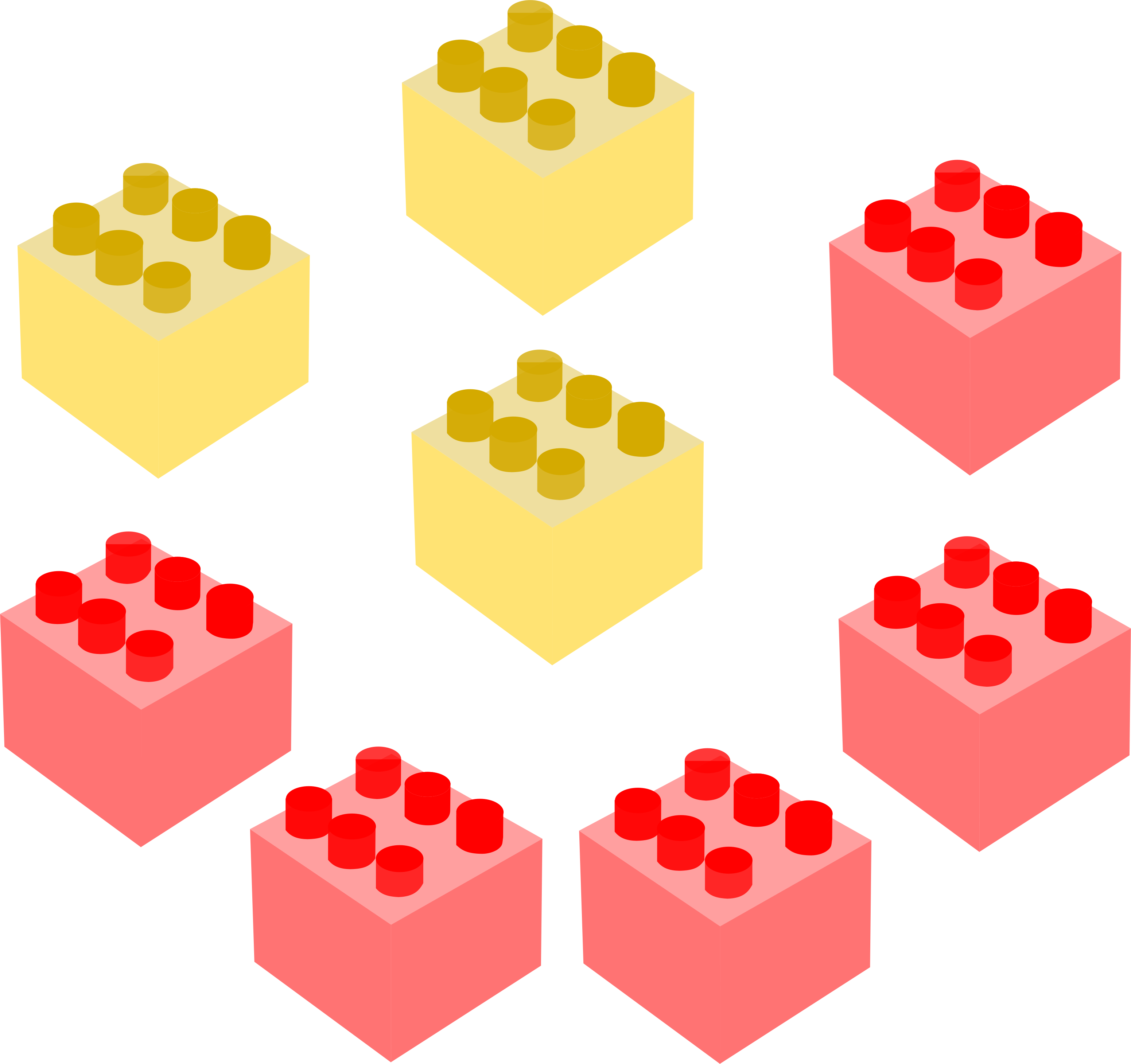
Express the number of red building bricks above as:
--- 1 WORK AREA LINES (style=lined) ---
--- 2 WORK AREA LINES (style=lined) ---

a. \(\dfrac{5}{8}\)
b. \(62.5\%\)
| a. \(\text{Fraction of total bricks}\) | \(=\dfrac{5}{8}\) |
| b. \(\text{Percentage of total bricks}\) | \(=\dfrac{5}{8}\times 100=\dfrac{125}{2}\) |
| \(=62.5\%\) |
Express the shaded area above as:
--- 1 WORK AREA LINES (style=lined) ---
a. \(\dfrac{2}{5}\)
b. \(40\%\)
| a. \(\text{Fraction of total area}\) | \(=\dfrac{4}{10}=\dfrac{2}{5}\) |
| b. \(\text{Percentage of total area}\) | \(=\dfrac{4}{10}\times 100=40\%\) |
Graham has a bag containing coloured marbles.
There are 5 blue marbles, 4 white marbles and 6 green marbles in the bag.
--- 3 WORK AREA LINES (style=lined) ---
a. \(33.\dot{3}\text{%}\)
b. \(50\text{%}\)
a. \(\text{Total marbles}\ =5+4+6=15\)
| \(\text{Percentage Blue}\) | \(=\dfrac{5}{15}\times 100\) |
| \(=33.33333…\text{%}\) | |
| \(=33.\dot{3}\text{%}\) |
b. \(\text{Total marbles after 3 removed}=12\)
| \(\text{Percentage Green}\) | \(=\dfrac{6}{12}\times 100\) |
| \(=50\text{%}\) |
Geordie achieved a mark of 31 out of 42 in his English essay.
Convert his mark to a percentage, correct to the nearest whole number. (2 marks)
\(74\text{%}\)
| \(\text{Conversion}\) | \(=\dfrac{31}{42}\times 100\) |
| \(=73.809…\text{%}\) | |
| \(\approx 74\text{%}\) |
The population of Australian states in 2015 and 2016 is recorded in the table below.
Some data for Western Australia is not shown.
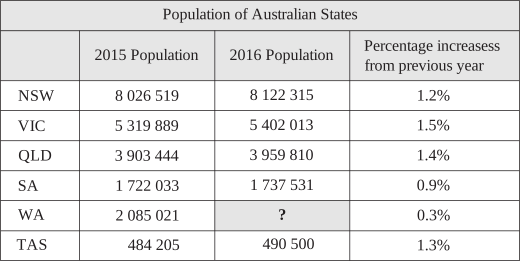
What was the population of Western Australia (WA) close to in 2016?
\(D\)
\(\text{Solution 1}\)
\(\text{WA Population in 2016}\)
\(= 2\ 085\ 021 + \Big(\dfrac{0.3}{100}\times 2\ 085\ 021\Big)=2\ 085\ 021 + 6255.063\)
\(=2\ 091\ 276.063\approx 2\ 091\ 300\)
\(\text{Solution 2 (Advanced)}\)
\(\text{WA Population in 2016}\)
\(=2\ 085\ 021\times 100.3\%= 2\ 085\ 021\times 1.003\)
\(\approx 2\ 091\ 300\)
\(\Rightarrow D\)
Max wanted to buy a squash racquet that cost $75.
He has saved $60.
How much extra does he need to save as a percentage of the cost price? (2 marks)
--- 2 WORK AREA LINES (style=lined) ---
\(20\%\)
| \(\text{Percentage}\) | \(=\dfrac{15}{75}\times 100=\dfrac{1}{5}\times 100\) |
| \(= 20\%\) |
\(\therefore\ \text{Max needs to save an extra 20%.}\)
A candy box contains 6 white chocolate bars and 11 dark chocolate bars.
About what percentage of the candy in the box are white chocolate bars? Give your answer to the nearest whole percentage. (2 marks)
\(35\text{%}\)
\(\text{Percentage of white chocolate bars}\)
\(=\dfrac{6}{17}\times 100\)
\(=35.294….\text{%}\)
\(\approx 35\text{% (nearest %)}\)
There were only 17 students in Grace's class on Wednesday. The other 8 were absent.
What percentage of Grace's class was absent?
\(C\)
\(\text{Total in class}= 17 + 8= 25\)
\(\therefore\ \text{Percentage absent}\)
\(=\dfrac{8}{25}\times 100= 32\%\)
\(\Rightarrow C\)
In a water polo season, Vladimir had 330 shots at goal.
He scored 170 goals but missed the rest.
Vladimir's success rate of scoring goals was?
\(C\)
| \(\text{Success rate}\) | \(=\dfrac{170}{330}\) |
| \(=0.515…\) | |
| \(=52\text{%}\) |
\(\therefore\ \text{His succes rate is more than 50% but less than 75%.}\)
\(\Rightarrow C\)
Ricky wants to buy a cricket bat that has a normal price of $160.
He is given a 15% discount.
What is the value of the discount? (2 marks)
--- 4 WORK AREA LINES (style=lined) ---
\($24\)
\(\text{Value of the discount}\)
\(10\text{% of }160 = 16\)
\(\therefore\ 5\text{% of }160=8\)
\(\therefore\ 15\text{% of }160=16 + 8 =24\)
\(\therefore\ \text{The value of the discount was }$24.\)
Hoon's camera has a memory card that holds 20 gigabytes.
He has used exactly 16 gigabytes of memory.
What percentage of the memory has not been used?
\(B\)
| \(\text{Memory left}\) | \(= 20-16\) |
| \(= 4\ \text{GB}\) |
\(\therefore\ \text{Percentage not used}\)
\(=\dfrac{4}{20}\)
\(= 20\text{%}\)
\(\Rightarrow B\)
Zoey scored 88% on her Geography exam.
If she achieved the same mark on her French exam, which of these could have been her mark?
\(D\)
| \(88\text{%}\) | \(=\dfrac{88}{100}\) |
| \(=\dfrac{44}{50}\) |
\(\Rightarrow D\)
Santana is buying a guitar string.
Some of the strings are on sale.
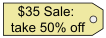
Select the string that will be cheapest.
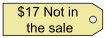
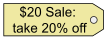
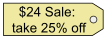
| A. | B. | C. | D. |
\(C\)
\(\text{C}\text{ost of each option:}\)
\(\text{A. }$17\)
\(\text{B. }$35\ \text{less }50\text{%} = $17.50\)
\(\text{C. }$20\ \text{less }20\text{%} = 20-4 = $16\)
\(\text{D. }$24\ \text{less } 25\text{%} = 24-6 = $18\)
\(\therefore\ \text{Sale: take }20\text{% off is the cheapest string.}\)
\(\Rightarrow C\)
A local soccer club has 1600 fans.
At a game, one-quarter of the fans wear a yellow jersey and the rest wear red.
25% of the red jerseys have a black stripe down the back.
How many red jerseys have a black stripe? (2 marks)
--- 5 WORK AREA LINES (style=lined) ---
\(300\)
| \(\text{Total red jerseys}\) | \(=75\text{%}\times 1600\) |
| \(=\dfrac{3}{4}\times 1600=1200\) |
| \(\therefore\ \text{Red jerseys with black stripe}\) |
| \(=0.25\times 1200=300\) |
Marty and Paul swam 3 kilometres in an ocean swimming race.
Marty finished in a time of 1 hour and 10 minutes.
Paul took 25% longer than Marty.
How long did Paul take to finish the race? (2 marks)
\(87.5\ \text{minutes}\)
\(\text{Solution 1}\)
| \(\text{Paul’s time}\) | \(=1\ \text{hour and 10 minutes}+(25\%\times 1\ \text{hour and 10 minutes})\) |
| \(=70+17.5\) | |
| \(=87.5\ \text{minutes}\) |
\(\text{Solution 2 (Advanced)}\)
\(\text{Paul’s time}\)
\(= (1\ \text{hour and 10 minutes})\times 125\%\)
\(= 70\times 1.25\)
\(= 87.5\ \text{minutes}\)
\(\therefore\ \text{Paul took 87.5 minutes to complete the race.}\)
Jake bought a mobile phone at 25% off the original price.
The original price was $380.
How much did Jake pay for the mobile phone? (2 marks)
--- 3 WORK AREA LINES (style=lined) ---
\($285\)
\(\text{Solution 1}\)
| \(\text{Price of mobile}\) | \(=380-(25\%\times 380)=380-95\) |
| \(=$285\) |
\(\text{Solution 2 (Advanced)}\)
| \(\text{Price of mobile}\) | \(=0.75\times 380=$285\) |
A hockey stick is on sale, reduced from $220 to $165.
What percentage discount has been applied? (2 marks)
\(25\text{%}\)
| \(\text{Discount}\) | \(=\dfrac{\text{reduction}}{\text{original price}}\times 100\) |
| \(=\dfrac{220-165}{220}\times 100\) | |
| \(=25\text{%}\) |
Richard bought a second hand snowboard at a cost of $390.
Richard had to spend 65% of his savings to buy the snowboard.
How much did Richard have in his savings after buying the snowboard? (2 marks)
\($210\)
| \(65\text{%}\times \text{Savings}\) | \(= $390\) |
| \(\therefore\ \text{Savings}\) | \(=\dfrac{390}{0.65}= $600\) |
| \(\therefore\ \text{Savings left}\) | \(= 600-390= $210\) |
Harrison was saving his money to buy a cricket bat.
After 1 month, he had saved 45% of the bat's cost.
After 2 months, he had saved another $90 and now had 75% of the bat's cost.
How much does the bat cost? (2 marks)
--- 4 WORK AREA LINES (style=lined) ---
\($300\)
| \(75\%-45\%\) | \(= $90\) |
| \(30\%\) | \(= $90\) |
| \(\therefore\ 1\%\) | \(= $3\) |
| \(\therefore\ \text{The bat cost}\) | \(= 100\times 3= $300\) |
Michael purchases a 3D printer worth $2 490 000.
He was given a 10% discount.
What was the price paid by Michael after the discount? (2 marks)
--- 5 WORK AREA LINES (style=lined) ---
\($2\ 241\ 000\)
\(\text{Solution 1}\)
| \(\text{Discount}\) | \(= 10\text{%}\times 2\ 490\ 000\) |
| \(= $249\ 000\) |
| \(\therefore\ \text{Discounted Price}\) | \(= 2\ 490\ 000-249\ 000\) |
| \(= $ 2\ 241\ 000\) |
\(\text{Solution 2 (Advanced)}\)
| \(\text{Discounted Price}\) | \(= 90\%\times 2\ 490\ 000=0.9\times 2\ 490\ 000\) |
| \(= $ 2\ 241\ 000\) |
A box of golf balls normally cost $19.50.
During a sale, the golf shop took 10% off the regular price of the balls.
What is the new sale price of the golf balls? (2 marks)
--- 3 WORK AREA LINES (style=lined) ---
\($17.55\)
| \(10\text{% discount}\) | \(=\dfrac{19.50}{10}= $1.95\) |
| \(\therefore\ \text{Sale price}\) | \(= $19.50-$1.95= $17.55\) |
Don buys a cricket ball, originally marked $30, that is discounted by 25%.
He also has a loyalty card that gives him another 20% off the sale price.
What is the final cost of the ball? (2 marks)
--- 5 WORK AREA LINES (style=lined) ---
\($18\)
\(\text{Solution 1}\)
| \(\text{Sale price}\) | \(= 30-(25\%\times 30)30-7.50= $22.50\) |
| \(\therefore\ \text{Final cost}\) | \(= 22.50-(20\%\times 22.50=22.50-4.50)\) |
| \(= $18\) |
\(\text{Solution 2 (Advanced)}\)
| \(\text{Final cost}\) | \(= 30\times 0.75\times 0.8= $18\) |
Walker is doing an intensive swim program over the summer holidays.
In his first session, he swims 50 laps.
In his second session, he swims 30% more laps than his first session.
In his third session, he swims 20% more laps than his second session.
How many laps does he swim at his third practice? (2 marks)
--- 5 WORK AREA LINES (style=lined) ---
\(78\ \text{laps}\)
\(\text{1st session} = 50\ \text{laps}\)
| \(\text{2nd session}\) | \(= 50 + (30\text{%}\times 50)\) |
| \(= 50 + 15\) | |
| \(= 65\ \text{laps}\) |
| \(\text{3rd session}\) | \(= 65 + (20\text{%}\times 65)\) |
| \(= 65 + 13\) | |
| \(= 78\ \text{laps}\) |
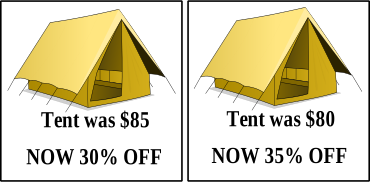
A sport store has a sale.
What is the difference in the sale prices of these two tents? (2 marks)
--- 5 WORK AREA LINES (style=lined) ---
\($7.50\)
| \(\text{Price of tent 1}\) | \(= 85-30\%\times 85\) |
| \(= 85-25.5\) | |
| \(= $59.50\) | |
| \(\text{Price of tent 2}\) | \(= 80-35\%\times 80\) |
| \(= 80-28.0\) | |
| \(= $52.00\) |
| \(\therefore\ \text{Price difference}\) | \(= 59.50-52\) |
| \(= $7.50\) |
Mary has 60 books and splits them into four categories.
This table shows the percentage of each category.
| Book Category | Percentage |
| Textbooks | 35% |
| Sport | 30% |
| Fiction | 20% |
| Travel | 15% |
How many sport books does Mary have? (2 marks)
\(18\)
\(\text{30% of 60 books are sport books.}\)
| \(\therefore\ \text{Number of sport books}\) | \(= 30\text{%}\times 60\) |
| \(=\dfrac{3}{10}\times 60\) | |
| \(= 18\text{ books}\) |
A scholarship fund of $1 000 000 is allocated between three scholarships as shown in the table below.
| Percentage of $1 million | |
| Academic Scholarship | 40% |
| Sport Scholarship | 30% |
| Hardship Scholarship | 30% |
150 students were given a Hardship Scholarship.
How much did each Hardship Scholarship winner receive? (2 marks)
--- 5 WORK AREA LINES (style=lined) ---
\($2000\)
\(\text{Hardship Scholarship Funds}\)
\(= 30\text{%}\times 1\ 000\ 000\)
\(= $300\ 000\)
\(\therefore\ \text{Amount each winner received}\)
\(= \dfrac{300\ 000}{150}\)
\(= $2000\)
Albert has 50 marbles in his bag.
He records the colour of each marble in the table below.
| Marble | Number of Marbles |
| Blue | 20 |
| Red | 12 |
| Orange | 4 |
| White | ? |
| TOTAL | 50 |
What percentage of the marbles are white? (2 marks)
--- 4 WORK AREA LINES (style=lined) ---
\(28\%\)
\(\text{Number of white marbles}\)
\(= 50-(20 + 12 + 4)= 14\)
| \(\therefore\ \text{% white}\) | \(=\dfrac{14}{50}\times 100= 28\%\) |
The table below lists the original price and the amount of discount of a pair of jeans at four different shops.
| JEANS SALE | ||
| Shop | Original price | Discount |
| A. | \($20\) | \(25\%\) |
| B. | \($21\) | \(\dfrac{1}{3}\) |
| C. | \($18\) | \(20\%\) |
| D. | \($17\) | \($2\text{ off}\) |
Which shop has the lowest sale price for the jeans?
\(B\)
\(\text{Consider the sale price at each shop:}\)
| \(\text{A}\) | \(= 20-(25\%\times 20) = $15\) |
| \(\text{B}\) | \(= 21-(1/3\times 21) = $14\) |
| \(\text{C}\) | \(= 18-(20 \text{%}\times 18) = $14.40\) |
| \(\text{D}\) | \(= 17-2 = $15\) |
\(\Rightarrow B\)
Which percentage has the same value as \(\dfrac{32}{50}\)?
\(A\)
\(\text{Converting to a percentage:}\)
\(\dfrac{32}{50} = \dfrac{64}{100} = 64\%\)
\(\Rightarrow A\)
A class of 28 students is surveyed. 21 students said they owned a mobile phone.
What percentage of the students surveyed owned a mobile phone? (2 marks)
\(75\%\)
| \(\text{Percentage}\) | \(=\dfrac{21}{28}\times 100=\dfrac{3}{4}\times 100= 75\%\) |
Gary is painting his house over 3 days.
In order to finish, what percentage of the house does Gary need to paint on the third day? (2 marks)
--- 5 WORK AREA LINES (style=lined) ---
\(25\%\)
| \(\text{Fraction painted}\) | \(=\dfrac{1}{3}+\dfrac{5}{12}=\dfrac{4 + 5}{12}\) |
| \(=\dfrac{9}{12}=\dfrac{3}{4}=75\%\) |
\(\therefore\ 25\text{% needs to be painted on the third day.}\)
Find:
--- 2 WORK AREA LINES (style=lined) ---
--- 3 WORK AREA LINES (style=lined) ---
a. \($0.29\)
b. \(45\ \text{kg}\)
c. \(110\ \text{km}\)
| a. \(1\%\ \text{of}\ $14.50\) | \(=$0.145\) |
| \(\therefore\ 2\%\ \text{of}\ $14.50\) | \(=2\times $0.145=$0.29\) |
| b. \(15\%\ \text{of}\ 300\text{ kg}\) | |
| \(10\text{% of }\ 300\ \text{kg}\) | \(=30\ \text{kg}\) |
| \(\therefore\ 5\text{% of }\ 300\ \text{kg}\) | \(=15\ \text{kg}\) |
| \(\therefore\ 15\text{% of }\ 300\ \text{kg}\) | \(=30+15=45\ \text{kg}\) |
| c. \(12\dfrac{1}{2}\text{% of}\ 880\ \text{km}\) | |
| \(25\text{% of}\ 880\ \text{km}\) | \(=220\ \text{km}\) |
| \(\therefore\ 12\dfrac{1}{2}\text{% of}\ 880\ \text{km}\) | \(=110\ \text{km}\) |
Find:
--- 2 WORK AREA LINES (style=lined) ---
a. \($32.50\)
b. \(360\text{ kg}\)
c. \(375\text{ km}\)
| a. \(10\text{% of}\ $325\) | \(=\dfrac{10}{100}\times 325=\dfrac{1}{10}\times 325\) |
| \(=$32.50\) |
| b. \(30\text{% of }1200\text{ kg}\) | \(=\dfrac{30}{100}\times 1200=30\times 12\) |
| \(=360\ \text{kg}\) |
| c. \(75\text{% of}\ 500\) | \(=\dfrac{75}{100}\times 500=75\times 5\) |
| \(=375\ \text{km}\) |
Brittany is an apprentice hair dresser who works 8 hours per day.
Yesterday she spent her time in the following way.
The rest of Brittany's day was spent restocking the shelves with new products.
What percentage of Brittany's day was spent restocking shelves? (2 marks)
\(35\text{%}\)
| \(\text{Percentage of day restocking shelves}\) | \(=1-(0.42+0.18+0.05)\) |
| \(=1-0.65=0.35=35\text{%}\) |
\(\therefore\ \text{Brittany spent 35% of her day restocking shelves.}\)
The breakdown of Joanna's weekly spending is shown in the sector graph below.
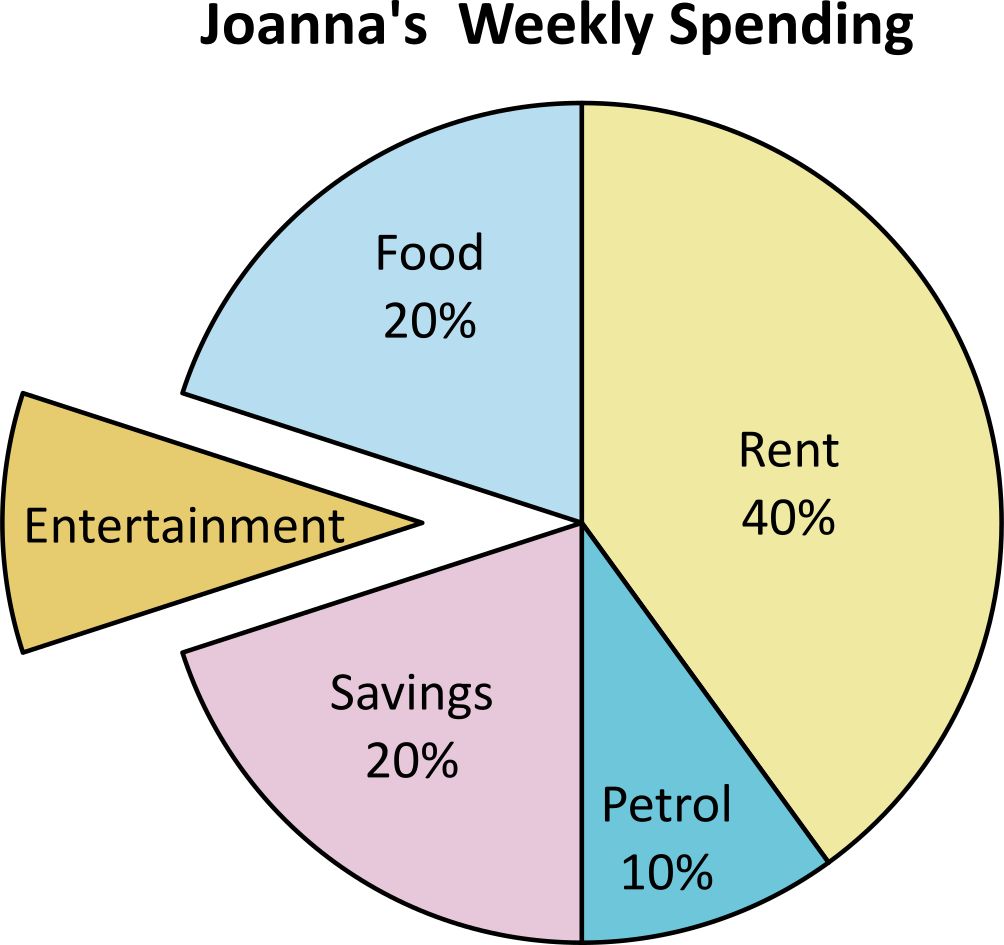
What percentage of Joanna's weekly spending was on entertainment? (2 marks)
\(10\text{%}\)
| \(\text{Percentage spent on Entertainment}\) | \(=100-(20+40+10+20)\) |
| \(=10\text{%}\) |
\(\therefore\ \text{Joanna spent } 10\text{% on Entertainment.}\)
Convert the following decimals to percentages.
--- 1 WORK AREA LINES (style=lined) ---
a. \(83\%\)
b. \(70\%\)
c. \(3\%\)
d. \(145\%\)
| a. \(0.83\) | \(=0.83\times 100=83\%\) |
| b. \(0.7\) | \(=0.7\times 100=70\%\) |
| c. \(0.03\) | \(=0.03\times 100=3\%\) |
| d. \(1.45\) | \(=1.45\times 100=145\%\) |
Convert the following percentages to fractions in simplest form.
--- 1 WORK AREA LINES (style=lined) ---
a. \(\dfrac{89}{100}\)
b. \(\dfrac{11}{20}\)
c. \(1\ \dfrac{16}{25}\)
d. \(3\ \dfrac{17}{20}\)
| a. \(89\%\) | \(=\dfrac{89}{100}\) |
| b. \(55\%\) | \(=\dfrac{55}{100}=\dfrac{11}{20}\) |
| c. \(164\%\) | \(=\dfrac{164}{100}=1\dfrac{64}{100}=1\dfrac{16}{25}\) |
| d. \(385\%\) | \(=\dfrac{385}{100}=3 \dfrac{85}{100}=3\ \dfrac{17}{20}\) |