SmarterEd

Aussie Maths & Science Teachers: Save your time with SmarterEd

  • Login
  • Get Help
  • About

v1 Algebra, STD2 A4 2009 HSC 28c

The brightness of a lamp \((L)\) is measured in lumens and varies directly with the square of the voltage \((V)\) applied, which is measured in volts.

When the lamp runs at 7 volts, it produces 735 lumens.

What voltage is required for the lamp to produce 1820 lumens? Give your answer correct to one decimal place.   (3 marks)

--- 6 WORK AREA LINES (style=lined) ---
Show Answers Only

 `11.2\ \text(volts)`

Show Worked Solution
♦♦ Mean mark 22%
TIP: Establishing `L=k V^2` is the key part of solving this question.

`L prop V^2\ \ => \ \ L=kV^2`

`text(Find)\ k\ \text{given}\ L = 735\ \text{when}\ V = 7:`

`735` `= k xx 7^2`
`:. k` `= 735/49=15`

 
`text(Find)\ V\ text(when)\ L = 1820:`

`1820` `= 15 xx V^2`
`V^2` `= 1820/15=121.33…`
`V` `= sqrt{121.33} = 11.2\ text(volts)\ \ text{(to 1 d.p.)}`

Filed Under: Non-Linear: Exponential/Quadratics (Std 2-X) Tagged With: Band 5, num-title-ct-patha, num-title-qs-hsc, smc-4239-40-a prop other, smc-830-20-Quadratics, smc-830-60-Proportional

v1 Algebra, STD2 A4 2019 HSC 33

The time taken for a student to type an assignment varies inversely with their typing speed.

It takes the student 180 minutes to finish the assignment when typing at 40 words per minute.

  1. Calculate the length of the assignment in words.   (1 mark)

    --- 5 WORK AREA LINES (style=lined) ---

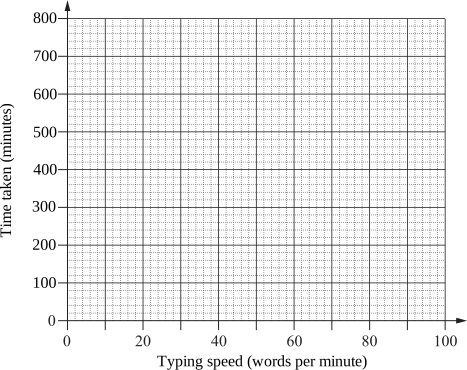
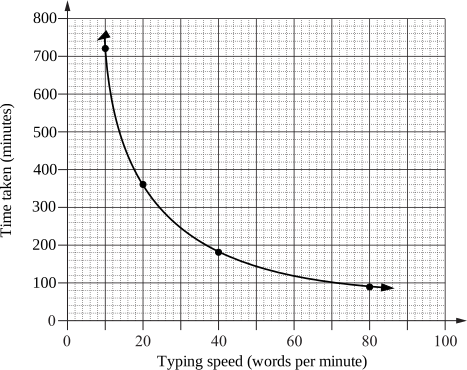
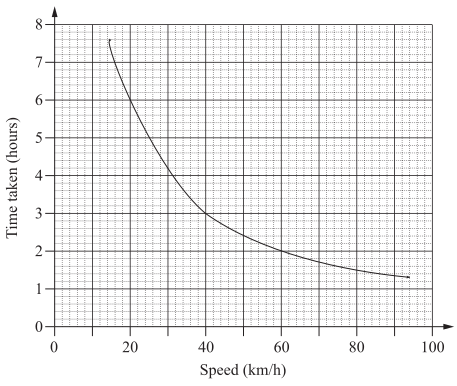
  2. By first plotting four points, draw the curve that shows the time taken to complete the assignment at different constant typing speeds.   (3 marks)


--- 0 WORK AREA LINES (style=lined) ---

Show Answers Only

a.   `7200\ text(words)`

b.   
     

Show Worked Solution

a.   `text{Assignment length}\ = 180 xx 40=7200\ \text{words}`

b.   `text{Time} (T) prop 1/{\text{Typing speed}\ (S)} \ \ =>\ \ T = k/S`
 

\begin{array} {|c|c|c|c|c|}
\hline
\rule{0pt}{2.5ex} \ \ T\ \  \rule[-1ex]{0pt}{0pt} & 720 & 360 & 180 & 90 \\
\hline
\rule{0pt}{2.5ex} S \rule[-1ex]{0pt}{0pt} & 10 & 20 & 40 & 80 \\
\hline
\end{array}

Filed Under: Non-Linear: Inverse and Other Problems (Std 2-X) Tagged With: Band 3, Band 4, num-title-ct-patha, num-title-qs-hsc, smc-4239-30-a prop 1/b, smc-795-10-Inverse

v1 Algebra, STD2 A4 2011 HSC 28a

The intensity of light, `I`, from a lamp varies inversely with the square of the distance, `d`, from the lamp.

  1. Write an equation relating `I`, `d` and `k`, where `k` is a constant.    (1 mark)

    --- 2 WORK AREA LINES (style=lined) ---

  2. It is known that `I = 20` when `d = 2`.


    By finding the value of the constant, `k`, find the value of `I` when `d = 5`.    (2 marks)

    --- 4 WORK AREA LINES (style=lined) ---

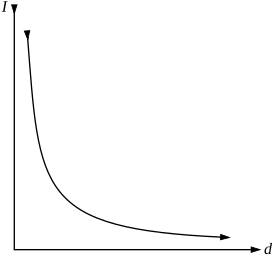
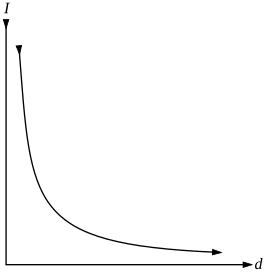
  3. Sketch a graph to show how `I` varies for different values of `d`.


    Use the horizontal axis to represent distance and the vertical axis to represent light intensity.   (2 marks)

    --- 8 WORK AREA LINES (style=lined) ---


Show Answers Only

a.   `I = k/d^2`

b.   `P = 1 1/2`

c.   
         

Show Worked Solution

a.   `I prop 1/d\ \ =>\ \ I=k/d^2`
 

b.  `text(When)\ I=20, d=2:`

`20` `= k/2^2`
`k` `=4 xx 20=80`

 
`text(Find)\ I\ text(when)\ d = 5:`

`I=80/5^2=16/5`
 

c.

Filed Under: Non-Linear: Inverse and Other Problems (Std 2-X) Tagged With: Band 5, num-title-ct-patha, num-title-qs-hsc, smc-4239-30-a prop 1/b, smc-795-10-Inverse, smc-795-40-Proportional

v1 Algebra, STD2 A4 2007 HSC 15 MC

If the speed `(s)` of a journey varies inversely with the time `(t)` taken, which formula correctly expresses `s` in terms of `t` and `k`, where `k` is a constant?

  1. `s = k/t`
  2. `s = kt`
  3. `s = k + t`
  4. `s = t/k`
Show Answers Only

`A`

Show Worked Solution

`s prop 1/t \ \ => \ s = k/t`

`=>  A`

Filed Under: Non-Linear: Inverse and Other Problems (Std 2-X) Tagged With: Band 4, num-title-ct-patha, num-title-qs-hsc, smc-4239-30-a prop 1/b, smc-795-10-Inverse, smc-795-40-Proportional

v1 Algebra, STD2 A4 2010 HSC 13 MC

The time taken to charge a battery varies inversely with the charging voltage. At 24 volts \((V)\) it takes 15 hours to fully charge a battery.

How long will it take the same battery to fully charge at 40 volts?

  1. 8 hours
  2. 9 hours
  3. 10.5 hours
  4. 12 hours
Show Answers Only

`B`

Show Worked Solution
 
♦ Mean mark 50% 

`text{Time to charge}\ (T) prop 1/text(Voltage) \ => \ T=k/V`

`text(When) \ T=15, V = 24:`

`15=k/24\ \ => \ k=15 xx 24=360` 
   

`text{Find}\ T\ text{when}\ \ V= 40:}`

`T=360/40=9\ \text{hours}`

 `=>  B`

Filed Under: Non-Linear: Inverse and Other Problems (Std 2-X) Tagged With: Band 5, num-title-ct-patha, num-title-qs-hsc, smc-4239-30-a prop 1/b, smc-795-10-Inverse, smc-795-40-Proportional

Circle Geometry, SMB-008

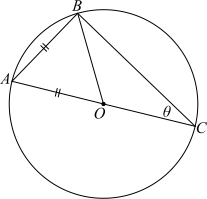
In the diagram, \(AC\) is a diameter of the circle centred at \(O\), and \(OA = AB\).
 

Find the value of \(\theta\).   (3 marks)   

--- 5 WORK AREA LINES (style=lined) ---

Show Answers Only

\(\theta = 30^{\circ}\)

Show Worked Solution

\(\angle ABC=90^{\circ}\ \ \text{(angle in semi-circle)}\)

\(OA=OB\ \ \text{(radii)} \)

\( \angle OAB=60^{\circ}\ \ ( \Delta OAB\ \text{is equilateral}) \)

\(\theta\) \(= 180-(90+60)\ \ (180^{\circ}\ \text{in}\ \Delta) \)  
  \(= 30^{\circ} \)  

Filed Under: Circle Geometry Tagged With: num-title-ct-patha, smc-4240-10-Angles on arcs

Cicle Geometry, SMB-007

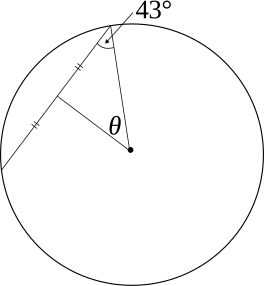
In the diagram, a line from the centre of the circle meets a chord at its midpoint.

Find the value of \(\theta\).  (2 marks) 
  

Show Answers Only

\(\theta = 47^{\circ}\)

Show Worked Solution

\(\text{Line from centre bisects chord}\ \ \Rightarrow\ \ \text{Line is ⊥ to chord}\)

\(\theta\) \(= 180-(90+43)\ \ (180^{\circ}\ \text{in}\ \Delta) \)  
  \(= 47^{\circ} \)  

Filed Under: Circle Geometry Tagged With: num-title-ct-patha, smc-4240-50-Chord properties

Circle Geometry, SMB-006

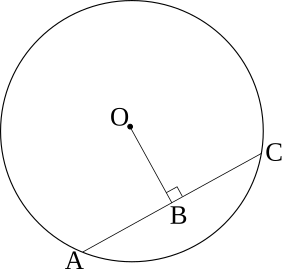
In the circle centred at \(O\), the chord \(AC\) has length 15 and \(OB\) meets the chord \(AC\) at right angles.

Find the length of \(BC\).  (1 mark) 
  

Show Answers Only

\(BC = 7.5\)

Show Worked Solution
\(BC\) \(= \dfrac{1}{2} \times 15\ \ \text{(perpendicular from centre to chord bisects chord)}\)  
  \(= 7.5 \)  

Filed Under: Circle Geometry Tagged With: num-title-ct-patha, smc-4240-50-Chord properties

Circle Geometry, SMB-005

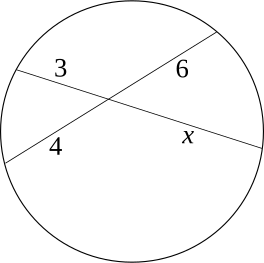
In the diagram, two chords of a circle intersect. 

Find \(x\).  (2 marks) 
  

Show Answers Only

\(x=8\)

Show Worked Solution
\(3 \times x\) \(=6 \times 4\ \ \text{(intercepts of intersecting chords)}\)  
\(x\) \(= \dfrac{24}{3} \)  
  \(=8\)  

Filed Under: Circle Geometry Tagged With: num-title-ct-patha, smc-4240-50-Chord properties

Circle Geometry, SMB-004

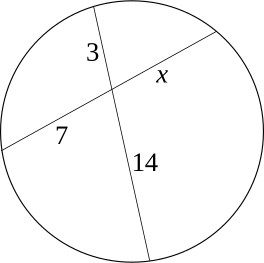
In the diagram, two chords of a circle intersect. 

Find \(x\).  (2 marks) 
  

Show Answers Only

\(x=6\)

Show Worked Solution
\(7 \times x\) \(=3 \times 14\ \ \text{(intercepts of intersecting chords)}\)  
\(x\) \(= \dfrac{42}{7} \)  
  \(=6\)  

Filed Under: Circle Geometry Tagged With: num-title-ct-patha, smc-4240-50-Chord properties

Circle Geometry, SMB-003

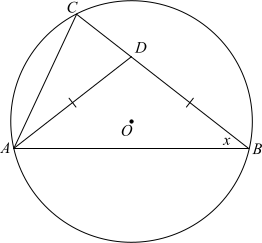
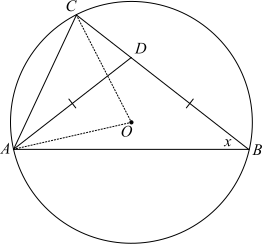
In the diagram, the vertices of  \(\Delta ABC\)  lie on the circle with centre \(O\). The point \(D\) lies on \(BC\) such that \(\Delta ABD\) is isosceles and \(\angle ABC = x\).

Explain why \(\angle AOC =2x\).   (2 marks)

--- 4 WORK AREA LINES (style=lined) ---

Show Answers Only

\(\text{See Worked Solutions}\)

Show Worked Solution

\(\text{Angles at circumference and centre are both on arc}\ AC\)

\(\therefore \angle AOC = 2x\)

Filed Under: Circle Geometry Tagged With: num-title-ct-patha, smc-4240-10-Angles on arcs

Circle Geometry, SMB-002

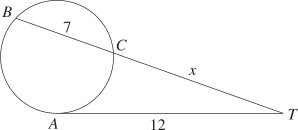
The line \(AT\) is the tangent to the circle at \(A\), and \(BT\) is a secant meeting the circle at \(B\) and \(C\).
  

Given that  \(AT = 12\),  \(BC = 7\)  and  \(CT = x\), find the value of \(x\).  (2 marks)

--- 5 WORK AREA LINES (style=lined) ---

Show Answers Only

\(x = 9\)

Show Worked Solution

\(\text{Property: square of tangent = product of secant intercepts}\)

\(AT^2\) \(= CT \times BT\)
\(12^2\) \(= x(x + 7)\)
\(144\) \(= x^2 + 7x\)
\(x^2 + 7x-144\) \(= 0\)
\((x + 16)(x-9)\) \(= 0\)


\(\therefore x = 9,\  (x \gt 0) \)

Filed Under: Circle Geometry Tagged With: num-title-ct-patha, smc-4240-55-Secants, smc-4240-60-Tangents

Circle Geometry, SMB-001

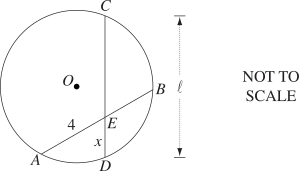
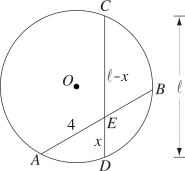
In the circle centred at \(O\) the chord \(AB\) has length 7. The point \(E\) lies on \(AB\) and \(AE\) has length 4. The chord \(CD\) passes through \(E\).

Let the length of \(CD\) be \(\ell\) and the length of \(DE\) be \(x\).

Show that  \(x^2-\ell x + 12 = 0\).  (2 marks)

--- 4 WORK AREA LINES (style=lined) ---

Show Answers Only

\(\text{See Worked Solutions}\)

Show Worked Solution

\(\text{Show}\ \ x^2-\ell x + 12 = 0\)


\(AB = 7 \ \ \Rightarrow \ EB=7-4=3\)

\(AE \times EB = ED \times CE\ \ \text{(intercepts of intersecting chords)}\)

\(4 \times 3\) \(= x(\ell-x)\)
\(12\) \(= x\ell-x^2\)
\(\therefore x^2-\ell x+12\) \(=0\)

Filed Under: Circle Geometry Tagged With: num-title-ct-patha, smc-4240-50-Chord properties

Rates of Change, SMB-010

Moses finds that for a Froghead eel, its mass is directly proportional to the square of its length.

An eel of this species has a length of 72 cm and a mass of 8250 grams.

What is the expected length of a Froghead eel with a mass of 10.2 kg? Give your answer to one decimal place.  (3 marks)

--- 6 WORK AREA LINES (style=lined) ---
Show Answers Only

`80.1\ text{cm}`

Show Worked Solution

`text(Mass) prop text(length)^2`

`m = kl^2`
  

`text(Find)\ k:`

`8250` `= k xx 72^2`
`k` `= 8250/72^2`
  `= 1.591…`

 
`text(When)\ \ l\ \ text(when)\ \ m = 10\ 200:`

`10\ 200` `= 1.591… xx l^2`
`l^2` `= (10\ 200)/(1.591…)`
`:. l` `= 80.058…`
  `= 80.1\ text{cm  (to 1 d.p.)}`

Filed Under: Variation and Rates of Change Tagged With: num-title-ct-patha, smc-4239-40-a prop other

Rates of Change, SMB-009

The number of trees that can be planted along the fence line of a paddock varies inversely with the distance between each tree.

There will be 108 trees if the distance between them is 5 metres.

  1. How many trees can be planted if the distance between them is 6 metres?  (2 marks)

    --- 4 WORK AREA LINES (style=lined) ---

  2. What is the distance between the trees if 120 trees are planted?  (1 mark)

    --- 2 WORK AREA LINES (style=lined) ---

Show Answers Only
  1. `90`
  2. `4.5\ text(metres)`
Show Worked Solution

i.   `t prop 1/d`

`t` `= k/d`
`108` `= k/5`
`k` `= 540`

 
`text(Find)\ t\ text(when)\ d = 6:`

`t` `= 540/6`
  `= 90`


ii.   `text(Find)\ d\ text(when)\ t = 120:`

`120` `= 540/d`
`d` `= 540/120`
  `= 4.5\ text(metres)`

Filed Under: Variation and Rates of Change Tagged With: num-title-ct-patha, smc-4239-30-a prop 1/b

Rates of Change, SMB-008

It is known that the quantity of steel produced in tonnes `(S)`, is directly proportional to the tonnes of iron ore used in the process `(I)`.

If 16 tonnes or iron ore produces 10 tonnes of steel, calculate the tonnes of iron ore required to produce 48 tonnes of steel.  (3 marks)

--- 6 WORK AREA LINES (style=lined) ---
Show Answers Only

`76.8\ text{tonnes}`

Show Worked Solutions

`S prop I\ \ =>\ \ S=kI`

`text(Find)\ k\ text{given}\ S=10\ text{when}\ I=16:`

`10` `=k xx 16`
`k` `=10/16`
  `=0.625`

 
`text{Find}\ I\ text{when}\ S=48:`

`48` `=0.625 xx I`
`:. I` `=48/0.625`
  `=76.8\ text{tonnes}`

Filed Under: Variation and Rates of Change Tagged With: num-title-ct-patha, smc-4239-10-a prop b

Rates of Change, SMB-007

It is known that a quantity `P` kgs is proportional to the reciprocal of another quantity `Q` kgs such that `P prop 1/Q`.

If  `P=12` when `Q=20`, calculate the estimated quantity of `Q` when `P=45` kgs, to the nearest gram.  (3 marks)

--- 6 WORK AREA LINES (style=lined) ---
Show Answers Only

`5333\ text{g}`

Show Worked Solutions

`P prop 1/Q\ \ =>\ \ P=k/Q`

`text(Find)\ k\ text{given}\ P=12\ text{when}\ Q=20:`

`12` `=k/20`
`:. k` `=12 xx 20`
  `=240`

 
`text{Find}\ Q\ text{when}\ P=45:`

`45` `=240/Q`
`:. Q` `=240/45`
  `=5.3333\ text{kg}`
  `=5333\ text{g}`

Filed Under: Variation and Rates of Change Tagged With: num-title-ct-patha, smc-4239-30-a prop 1/b

Rates of Change, SMB-006

The stopping distance of a car on a certain road, once the brakes are applied, is directly proportional to the square of the speed of the car when the brakes are first applied.

A car travelling at 70 km/h takes 58.8 metres to stop.

How far does it take to stop if it is travelling at 105 km/h?  (3 marks)

--- 6 WORK AREA LINES (style=lined) ---
Show Answers Only

`132.3\ text(metres)`

Show Worked Solution

`text(Let)\ \ d\ text(= stopping distance)`

`d prop s^2`

`d = ks^2`
 

`text(Find)\ k,`

`58.8` `= k xx 70^2`
`k` `= 58.8/(70^2)`
  `= 0.012`

 
`text(Find)\ d\ \ text(when)\ s = 105:`

`d` `= 0.012 xx 105^2`
  `= 132.3\ text(metres)`

Filed Under: Variation and Rates of Change Tagged With: num-title-ct-patha, smc-4239-40-a prop other

Rates of Change, SMB-005

Fuifui finds that for Giant moray eels, the mass of an eel `(M)` is directly proportional to the cube of its length `(l)`.

An eel of this species has a length of 15 cm and a mass of 675 grams.

What is the expected length of a Giant moray eel with a mass of 3.125 kg? Give your answer to one decimal place.  (3 marks)

--- 6 WORK AREA LINES (style=lined) ---
Show Answers Only

`25\ text{cm}`

Show Worked Solution

`M prop l^3`

`M = kl^3`
 

`text(Find)\ k:`

`675` `= k xx 15^3`
`k` `= 675/15^3`
  `= 0.2`

 
`text(Find)\ \ l\ \ text(when)\ \ M = 3125:`

`3125` `= 0.2 xx l^3`
`l^3` `= 3125/0.2`
`:. l` `= root3(15\ 625)`
  `= 25\ text{cm}`

Filed Under: Variation and Rates of Change Tagged With: num-title-ct-patha, smc-4239-40-a prop other

Rates of Change, SMB-004

Jacques is a marine biologist and finds that the mass of a crab `(M)` is directly proportional to the cube of the diameter of its shell `(d)`.

If a crab with a shell diameter of 15 cm weighs 680 grams, what will be the diameter of a crab that weighs 1.1 kilograms? Give your answer to 1 decimal place.  (3 marks)

--- 6 WORK AREA LINES (style=lined) ---
Show Answers Only

`17.6\ text(cm)`

Show Worked Solution
`M` `prop d^3`  
`M` `= kd^3`  

 
`text(When)\ \ M=680, \ d=15`

`680` `=k xx 15^3`  
`k` `=0.201481…`  

 
`text(Find)\ \ d\ \ text(when)\ \ M=1100:`

`1100` `=0.20148… xx d^3`  
`d` `=root3(1100/(0.20148…))`  
  `=17.608…`  
  `=17.6\ text{cm  (to 1 d.p.)}`  

Filed Under: Variation and Rates of Change Tagged With: num-title-ct-patha, smc-4239-40-a prop other

Rates of Change, SMB-003

The current of an electrical circuit, measured in amps (A), varies inversely with its resistance, measured in ohms (R).

When the resistance of a circuit is 28 ohms, the current is 3 amps.

What is the current when the resistance is 8 ohms? (2 marks)

--- 5 WORK AREA LINES (style=lined) ---
Show Answers Only

`10.5`

Show Worked Solution
`A` `prop 1/R`  
`A` `= k/R`  

 
`text(When)\ \ A=3, \ R=28`

`3` `=k/28`  
`k` `=84`  

 
`text(Find)\ \ A\ \ text(when)\ \ R=8:`

`A` `=84/8`  
  `=10.5`  

Filed Under: Variation and Rates of Change Tagged With: num-title-ct-patha, smc-4239-30-a prop 1/b

Rates of Change, SMB-002

It is known that at a constant speed, the distance travelled in kilometres `(d)` is directly proportional to the time of travel in hours `(t)`, or  `d prop t`.

  1. If `d=75` when `t=5`, calculate the constant of variation `k`.  (2 marks)

    --- 4 WORK AREA LINES (style=lined) ---
  2. In the context of this question, what does the value of `k` represent?  (1 mark)

    --- 2 WORK AREA LINES (style=lined) ---
Show Answers Only

i.    `k=15`

ii.   `text{Speed}`

Show Worked Solutions

i.    `d prop t`

`d=kt`

`text(Find)\ k\ text{given}\ d=75\ text{when}\ t=5:`

`75` `=k xx 5`
`:. k` `=75/5`
  `=15`

 
ii.
   `k\ text{represents the speed.}`

Filed Under: Variation and Rates of Change Tagged With: num-title-ct-patha, smc-4239-10-a prop b

Rates of Change, SMB-001

It is known that a quantity `y` is inversely proportional to another quantity `x`.

If  `y=3` when `x=1.8`, calculate the constant of variation `k`.  (2 marks)

--- 4 WORK AREA LINES (style=lined) ---
Show Answers Only

`k=5.4`

Show Worked Solutions

`y prop 1/x`

`y=k/x`

`text(Find)\ k\ text{given}\ y=3\ text{when}\ x=1.8:`

`3` `=k/1.8`
`:. k` `=3xx1.8`
  `=5.4`

Filed Under: Variation and Rates of Change Tagged With: num-title-ct-patha, smc-4239-30-a prop 1/b

Functions and Graphs, SMB-019

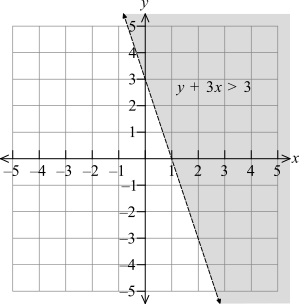
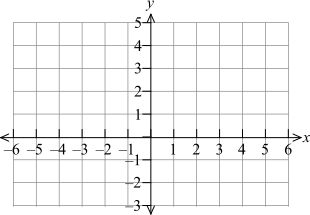
Shade the region defined by  `y+3x>3`  on the graph below and verify your result.  (3 marks)

--- 2 WORK AREA LINES (style=lined) ---
Show Answers Only

`text{Test}\ (0,0):`

`3(0)-4(0)<12\ \ =>\ \ 0<12\ \ text{(Incorrect – not in shaded area)}`

Show Worked Solution

`xtext{-intercept occurs when}\ y=0:`

`0+3x=3\ \ =>\ \ x=1`

`ytext{-intercept occurs when}\ x=0:`

`y+3(0)=3\ \ =>\ \ y=3`

`text{Test}\ (0,0):`

`0+3(0)>3\ \ =>\ \ 0>3\ \ text{(Incorrect – not in shaded area)}`

Filed Under: Functions and Other Graphs Tagged With: num-title-ct-patha, smc-4244-80-Linear inequalities

Functions and Graphs, SMB-018

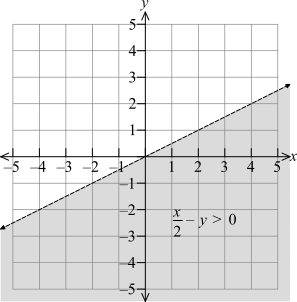
Shade the region defined by  `x/2-y>0`  on the graph below and verify your result.  (2 marks)

--- 2 WORK AREA LINES (style=lined) ---
Show Answers Only

`text{Test}\ (1,0):`

`1/2-0>0\ \ text{(correct)}`

Show Worked Solution

`xtext{-intercept occurs when}\ y=0:`

`x/2-0=0\ \ =>\ \ x=0`

`text{Graph cuts at}\ (0,0)`

`text{Also passes through}\ (2,1)`
 

`text{Test}\ (1,0):`

`1/2-0>0\ \ text{(Correct – in shaded area)}`

Filed Under: Functions and Other Graphs Tagged With: num-title-ct-patha, smc-4244-80-Linear inequalities

Functions and Graphs, SMB-017

  1. Express the function  `5y-3x=15`  in the form  `y=mx+b`.  (1 mark)

    --- 2 WORK AREA LINES (style=lined) ---
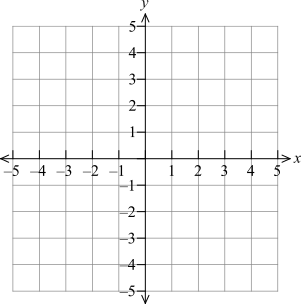
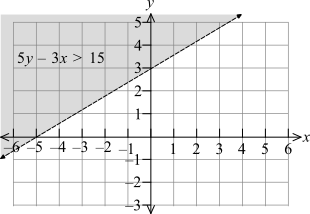
  2. Shade the region defined by  `5y-3x>15`  on the graph below and verify your result.  (3 marks)
      

    --- 2 WORK AREA LINES (style=lined) ---
Show Answers Only

i.    `y=3/5x+3`

ii.  

`text{Test}\ (0,0):`

`5(0)-3(0)>15\ \ =>\ \ 0<15\ \ text{(incorrect)}`

Show Worked Solution
i.     `5y-3x` `=15`
  `5y` `=3x+15`
  `y` `=3/5x+3`


ii.   `xtext{-intercept occurs when}\ y=0:`

`5(0)-3x=15\ \ =>\ \ x=-5`

`ytext{-intercept at}\ \ y=3`

`text{Test}\ (0,0):`

`5(0)-3(0)>15\ \ =>\ \ 0>15\ \ text{(Incorrect – not in shaded area.)}`

Filed Under: Functions and Other Graphs Tagged With: num-title-ct-patha, smc-4244-80-Linear inequalities

Functions and Graphs, SMB-016

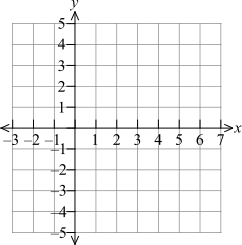
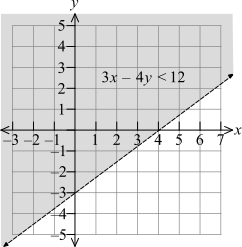
Shade the region defined by  `3x-4y<12`  on the graph below and verify your result.  (3 marks)


--- 2 WORK AREA LINES (style=lined) ---
Show Answers Only

`text{Test}\ (0,0):`

`3(0)-4(0)<12\ \ =>\ \ 0<12\ \ text{(correct)}`

Show Worked Solution

`xtext{-intercept occurs when}\ y=0:`

`3x-4(0)=12\ \ =>\ \ x=4`

`ytext{-intercept occurs when}\ x=0:`

`3(0)-4y=12\ \ =>\ \ y=-3`

`text{Test}\ (0,0):`

`3(0)-4(0)<12\ \ =>\ \ 0<12\ \ text{(Correct – is in shaded area)}`

Filed Under: Functions and Other Graphs Tagged With: num-title-ct-patha, smc-4244-80-Linear inequalities

Functions and Graphs, SMB-015

State the inequality that defines the domain of the function  `g(x) = 2/sqrt(5-x)` ?  (2 marks)

Show Answers Only

`text(Domain)\ g(x):\ \ x<5`

Show Worked Solution

`g(x) = 2/sqrt(5-x)\ \ text{exists for:}`

`5-x` `> 0\ \ \ (5-x!=0)`
`-x` `> -5`
`x` `<5`

 
`:.\ text(Domain)\ g(x):\ \ x<5`

Filed Under: Functions and Other Graphs Tagged With: num-title-ct-patha, smc-4244-10-Domain, smc-4244-70-Square root

Functions and Graphs, SMB-014

What is the domain of the function  `g(x) = log_2(x^2-3)`?  (2 marks)

Show Answers Only

`text{Domain:}\ x>sqrt3\ \ ∪\ \ x<-sqrt3`

Show Worked Solution

`g(x)\ text{exists when:}`

`x^2-3` `> 0`
`x^2` `> 3`

 
`x>sqrt3\ \ or\ \ x<-sqrt3`

`:.\ text{Domain:}\ x>sqrt3\ \ ∪\ \ x<-sqrt3`

Filed Under: Functions and Other Graphs Tagged With: num-title-ct-patha, smc-4244-10-Domain, smc-4244-75-Logarithm

Functions and Graphs, SMB-013

  1. Factorise the expression  `x^2-x-6`.  (1 mark)

    --- 1 WORK AREA LINES (style=lined) ---
  2. What is the domain of the function  `f(x) = log_2(x^2-x-6)`?  (2 marks)

    --- 4 WORK AREA LINES (style=lined) ---
Show Answers Only

i.    `x^2-x-6=(x-3)(x+2)`

ii.   `text{Domain:}\ x< -2 \ ∪ \ x>3`

Show Worked Solution

i.    `x^2-x-6=(x-3)(x+2)`
 

ii.    `f(x) = log_2(x^2-x-6)=log_2(x-3)(x+2)`

`f(x)\ text{exists when:}`

`(x-3)(x+2)>0`

`x< -2 and x>3`

`text{Domain:}\ x< -2 \ ∪ \ x>3`

Filed Under: Functions and Other Graphs Tagged With: num-title-ct-patha, smc-4244-10-Domain, smc-4244-75-Logarithm

Functions and Graphs, SMB-012

What is the domain of the function  `f(x) = log_10(3-2x)`?  (2 marks)

Show Answers Only

`text{Domain:}\ x<3/2`

Show Worked Solution

`f(x)\ text{exists when:}`

`3-2x` `> 0`
`-2x` `> -3`
`2x` `< 3`
`x` `< 3/2`

Filed Under: Functions and Other Graphs Tagged With: num-title-ct-patha, smc-4244-10-Domain, smc-4244-75-Logarithm

Functions and Graphs, SMB-011

What is the domain of the function  `g(x) = log_2(x+1)`?  (2 marks)

Show Answers Only

`text{Domain:}\ x> -1`

Show Worked Solution

`g(x)\ text{exists when:}`

`x+1` `> 0`
`x` `> -1`

Filed Under: Functions and Other Graphs Tagged With: num-title-ct-patha, smc-4244-10-Domain, smc-4244-75-Logarithm

Functions and Graphs, SMB-010

A function has the equation  `h(x)=-1-(x-3)^2`.

State the domain and range of `h(x)`.   (2 marks)

--- 4 WORK AREA LINES (style=lined) ---
Show Answers Only

`text{Domain}\ h(x):\ text{all}\ x`

`text{Range}\ h(x):\ y<=-1`

Show Worked Solution

`h(x)\ text{exists for all}\ x`

`text{Domain}\ h(x):\ text{all}\ x`
 

`text{Consider the function transformation:}`

`y=x^2\ text{translated 3 units right}\ \ =>\ \ y=(x-3)^2`

`y=(x-3)^2\ text{reflected in the}\ xtext{-axis}\ =>\ \ y=-(x-3)^2`

`y=-(x-3)^2\ text{translated 1 unit down}\ =>\ \ y=-1-(x-3)^2`

`:.\ text{Range}\ h(x): \ y<=-1`

Filed Under: Functions and Other Graphs Tagged With: num-title-ct-patha, smc-4244-10-Domain, smc-4244-20-Range, smc-4244-60-Quadratic

Functions and Graphs, SMB-009

A function has the equation  `f(x)=2x^2+1`.

State the range of `f(x)`.   (2 marks)

Show Answers Only

`text{Range}\ f(x): \ y>=1`

Show Worked Solution

`text{Consider the function transformation:}`

`y=2x^2\ text{translated 1 unit up}\ \ =>\ \ y=2x^2+1`

`(x^2>0\ text{for all}\ x)`

`:.\ text{Range}\ f(x): \ y>=1`

Filed Under: Functions and Other Graphs Tagged With: num-title-ct-patha, smc-4244-20-Range, smc-4244-60-Quadratic

Functions and Graphs, SMB-008

A function has the equation  `f(x)=4-(x+1)^2`.

State the domain and range of `f(x)`.   (3 marks)

Show Answers Only

`text{Domain}\ f(x): \ text{all}\ x`

`text{Range}\ f(x): \ y<=4`

Show Worked Solution

`f(x)\ text{exists for all}\ x`

`text{Domain}\ f(x): \ text{all}\ x`
 

`text{Consider the function transformation:}`

`y=x^2\ text{translated 1 unit left}\ =>\ \ y=(x+1)^2`

`y=(x+1)^2\ text{reflected in the}\ xtext{-axis}\ =>\ \ y=-(x+1)^2`

`y=-(x+1)^2\ text{translated 4 units up}\ \ =>\ \ y=4-(x+1)^2`

`:.\ text{Range}\ f(x): \ y<=4`

Filed Under: Functions and Other Graphs Tagged With: num-title-ct-patha, smc-4244-10-Domain, smc-4244-20-Range, smc-4244-60-Quadratic

Functions and Graphs, SMB-007

A function has the equation  `g(x)=x^2-1`.

State the range of `g(x)`.   (2 marks)

Show Answers Only

`text{Range}\ g(x): \ y>=-1`

Show Worked Solution

`text{Consider the function transformation:}`

`y=x^2\ text{translated 1 unit down}\ \ =>\ \ y=x^2-1`

`:.\ text{Range}\ g(x): \ y>=-1`

Filed Under: Functions and Other Graphs Tagged With: num-title-ct-patha, smc-4244-20-Range, smc-4244-60-Quadratic

Functions and Graphs, SMB-006

State the domain of the function  `f(x) = x^2 + log_10(x)`.  (2 marks)

Show Answers Only

`x>0`

Show Worked Solution

`f(x) = x^2 + log_10(x)`

`x^2 \ text(is defined for all)\ x`

`log_10 x \ text(is defined for)\ \ x > 0`

`:. \ text(Domain)\ f(x):  x>0`

Filed Under: Functions and Other Graphs Tagged With: num-title-ct-patha, smc-4244-10-Domain, smc-4244-75-Logarithm

Functions and Graphs, SMB-005 MC

The domain of the function  `f (x) = log_2 (2x + 1)`  is

  1. `-1/2<x<0`
  2. `text{All}\ x`
  3. `x> -1/2`
  4. `– oo<x<-1/2`
Show Answers Only

`C`

Show Worked Solution

`text(Domain exists for:)`

`2x + 1` `> 0`
`2x` `> -1`
`x` `> -1/2`

 
`=>   C`

Filed Under: Functions and Other Graphs Tagged With: num-title-ct-patha, smc-4244-10-Domain, smc-4244-75-Logarithm

Functions and Graphs, SMB-004 MC

What is the domain of the function  `f(x) = log_10(4-x)`?

  1. `x < 4`
  2. `x <= 4`
  3. `x > 4`
  4. `x >= 4`
Show Answers Only

`A`

Show Worked Solution
`4-x` `> 0`
`-x` `> -4`
`x` `< 4`

 
`=>  A`

Filed Under: Functions and Other Graphs Tagged With: num-title-ct-patha, smc-4244-10-Domain, smc-4244-75-Logarithm

Functions and Graphs, SMB-003

State the domain and range of  `y = -sqrt(12-x^2)`.   (2 marks)

--- 5 WORK AREA LINES (style=lined) ---
Show Answers Only

`text(Domain:)\ -sqrt12<=x<= sqrt12`

`text(Range:)\ -sqrt12<=y<= 0`

Show Worked Solution

`y = -sqrt(12-x^2)`

`12-x^2>=0\ \ =>\ \ x^2<=12`

`:.\ text(Domain:)\ -sqrt12<=x<= sqrt12`
 

`y_max =0`

`y_min = -sqrt12\ \ (text{when}\ x=0)`

`:.\ text(Range:)\ -sqrt12<=y<= 0`

Filed Under: Functions and Other Graphs Tagged With: num-title-ct-patha, smc-4244-10-Domain, smc-4244-20-Range, smc-4244-70-Square root

Functions and Graphs, SMB-002

A function has the equation  `f(x)=(x-2)^2-5`.

State the range of `f(x)`.   (2 marks)

Show Answers Only

`text{Range}\ f(x): \ y>=-5`

Show Worked Solution

`text{Consider the function transformation:}`

`y=x^2\ \ text{translated 2 units to the right}\ \ =>\ \ y=(x-2)^2`

`y=(x-2)^2\ text{translated 5 units down}\ \ =>\ \ y=(x-2)^2-5`

`:.\ text{Range}\ f(x): \ y>=-5`

Filed Under: Functions and Other Graphs Tagged With: num-title-ct-patha, smc-4244-20-Range, smc-4244-60-Quadratic

Functions and Graphs, SMB-001

`f(x)` is defined by the equation  `f(x)=3-x^2`.

  1. Find the coordinates of the `x`-intercepts of `f(x)`.  (1 mark)

    --- 2 WORK AREA LINES (style=lined) ---
  2. State the domain and range of `f(x)`.   (2 marks)

    --- 3 WORK AREA LINES (style=lined) ---
Show Answers Only

i.    `(sqrt3,0) and (-sqrt3, 0)`

ii.    `text{Domain: all}\ x`

`text{Range}\ f(x): \ y<=3`

Show Worked Solution

i.    `xtext{-intercepts occur when}\ y=0`

`3-x^2` `=0`  
`x^2` `=3`  
`x` `=+-sqrt3`  

 
`:. xtext{-intercepts at} (sqrt3,0) and (-sqrt3, 0)`
 

ii.   `text{Domain: all}\ x`

`text{Find range}\ f(x):`

`x^2>=0\ text{for all}\ x \ \ => \ \ 3-x^2<=3\ text{for all}\ x`

`:.\ text{Range}\ f(x): \ y<=3`

Filed Under: Functions and Other Graphs Tagged With: num-title-ct-patha, smc-4244-10-Domain, smc-4244-20-Range, smc-4244-60-Quadratic

Polynomials, SMB-017

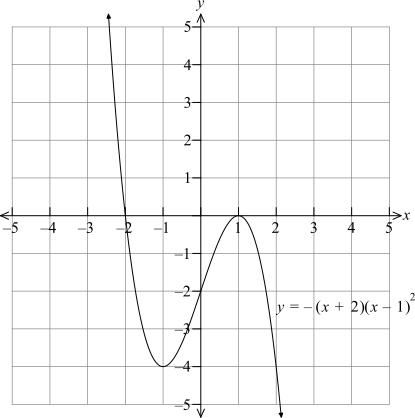
Sketch  `y=-(x+2)(x-1)^2` on the graph below, clearly showing all intercepts.  (3 marks)
 

--- 0 WORK AREA LINES (style=lined) ---
Show Answers Only

Show Worked Solution

`xtext{-axis intercepts at}\ \ x=-2 and 1\ text{(touches only)}`

`ytext{-intercept when}\ \ x=0\ \ =>\ \ y=-2xx(-1)^2=-2`
 

Filed Under: Polynomials Tagged With: num-title-ct-patha, smc-4242-30-Graphs

Polynomials, SMB-016

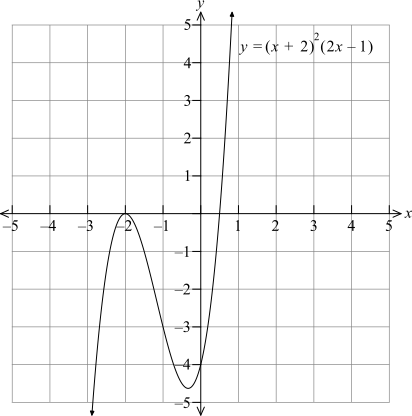
Sketch  `y=(x+2)^2(2x-1)` on the graph below, clearly showing all intercepts .  (3 marks)
 

--- 0 WORK AREA LINES (style=lined) ---
Show Answers Only

Show Worked Solution

`xtext{-axis intercepts at}\ \ x=-2\ text{(touches only) and}\ 1/2`

`ytext{-intercept when}\ x=0\ \ =>\ \ y=2^2(-1)=-4`
 

Filed Under: Polynomials Tagged With: num-title-ct-patha, smc-4242-30-Graphs

Polynomials, SMB-015

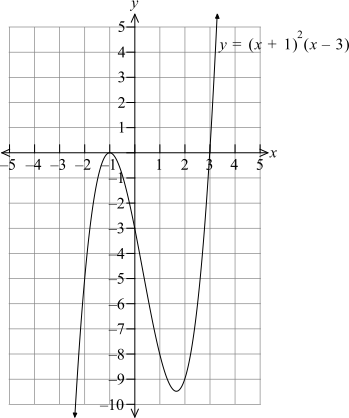
Sketch  `y=(x+1)^2(x-3)` on the graph below, clearly showing all intercepts .  (3 marks)


--- 0 WORK AREA LINES (style=lined) ---
Show Answers Only

Show Worked Solution

`xtext{-axis intercepts at}\ \ x=-1\ text{(touches only) and}\ 3`

`ytext{-intercept when}\ x=0\ \ =>\ \ y=1^2(-3)=-3`
 

Filed Under: Polynomials Tagged With: num-title-ct-patha, smc-4242-30-Graphs

Polynomials, SMB-014

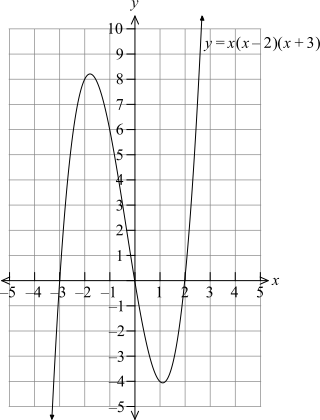
Sketch  `y=x(x-2)(x+3)` on the graph below, clearly showing all intercepts .  (3 marks)


--- 0 WORK AREA LINES (style=lined) ---
Show Answers Only

Show Worked Solution

`xtext{-axis intercepts at}\ \ x=-3, 0 and 2`

`ytext{-intercept at}\ (0,0)`

`text{At}\ \ x=1\ \ =>\ \ y=-4`
  

Filed Under: Polynomials Tagged With: num-title-ct-patha, smc-4242-30-Graphs

Polynomials, SMB-013

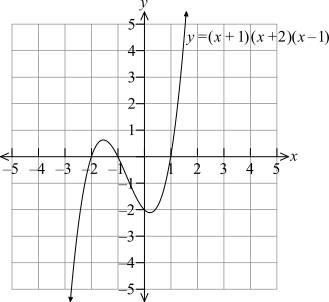
Sketch  `y=(x+1)(x+2)(x-1)` on the graph below, clearly showing all intercepts .  (3 marks)

--- 0 WORK AREA LINES (style=lined) ---
Show Answers Only

Show Worked Solution

`xtext{-axis intercepts at}\ \ x=-2, -1 and 1`

`ytext{-intercept when}\ \ x=0\ \ =>\ \  y=1xx2xx-1=-2`
  

Filed Under: Polynomials Tagged With: num-title-ct-patha, smc-4242-30-Graphs

Polynomials, SMB-012

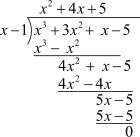
`h(x)=x^3+3x^2+x-5`.

  1. Show  `h(1)=0`  (1 mark)

    --- 1 WORK AREA LINES (style=lined) ---
  2. Express `h(x)` in the form `h(x)=(x-1)*g(x)` where `g(x)` is a quadratic factor.  (2 marks)

    --- 5 WORK AREA LINES (style=lined) ---
  3. Justify that `h(x)` only has one zero.  (2 marks)

    --- 4 WORK AREA LINES (style=lined) ---
Show Answers Only

i.    `text{Proof (See worked solutions)}`

ii.    `h(x)=(x-1)(x^2+4x+5)`

iii.   `text{Proof (See worked solutions)}`

Show Worked Solution

i.   `h(x)=x^3+3x^2+x-5`.

`h(1) = 1+3+1-5=0`
 

ii.   `h(x)=(x-1)*g(x)`

`text{By long division:}`
 

`h(x)=(x-1)(x^2+4x+5)`
 

iii.   `text{Consider the roots of}\ \ y=x^2+4x+5`

`Δ = b^2-4ac=4^2-4*1*5=-4<0`

`text{Since}\ \ Δ<0\ \ =>\ \ text{No zeros (roots)}`

`:. h(x)\ text{only has 1 zero at}\ x=1\ (h(1)=0)`

Filed Under: Polynomials Tagged With: num-title-ct-patha, smc-4242-10-Factor Theorem, smc-4242-40-Long division, smc-4242-50-Discriminant

Polynomials, SMB-011

`g(x)=(x-1)(x^2-2x+8)`.

Justify that `g(x)` only has one zero.  (2 marks)

--- 5 WORK AREA LINES (style=lined) ---
Show Answers Only

`text{Proof (See worked solutions)}`

Show Worked Solution

`g(x)=(x-1)(x^2-2x+8)`.

`g(1)=0\ \ =>\ \ text{one zero at}\ \ x=1`

`text{Consider the roots of}\ \ y=x^2-2x+8`

`Δ = b^2-4ac=(-2)^2-4*1*8=-28<0`

`text{Since}\ \ Δ<0\ \ =>\ \ text{No zeros (roots)}`

`:. g(x)\ text{only has 1 zero}`

Filed Under: Polynomials Tagged With: num-title-ct-patha, smc-4242-10-Factor Theorem, smc-4242-50-Discriminant

Polynomials, SMB-010 MC

`P(x)` is a monic polynomial of degree 4.

The maximum number of zeros that `P(x)` can have is

  1. `0`
  2. `1`
  3. `3`
  4. `4`
Show Answers Only

`D`

Show Worked Solution

`text{A polynomial of degree 4 has a leading term}\ ax^4`

`text{A monic polynomial of degree 4 has a leading term}\ x^4`

`:.\ text{Maximum number of zeroes}\ = 4`

`=>D`

Filed Under: Polynomials Tagged With: num-title-ct-patha, smc-4242-10-Factor Theorem

Polynomials, SMB-009

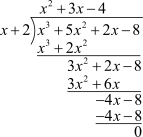
Let  `P(x) = x^3+5x^2+2x-8`.

  1. Show that  `P(-2) = 0`.  (1 mark)

    --- 2 WORK AREA LINES (style=lined) ---
  2. Hence, factor the polynomial  `P(x)`  as  `A(x)B(x)`, where  `B(x)`  is a quadratic polynomial.  (2 marks)

    --- 5 WORK AREA LINES (style=lined) ---
Show Answers Only
  1. `text(See Worked Solutions)`
  2. `P(x)=(x+2)(x^2+3x-4)`
Show Worked Solution
i.    `P(-2)` `= (-2)^3+ 5(-2)^2+2(-2)-8`
    `=-8+20-4-8`
    `= 0`


ii.  `text{Since}\ \ P(-2)=0\ \ =>\ \ (x+2)\ text{is a factor of}\ P(x)`

`P(x)=A(x)B(x)=(x+2)*B(x)`

`text{Using long division:}\ P(x)-:(x+2)=B(x)`
 

`:.P(x)=(x+2)(x^2+3x-4)`

Filed Under: Polynomials Tagged With: num-title-ct-patha, smc-4242-10-Factor Theorem, smc-4242-40-Long division

Polynomials, SMB-008

Consider the polynomial  `P(x) = 2x^4+3x^3-12x^2-7x+6`.

Fully factorised, `P(x) = (2x-1)(x+3)(x+a)(x-b)`

Find the value of `a` and `b` where `a,b>0`.  (3 marks)

Show Answers Only

`a=1, b=2`

Show Worked Solution

`text{Test for factors (by trial and error):}`

`P(1) = 2+3-12-7+6 = -8`

`P(-1) = 2-3-12+7+6 = 0\ \ =>\ \ (x+1)\ \ text{is a factor}`

`P(2) = 32+24-48-14+6 = 0\ \ =>\ \ (x-2)\ \ text{is a factor}`

`:. a=1, b=2`

Filed Under: Polynomials Tagged With: num-title-ct-patha, smc-4242-10-Factor Theorem

Polynomials, SMB-007

Consider the polynomial  `P(x) = 3x^3+x^2-10x-8`.

Is `(x+2)` a factor of `P(x)`? Justify your answer.  (2 marks)

Show Answers Only

`P(-2) = -24+4+20-8=-8`

`:. (x+2)\ \ text(is not a factor of)\ P(x)`

Show Worked Solution

`P(-2) = -24+4+20-8=-8`

`:. (x+2)\ \ text(is not a factor of)\ P(x)`

Filed Under: Polynomials Tagged With: num-title-ct-patha, smc-4242-10-Factor Theorem

Polynomials, SMB-006

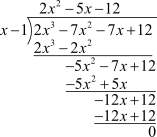
Consider the polynomial  `P(x) = 2x^3-7x^2-7x+12`.

  1. Show that  `(x-1)`  is a factor of  `P(x)`.  (1 mark)

    --- 2 WORK AREA LINES (style=lined) ---
  2. Fully factorise `P(x)`.  (2 marks)

    --- 5 WORK AREA LINES (style=lined) ---
Show Answers Only
  1. `text(See Worked Solution)`
  2. `P(x)=(x-1)(2x+3)(x-4)`
Show Worked Solution

i.   `P(1) = 2-7-7+12=0`

`:. (x-1)\ \ text(is a factor of)\ P(x)`


ii.   `text{Using part (i)} \ => (x-1)\ text{is a factor of}\ P(x)`

`P(x) = (x-1)*Q(x)`
 

`text(By long division:)`
 

`P(x)` `= (x-1) (2x^2-5x-12)`
  `= (x-1)(2x+3)(x-4)`

Filed Under: Polynomials Tagged With: num-title-ct-patha, smc-4242-10-Factor Theorem, smc-4242-40-Long division

Polynomials, SMB-005

Consider the polynomial  `P(x) = x^3-4x^2+x+6`.

  1. Show that  `x = -1`  is a zero of  `P(x)`.  (1 mark)

    --- 1 WORK AREA LINES (style=lined) ---

  2. Find the other zeros.  (2 marks)

    --- 4 WORK AREA LINES (style=lined) ---

Show Answers Only
  1. `text(See Worked Solution)`
  2. `x = 2 and 3`
Show Worked Solution

i.   `P(-1) = -1-4-1+6 = 0`

`:. x=-1\ \ text(is a zero)`


ii.   `text{Using part (i)} \ => (x+1)\ text{is a factor of}\ P(x)`

`P(x) = (x+1)*Q(x)`
 

`text(By long division:)`

`P(x)` `= (x+1) (x^2-5x+6)`
  `= (x+1)(x-2)(x-3)`

 
`:.\ text(Other zeroes are:)`

`x = 2 and x = 3`

Filed Under: Polynomials Tagged With: num-title-ct-patha, smc-4242-10-Factor Theorem

Polynomials, SMB-004

Let  `p(x)=x^{3}-2 a x^{2}+x-1`. When `p(x)` is divided by `(x+2)`, the remainder is 5.

Find the value of `a`.  (2 marks)

--- 4 WORK AREA LINES (style=lined) ---

Show Answers Only

`-2`

Show Worked Solution

`text{Since}\ \ p(x) -: (x+2)\ \ text{has a remainder of 5:}`

`P(-2)` `=5`  
`5` `=(-2)^3-2a(-2)^2-2-1`  
`5` `=-8-8a-2-1`  
`8a` `=-16`  
`:.a` `=-2`  

Filed Under: Polynomials Tagged With: num-title-ct-patha, smc-4242-20-Remainder Theorem

Polynomials, SMB-003 MC

If  `x + a`  is a factor of  `8x^3-14x^2-a^2 x`, then the value of  `a`  is

  1.  7
  2.  4
  3.  1
  4. –2
Show Answers Only

`D`

Show Worked Solution
`f(-a)` `= 8(-a)^3-14(-a)^2-a^2(-a)`
`0` `= -8a^3-14a^2 + a^3`
`0` `= -7a^3-14a^2`
`0` `= -7a^2 (a + 2)`
`a` `= -2`

 
`=>D`

Filed Under: Polynomials Tagged With: num-title-ct-patha, smc-4242-10-Factor Theorem

Polynomial, SMB-002

If  `P(x)=3x^3+2x^2-4x+2`, evaluate `P(-1)`.  (1 mark)

--- 3 WORK AREA LINES (style=lined) ---

Show Answers Only

`5`

Show Worked Solution
`P(x)` `=3x^3+2x^2-4x+2`  
`P(2)` `=3(-1)^3+2(-1)^2-4(-1)+2`  
  `=-3+2+4+2`  
  `=5`  

Filed Under: Polynomials Tagged With: num-title-ct-patha, smc-4242-20-Remainder Theorem

Polynomials, SMB-001

If  `P(x)=2x^3+x^2-4x+5`, evaluate `P(2)`.  (1 mark)

--- 2 WORK AREA LINES (style=lined) ---

Show Answers Only

`17`

Show Worked Solution
`P(x)` `=2x^3+x^2-4x+5`  
`P(2)` `=2xx2^3+2^2-4xx2+5`  
  `=16+4-8+5`  
  `=17`  

Filed Under: Polynomials Tagged With: num-title-ct-patha, smc-4242-20-Remainder Theorem

Logarithm, SMB-024

Solve  `log_9 27=x`  for `x`.  (2 marks)

--- 5 WORK AREA LINES (style=lined) ---

Show Answers Only

`3/2`

Show Worked Solution
`log_9 27` `=x`  
`9^x` `=27\ \ text{(by log definition)}`  
`log_10 9^x` `=log_10 27`  
`x log_10 9` `=log_10 27`  
`x` `=(log_10 27)/(log_10 9)`  
  `=3/2`  

Filed Under: Logarithms Tagged With: num-title-ct-patha, smc-4243-05-Solve by log definition, smc-4243-70-Solve exponentials

  • 1
  • 2
  • 3
  • Next Page »

Copyright © 2014–2025 SmarterEd.com.au · Log in