SmarterEd

Aussie Maths & Science Teachers: Save your time with SmarterEd

  • Login
  • Get Help
  • About

Calculus, EXT1 C3 2025 HSC 12b

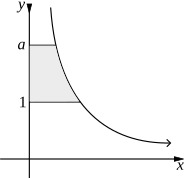
Consider the region bounded by the hyperbola  \(y=\dfrac{1}{x}\),  the \(y\)-axis and the lines  \(y=1\)  and  \(y=a\)  for  \(a>1\).

Find the volume of the solid of revolution formed when the region is rotated about the \(y\)-axis.   (2 marks)

--- 7 WORK AREA LINES (style=lined) ---

Show Answers Only

\(\pi\left(1-\dfrac{1}{a}\right)\ \text{u}^3\)

Show Worked Solution

\(y=\dfrac{1}{x} \ \Rightarrow \ x^2=\dfrac{1}{y^2}\)

\(V\) \(=\pi \displaystyle \int_1^a x^2\, dy\)
  \(=\pi \displaystyle \int_1^a y^{-2}\, d y\)
  \(=-\pi\left[y^{-1}\right]_1^a\)
  \(=-\pi\left(\dfrac{1}{a}-1\right)\)
  \(=\pi\left(1-\dfrac{1}{a}\right)\ \text{u}^3\)

Filed Under: Further Area and Solids of Revolution (Ext1) Tagged With: Band 4, smc-1039-40-Other Graphs, smc-1039-61-y-axis Rotation

Calculus, EXT1 C3 2023 HSC 12e

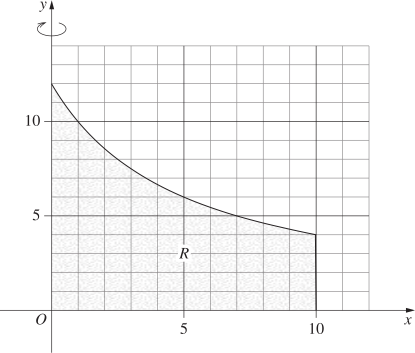
The region, \(R\), bounded by the hyperbola  \(y=\dfrac{60}{x+5}\), the line \(x=10\) and the coordinate axes is shown.
 

Find the volume of the solid of revolution formed when the region \(R\) is rotated about the \(y\)-axis. Leave your answer in exact form.  (4 marks)

--- 8 WORK AREA LINES (style=lined) ---

Show Answers Only

\(V=1200 \pi-600\pi\ \ln3 \ \ \text{u}^3\)

Show Worked Solution

\(y=\dfrac{60}{x+5}\ \ \Rightarrow\ \ x=\dfrac{60}{y}-5 \)

♦ Mean mark 49%.
\(V\) \(=\pi \displaystyle \int_4^{12} x^2\ dy + \pi r^2h\)  
  \(=\pi \displaystyle \int_4^{12} \Big{(} \dfrac{60}{y}-5 \Big{)}^2 \ dy + \pi \times 10^2 \times 4 \)  
  \(=\ 25\pi \displaystyle \int_4^{12} \Big{(} \dfrac{12}{y}-1 \Big{)}^2 \ dy + 400\pi \)  
  \(=\ 25\pi \displaystyle \int_4^{12} \Big{(} \dfrac{144}{y^2}-\dfrac{24}{y} + 1 \Big{)} \ dy + 400\pi \)  
  \(=\ 25\pi \Big{[} \dfrac{-144}{y}- 24 \ln y + y\Big{]}_4^{12} + 400\pi \)  
  \(=\ 25\pi \Big{[} (-12-24 \ln 12 +12)-(-36-24 \ln 4+4)\Big{]} + 400\pi \)  
  \(=\ 25\pi (24 \ln 4-24 \ln 12+32) + 400\pi \)  
  \(=600 \pi\ \ln(3^{-1}) + 800 \pi + 400 \pi \)  
  \(=1200 \pi-600\pi\ \ln3 \ \ \text{u}^3\)  

Filed Under: Further Area and Solids of Revolution (Ext1) Tagged With: Band 5, smc-1039-40-Other Graphs, smc-1039-61-y-axis Rotation

Calculus, EXT1 C3 SM-Bank 3

Find the volume of the solid of revolution formed when the graph of  `y = sqrt((1 + 2x)/(1 + x^2))`  is rotated about the `x`-axis over the interval  `[0,1]`.  (3 marks)

Show Answers Only

`pi(pi/4 + ln2)\ \ text(u³)`

Show Worked Solution
`V` `= pi int_0^1 (1 + 2x)/(1 + x^2)\ dx`
  `= pi int_0^1 1/(1 + x^2)\ dx + pi int_0^1 (2x)/(1 + x^2)\ dx`
  `= pi [tan^(−1)(x)]_0^1 + pi [ln(1 + x^2)]_0^1`
  `= pi(tan^(−1)1 – tan^(−1)0) + pi(ln2 – ln1)`
  `= pi(pi/4) + pi(ln2)`
  `= pi(pi/4 + ln2)\ \ text(u³)`

Filed Under: Further Area and Solids of Revolution (Ext1) Tagged With: Band 4, smc-1039-40-Other Graphs, smc-1039-60-x-axis Rotation

Calculus, EXT1* C3 2017 HSC 12b

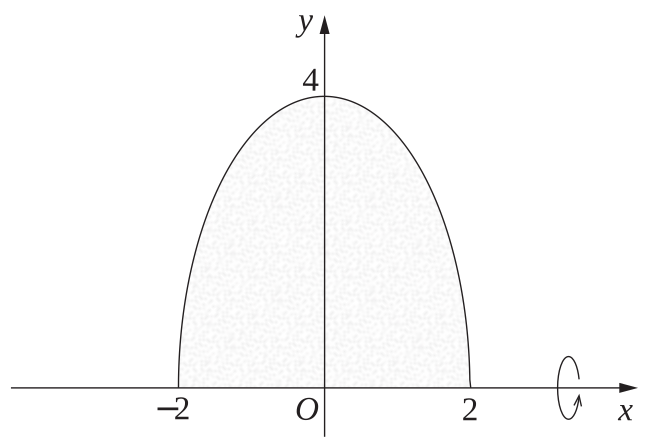
The diagram shows the region bounded by  `y = sqrt (16 - 4x^2)`  and the `x`-axis.


The region is rotated about the `x`-axis to form a solid.

Find the exact volume of the solid formed.  (3 marks)

Show Answers Only

`(128 pi)/3\ text(u³)`

Show Worked Solution
`y` `= sqrt (16 – 4x^2)`
`V` `= pi int_(-2)^2 y^2\ dx`
  `= 2 pi int_0^2 16 – 4x^2\ dx`
  `= 2 pi [16x – 4/3 x^3]_0^2`
  `= 2 pi [(16 ⋅ 2 – 4/3 2^3)-0]`
  `= 2 pi (64/3)`
  `= (128 pi)/3\ text(u³)`

Filed Under: Further Area and Solids of Revolution (Ext1), Volumes of Solids of Rotation Tagged With: Band 3, smc-1039-40-Other Graphs, smc-1039-60-x-axis Rotation

Calculus, EXT1* C3 2016 HSC 15a

The diagram shows two curves  `C_1` and `C_2.` The curve `C_1` is the semicircle  `x^2 + y^2 = 4, \ -2 <= x <= 0.` The curve `C_2` has equation  `x^2/9 + y^2/4 = 1, \ 0 <= x <= 3.`
 

hsc-2016-15a
 

An egg is modelled by rotating the curves about the `x`-axis to form a solid of revolution.

Find the exact value of the volume of the solid of revolution.  (4 marks)

--- 10 WORK AREA LINES (style=lined) ---

Show Answers Only

`(40 pi)/3\ text(u³)`

Show Worked Solution

`text(Consider)\ \ C_1,`

`V_1` `= pi int_-2^0 y^2\ dx`
  `= pi int_-2^0 4 – x^2\ dx`
  `= pi [4x – x^3/3]_-2^0`
  `= pi [0 – (-8 + 8/3)]`
  `= (16 pi)/3\ u³`


`text(Consider)\ \ C_2`

`x^2/9 + y^2/4` `= 1`
`y^2` `= 4 – (4x^2)/9`


`V_2` `= pi int_0^3 4 – (4x^2)/9\ dx`
  `= pi [4x – (4x^3)/27]_0^3`
  `= pi [(12 – (4 · 3^3)/27) – 0]`
  `= 8 pi\ text(u³)`


`text(Volume)` `= V_1 + V_2`
  `= (16 pi)/3 + 8 pi`
  `= (40 pi)/3\ text(u³)`

Filed Under: Further Area and Solids of Revolution (Ext1), Volumes of Solids of Rotation Tagged With: Band 5, smc-1039-30-(Semi) Circle, smc-1039-40-Other Graphs, smc-1039-60-x-axis Rotation

Calculus, EXT1* C3 2007 HSC 3a

Find the volume of the solid of revolution formed when the region bounded by the curve  `y = 1/(sqrt(9 + x^2))`, the `x`-axis, the `y`-axis and the line  `x = 3`, is rotated about the `x`-axis.  (3 marks)

--- 6 WORK AREA LINES (style=lined) ---

Show Answers Only

`(pi^2)/(12)\ \ text(u³)`

Show Worked Solution

`y = 1/(sqrt(9 + x^2))`

`:.\ text(Volume)` `= pi int_0^3 y^2\ dx`
  `= pi int_0^3 (1/(sqrt(9 + x^2)))^2\ dx`
  `= pi int_0^3 1/(9 + x^2)\ dx`
  `= pi [1/3 tan^(−1)\ x/3]_0^3`
  `= pi [1/3 tan^(−1)\ 1 − 1/3 tan^(−1)\ 0]`
  `= pi [(1/3 xx pi/4) − 0]`
  `= (pi^2)/(12)\ \ text(u³)`

Filed Under: 11. Integration EXT1, Further Area and Solids of Revolution (Ext1), Inverse Trig Functions EXT1 Tagged With: Band 4, smc-1039-40-Other Graphs, smc-1039-60-x-axis Rotation

Calculus, EXT1* C3 2015 HSC 16b

A bowl is formed by rotating the curve  `y = 8 log_e (x - 1)`  about the `y`-axis for  `0 <= y <= 6.`
 

2015 16b
 

Find the volume of the bowl. Give your answer correct to 1 decimal place.  (3 marks)

--- 8 WORK AREA LINES (style=lined) ---

Show Answers Only

`118.7\ text(u³)`

Show Worked Solution
♦ Mean mark 38%.
`y` `=8 log_e (x – 1)`
`y/8` `=log_e (x – 1)`
`e^(y/8)` `=x – 1`
`x` `=e^(y/8) + 1`
`x^2` `=(e^(y/8) + 1)^2`
  `=(e^(y/8))^2 + 2e^(y/8) + 1`
  `=e^(y/4) + 2e^(y/8) + 1`


`V` `= pi int_0^6 x^2\ dy`
  `= pi int_0^6 (e^(y/4) + 2e^(y/8) + 1)\ dy`
  `= pi [4e^(y/4) + 16e^(y/8) + y]_0^6`
  `= pi [(4e^(6/4) + 16e^(6/8) + 6) – (4e^0 + 16e^0 + 0)]`
  `= pi [(4e^1.5 + 16e^0.75 + 6) – (4 + 16)]`
  `= pi [4e^1.5 + 16e^0.75 – 14]`
  `= 118.748…`
  `= 118.7\ \ text{(to 1 d.p.)}`

 
`:.\ text(Volume of the bowl is 118.7 u³.)`

Filed Under: Applied Calculus (L&E), Further Area and Solids of Revolution (Ext1), Volumes of Solids of Rotation Tagged With: Band 5, smc-1039-40-Other Graphs, smc-1039-61-y-axis Rotation

Calculus, EXT1* C3 2008 HSC 6c

The graph of  `y = 5/(x - 2)`  is shown below.
 

2008 6c
 

The shaded region in the diagram is bounded by the curve  `y = 5/(x - 2)`, the  `x`-axis and the lines  `x = 3`  and  `x = 6`.

Find the volume of the solid of revolution formed when the shaded region is rotated about the  `x`-axis.  (3 marks)

--- 6 WORK AREA LINES (style=lined) ---

Show Answers Only

`(75pi)/4\ text(u³)`

Show Worked Solution
`y` `= 5/(x – 2)`
`V` `= pi int_3^6 y^2\ dx`
  `= pi int_3^6 (5/(x – 2))^2\ dx`
  `= 25 pi int_3^6 1/((x – 2)^2)\ dx`
  `= 25 pi [(-1)/(x – 2)]_3^6`
  `= 25 pi [-1/4 – (-1)]`
  `=25 pi [3/4]`
  `= (75pi)/4\ text(u³)`

Filed Under: Further Area and Solids of Revolution (Ext1), Volumes of Solids of Rotation Tagged With: Band 4, smc-1039-40-Other Graphs, smc-1039-60-x-axis Rotation

Calculus, EXT1* C3 2014 HSC 14c

The region bounded by the curve  `y = 1 + sqrtx`  and the  `x`-axis between  `x = 0`  and  `x = 4`  is rotated about the  `x`-axis to form a solid.
 

2014 14c
 

Find the volume of the solid.   (3 marks) 

--- 6 WORK AREA LINES (style=lined) ---

Show Answers Only

`(68 pi)/3\ text(u³)`

Show Worked Solution

`y = 1 + sqrtx`

`V` `= pi int_0^4 y^2\ dx`
  `= pi int_0^4 (1 + sqrtx)^2\ dx`
  `= pi int_0^4 (1 + 2 sqrtx + x)\ dx`
  `= pi [x + 4/3 x^(3/2) + 1/2 x^2]_0^4`
  `= pi [(4 + 4/3 xx 4^(3/2) + 1/2 xx 4^2)\ – 0]`
  `= pi (4 + 32/3 + 8)`
  `= (68 pi)/3\ text(u³)`

Filed Under: Further Area and Solids of Revolution (Ext1), Volumes of Solids of Rotation Tagged With: Band 4, smc-1039-40-Other Graphs, smc-1039-60-x-axis Rotation

Calculus, EXT1* C3 2012 HSC 14b

The diagram shows the region bounded by  `y = 3/((x+2)^2)`, the `x`-axis, the  `y`-axis,  and the line  `x = 1`.  
 

2012 14b
 

The region is rotated about the  `x`-axis to form a solid.

Find the volume of the solid.  (3 marks)

--- 8 WORK AREA LINES (style=lined) ---

Show Answers Only

 `(19pi)/72\ text(u³)`

Show Worked Solution
MARKER’S COMMENT: Most students omitted the `dx` when stating the definite integral in this question!
`V` `= pi int_0^1 y^2\ dx`
  `= pi int_0^1 (3/((x+2)^2))^2\ dx`
  `= pi int_0^1 9/((x+2)^4)\ dx`
  `= 9pi int_0^1 (x + 2)^-4\ dx`
  `= 9pi  [-1/3 (x + 2)^-3]_0^1`
  `= 9pi  [(-1/3 xx 1/(3^3))\ – (-1/3 xx 1/(2^3))]`
  `= 9 pi [-1/81 + 1/24]`
  `= 9 pi (19/648)`
  `= (19pi)/72\ text(u³)`


`:.\ text(Volume of the solid is)\ (19pi)/72\ text(u³)`.

Filed Under: Further Area and Solids of Revolution (Ext1), Volumes of Solids of Rotation Tagged With: Band 4, smc-1039-40-Other Graphs, smc-1039-60-x-axis Rotation

Copyright © 2014–2025 SmarterEd.com.au · Log in