SmarterEd

Aussie Maths & Science Teachers: Save your time with SmarterEd

  • Login
  • Get Help
  • About

Calculus, EXT1 C3 2025 HSC 6 MC

Given that \(a\) is a non-zero constant, which of the following integrals is equal to zero?

  1. \(\displaystyle \int_{-a}^a x\, \cos ^{-1}(x) d x\)
  2. \(\displaystyle\int_{-a}^a x^2\, \cos ^{-1}(x) d x\)
  3. \(\displaystyle\int_{-a}^a x\, \tan ^{-1}(x) d x\)
  4. \(\displaystyle\int_{-a}^a x^2\, \tan ^{-1}(x) d x\)
Show Answers Only

\(D\)

Show Worked Solution

\(\text{Since the limits are symmetrical about 0:}\)

\(\text{Integral will equal zero if function is odd.}\)

\(\text{Consider option D:}\)

\(f(x)=x^2\, \tan^{-1}(x)\)

\(f(-x)=(-x)^2\, \tan^{-1}(-x)=-x^2\, \tan ^{-1}(x)=-f(x)\ \text{(odd)}\)

\(\Rightarrow D\)

Filed Under: Further Area and Solids of Revolution (Ext1) Tagged With: Band 4, smc-1039-50-Area

Calculus, EXT1 C3 2024 HSC 11g

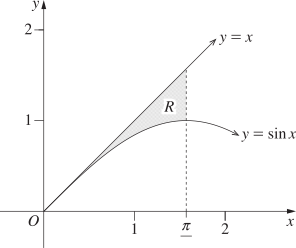
The region, \(R\), is bounded by the curves  \(y=\sin x, y=x\)  and the line  \(x=\dfrac{\pi}{2}\)  as shown in the diagram.
 

Find the area of the region \(R\).   (3 marks)

--- 6 WORK AREA LINES (style=lined) ---

Show Answers Only

\(\dfrac{\pi^2}{8}-1\ \ \text{u}^2\)

Show Worked Solution

  \(R\) \(=\displaystyle{\int}_0^{\frac{\pi}{2}} x-\sin x \, d x\)
    \(=\left[\dfrac{x^2}{2}+\cos x\right]_0^{\frac{\pi}{2}}\)
    \(=\left[\left(\dfrac{\pi^2}{8}+\cos \dfrac{\pi}{2}\right)-(0+\cos 0)\right]\)
    \(=\dfrac{\pi^2}{8}-1\ \ \text{u}^2\)

Filed Under: Further Area and Solids of Revolution (Ext1) Tagged With: Band 3, smc-1039-50-Area

Calculus, EXT1 C3 2024 HSC 2 MC

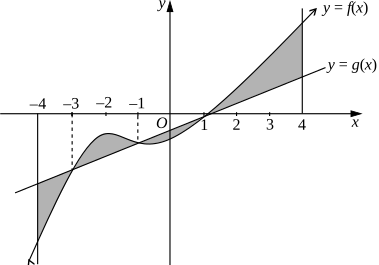
Consider the functions  \(y=f(x)\)  and  \(y=g(x)\), and the regions shaded in the diagram below. 
 

Which of the following gives the total area of the shaded regions?

  1. \(\displaystyle \int_{-4}^4 f(x)-g(x)\,d x\)
  2. \(\displaystyle \left|\int_{-4}^4 f(x)-g(x)\,d x\right|\)
  3. \(\displaystyle \int_{-4}^{-3} f(x)-g(x)\,d x+\int_{-3}^{-1} f(x)-g(x)\,d x+\int_{-1}^1 f(x)-g(x)\,d x+\int_1^4 f(x)-g(x)\,d x \)
  4. \(\displaystyle - \int_{-4}^{-3} f(x)-g(x)\,d x+\int_{-3}^{-1} f(x)-g(x)\,d x-\int_{-1}^1 f(x)-g(x)\,d x+\int_1^4 f(x)-g(x)\,d x\)
Show Answers Only

\(D\)

Show Worked Solution

\(\text{Intervals where}\ f(x) \gt g(x)\ \ \Rightarrow\ \text{Positive area values}\)

\(\text{Intervals where}\ g(x) \gt f(x)\ \ \Rightarrow\ \text{Negative area values}\)

\(\Rightarrow D\)

Filed Under: Further Area and Solids of Revolution (Ext1) Tagged With: Band 3, smc-1039-50-Area

Calculus, EXT1 C3 2023 HSC 4 MC

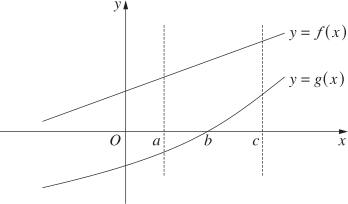
The diagram shows the graphs of the functions \(f(x)\) and \(g(x)\).
 

It is known that

\begin{aligned} & \int_a^c f(x) d x=10 \\ & \int_a^b g(x) d x=-2 \\ & \int_b^c g(x) d x=3 .\end{aligned}

What is the area between the curves  \(y=f(x)\)  and  \(y=g(x)\)  between \(x=a\) and \(x=c\) ?

  1. 5
  2. 7
  3. 9
  4. 11
Show Answers Only

\(C\)

Show Worked Solution
\(A\) \[= \int_a^c f(x)\ dx-\int_b^c g(x)\ dx+\Big{|}\int_a^b g(x)\ dx\Big{|} \]  
  \(= 10-3+|-2| \)  
  \(=9\)  

 
\(\Rightarrow C\)

Filed Under: Further Area and Solids of Revolution (Ext1) Tagged With: Band 4, smc-1039-50-Area

Calculus, EXT1 C3 2021 HSC 13c

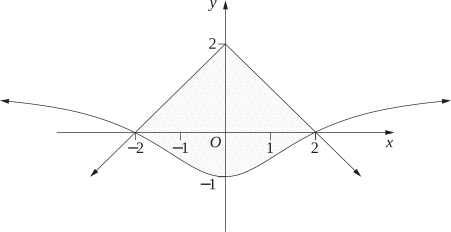
The region enclosed by  `y = 2 - |x|`  and  `y = 1 - 8/(4 + x^2)`  is shaded in the diagram.
 

Find the exact value of the area of the shaded region.  (3 marks)

Show Answers Only

`2pi\ text(u²)`

Show Worked Solution
`A` `= text(Area of)\ Delta + 2|int_0^2 1 – 8/(4 + x^2)\ dx|`
  `= 1/2 xx 4 xx 2 + 2|[x – 4 tan^(-1)\ x/2]_0^2|`
  `= 4 + 2|(2 – 4tan^(-1)1) – 0|`
  `= 4 + 2|2 – (4pi)/4|`
  `= 4 + 2(pi – 2)`
  `= 2pi\ text(u²)`

Filed Under: Further Area and Solids of Revolution (Ext1) Tagged With: Band 4, smc-1039-50-Area

Calculus, EXT1 C3 EQ-Bank 1

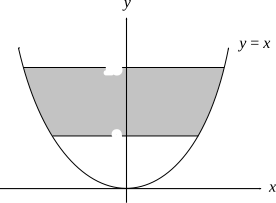
  1. Sketch the region bounded by the curve  `y = x^2`  and the lines  `y = 16`  and  `y = 9`.  (1 mark)

    --- 8 WORK AREA LINES (style=lined) ---

  2. Calculate the area of this region.  (3 marks)

    --- 6 WORK AREA LINES (style=lined) ---

Show Answers Only
  1.  
  2. `148/3 \ text(u²)`
Show Worked Solution
i.   


ii.   `text(Areas either side of)\ ytext(-axis are equal.)`

`y = x^2\ \ =>\ \ x = sqrty`

`:. A` `= 2 int_9^16 x\ dy`
  `= 2 int_9^16 sqrty\ dy`
  `= 2[2/3 y^(3/2)]_9^16`
  `= 4/3[(sqrt16)^3 – (sqrt9)^3]`
  `= 4/3[64 – 27]`
  `= 148/3 \ text(u²)`

Filed Under: Further Area and Solids of Revolution (Ext1) Tagged With: Band 3, Band 4, smc-1039-50-Area

Calculus, EXT1 C3 2019 SPEC1-N 9

i.  Show that  `tan((5pi)/(12)) = sqrt3 + 2`.   (2 marks)

--- 5 WORK AREA LINES (style=lined) ---

ii. 
       
 
Hence, find the area bounded by the graph of  `f(x) = (2)/(x^2 - 4x + 8)`  shown above, the `x`-axis and the lines  `x = 0`  and  `x = 2 sqrt3 +6`.   (4 marks)

--- 6 WORK AREA LINES (style=lined) ---

Show Answers Only
  1. `text(Proof (See Worked Solution))`
  2. `(2pi)/(3)`
Show Worked Solution

i.    `text(Method 1:)`

`tan \ (5pi)/(12)` `= tan ((pi)/(4) + (pi)/(6))`
  `= (tan \ (pi)/(4) + tan\ (pi)/(6))/(1 – tan \ (pi)/(4) · tan \ (pi)/(6))`
  `= (1 + (1)/(sqrt3))/(1 – (1)/(sqrt3))`
  `= (sqrt3+1)/(sqrt3-1) xx (sqrt3+1)/(sqrt3+1)`
  `= (3+ 2 sqrt3 + 1)/(3 – 1)`
  `= sqrt3 +2`

  
`text(Method 2:)`

`tan \ (5pi)/(6)` `= (2tan \ (5pi)/(12))/(1 – tan^2 \ (5pi)/(12))`
`- 1/sqrt3` `=(2tan \ (5pi)/(12))/(1 – tan^2 \ (5pi)/(12))`
`-2 sqrt3 tan \ (5pi)/(12)` `= 1 – tan^2 \ (5pi)/(12)`


`tan^2 \ (5pi)/(12) – 2 sqrt(3) tan \ (5pi)/(12) – 1 = 0`

`tan \ (5pi)/(12)` `= (2 sqrt3 ± sqrt(12 + 4))/(2)`
  `= sqrt3 + 2 \ \ \ (tan theta > 0)`


ii.   `text(Area)` `= int_0 ^(2 sqrt3 + 6) \ (2)/(x^2 – 4x + 8)\ dx`
  `= int_0 ^(2 sqrt3 + 6) \ (2)/((x -2)^2 + 2^2)`
  `= [tan^-1 ((x – 2)/(2))]_0 ^(2 sqrt3 + 6)`
  `= tan^-1 (sqrt3 + 2) – tan^-1 (-1)`
  `= (5pi)/(12) – (-(pi)/(4))`
  `= (2pi)/(3)`

Filed Under: Further Area and Solids of Revolution (Ext1) Tagged With: Band 4, Band 5, smc-1039-50-Area

Copyright © 2014–2025 SmarterEd.com.au · Log in