SmarterEd

Aussie Maths & Science Teachers: Save your time with SmarterEd

  • Login
  • Get Help
  • About

Mechanics, EXT2 M1 2022 HSC 15b

The diagrams show two positions of a single piston in the cylinder chamber of a motorcycle. The piston moves vertically, in simple harmonic motion, between a maximum height of 0.17 metres and a minimum height of 0.05 metres.
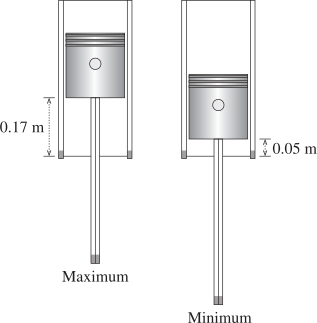


The mass of the piston is 0.8 kg. The piston completes 40 cycles per second.

What is the resultant force on the piston, in newtons, that produces the maximum acceleration of the piston? Give your answer correct to the nearest newton.  (3 marks)

--- 5 WORK AREA LINES (style=lined) ---

Show Answers Only

`text{3032 N}`

Show Worked Solution

`text{Using}\ \ ddotx=-n^2(x-b)`

`text{Centre of motion}\ (b) = 0.11`

`text{Amplitude}\ (a) = (0.17-0.05)/2=0.06\ text{m}`

`text{Period}\ (T) = 1/40=0.025\ text{sec}`

`n=(2pi)/T=80pi`

`:.ddotx=-(80pi)^2(x-0.11)`


♦ Mean mark 50%.

`ddotx_(max)\ text{occurs when}\ x=0.17\ text{or}\ 0.05`

`ddotx_(max)` `=-(80pi)^2(0.17-0.11)`  
  `=384pi^2\ text{m s}^(-2)`  


`:.F_(max)` `=mddotx`  
  `=0.8xx384pi^2`  
  `=3031.942…`  
  `=3032\ text{N (to 0 d.p.)}`  

Filed Under: Simple Harmonic Motion Tagged With: Band 5, smc-1059-10-Amplitude / Period, smc-1059-50-Real World examples

Mechanics, EXT2* M1 2016 HSC 13a

The tide can be modelled using simple harmonic motion.

At a particular location, the high tide is 9 metres and the low tide is 1 metre.

At this location the tide completes 2 full periods every 25 hours.

Let `t` be the time in hours after the first high tide today.

  1. Explain why the tide can be modelled by the function  `x = 5 + 4cos ((4pi)/25 t)`.  (2 marks)

    --- 6 WORK AREA LINES (style=lined) ---

  2. The first high tide tomorrow is at 2 am.


    What is the earliest time tomorrow at which the tide is increasing at the fastest rate?  (2 marks)

    --- 5 WORK AREA LINES (style=lined) ---

Show Answers Only
  1. `text(See Worked Solutions)`
  2. `11:22:30\ text(am)`
Show Worked Solution
i.    `text(High tide)` `= 9\ text(m)`
  `text(Low tide)` `= 1\ text(m)`

 
`:. A = (9 – 1)/2 = 4\ text(m)`

`T = 25/2`

`:. (2 pi)/n` `= 25/2`
`n` `= (4 pi)/25`


`text(Centre of motion) = 5`


`text(S) text(ince high tide occurs at)\ \ t = 0,`

`x` `= 5 + 4 cos (nt)`
  `= 5 + 4 cos ((4 pi)/25 t)`


ii.   `x = 5 + 4 cos ((4 pi)/25 t)`

`(dx)/(dt)` `= -4 · (4 pi)/25 *sin ((4 pi)/25 t)`
  `= -(16 pi)/25 *sin ((4 pi)/25 t)`


`text(Tide increases at maximum rate)`

`text(when)\ \ sin ((4 pi)/25 t) = -1,`

`:. (4 pi)/25 t` `= (3 pi)/2`
  `= 75/8`
  `= 9\ text(hours 22.5 minutes)`


`:.\ text(Earliest time is)\ 11:22:30\ text(am)`

Filed Under: Simple Harmonic Motion, Simple Harmonic Motion EXT1 Tagged With: Band 4, Band 5, smc-1059-20-Prove/Identify SHM, smc-1059-31-Max Speed, smc-1059-50-Real World examples

Mechanics, EXT2* M1 2004 HSC 7a

The rise and fall of the tide is assumed to be simple harmonic, with the time between successive high tides being 12.5 hours. A ship is to sail from a wharf to the harbour entrance and then out to sea. On the morning the ship is to sail, high tide at the wharf occurs at 2 am. The water depths at the wharf at high tide and low tide are 10 metres and 4 metres respectively.

  1. Show that the water depth, `y` metres, at the wharf is given by
     
         `y = 7 + 3 cos\ ((4pit)/(25))`, where  `t`  is the number of hours after high tide.  (2 marks)  

    --- 5 WORK AREA LINES (style=lined) ---

  2. An overhead power cable obstructs the ship’s exit from the wharf. The ship can only leave if the water depth at the wharf is 8.5 metres or less.


    Show that the earliest possible time that the ship can leave the wharf is 4:05 am.  (2 marks)

    --- 8 WORK AREA LINES (style=lined) ---

  3. At the harbour entrance, the difference between the water level at high tide and low tide is also 6 metres. However, tides at the harbour entrance occur 1 hour earlier than at the wharf. In order for the ship to be able to sail through the shallow harbour entrance, the water level must be at least 2 metres above the low tide level.


    The ship takes 20 minutes to sail from the wharf to the harbour entrance and it must be out to sea by 7 am. What is the latest time the ship can leave the wharf?  (2 marks)

    --- 6 WORK AREA LINES (style=lined) ---

Show Answers Only
  1. `text{Proof (See Worked Solutions)}`
  2. `text{Proof (See Worked Solutions)}`
  3. `4:28\ text(am)`
Show Worked Solution

i.   `text(Period)`

`(2pi)/n =` ` 12.5`
`12.5n =` ` 2pi`
`25n =` ` 4pi`
`n =` ` (4pi)/25`

 
`text(Amplitude)`

`a` `= 1/2(10 − 4)`
  `= 3`

 
`=>\ text(Motion centres around)\ \ x = 7\ \ text(with)`

`y = 10\ \ text(when)\ \ t= 0`


`:.\ text(Water depth is given by)`

`y` `= 7+a cos nt`
  `= 7 + 3 cos\ ((4pit)/(25))\ \ …\ text(as required.)`


ii.  

 Calculus in the Physical, EXT1 2004 HSC 7a Answer

`text(Find)\ \ t\ \ text(when)\ \ y = 8.5:`

`8.5` `= 7 + 3\ cos\ ((4pit)/25)`
`3\ cos\ ((4pit)/25)` `= 1.5`
`cos\ ((4pit)/25)` `= 1/2`
`(4pit)/25` `=pi/3`
`t` `=(25pi)/(3 xx 4pi)`
  `=2 1/12`
  `= 2\ text(hrs 5 mins)`


`:.\ text(The earliest time the ship can leave)`

`text(is 4:05 am  … as required.)`


iii.  `text(2 metres above low tide = 6 m)`

`text(Find)\ t\ text(when)\ y = 6:`

`6 = 7 + 3\ cos\ ((4pit)/(25))`

`3\ cos\ ((4pit)/(25))` `= -1`
`cos\ ((4pit)/(25))` `= -1/3`
`(4pit)/25` `= 1.9106…`
`:.t` `= (25 xx 1.9106…)/(4pi)`
  `= 3.801…`
  `= 3\ text{hr 48 min  (nearest min)}`


`:.\ text(At the harbour entrance, water depth)`

`text(of 6 m occurs when)\ \ t = 2\ text(hr 48 min.)`


`:.\ text(Given 20 mins sailing time, the latest the ship can)`

`text(leave the wharf is at)\ \ t = 2\ text(hr 28 min, or 4:28 am.)`

Filed Under: Simple Harmonic Motion, Simple Harmonic Motion EXT1 Tagged With: Band 4, Band 5, Band 6, smc-1059-20-Prove/Identify SHM, smc-1059-50-Real World examples

Copyright © 2014–2025 SmarterEd.com.au · Log in