SmarterEd

Aussie Maths & Science Teachers: Save your time with SmarterEd

  • Login
  • Get Help
  • About

Mechanics, EXT2 M1 SM-Bank 5

A student throws a ball for his dog to retrieve. The position vector of the ball, relative to an origin \(O\) at ground level \(t\) seconds after release, is given by  \(  \underset{\sim}{\text{r}}{}_\text{B} (t)=5 t \underset{\sim}{\text{i}}+7 t \underset{\sim}{\text{j}}+(15 t-4.9 t^2+1.5) \underset{\sim}{\text{k}} \). Displacement components are measured in metres, where \(\underset{\sim}{\text{i}}\) is a unit vector to the east, \(\underset{\sim}{\text{j}}\) is a unit vector to the north and \( \underset{\sim} {\text{k}}\) is a unit vector vertically up.

Calculate the total vertical distance, in metres, travelled by the ball before it hits the ground. Give your answer correct to one decimal place.   (3 marks)

Show Answers Only

\(24.5\ \text{m} \)

Show Worked Solution

\(\text{Upwards distance}\ (z) = 15t-4.9t^2+1.5\)

\(\dfrac{dz}{dt}=15-9.8t\)

\(\text{Find}\ t\ \text{when}\ \dfrac{dz}{dt}=0\ \text{(vertical max):} \)

\(15-9.8t=0\ \ \Rightarrow \ \ t=\dfrac{15}{9.8} \)

\(z\Big{(}t=\frac{15}{9.8}\Big{)} = 15 \times \Big{(}\dfrac{15}{9.8}\Big{)}-4.9 \times \Big{(}\dfrac{15}{9.8}\Big{)}^2 + 1.5 \approx 12.98\ \text{m} \)
  

\(\text{At}\ \ t=0, \ z=1.5 \)

\(\therefore \text{Total vertical distance}\ = (12.98-1.5)+12.98 = 24.5\ \text{m (1 d.p.)} \)

Filed Under: Projectile Motion Tagged With: Band 4, smc-1060-04-Motion as f(t), smc-1060-50-Vectors and motion

Mechanics, EXT2 M1 2023 HSC 12c

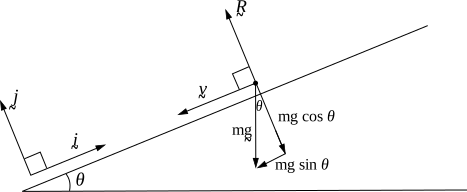
An object with mass \(m\) kilograms slides down a smooth inclined plane with velocity \( \underset{\sim}{v}(t)\), where \(t\) is the time in seconds after the object started sliding down the plane. The inclined plane makes an angle \(\theta\) with the horizontal, as shown in the diagram. The normal reaction force is \(\underset{\sim}{R}\). The acceleration due to gravity is \(\underset{\sim}{g}\) and has magnitude \(g\). No other forces act on the object.

The vectors \(\underset{\sim}{i}\) and \( \underset{\sim}{j} \) are unit vectors parallel and perpendicular, respectively, to the plane, as shown in the diagram.
 

  1. Show that the resultant force on the object is  \(\underset{\sim}{F}=-(m g \ \sin \theta) \underset{\sim}{i}\).  (2 marks)

    --- 5 WORK AREA LINES (style=lined) ---

  2. Given that the object is initially at rest, find its velocity \(\underset{\sim}{v}(t)\) in terms of \(g\), \(\theta, t\) and \(\underset{\sim}{i}\).  (2 marks)

    --- 5 WORK AREA LINES (style=lined) ---

Show Answers Only

i.    \(\text{Proof (See Worked Solution)} \)

ii.   \(\underset{\sim}{v}=-gt\ \sin \theta \ \underset{\sim}{i} \)

Show Worked Solution

i.       
         

\(\text{Resolving forces in}\ \underset{\sim}{j} \ \text{direction:} \)

\( {\underset{\sim}{F}}_\underset{\sim}{j} = \underset{\sim}{R} + m\underset{\sim}{g}\ \cos \theta = 0\ \ \text{(in equilibrium)} \)

\(\text{Resolving forces in}\ \underset{\sim}{i} \ \text{direction:} \)

\( {\underset{\sim}{F}}_\underset{\sim}{i} = -m\underset{\sim}{g} \ \sin \theta \ \ \ \text{(down slope)} \)

\(\therefore \text{Resultant force:}\ \ \underset{\sim}{F}=-(m g \ \sin \theta) \underset{\sim}{i} \)
 

♦ Mean mark (i) 50%.

ii.   \(\text{Using}\ \ \underset{\sim}{F}=m \underset{\sim}{a}: \)

\(m \underset{\sim}{a}\) \(=-mg\ \sin \theta \ \underset{\sim}{i} \)  
\(\underset{\sim}{a}\) \(=-g\ \sin \theta \ \underset{\sim}{i} \)  
\(\underset{\sim}{v}\) \(= \displaystyle \int \underset{\sim}{a}\ dt \)  
  \(=-gt\ \sin \theta +c \)  

 
\(\text{When}\ \ t=0,\ \ \underset{\sim}{v}=0\ \ \Rightarrow \ \ c=0 \)

\(\therefore \underset{\sim}{v}=-gt\ \sin \theta \ \underset{\sim}{i} \)

Filed Under: Motion Without Resistance Tagged With: Band 4, Band 5, smc-1060-04-Motion as f(t), smc-1060-45-Inclined planes, smc-1060-50-Vectors and motion

Mechanics, EXT2 M1 2022 HSC 12b

A particle is moving in a straight line with acceleration  `a=12-6 t`. The particle starts from rest at the origin.

What is the position of the particle when it reaches its maximum velocity?  (3 marks)

--- 7 WORK AREA LINES (style=lined) ---

Show Answers Only

`x=16`

Show Worked Solution
`a` `=12-6t`  
`v` `=int 12-6t\ dt`  
  `=12t-3t^2+c`  

 
`text{When}\ \ t=0, v=0\ \ =>\ \ c=0`

`x` `=int 12t-3t^2\ dt`  
  `=6t^2-t^3+c`  

 
`text{When}\ \ t=0, x=0\ \ =>\ \ c=0`

 
`v_max\ \ text{occurs when}\ \ a=0:`

`12-6t=0\ \ =>\ \ t=2`

`:.x|_(t=2)` `=6(2^2)-2^3`  
  `=16`  

Filed Under: Motion Without Resistance Tagged With: Band 3, smc-1060-04-Motion as f(t)

Mechanics, EXT2* M1 2007 HSC 2d

A skydiver jumps from a hot air balloon which is 2000 metres above the ground. The velocity, `v` metres per second, at which she is falling  `t`  seconds after jumping is given by  `v =50(1 - e^(-0.2t))`.

  1. Find her acceleration ten seconds after she jumps. Give your answer correct to one decimal place.  (2 marks)

    --- 6 WORK AREA LINES (style=lined) ---

  2. Find the distance that she has fallen in the first ten seconds. Give your answer correct to the nearest metre.  (2 marks)

    --- 7 WORK AREA LINES (style=lined) ---

Show Answers Only
  1. `1.4\ text(ms)^(−2)\ \ text{(to 1 d.p.)}`
  2. `284\ text{m  (nearest m)}`
Show Worked Solution
i.     `v` `= 50(1 − e^(-0.2t))`
    `=50-50e^(-0.2t)`
  `ddot x` `= (dv)/(dt)`
    `= −0.2 xx 50 xx −e^(−0.2t)`
    `= 10 e^(−0.2t)`

 
`text(When)\ \ t = 10:`

`ddot x` `= 10 e^(−0.2 xx 10)`
  `= 10 e ^(−2)`
  `= 1.353…`
  `= 1.4\ text(ms)^(−2)\ \ \ text{(to 1 d.p.)}`


ii.  `text(Distance travelled)`

`= int_0^10 v\ dt`

`= 50 int_0^10 1 − e^(−0.2t) \ dt`

`= 50 [t + 1/0.2 · e^(−0.2t)]_0^10`

`= 50 [t + 5e^(−0.2t)]_0^10`

`= 50 [(10 + 5e^(−2)) − (0 + 5e^0)]`

`= 50 [10 + 5e^(−2) − 5]`

`= 50 [5 + 5e^(−2)]`

`= 283.833…`

`= 284\ text{m  (nearest m)}`

Filed Under: Motion Without Resistance, Other Motion EXT1 Tagged With: Band 3, Band 4, smc-1060-04-Motion as f(t), smc-1060-20-Exponential

Copyright © 2014–2025 SmarterEd.com.au · Log in