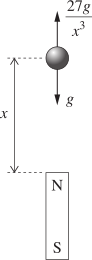
A bar magnet is held vertically. An object that is repelled by the magnet is to be dropped from directly above the magnet and will maintain a vertical trajectory. Let \(x\) be the distance of the object above the magnet. The object is subject to acceleration due to gravity, \(g\), and an acceleration due to the magnet \(\dfrac{27 g}{x^3}\), so that the total acceleration of the object is given by \(a=\dfrac{27 g}{x^3}-g\) The object is released from rest at \(x=6\). --- 8 WORK AREA LINES (style=lined) --- --- 10 WORK AREA LINES (style=lined) ---
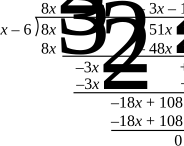
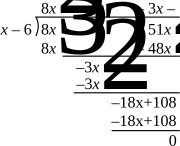
i. \(a=\dfrac{27 g}{x^3}-g\) ii. \(\text{Find \(x\) when \(v=0\):}\) \(8 x^3-51 x^2+108=(x-6)\left(8 x^2-3 x-18\right)\) \(\text{Other roots:}\)
\(\dfrac{d}{dx}(\frac{1}{2}v^{2})\)
\(= \dfrac{27g}{x^3}-g\)
\(\dfrac{1}{2} v^2\)
\(=-\dfrac{27 g}{2 x^2}-g x+c\)
\(\text{When}\ \ x=6, v=0:\)
\(0\)
\(=-\dfrac{27g}{2 \times 6^2}-6g+c\)
\(c\)
\(=\dfrac{459 g}{72}=\dfrac{51 g}{8}\)
\(\dfrac{1}{2} v^2\)
\(=-\dfrac{27 g}{2 x^2}-g x+\dfrac{51 g}{8}\)
\(v^2\)
\(=-\dfrac{27 g}{x^2}-2 g x+\dfrac{51g }{4}\)
\(=g\left(\dfrac{51}{4}-2 x-\dfrac{27}{x^2}\right)\)
\(\dfrac{51}{4}-2 x-\dfrac{27}{x^2}\)
\(=0\)
\(51 x^2-8 x^3-108\)
\(=0\)
\(8 x^3-51 x^2+108\)
\(=0\)
\(\text{Given \(x=6\) is a root:}\)
\(x\)
\(=\dfrac{3 \pm \sqrt{9-4 \cdot 8 \cdot 18}}{2 \times 8}\)
\(=\dfrac{3 \pm \sqrt{585}}{16}\)
\(=\dfrac{3+3 \sqrt{65}}{16} \quad(x>0)\)
\(=1.7 \ \text{units (1 d.p.)}\)
\(\therefore \ \text{Object next comes to rest at \(x=1.7\) units}\)
Mechanics, EXT2 M1 EQ-Bank 3
A car and its driver has a mass of 1200 kilograms and is travelling at 90 km/h.
Calculate the magnitude of the uniform breaking force, in Newtons, required to bring the car to a stop in 40 metres. (3 marks)
--- 8 WORK AREA LINES (style=lined) ---