A particle of mass 1 kg is projected from the origin with speed 40 m s\( ^{-1}\) at an angle 30° to the horizontal plane. --- 6 WORK AREA LINES (style=lined) --- The forces acting on the particle are gravity and air resistance. The air resistance is proportional to the velocity vector with a constant of proportionality 4 . Let the acceleration due to gravity be 10 m s \( ^{-2}\). The position vector of the particle, at time \(t\) seconds after the particle is projected, is \(\mathbf{r}(t)\) and the velocity vector is \(\mathbf{v}(t)\). --- 12 WORK AREA LINES (style=lined) --- --- 10 WORK AREA LINES (style=lined) --- --- 7 WORK AREA LINES (style=lined) ---
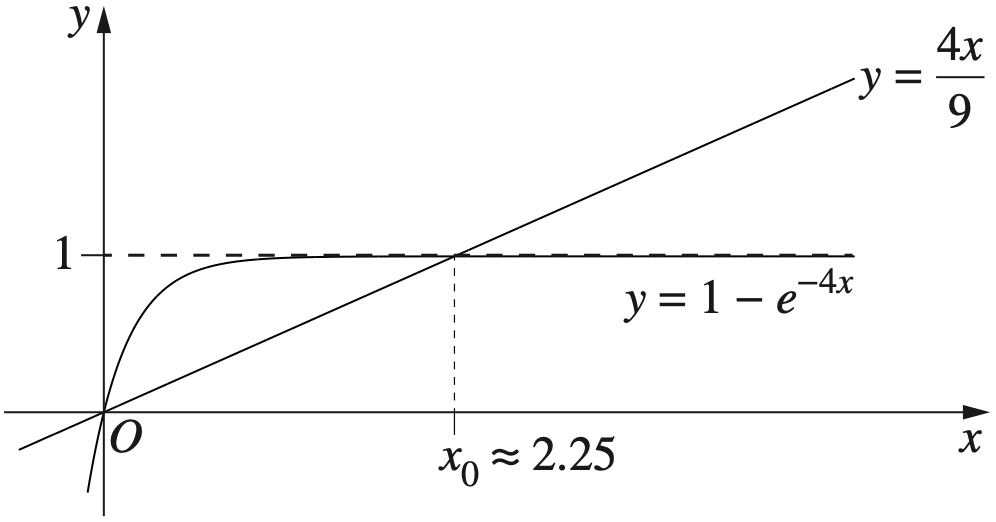
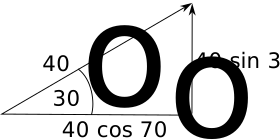
i. \(\underset{\sim}{v}(0)={\displaystyle\left(\begin{array}{cc} 40 \cos\ 30° \\ 40 \sin\ 30°\end{array}\right)} = {\displaystyle\left(\begin{array}{cc} 40 \times \frac{\sqrt3}{2} \\ 40 \times \frac{1}{2}\end{array}\right)} = {\displaystyle\left(\begin{array}{cc}20 \sqrt{3} \\ 20\end{array}\right)} \) ii. \(\text{Air resistance:} \) \(\underset{\sim}{F} = -4\underset{\sim}{v} = {\displaystyle\left(\begin{array}{cc} -4\dot{x} \\ -4\dot{y} \end{array}\right)} \) \(\text{Horizontally:}\) iv. \(\text{Range}\ \Rightarrow\ \text{Find}\ \ t\ \ \text{when}\ \ y=0: \) \(\Rightarrow \text{Solution when}\ \ t\approx 2.25\)
\(1 \times \ddot{x} \)
\(=-4 \dot{x} \)
\(\dfrac{d\dot{x}}{dt}\)
\(=-4\dot{x}\)
\(\dfrac{dt}{d\dot{x}}\)
\(= -\dfrac{1}{4\dot{x}} \)
\(t\)
\(=-\dfrac{1}{4} \displaystyle \int \dfrac{1}{\dot{x}} \ d\dot{x} \)
\(-4t\)
\(=\ln |\dot{x}|+c \)
\(\text{When}\ \ t=0, \ \dot{x}=20\sqrt3 \ \ \Rightarrow\ \ c=-\ln{20\sqrt3} \)
\(-4t\)
\(=\ln|\dot{x}|-\ln 20\sqrt3 \)
\(-4t\)
\(=\ln\Bigg{|}\dfrac{\dot{x}}{20\sqrt{3}} \Bigg{|} \)
\(\dfrac{\dot{x}}{20\sqrt{3}} \)
\(=e^{-4t} \)
\(\dot{x}\)
\(=20\sqrt{3}e^{-4t}\)
\(\text{Vertically:} \)
\(1 \times \ddot{y} \)
\(=-1 \times 10-4 \dot{y} \)
\(\dfrac{d\dot{y}}{dt}\)
\(=-(10+4\dot{y})\)
\(\dfrac{dt}{d\dot{y}}\)
\(= -\dfrac{1}{10+4\dot{y}} \)
\(t\)
\(=- \displaystyle \int \dfrac{1}{10+4\dot{y}} \ d\dot{y} \)
\(-4t\)
\(=- \displaystyle \int \dfrac{4}{10+4\dot{y}} \ d\dot{y} \)
\(-4t\)
\(=\ln |10+4\dot{y}|+c \)
\(\text{When}\ \ t=0, \ \dot{y}=20 \ \ \Rightarrow\ \ c=-\ln{90} \)
\(-4t\)
\(=\ln|10+4\dot{y}|-\ln 90 \)
\(-4t\)
\(=\ln\Bigg{|}\dfrac{10+4\dot{y}}{\ln{90}} \Bigg{|} \)
\(\dfrac{10+4\dot{y}}{90} \)
\(=e^{-4t} \)
\(4\dot{y}\)
\(=90e^{-4t}-10\)
\(\dot{y}\)
\(=\dfrac{45}{2} e^{-4t}-\dfrac{5}{2} \)
\(\therefore \underset{\sim}v={\displaystyle \left(\begin{array}{cc}20 \sqrt{3} e^{-4 t} \\ \dfrac{45}{2} e^{-4 t}-\dfrac{5}{2}\end{array}\right)}\)
iii. \(\text{Horizontally:}\)
\(x\)
\(= \displaystyle \int \dot{x}\ dx\)
\(= \displaystyle \int 20\sqrt3 e^{-4t}\ dt \)
\(=-5\sqrt3 e^{-4t}+c \)
\(\text{When}\ \ t=0, \ x=0\ \ \Rightarrow\ \ c=5\sqrt3 \)
\(x\)
\(=5\sqrt3-5\sqrt3 e^{-4t} \)
\(=5\sqrt3(1-e^{-4t}) \)
\(\text{Vertically:}\)
\(y\)
\(= \displaystyle \int \dot{y}\ dx\)
\(= \displaystyle \int \dfrac{45}{2} e^{-4t}-\dfrac{5}{2}\ dt \)
\(=-\dfrac{45}{8}e^{-4t}-\dfrac{5}{2}t+c \)
\(\text{When}\ \ t=0, \ y=0\ \ \Rightarrow\ \ c= \dfrac{45}{8} \)
\(y\)
\(=\dfrac{45}{8}-\dfrac{45}{8} e^{-4t}-\dfrac{5}{2}t \)
\(=\dfrac{45}{8}(1-e^{-4t})-\dfrac{5}{2} \)
\(\therefore \underset{\sim}{r}=\left(\begin{array}{c}5 \sqrt{3}\left(1-e^{-4 t}\right) \\ \dfrac{45}{8}\left(1-e^{-4 t}\right)-\dfrac{5}{2} t\end{array}\right)\)
\(\dfrac{45}{8}(1-e^{-4t})-\dfrac{5}{2}t \)
\(=0\)
\(\dfrac{45}{8}(1-e^{-4t}) \)
\(=\dfrac{5}{2}t \)
\(1-e^{-4t}\)
\(=\dfrac{4}{9}t \)
\(\text{Graph shows intersection of these two graphs.}\)
\(\therefore\ \text{Range}\)
\(=5\sqrt3(1-e^{(-4 \times 2.25)}) \)
\(=8.659…\)
\(=8.7\ \text{metres (to 1 d.p.)}\)