SmarterEd

Aussie Maths & Science Teachers: Save your time with SmarterEd

  • Login
  • Get Help
  • About

Statistics, EXT1 S1 2024 HSC 9 MC

A bag contains \(n\) metal coins, \(n \ge 3\), that are made from either silver or bronze.

There are \(k\) silver coins in the bag and the rest are bronze.

Two coins are to be drawn at random from the bag, with the first coin drawn not being replaced before the second coin is drawn.

Which of the following expressions will give the probability that the two coins drawn are made of the same metal?
 

  1. \(\dfrac{k(k-1)+(n-k)(n-k-1)}{n(n-1)}\)
  2. \(\left(\begin{array}{l}n \\ 2\end{array}\right) \left(\begin{array}{l}n \\ k\end{array}\right) \left(\begin{array}{l}1-\dfrac{k}{n}  \end{array}\right)^{n-2} \)
  3. \(\dfrac{\left(\begin{array}{l}k \\ 2\end{array}\right) + \left(\begin{array}{c}n-k \\ 2\end{array}\right)}{n(n-1)}  \)
  4. \(\dfrac{k^{2}+(n-k)^2}{n^{2}}\)
Show Answers Only

\(A\)

Show Worked Solution

\(P(B)=P(\text{Bronze}), \ P(S)=P(\text{Silver}) \)

\(n=\ \text{total coins},\ k=\ \text{bronze coins},\ n-k=\ \text{silver coins}\)
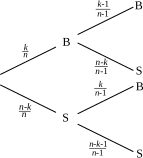
 

\(P(BB \cup SS)\) \(=\dfrac{k}{n} \times \dfrac{k-1}{n-1} + \dfrac{n-k}{n} \times \dfrac{n-k-1}{n-1}\)  
  \(=\dfrac{k(k-1)+(n-k)(n-k-1)}{n(n-1)}\)  

 
\(\Rightarrow A\)

♦ Mean mark 54%.

Filed Under: Binomial Probability (Ext1) Tagged With: Band 5, smc-1084-30-Algebraic examples

Statistics, EXT1 S1 2011 MET1 7

A biased coin tossed three times. The probability of a head from a toss of this coin is `p.`

  1. Find, in terms of `p`, the probability of obtaining

    1. three heads from the three tosses  (1 mark)

      --- 1 WORK AREA LINES (style=lined) ---

    2. two heads and a tail from the three tosses.  (1 mark)

      --- 2 WORK AREA LINES (style=lined) ---

  2. If the probability of obtaining three heads equals the probability of obtaining two heads and a tail, find `p`.  (2 marks)

    --- 3 WORK AREA LINES (style=lined) ---

Show Answers Only
    1. `p^3`
    2. `3p^2 (1 – p)`
  1. `0 or 3/4`
Show Worked Solution
a.i.    `text(P) (HHH)` `= p xx p xx p`
    `= p^3`


  ii.   `text(P) text{(2 Heads and 1 Tail from 3 tosses)}`

♦ Part (a)(ii) mean mark 41%.

`= ((3), (2)) xx p^2 xx (1 – p)^1`

`= 3 p^2 (1 – p)`


b.   `text(If probabilities are equal:)`

♦ Mean mark 48%.
MARKER’S COMMENT: Many students incorrectly assumed `p` could not be zero.
`p^3` `= 3p^2 – 3p^3`
`4p^3 – 3p^2` `= 0`
`p^2 (4p – 3)` `= 0`

 
`:. p = 0 or p = 3/4`

Filed Under: Binomial Probability (Ext1) Tagged With: Band 4, Band 5, smc-1084-30-Algebraic examples

Statistics, EXT1 S1 2006 HSC 6b

In an endurance event, the probability that a competitor will complete the course is  `p`  and the probability that a competitor will not complete the course is  `q = 1 - p.` Teams consist of either two or four competitors. A team scores points if at least half its members complete the course.

  1. Show that the probability that a four-member team will have at least three of its members not complete the course is  `4pq^3 + q^4.`  (1 mark)

    --- 2 WORK AREA LINES (style=lined) ---

  2. Hence, or otherwise, find an expression in terms of  `q`  only for the probability that a four-member team will score points.  (2 marks)

    --- 4 WORK AREA LINES (style=lined) ---

  3. Find an expression in terms of  `q`  only for the probability that a two-member team will score points.  (1 mark)

    --- 2 WORK AREA LINES (style=lined) ---

  4. Hence, or otherwise, find the range of values of  `q`  for which a two-member team is more likely than a four-member team to score points.  (2 marks)

    --- 6 WORK AREA LINES (style=lined) ---

Show Answers Only
  1. `text(Proof)\ \ text{(See Worked Solutions)}`
  2. `1  – 4q^3 + 3q^4`
  3. `1 – q^2 `
  4. `1/3 < q < 1`
Show Worked Solution

i.  `P text{(at least 3 don’t complete)}`

`= P\ text{(3 don’t complete)} + P\ text{(4 don’t complete)}`

`= \ ^4C_3 q^3 p + \ ^4C_4 q^4`

`= 4pq^3 + q^4`


ii.  `P text{(4-member team scores)}`

`= 1 – P\ text{(at least 3 don’t complete)}`

`= 1 – 4pq^3 + q^4`

`= 1 – [4 (1 – q) q^3 + q^4]`

`= 1 – (4q^3 – 4q^4 + q^4)`

`= 1  – 4q^3 + 3q^4`


iii.   `P text{(2-member team scores)}`

`= 1 – P\ text{(both don’t complete)}`

`= 1 – q*q`

`= 1 – q^2`


iv.   `text(A 2-member team is more likely to score when)`

`1 – q^2` `> 1 -4q^3 + 3q^4`
`3q^4 – 4q^3 + q^2` `< 0`
`q^2 (3q^2 – 4q + 1)` `< 0`
`q^2 (3q – 1) (q – 1)` `< 0`


`text(Consider)\ \ (3q – 1) (q – 1) < 0`

`:.\ text(S)text(ince)\ \ q\ \ text(is positive and)\ != 1`

`q^2 (3q – 1) (q – 1) < 0\ \ text(when)`

`1/3 < q < 1.`

Filed Under: Binomial Probability (Ext1), Binomial Probability EXT1 Tagged With: Band 4, Band 5, smc-1084-30-Algebraic examples

Statistics, EXT1 S1 2011 HSC 6c

A game is played by throwing darts at a target. A player can choose to throw two or three darts.

Darcy plays two games. In Game 1, he chooses to throw two darts, and wins if he hits the target at least once. In Game 2, he chooses to throw three darts, and wins if he hits the target at least twice.

The probability that Darcy hits the target on any throw is  `p`, where  `0 < p < 1`.

  1. Show that the probability that Darcy wins Game 1 is  `2p- p^2`.    (1 mark)

    --- 4 WORK AREA LINES (style=lined) ---

  2. Show that the probability that Darcy wins Game 2 is  `3p^2- 2p^3`.     (1 mark)

    --- 3 WORK AREA LINES (style=lined) ---

  3. Prove that Darcy is more likely to win Game 1 than Game 2.    (2 marks)

    --- 3 WORK AREA LINES (style=lined) ---

  4. Find the value of  `p`  for which Darcy is twice as likely to win Game 1 as he is to win Game 2.    (2 marks)

    --- 6 WORK AREA LINES (style=lined) ---

Show Answers Only
  1. `text(Proof)\ \ text{(See Worked Solutions)}`
  2. `text(Proof)\ \ text{(See Worked Solutions)}`
  3. `text(Proof)\ \ text{(See Worked Solutions)}`
  4. `p = (7 – sqrt17)/8`
Show Worked Solution

i.  `text(Show)\ P text{(wins Game 1)} = 2p\ – p^2`

♦ Mean mark 47%.

`P text{(Hits)} = P text{(H)} = p`

`P text{(Miss)} = P text{(M)} = 1 – p`
 

`P text{(Wins G1)}` `= 1 – P text{(MM)}`
  `= 1 – (1 – p)^2`
  `= 1 – 1 + 2p – p^2`
  `= 2p – p^2\ \ \ text(… as required)`


ii.  `text(Show)\ \ P text{(wins Game 2)} = 3p – 2p^3 :`

♦ Mean mark 40%.

`text(Darcy wins G2 if he hits 3 times, or twice.)`

`Ptext{(Hits 3 times)}=\ ^3C_3 (p)^3=p^3`

`Ptext{(Hits twice)}=\ ^3C_2 (p)^2 (1-p)=3p^2-3p^3`

 `P text{(Wins G2)}` `= p^3 + 3p^2-3p^3`
  `= 3p^2 – 2p^3\ \ \ text(… as required)`


♦♦♦ Mean mark 17%.
COMMENT: It is critical for students to utilise the limits of  `0<p<1`  to answer part (iii).

iii.  `text(Prove more likely to win G1 vs G2)`

`text(i.e.  Show)\ \ \ ` `2p – p^2 > 3p^2 – 2p^3`
  `2p^3 – 4p^2 + 2p` `> 0`
  `2p (p^2 – 2p + 1)` `> 0` 
  `2p (p – 1)^2` `> 0` 

 
`=> text(TRUE since)\ \ (p-1)^2>0\ \ text(and)\ \ 0 < p < 1`

`:.\ text(More likely for Darcy to win Game 1.)`
 

iv.  `text(If twice as likely to win G1 vs G2)`

♦♦ Mean mark 21%.
MARKER’S COMMENT: BE CAREFUL in formulating your equation here. Many students multiplied the wrong side by 2.
`2p\ – p^2` `= 2(3p^2 – 2p^3)`
  `= 6p^2 – 4p^3`
`4p^3 – 7p^2 + 2p` `= 0`
`p(4p^2 – 7p + 2)` `= 0`


`p` `= (–(–7) +- sqrt((–7)^2\ – 4 xx 4 xx 2))/(2 xx 4)`
  `= (7 +- sqrt(49\ – 32))/8`
  `= (7 +- sqrt17)/8`

 
`text(S)text(ince)\ \ 0<p<1,`

`p = (7\ – sqrt17)/8`

Filed Under: Binomial Probability (Ext1), Binomial Probability EXT1 Tagged With: Band 5, Band 6, smc-1084-30-Algebraic examples

Copyright © 2014–2025 SmarterEd.com.au · Log in