SmarterEd

Aussie Maths & Science Teachers: Save your time with SmarterEd

  • Login
  • Get Help
  • About

Calculus, 2ADV C3 EQ-Bank 1 MC

When  \(x=-2\)  on the curve  \(y=f(x)\), the following is true:

\(\dfrac{dy}{dx}<0\)  and  \(\dfrac{d^2 y}{d x^2}>0\)

At  \(x=-2, f(x)\) is

  1. Increasing and concave up
  2. Decreasing and concave up
  3. Increasing and concave down
  4. Decreasing and concave down
Show Answers Only

\(B\)

Show Worked Solution

\(\text{At}\ \ x=-2: \)

\(\dfrac{dy}{dx}<0 \ \Rightarrow \ \text{Decreasing}\)

\(\dfrac{d^2 y}{d x^2}>0 \ \Rightarrow \  \text{Concave up}\)

\(\Rightarrow B\)

Filed Under: The Derivative Function and its Graph Tagged With: Band 4, smc-1089-40-Investigate Graph Shapes

Calculus, 2ADV C4 2024 HSC 22

The graph of the function  \(f(x) = \ln(1 + x^{2})\)  is shown.
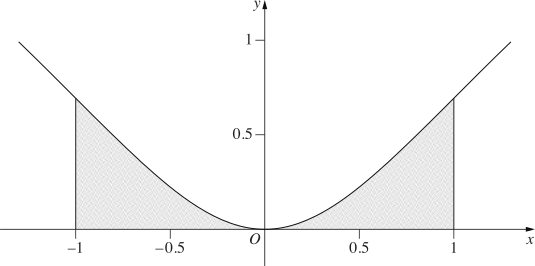
 

  1. Prove that \(f(x)\) is concave up for  \(-1 < x < 1\).   (3 marks)

    --- 10 WORK AREA LINES (style=lined) ---

  2. A table of function values, correct to 4 decimal places, for some \(x\) values is provided.

\begin{array} {|c|c|c|c|c|c|}
\hline
\rule{0pt}{2.5ex} x \rule[-1ex]{0pt}{0pt} & 0 & 0.25 & 0.5 & 0.75 & 1 \\
\hline
\rule{0pt}{2.5ex} \ln(1+x^2) \rule[-1ex]{0pt}{0pt} & \ \ \ \ 0\ \ \ \  & 0.0606 & 0.2231 & 0.4463 & 0.6931 \\
\hline
\end{array}

  1. Using the function values provided and the trapezoidal rule, estimate the shaded area in the diagram.   (2 marks)

    --- 5 WORK AREA LINES (style=lined) ---

  2. Is the answer to part (b) an overestimate or underestimate? Give a reason for your answer.   (1 mark)

    --- 5 WORK AREA LINES (style=lined) ---

Show Answers Only

a.   \(f(x)= \ln(1+x^2)\)

\(f^{′}(x)=\dfrac{2x}{1+x^2}\)

\(f^{″}(x)\) \(=\dfrac{2(1+x^2)-2x(2x)}{(1+x^2)^2}\)  
  \(=\dfrac{2+2x^2-4x^2}{(1+x^2)^2}\)  
  \(=\dfrac{2(1-x^2)}{(1+x^2)^2}\)  

 
\(\text{Consider domain}\ x \in(-1,1)\ \ \Rightarrow\ \ 1-x^2>0 \)

\((1+x^2)^2 \gt 0\ \ \text{for all}\ x\)

\(\Rightarrow \ f^{″}(x) \gt 0\ \text{for}\ x \in(-1,1) \)

\(\therefore f(x)\ \text{is concave up for}\ x \in(-1,1) \)
 

b.   \(\text{Total shaded area}\ \approx 0.5383\ \text{(4 d.p.)}\)

c.   \(\text{Trapezoidal rule assumes straight lines join points in the table.}\)

\(\text{Since the graph is concave up in the given domain, the trapezoidal rule will}\)

\(\text{overestimate the area.}\)

Show Worked Solution

a.   \(f(x)= \ln(1+x^2)\)

\(f^{′}(x)=\dfrac{2x}{1+x^2}\)

\(f^{″}(x)\) \(=\dfrac{2(1+x^2)-2x(2x)}{(1+x^2)^2}\)  
  \(=\dfrac{2+2x^2-4x^2}{(1+x^2)^2}\)  
  \(=\dfrac{2(1-x^2)}{(1+x^2)^2}\)  

 
\(\text{In domain}\ x \in(-1,1)\ \ \Rightarrow\ \ 1-x^2>0 \)

\((1+x^2)^2 \gt 0\ \ \text{for all}\ x\)

\(\Rightarrow \ f^{″}(x) \gt 0\ \text{for}\ x \in(-1,1) \)

\(\therefore f(x)\ \text{is concave up for}\ x \in(-1,1) \)

♦ Mean mark (a) 47%.

b.   \(\text{Total shaded area}\)

\(\approx 2 \times \dfrac{h}{2}[ y_0 + 2(y_1+y_2+y_3) + y_4] \)

\(\approx 2 \times \dfrac{0.25}{2}[ 0 + 2(0.0606+0.2231+0.4463) + 0.6931] \)

\(\approx 0.538275 \)

\(\approx 0.5383\ \text{(4 d.p.)}\)

♦ Mean mark (b) 50%.

c.   \(\text{Trapezoidal rule assumes straight lines join points in the table.}\)

\(\text{Since the graph is concave up in the given domain, the trapezoidal rule will}\)

\(\text{overestimate the area.}\)

♦ Mean mark (c) 49%.

Filed Under: The Derivative Function and its Graph (Y12), Trapezoidal Rule (Y12) Tagged With: Band 5, smc-1089-40-Investigate Graph Shapes, smc-976-10-Table provided, smc-976-30-Estimate Comparison

Calculus, 2ADV C3 2024 HSC 11

The graph of the function \(g(x)\) is shown.
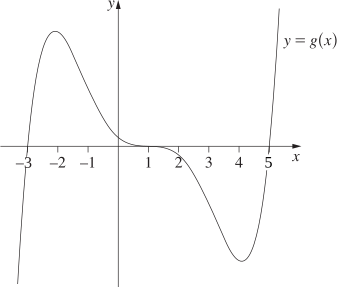
 

Using the graph, complete the table with the words positive, zero or negative as appropriate.   (3 marks)

--- 0 WORK AREA LINES (style=lined) ---

\begin{array} {|l|c|}
\hline
\rule{0pt}{2.5ex} \textit{\(x\)-value} \rule[-1ex]{0pt}{0pt} & \textit{First derivative of \(g(x)\) at \(x\)} \rule[-1ex]{0pt}{0pt} & \textit{Second derivative of \(g(x)\) at \(x\)} \\
\hline
\rule{0pt}{2.5ex} \text{\(x=-3\)} \rule[-1ex]{0pt}{0pt} & \text{ } \rule[-1ex]{0pt}{0pt} & \text{ } \\
\hline
\rule{0pt}{2.5ex} \text{\(x=1\)} \rule[-1ex]{0pt}{0pt} & \text{ } \rule[-1ex]{0pt}{0pt} & \text{ } \\
\hline
\rule{0pt}{2.5ex} \text{\(x=5\)} \rule[-1ex]{0pt}{0pt} & \text{ } \rule[-1ex]{0pt}{0pt} & \text{ } \\
\hline
\end{array}

Show Answers Only

\begin{array} {|l|c|}
\hline
\rule{0pt}{2.5ex} \textit{\(x\)-value} \rule[-1ex]{0pt}{0pt} & \textit{First derivative of \(g(x)\) at \(x\)} \rule[-1ex]{0pt}{0pt} & \textit{Second derivative of \(g(x)\) at \(x\)} \\
\hline
\rule{0pt}{2.5ex} \text{\(x=-3\)} \rule[-1ex]{0pt}{0pt} & \text{positive} \rule[-1ex]{0pt}{0pt} & \text{negative} \\
\hline
\rule{0pt}{2.5ex} \text{\(x=1\)} \rule[-1ex]{0pt}{0pt} & \text{zero} \rule[-1ex]{0pt}{0pt} & \text{zero} \\
\hline
\rule{0pt}{2.5ex} \text{\(x=5\)} \rule[-1ex]{0pt}{0pt} & \text{positive} \rule[-1ex]{0pt}{0pt} & \text{positive} \\
\hline
\end{array}

Show Worked Solution

\begin{array} {|l|c|}
\hline
\rule{0pt}{2.5ex} \textit{\(x\)-value} \rule[-1ex]{0pt}{0pt} & \textit{First derivative of \(g(x)\) at \(x\)} \rule[-1ex]{0pt}{0pt} & \textit{Second derivative of \(g(x)\) at \(x\)} \\
\hline
\rule{0pt}{2.5ex} \text{\(x=-3\)} \rule[-1ex]{0pt}{0pt} & \text{positive} \rule[-1ex]{0pt}{0pt} & \text{negative} \\
\hline
\rule{0pt}{2.5ex} \text{\(x=1\)} \rule[-1ex]{0pt}{0pt} & \text{zero} \rule[-1ex]{0pt}{0pt} & \text{zero} \\
\hline
\rule{0pt}{2.5ex} \text{\(x=5\)} \rule[-1ex]{0pt}{0pt} & \text{positive} \rule[-1ex]{0pt}{0pt} & \text{positive} \\
\hline
\end{array}

Filed Under: The Derivative Function and its Graph (Y12) Tagged With: Band 3, smc-1089-40-Investigate Graph Shapes

Calculus, 2ADV C3 2023 HSC 6 MC

The following table gives the signs of the first and second derivatives of a function  \(y=f(x)\)  for different values of \(x\).
 

\(x\) \(-2\ \ \) \(0\) \(2\)
\( f^{′}(x) \) \(+\) \(0\) \(+\)
\(f^{″}(x)\) \(-\) \(0\) \(+\)

 
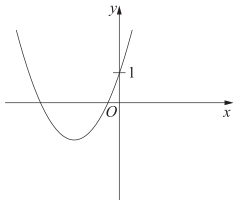
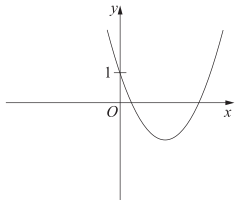
Which of the following is a possible sketch of  \(y=f(x)\)?
 

Show Answers Only

\(C\)

Show Worked Solution

\(\text{By elimination:}\)

\(\text{Gradient is positive at}\ x=-2\ \text{and}\ 2\ \ (\text{Eliminate}\ B\ \text{and}\ D)\)

\(\text{SP and POI at}\ x=0\ \ (\text{Eliminate}\ A)\)

\(\Rightarrow C\)

Filed Under: The Derivative Function and its Graph (Y12) Tagged With: Band 4, smc-1089-40-Investigate Graph Shapes

Calculus, 2ADV C3 2021 HSC 7 MC

The diagram shows part of  `y = f(x)`  which has a local minimum at  `x = –2`  and a local maximum at  `x = 3`.
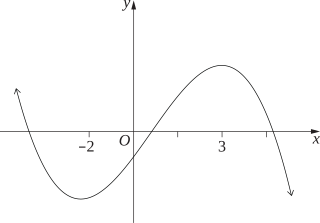
 

Which of the following shows the correct relationship between  `f^(″)(–2), \ f(0)`  and  `f^(′)(3)`?

  1. `f(0) < f^(′)(3) < f^(″)(–2)`
  2. `f(0) < f^(″)(–2) < f^(′)(3)`
  3. `f^(″)(–2) < f^(′)(3) < f(0)`
  4. `f^(″)(–2) < f(0) < f^(′)(3)`
Show Answers Only

`A`

Show Worked Solution

Mean mark 52%.
`f^(″)(–2)` `> 0\ \ \ (text(concave up at)\ \  x = –2)`
`f(0)` `< 0\ \ \ (text(see graph))`
`f^(′)(3)` `= 0\ \ \ (text(S.P.))`

 
`:. f(0) < f^(′)(3) < f^(″)(–2)`

`=> A`

Filed Under: The Derivative Function and its Graph (Y12) Tagged With: Band 4, smc-1089-40-Investigate Graph Shapes

Calculus, 2ADV C3 2020 HSC 5 MC

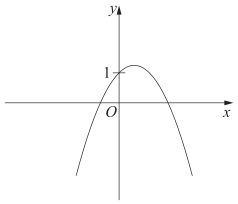
Which of the following could represent the graph of  `y = −x^2 + bx + 1`, where  `b > 0`?
 

A. B.
C. D.
Show Answers Only

`C`

Show Worked Solution

`y = −x^2 + bx + 1`

`(dy)/(dx) = −2x + b`

`text(S.P. occurs when)\ \ (dy)/(dx) = 0:`

`−2x + b` `= 0`
`x` `= b/2`

 
`text(S)text(ince)\ b > 0, text(SP occurs when)\ x > 0`

`=>C`

Filed Under: The Derivative Function and its Graph (Y12) Tagged With: Band 4, smc-1089-40-Investigate Graph Shapes

Calculus, 2ADV C3 2018 HSC 9 MC

The diagram shows the graph of  `f^{′}(x)`, the derivative of a function.
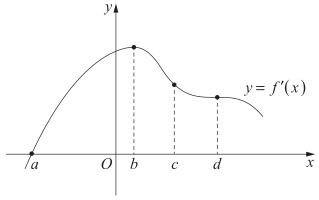
 

For what value of `x` does the graph of the function  `f(x)`  have a point of inflection?

  1. `x = a`
  2. `x = b`
  3. `x = c`
  4. `x = d`
Show Answers Only

`B`

Show Worked Solution

`text(P.I. will occur when the graph of)\ \ f^{′}(x)`

♦ Mean mark 41%.

`text(has a turning point).`

`:. x = b`

`=>  B`

Filed Under: Curve Sketching and The Primitive Function, The Derivative Function and its Graph (Y12) Tagged With: Band 5, smc-1089-40-Investigate Graph Shapes

Calculus, 2ADV C3 2017 HSC 4 MC

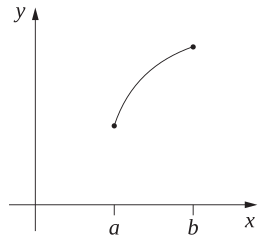
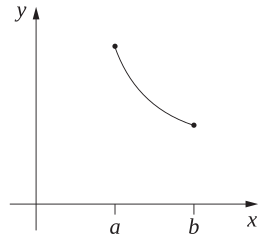
The function  `f(x)` is defined for  `a <= x <= b.`

On this interval,  `f ^{′}(x) > 0 and f^{″}(x) < 0.`

Which graph best represents  `y = f(x)`?
 

(A)   (B)  
(C)   (D)  
Show Answers Only

`A`

Show Worked Solution

`text(Interpreting)\ \ f^{′}(x) > 0,`

`=>\ text(gradient is always positive)`

`text(Interpreting)\ \ f^{″}(x) < 0,`

`=>\ text(Curve is concave down)`

`=>  A`

Filed Under: Curve Sketching and The Primitive Function, The Derivative Function and its Graph (Y12) Tagged With: Band 4, smc-1089-40-Investigate Graph Shapes

Calculus, 2ADV C3 2012 HSC 4 MC

The diagram shows the graph  `f(x)`.
 

2012 4 mc
 

Which of the following statements is true? 

  1. `f^{′}(a)>0\ \ text(and)\ \ f^{″}(a)<0`  
  2. `f^{′}(a)>0\ text(and)\ \ f^{″}(a)>0`  
  3. `f^{′}(a)<0\ \ text(and)\ \ f^{″}(a)<0`  
  4.  `f^{′}(a)<0\ \ text(and)\ \ f^{″}(a)>0`  
Show Answers Only

`A`

Show Worked Solution

`text(At)\ \ x=a,`

`f^{′}(a) > 0\ \ \ :.\ text(Cannot be)\ C\ text(or)\ D`

`f^{″}(a) < 0\ \ text(because)\ \ f(x)\ text(is concave down at)\ x=a`

`:.\ text(Cannot be)\ B`

`=>  A`

Filed Under: Curve Sketching and The Primitive Function, The Derivative Function and its Graph (Y12) Tagged With: Band 4, smc-1089-40-Investigate Graph Shapes

Calculus, 2ADV C3 2013 HSC 8 MC

The diagram shows points  `A`,  `B`,  `C`  and  `D`  on the graph  `y = f(x)`.
 

2013 8 mc

 
 At which point is  `f^{′}(x) > 0`  and  ` f^{″}(x)= 0`? 

  1. `A`  
  2. `B`  
  3. `C`  
  4. `D`  
Show Answers Only

`B`

Show Worked Solution
♦ Mean mark 48%

`text(At)\ A,\ \ \ f^{′}(x) <0`

`text(At)\ C,\ \ \ f^{′}(x) =0`

`:.\ text(It cannot be)\ A\ text(or)\ C.`

`text(At)\ D,\ \ \ f^{″}(x) >0\ \ \ text{(concave up)}`

`text(At)\ B,\ \ \ f^{″}(x) =0\ \ \ text{(concavity changes)}`

`=> B`

Filed Under: ATTENTION, Curve Sketching and The Primitive Function, The Derivative Function and its Graph (Y12) Tagged With: Band 5, smc-1089-40-Investigate Graph Shapes

Copyright © 2014–2025 SmarterEd.com.au · Log in