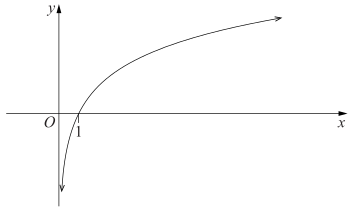
The graphs of \(y=e\, \ln x\) and \(y=a x^2+c\) are shown. The line \(y=x\) is a tangent to both graphs at their point of intersection.

Find the values of \(a\) and \(c\). (4 marks)
--- 16 WORK AREA LINES (style=lined) ---
Aussie Maths & Science Teachers: Save your time with SmarterEd
The graphs of \(y=e\, \ln x\) and \(y=a x^2+c\) are shown. The line \(y=x\) is a tangent to both graphs at their point of intersection.
Find the values of \(a\) and \(c\). (4 marks)
--- 16 WORK AREA LINES (style=lined) ---
The diagram shows the graph of `y = c ln x, \ c > 0`.
--- 5 WORK AREA LINES (style=lined) ---
--- 5 WORK AREA LINES (style=lined) ---
Find the equation of the tangent to `y = log_ex` at the point `(e, 1)`. (2 marks)
--- 5 WORK AREA LINES (style=lined) ---
The line `y = mx` is a tangent to the curve `y = e^(2x)` at a point `P`.
--- 8 WORK AREA LINES (style=lined) ---
--- 6 WORK AREA LINES (style=lined) ---
--- 1 WORK AREA LINES (style=lined) ---

| i. | |
| ii. | `y` | `= e^(2x)` |
| `dy/dx` | `= 2e^(2x)` |
`text(Gradient of)\ \ y = mx\ \ text(is)\ \ m`
`text(Gradients equal when)`
| `2e^(2x)` | `= m` |
| `e^(2x)` | `= m/2` |
| `ln e^(2x)` | `= ln (m/2)` |
| `2x` | `= ln (m/2)` |
| `x` | `= 1/2 ln (m/2)` |
`text(When)\ \ x = 1/2 ln (m/2)`
| `y` | `= e^(2 xx 1/2 ln (m/2))` |
| `= e^(ln(m/2))` | |
| `= m/2` |
`:.\ P (1/2 ln (m/2), m/2)`
iii. `y=mx\ \ text(passes through)\ \ (0,0)\ text(and)\ (1/2 ln (m/2), m/2)`
`text(Equating gradients:)`
| `(m/2 – 0)/(1/2 ln (m/2) – 0)` | `=m` |
| `m/2` | `=m xx 1/2 ln(m/2)` |
| `ln (m/2)` | `= 1` |
| `m/2` | `= e^1` |
| `m` | `= 2e` |
Find the gradient of the tangent to the curve `y=ln (3x)` at the point where `x=2`. (2 marks)