Find the equation of the tangent to \(y=5 x^3-\dfrac{2}{x^2}-9\) at the point \((1,-6)\). (3 marks)
--- 9 WORK AREA LINES (style=lined) ---
Aussie Maths & Science Teachers: Save your time with SmarterEd
Find the equation of the tangent to \(y=5 x^3-\dfrac{2}{x^2}-9\) at the point \((1,-6)\). (3 marks)
--- 9 WORK AREA LINES (style=lined) ---
\(y=19 x-25\)
\(y=5 x^3-2 x^{-2}-9\)
\(y^{\prime}=15 x^2+4 x^{-3} \)
\(\text{At} \ \ x=1:\)
\(y^{\prime}=15+4=19\)
\(\text{Equation of line} \ \ m=19 \ \ \text {through}\ \ (1,-6): \)
| \(y+6\) | \(=19(x-1)\) |
| \(y+6\) | \(=19 x-19\) |
| \(y\) | \(=19 x-25\) |
Suppose that a function \(f(x)\) and its derivative \(f^{\prime}(x)\) satisfy \(f(4)=25\) and \(f^{\prime}(4)=15\).
Determine the gradient of the tangent line to the graph of \( {\displaystyle y=\sqrt{f(x)} } \) at \( x=4 \).
\(D\)
| \(y\) | \(=\sqrt{f(x)}={f(x)}^{\frac{1}{2}}\) |
| \(y^{\prime}\) | \(=\dfrac{1}{2}\left({f(x)}^{-\frac{1}{2}}\right)\times f^{\prime}(x)=\dfrac{f^{\prime}(x)}{2\sqrt{f(x)}}\) |
\(\text{Given}\ \ f(4)=25,\ f^{\prime}(4)=15\)
\(\therefore\ y^{\prime}=\dfrac{15}{2\sqrt{25}}=\dfrac{3}{2}\)
\(\Rightarrow D\)
The graph of `y = f(x)` is shown.
Which of the following inequalities is correct?
`A`
`y = f(x)\ text(is concave down at)\ \ x = 1`
`f^{″}(1) < 0`
`=>\ text(Eliminate C and D.)`
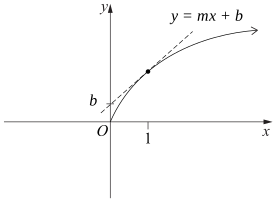
`text(T)text(angent)\ => y=mx+b`
`text(At)\ \ x = 1, m_text(tang) = f^{′}(1)`
`text(At intersection:)`
| `mx+b` | `=f(1)` | |
| `f^{′}(1) xx 1 + b` | `=f(1)` | |
| `:. f^{′}(1)` | `<f(1),\ \ \ (b>0)` |
`:. f^{″}(1) < 0 < f^{′}(1) < f(1)`
`=>A`
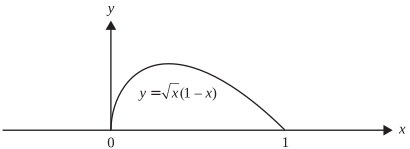
The graph of `f(x) = sqrt x (1 - x)` for `0<=x<=1` is shown below.
--- 5 WORK AREA LINES (style=lined) ---
--- 2 WORK AREA LINES (style=lined) ---
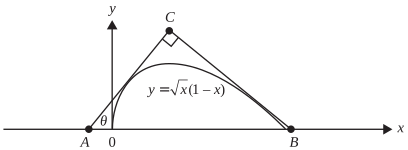
The edges of the right-angled triangle `ABC` are the line segments `AC` and `BC`, which are tangent to the graph of `f(x)`, and the line segment `AB`, which is part of the horizontal axis, as shown below.
Let `theta` be the angle that `AC` makes with the positive direction of the horizontal axis.
--- 6 WORK AREA LINES (style=lined) ---
| i. | `text(Area)` | `= int_0^1 (sqrt x – x sqrt x)\ dx` |
| `= int_0^1 (x^(1/2) – x^(3/2))\ dx` | ||
| `= [2/3 x^(3/2) – 2/5 x^(5/2)]_0^1` | ||
| `= (2/3 – 2/5) – (0 – 0)` | ||
| `= 10/15 – 6/15` | ||
| `= 4/15\ text(units)^2` |
| ii. | `f (x)` | `= x^(1/2) – x^(3/2)` |
| `f prime (x)` | `= 1/2 x^(-1/2) – 3/2 x^(1/2)` | |
| `= 1/(2 sqrt x) – (3 sqrt x)/2` | ||
| `= (1 – 3x)/(2 sqrt x)\ \ text(.. as required.)` |
iii. `m_(AC) = tan 45^@=1`
`=> m_(BC) = -1\ \ (m_text(BC) _|_ m_(AC))`
`text(At point of tangency of)\ BC,\ f prime(x) = -1`
| `(1 – 3x)/(2 sqrt x)` | `=-1` |
| `1-3x` | `=-2sqrtx` |
| `3x-2sqrt x-1` | `=0` |
`text(Let)\ \ a=sqrtx,`
| `3a^2-2a-1` | `=0` |
| `(3a+1)(a-1)` | `=0` |
| `a=1 or -1/3` |
| `:. sqrt x` | `=1` | `or` | `sqrt x=- 1/3\ \ text{(no solution)}` |
| `x` | `=1` |
`f(1)=sqrt1(1-1)=0\ \ =>B(1,0)`
`text(Equation of)\ \ BC, \ m=-1, text{through (1,0):}`
| `y-0` | `=-1(x-1)` |
| `y` | `=-x+1` |