SmarterEd

Aussie Maths & Science Teachers: Save your time with SmarterEd

  • Login
  • Get Help
  • About

Statistics, STD1 S3 2025 HSC 15

A researcher is using the statistical investigation process to investigate a possible relationship between average number of minutes per day a person spends watching television, and the average number of minutes per day the person spends exercising.

  1. State the statistical question being posed.   (1 mark)

    --- 3 WORK AREA LINES (style=lined) ---

Participants were asked to record the number of minutes they spent watching television each day and the number of minutes they spent exercising each day. The averages for each participant were recorded and graphed, and a line of best fit was included.
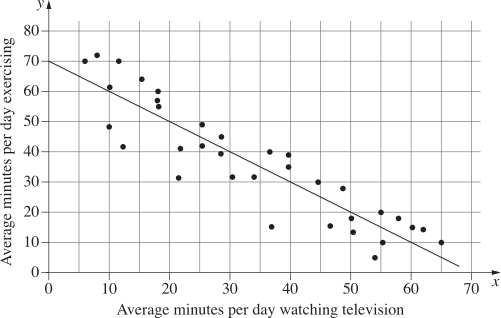
 

  1. From the graph, identify the dependent variable.   (1 mark)

    --- 1 WORK AREA LINES (style=lined) ---

  2. Describe the bivariate dataset in terms of its form and direction.   (2 marks)

    --- 3 WORK AREA LINES (style=lined) ---

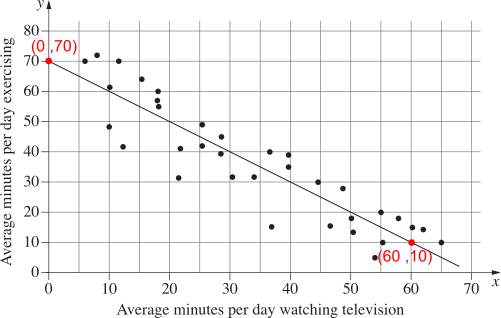
  3. The points \((0, 70)\) and \((60, 10)\) lie on the line of best fit. By first plotting these points on the graph, find the gradient and the \(y\)-intercept of the line of best fit.   (3 marks)

    --- 10 WORK AREA LINES (style=lined) ---

  4. Explain why it is NOT appropriate to extrapolate the line of best fit to predict the average number of minutes of exercise per day for someone who watches an average of 2 hours of television per day.   (1 mark)

    --- 4 WORK AREA LINES (style=lined) ---

Show Answers Only

a.    \(\text{How does the average daily time spent watching television}\)

\(\text{relate to the average daily time spent exercising?}\)
 

b.    \(\text{Dependent variable: Average minutes per day exercising, or }y.\)
 

c.    \(\text{Form:  Linear}\)

\(\text{Direction:  Negative}\)
 

d.   \(\text{Gradient}=-1\)
 

e.    \(\text{The extrapolation of the graph past 70 minutes produces}\)

\(\text{negative average minutes per day exercising (impossible).}\)
Show Worked Solution

a.    \(\text{How does the average daily time spent watching television}\)

\(\text{relate to the average daily time spent exercising?}\)
 

b.    \(\text{Dependent variable:}\)

\(\text{Average minutes per day exercising, or }y.\)
 

c.    \(\text{Form:  Linear}\)

\(\text{Direction:  Negative}\)
 

d. 


\(y-\text{intercept = 70}\)

\(\text{Gradient}=\dfrac{\text{rise}}{\text{run}}=\dfrac{-60}{60}=-1\)
 

e.    \(\text{The extrapolation of the graph past 70 minutes produces}\)

\(\text{negative average minutes per day exercising (impossible).}\)
Filed Under: S3 Further Statistical Analysis (Y12) Tagged With: Band 3, Band 4, Band 5, smc-1113-10-Line of Best Fit, smc-1113-50-Gradient, smc-1113-60-Limitations, smc-1113-80-Investigation Process

Statistics, STD1 S3 2020 HSC 22

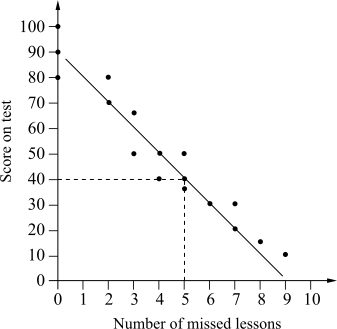
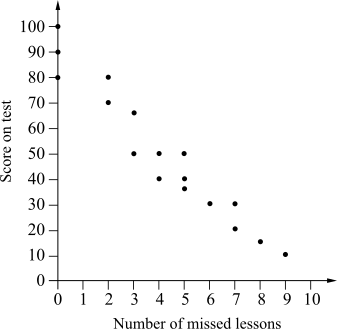
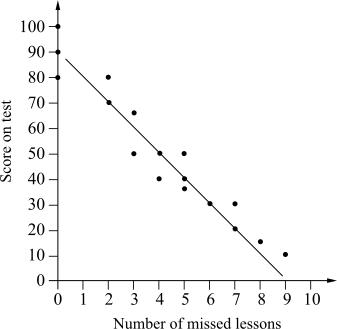
A group of students sat a test at the end of term. The number of lessons each student missed during the term and their score on the test are shown on the scatterplot.


  1. Describe the strength and direction of the linear association observed in this dataset.  (2 marks)

    --- 5 WORK AREA LINES (style=lined) ---

  2. Calculate the range of the test scores for the students who missed no lessons.  (1 mark)

    --- 1 WORK AREA LINES (style=lined) ---

  3. Draw a line of the best fit in the scatterplot above.  (1 mark)
  4. Meg did not sit the test. She missed five lessons.


    Use the line of the best fit drawn in part (c) to estimate Meg's score on this test. (1 mark)

    --- 1 WORK AREA LINES (style=lined) ---

  5. John also did not sit the test and he missed 16 lessons.


    Is it appropriate to use the line of the best fit to estimate his score on the test? Briefly explain your answer. (1 mark)

    --- 2 WORK AREA LINES (style=lined) ---

Show Answers Only

a.    \(\text{Strength : strong}\)

\(\text{Direction : negative} \)

b.    \(\text{Range}\ = \text{high}-\text{low}\ = 100-80=20\)
 

c.   

d. 


e.    \(\text{John’s missed days are too extreme and the LOBF is not}\)

\(\text{appropriate. The model would estimate a negative score for}\)

\(\text{John which is impossible.}\)

Show Worked Solution

a.    \(\text{Strength : strong}\)

\(\text{Direction : negative} \)

♦ Mean mark (a) 45%.
♦♦ Mean mark (b) 31%.

b.    \(\text{Range}\ = \text{high}-\text{low}\ = 100-80=20\)
 

c.   

d. 


\(\therefore\ \text{Meg’s estimated score = 40}\)
 

e.    \(\text{John’s missed days are too extreme and the LOBF is not}\)

\(\text{appropriate. The model would estimate a negative score for}\)

\(\text{John which is impossible.}\)

♦ Mean mark (e) 38%.

Filed Under: Bivariate Data, S3 Further Statistical Analysis (Y12) Tagged With: Band 4, Band 5, num-title-ct-coreb, num-title-qs-hsc, smc-1113-10-Line of Best Fit, smc-1113-60-Limitations, smc-5022-10-Line of best fit graphs, smc-5022-25-Draw LOBF, smc-5022-30-Correlation, smc-5022-60-Limitations

Statistics, STD2 S4 2013 HSC 28b

Ahmed collected data on the age (`a`) and height (`h`) of males aged 11 to 16 years.

He created a scatterplot of the data and constructed a line of best fit to model the relationship between the age and height of males.
 

  1. Determine the gradient of the line of best fit shown on the graph.   (1 mark)

    --- 2 WORK AREA LINES (style=lined) ---

  2. Explain the meaning of the gradient in the context of the data.   (1 mark)

    --- 2 WORK AREA LINES (style=lined) ---

  3. Determine the equation of the line of best fit shown on the graph.  (2 marks)

    --- 5 WORK AREA LINES (style=lined) ---

  4. Use the line of best fit to predict the height of a typical 17-year-old male.   (1 mark)

    --- 1 WORK AREA LINES (style=lined) ---

  5. Why would this model not be useful for predicting the height of a typical 45-year-old male?   (1 mark)

    --- 2 WORK AREA LINES (style=lined) ---

Show Answers Only
  1. `text(Gradient = 6)`
  2. `text(Males should grow 6 cm per)`


    `text(year between the ages 11-16.)`

  3. `h = 6a + 80`
  4. `text(182 cm)`
  5. `text(People slow and eventually stop growing)`
  6.  

    `text(after they become adults.)`

Show Worked Solution

i.    `text{Gradient}\ =(176-146)/(16-11)=30/5=6`
 

ii.   `text{Males should grow 6cm per year between the}`

`text{ages 11–16.}`
 

♦♦ Mean marks of 38%, 26% and 25% respectively for parts (i)-(iii).
MARKER’S COMMENT: Interpreting gradients has been consistently examined in recent history and almost always poorly answered. 

iii.   `text{Gradient = 6,  Passes through (11, 146)}`

`y-y_1` `=m(x-x_1)`
`h-146` `=6(a-11)`
`:. h` `=6a-66+146`
  `=6a + 80`


iv.   `text{Substitue}\ \ a=17\ \ \text{into equation from part (iii):}`

`h=(6 xx 17) +80=182`

`:.\ text{A typical 17 year old is expected to be 182cm.}`
  

v.    `text(People slow and eventually stop growing)`
  `text(after they become adults.)`

Filed Under: Bivariate Data Analysis (Y12), Life Expectancy, Other Linear Modelling, S3 Further Statistical Analysis (Y12), S4 Bivariate Data Analysis (Y12) Tagged With: Band 4, Band 5, common-content, smc-1001-10-Line of Best Fit, smc-1001-50-Gradient Interpretation, smc-1001-60-Limitations, smc-1113-10-Line of Best Fit, smc-1113-50-Gradient, smc-1113-60-Limitations, smc-785-10-Line of Best Fit, smc-785-50-Gradient Interpretation, smc-785-60-Limitations

Copyright © 2014–2025 SmarterEd.com.au · Log in