SmarterEd

Aussie Maths & Science Teachers: Save your time with SmarterEd

  • Login
  • Get Help
  • About

Probability, STD1 S2 2024 HSC 17

A wheel is shown with the numbers 0 to 19 marked.

A game is played where the wheel is spun until it stops.

When the wheel stops, a pointer points to the winning number. Each number is equally likely to win.
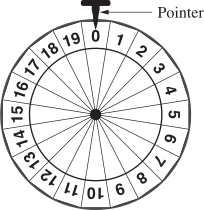
 

  1. List all the even numbers on the wheel that are greater than 7.   (1 mark)

    --- 2 WORK AREA LINES (style=lined) ---

  2. What is the probability that the winning number is NOT an even number greater than 7?   (2 marks)

    --- 4 WORK AREA LINES (style=lined) ---

Show Answers Only

a.    \(8\ ,\ 10\ ,\ 12\ ,\ 14\ ,\ 16\ ,\ 18\)

b.    \(0.7\)

Show Worked Solution

a.    \(8\ ,\ 10\ ,\ 12\ ,\ 14\ ,\ 16\ ,\ 18\ \text{(6 numbers)}\)
 

b.   \(\text{Total numbers = 20}\)

\(\text{Numbers not even and > 7}\ = 20-6=14\ \text{numbers}\)

\(P\text{(not even and > 7)}\ =\dfrac{14}{20}=0.7\)

♦♦ Mean mark (b) 32%.

Filed Under: Single and Multi-Stage Events (Std 1) Tagged With: Band 3, Band 5, smc-1135-05-Simple Probability, smc-1135-30-P(E) = 1 - P(not E)

Probability, STD1 S2 2022 HSC 17

Each number from 1 to 30 is written on a separate card. The 30 cards are shuffled. A game is played where one of these cards is selected at random. Each card is equally likely to be selected.

Ezra is playing the game, and wins if the card selected shows an odd number between 20 and 30.

  1. List the numbers which would result in Ezra winning the game.  (1 mark)

    --- 1 WORK AREA LINES (style=lined) ---

  2. What is the probability that Ezra does NOT win the game?  (2 marks)

    --- 4 WORK AREA LINES (style=lined) ---
Show Answers Only
  1. `21, 23, 25, 27, 29`
  2. `Ptext{(not win)} = 5/6`
Show Worked Solution

a.   `21, 23, 25, 27, 29`
 

b.    `Ptext{(not win)}` `=1-Ptext{(win)}`
    `=1-5/30`
    `=25/30`
    `=5/6`


♦ Mean mark 51%.

Filed Under: Probability, Single and Multi-Stage Events (Std 1) Tagged With: Band 3, Band 5, num-title-ct-core, num-title-qs-hsc, smc-1135-05-Simple Probability, smc-1135-30-P(E) = 1 - P(not E), smc-4225-15-Single-stage events, smc-4225-20-Complementary events

Probability, STD1 S2 2021 HSC 20

In a bag, there are six playing cards, 2, 4, 6, 8, Queen and King. The Queen and King are known as picture cards.

Two of these cards are chosen randomly. All the possible outcomes are shown.


  1. What is the probability that the two cards chosen include one or both picture cards?  (1 mark)

    --- 2 WORK AREA LINES (style=lined) ---

  2. What is the probability that the two cards chosen do NOT include any picture cards?  (1 mark)

    --- 2 WORK AREA LINES (style=lined) ---

Show Answers Only
  1. `9/15`
  2. `6/15`
Show Worked Solution

a.   `P text{(at least 1 picture card)} = 9/15`


b.    `P text{(no picture card)}` `= 1 – 9/15`
    `= 6/15`

Filed Under: Probability, Single and Multi-Stage Events (Std 1) Tagged With: Band 4, num-title-ct-core, num-title-qs-hsc, smc-1135-20-Other Multi-Stage Events, smc-1135-30-P(E) = 1 - P(not E), smc-4225-15-Single-stage events, smc-4225-20-Complementary events

Probability, STD2 S2 SM-Bank 1

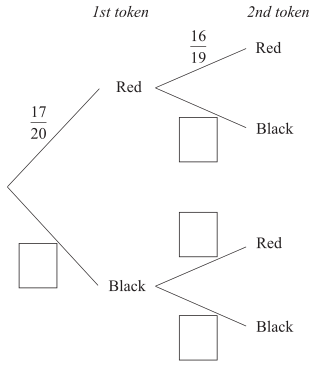
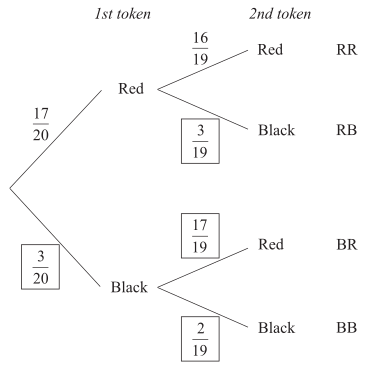
A game consists of two tokens being drawn at random from a barrel containing 20 tokens. There are 17 red tokens and 3 black tokens. The player keeps the two tokens drawn.

  1.  Complete the probability tree by writing the missing probabilities in the boxes.  (2 marks)


  2.  What is the probability that a player draws at least one red token. Give your answer in exact form.  (2 marks)

    --- 4 WORK AREA LINES (style=lined) ---
Show Answers Only
  1.  
  2. `187/190`
Show Worked Solution
i.   


ii.   `P(text(at least one red))`

`= 1 – P(BB)`

`= 1 – 3/20 · 2/19`

`= 187/190`

Filed Under: Multi-Stage Events (Std 2), Single and Multi-Stage Events (Std 1) Tagged With: Band 4, Band 5, smc-1135-10-Probability Trees, smc-1135-30-P(E) = 1 - P(not E), smc-829-10-Probability Trees, smc-829-30-P(E) = 1 - P(not E)

Probability, STD2 S2 2009 HSC 27c

In each of three raffles, 100 tickets are sold and one prize is awarded.

Mary buys two tickets in one raffle. Jane buys one ticket in each of the other two raffles.

Determine who has the better chance of winning at least one prize. Justify your response using probability calculations.   (4 marks)  

Show Answers Only
`P(text(Mary wins) )` `= 2/100`
  `= 1/50`


`P(text(Jane wins at least 1) )` `= 1-P (text(loses both) )`
  `= 1-99/100 xx 99/100`
  `= 1-9801/(10\ 000)`
  `= 199/(10\ 000)`

 
`text{Since}\ \ 1/50 > 199/(10\ 000)`

`=>\ text(Mary has a better chance of winning.)`

Show Worked Solution
`P(text(Mary wins) )` `= 2/100`
  `= 1/50`


`P(text(Jane wins at least 1) )` `= 1-P (text(loses both) )`
  `= 1-99/100 xx 99/100`
  `= 1-9801/(10\ 000)`
  `= 199/(10\ 000)`

 
`text{Since}\ \ 1/50 > 199/(10\ 000)`

`=>\ text(Mary has a better chance of winning.)`

♦♦ Mean mark 31%.
MARKER’S COMMENT: Very few students calculated Jane’s chance of winning correctly. Note the use of “at least” in the question. Finding `1-P`(complement) is the best strategy here.

Filed Under: Multi-Stage Events, Multi-stage Events, Multi-Stage Events (Std 2), Single and Multi-Stage Events (Std 1) Tagged With: Band 5, num-title-ct-pathb, num-title-qs-hsc, smc-1135-20-Other Multi-Stage Events, smc-1135-30-P(E) = 1 - P(not E), smc-4238-70-Complementary events, smc-4238-80-"at least", smc-829-20-Other Multi-Stage Events, smc-829-30-P(E) = 1 - P(not E)

Probability, STD2 S2 2012 HSC 12 MC

Two unbiased dice, each with faces numbered 1, 2, 3, 4, 5, 6, are rolled. 

What is the probability of a 6 appearing on at least one of the dice? 

  1. `1/6`  
  2. `11/36` 
  3. `25/36`  
  4. `5/6`  
Show Answers Only

`B`

Show Worked Solution

`P(text(at least 1 six))`

`= 1-P(text(no six)) xx P(text(no six))`

`=1-5/6 xx 5/6`

`=11/36`
 

`=>  B`

♦♦♦ Mean mark 25%
COMMENT: The term “at least” should flag that calculating the probability of `1-P text{(event not happening)}` is likely to be the most efficient way to solve.

Filed Under: Multi-stage Events, Multi-Stage Events (Std 2), Single and Multi-Stage Events (Std 1) Tagged With: Band 5, num-title-ct-pathb, num-title-qs-hsc, smc-1135-20-Other Multi-Stage Events, smc-1135-30-P(E) = 1 - P(not E), smc-4238-70-Complementary events, smc-4238-80-"at least", smc-829-20-Other Multi-Stage Events, smc-829-30-P(E) = 1 - P(not E)

Copyright © 2014–2025 SmarterEd.com.au · Log in