SmarterEd

Aussie Maths & Science Teachers: Save your time with SmarterEd

  • Login
  • Get Help
  • About

Financial Maths, STD1 F3 2024 HSC 30

The graph shows the decreasing value of an asset.
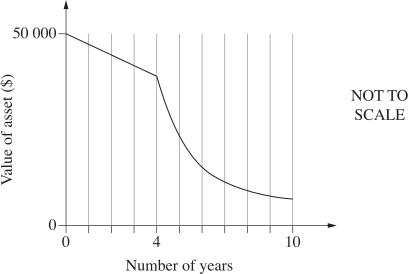
For the first 4 years, the value of the asset depreciated by $1500 per year, using a straight-line method of depreciation.

After the end of the 4th year, the method of depreciation changed to the declining-balance method at the rate of 35% per annum.

What is the total depreciation at the end of 10 years?   (4 marks)

--- 10 WORK AREA LINES (style=lined) ---
Show Answers Only

\(\text{Total depreciation}\ =$46\,681.57\)

Show Worked Solution

\(\text{Depreciation after 4 years}\ = 4 \times 1500 = $6000\)

\(\text{Value after 4 years}\ = 50\,000-6000=44\,000\)

\(\text{Declining balance used for the next 6 years:}\)

\(V_0=$44\,000, r=0.35, n=6\)

\(S\) \(=V_0(1-r)^n\)  
  \(=44\,000(1-0.35)^6\)  
  \(=$3318.43\)  

 
\(\therefore\ \text{Total depreciation}\ =50\,000-3318.43=$46\,681.57\)

♦ Mean mark 40%.

Filed Under: Depreciation - Declining Balance (Std 1) Tagged With: Band 5, smc-1139-10-Find S, smc-1139-50-Declining Balance vs Straight Line, smc-1139-60-Depreciation Graphs

Financial Maths, STD1 F3 2023 HSC 30

A plumber leases equipment which is valued at $60 000.

The salvage value of the equipment at any time can be calculated using either of the two methods of depreciation shown in the table.

\begin{array} {|l|c|}
\hline
\rule{0pt}{2.5ex} \textit{Method of depreciation} \rule[-1ex]{0pt}{0pt} & \textit{Rate of depreciation} \\
\hline
\rule{0pt}{2.5ex} \text{Straight-line method} \rule[-1ex]{0pt}{0pt} & \text{\$3500 per annum} \\
\hline
\rule{0pt}{2.5ex} \text{Declining-balance method} \rule[-1ex]{0pt}{0pt} & \text{12% per annum} \\
\hline
\end{array}

Under which method of depreciation would the salvage value of the equipment be lower at the end of 3 years? Justify your answer with appropriate mathematical calculations.  (3 marks)

--- 6 WORK AREA LINES (style=lined) ---

Show Answers Only

\(\text{Straight-line method:}\)

\(S\) \(=V_0-Dn\)  
  \(=60\ 000-3500\times 3\)  
  \(=$49\ 500\)  

 
\(\text{Declining-balance method:}\)

\(S\) \(=V_0(1-r)^n\)  
  \(=60\ 000(1-0.12)^3\)  
  \(=60\ 000(0.88)^3\)  
  \(=$40\ 888.32\)  

 
\(\text{Salvage value is lower for the declining-balance method.}\)

Show Worked Solution

\(\text{Straight-line method:}\)

\(S\) \(=V_0-Dn\)  
  \(=60\ 000-3500\times 3\)  
  \(=$49\ 500\)  

 
\(\text{Declining-balance method:}\)

\(S\) \(=V_0(1-r)^n\)  
  \(=60\ 000(1-0.12)^3\)  
  \(=60\ 000(0.88)^3\)  
  \(=$40\ 888.32\)  

 
\(\text{Salvage value is lower for the}\)

\(\text{declining-balance method.}\)


♦ Mean mark 48%.

Filed Under: Depreciation - Declining Balance (Std 1) Tagged With: Band 5, smc-1124-20-Straight Line Depreciation, smc-1139-50-Declining Balance vs Straight Line, std2-std1-common

Financial Maths, STD1 F3 2022 HSC 30

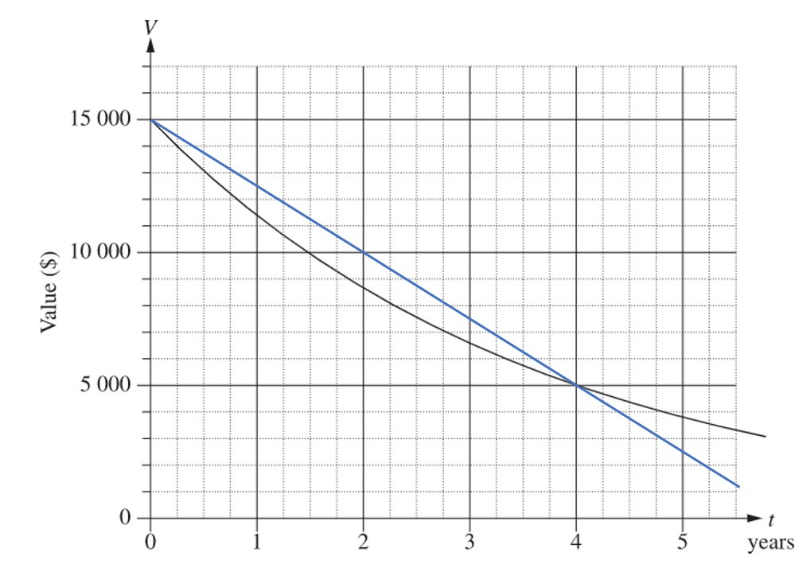
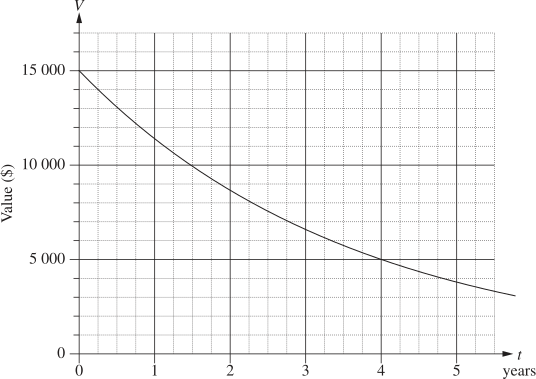
A car is purchased for $15 000. The graph shows the value of the car, `$V`, at time `t` years since it was purchased, using the declining-balance method of depreciation.


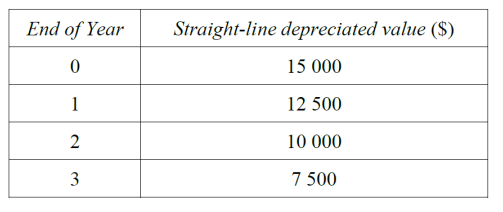
  1. When using the straight-line method of depreciation, the value of the car depreciates at a rate of $2500 per year.

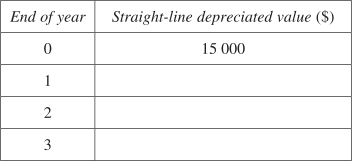
  2. By first completing the table, plot on the grid above the value of the car for the first three years based on the straight-line method of depreciation.  (2 marks)

  3.      
  4. After how many years will the value of the car using the straight-line method of depreciation be equal to its value using the declining-balance method?  (2 marks)

    --- 1 WORK AREA LINES (style=lined) ---

Show Answers Only

a.  
     

b.   
     

Values are equal when graphs intersect

→ after 4 years

Show Worked Solution

a.  
     

b.   
     

Values are equal when graphs intersect

→ after 4 years


♦♦ Mean mark part (a) 37%.
♦♦ Mean mark part (b) 31%.

Filed Under: Depreciation - Declining Balance (Std 1) Tagged With: Band 5, smc-1139-50-Declining Balance vs Straight Line, smc-1139-60-Depreciation Graphs

Financial Maths, STD2 F4 2006 HSC 27c

Kai purchased a new car for $30 000. It depreciated in value by $2000 per year for the first three years.

After the end of the third year, Kai changed the method of depreciation to the declining balance method at the rate of 25% per annum.

  1. Calculate the value of the car at the end of the third year.  (1 mark)

    --- 1 WORK AREA LINES (style=lined) ---

  2. Calculate the value of the car seven years after it was purchased.  (2 marks)

    --- 4 WORK AREA LINES (style=lined) ---

  3. Without further calculations, sketch a graph to show the value of the car over the seven years.


    Use the horizontal axis to represent time and the vertical axis to represent the value of the car.  (3 marks)

    --- 8 WORK AREA LINES (style=lined) ---

Show Answers Only
  1. `$24\ 000`
  2. `$7593.75`
  3. `text{See Worked Solutions}`
Show Worked Solution

i.  `text(Using)\ \ S = V_0 – Dn`

`S` `= 30\ 000 – (2000 xx 3)`
  `= $24\ 000`


ii.  `text(Using)\ \ S = V_0(1 – r)^n`

`text(where)\ V_0` `= 24\ 000`
`r` `= 0.25`
`n` `= 4`


`S` `= 24\ 000(1 – 0.25)^4`
  `= $7593.75`

 
`:.\ text(The value of the car after 7 years is $7593.75)`


iii.

Filed Under: Depreciation - Declining Balance (Std 1), Depreciation - Declining Balance (Std 2), Depreciation / Running costs Tagged With: Band 3, Band 4, Band 5, smc-1139-50-Declining Balance vs Straight Line, smc-1139-60-Depreciation Graphs, smc-813-50-Declining Balance vs Straight Line, smc-813-60-Depreciation Graphs

Financial Maths, STD2 F4 2013 HSC 28e

Zheng has purchased a computer for $5000 for his company. He wants to compare two different methods of depreciation over two years for the computer.

Method 1: Straight-line with $1250 depreciation per annum.

Method 2: Declining balance with 35% depreciation per annum.

Which method gives the greatest depreciation over the two years? Justify your answer with suitable calculations.     (3 marks)

--- 6 WORK AREA LINES (style=lined) ---

Show Answers Only

 `text(Method 2)`

Show Worked Solution

`text(Method 1)`

`text(Depreciation over 2 years)` `=2xx 1250`
  `= $2500`


`text(Method 2)`

`text(Depreciation (Year 1) )` `=35text(%) xx 5000`
  `=$1750`
`text(Depreciation (Year 2) )` `=35text(%) xx (5000-1750)`
  `=$1137.50`


`text(Depreciation over 2 years)` `=1750 + 1137.50`
  `=$2887.50`


`:.\ text(Method 2 gives the greater depreciation.)`

Filed Under: Depreciation - Declining Balance (Std 1), Depreciation - Declining Balance (Std 2), Depreciation / Running costs Tagged With: Band 4, smc-1139-50-Declining Balance vs Straight Line, smc-813-50-Declining Balance vs Straight Line

Financial Maths, STD2 F4 2009 HSC 24e

Jay bought a computer for $3600. His friend Julie said that all computers are worth nothing (i.e. the value is $0) after 3 years.

  1. Find the amount that the computer would depreciate each year to be worth nothing after 3 years, if the straight line method of depreciation is used.   (1 mark)

    --- 3 WORK AREA LINES (style=lined) ---

  2. Explain why the computer would never be worth nothing if the declining balance method of depreciation is used, with 30% per annum rate of depreciation. Use suitable calculations to support your answer.    (2 marks)

    --- 4 WORK AREA LINES (style=lined) ---

Show Answers Only
  1. `$1200`
  2. `text(See Worked Solutions.)`
Show Worked Solution
i.    `S` `= V_0-Dn`
  `0` `= 3600-D xx 3`
  `3D` `= 3600`
  `D` `= 3600/3`
    `= 1200`

 
`:.\ text(Annual depreciation = $1200`


♦ Mean mark 45%
ii   `text(Using)\ \ S = V_0 (1-r)^n`
  `text(where)\ r = text(30%)\ \ text(and)\ \ V_0 = 3600`


`S` `=3600 (1-30/100)^n`  
  `= 3600 (0.7)^n`  

 
`(0.7)^n > 0\ text(for all)\ n`

`:.\ text(Salvage value is always)\ >0`

Filed Under: Depreciation - Declining Balance (Std 1), Depreciation - Declining Balance (Std 2), Depreciation / Running costs Tagged With: Band 3, Band 5, smc-1139-50-Declining Balance vs Straight Line, smc-813-50-Declining Balance vs Straight Line

Copyright © 2014–2025 SmarterEd.com.au · Log in