SmarterEd

Aussie Maths & Science Teachers: Save your time with SmarterEd

  • Login
  • Get Help
  • About

Trigonometry, SPEC2 2021 VCAA 7 MC

A relation is defined parametrically by

\(x(t)=5 \cos (2 t)+1, \quad y(t)=5 \sin (2 t)-1\)

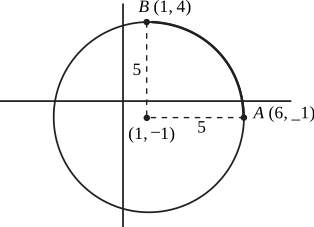
If  \(A(6,-1)\)  and  \(B(1,4)\)  are two points that lie on the graph of the relation, then the shortest distance along the graph from \(A\) to \(B\) is

  1. \(\dfrac{\pi}{4}\)
  2. \(\dfrac{\pi}{2}\)
  3. \(\pi\)
  4. \(\dfrac{5 \pi}{4}\)
  5. \(\dfrac{5 \pi}{2}\)
Show Answers Only

\(E\)

Show Worked Solution

\(x=5 \cos (2 t)+1 \Rightarrow \cos (2 t)=\dfrac{x-1}{5}\)

♦ Mean mark 39%.

\(y=5 \sin (2 t)-1 \Rightarrow \sin (2 t)=\dfrac{y+1}{5}\)

\((\cos (2 t))^2+(\sin (2 t))^2\) \(=1\)  
\((x-1)^2+(y+1)^2\) \(=25\)  


\(\text {Distance}\ =\dfrac{1}{4} \times 2 \times \pi \times r =\dfrac{5 \pi}{2}\)

\(\Rightarrow E\)
Filed Under: Trigonometry (SM) Tagged With: Band 5, smc-1150-20-Parametric

Graphs, SPEC2-NHT 2019 VCAA 2 MC

The curve given by  `x = 3sec(t) + 1`  and  `y = 2tan(t) - 1`  can be expressed in cartesian form as

  1.  `((y + 1)^2)/4 - ((x - 1)^2)/9 = 1`
  2.  `((x + 1)^2)/3 - ((y - 1)^2)/2 = 1`
  3.  `((y + 1)^2)/9 - ((x - 1)^2)/4 = 1`
  4.  `((x - 1)^2)/3 + ((y + 1)^2)/2 = 1`
  5.  `((x - 1)^2)/9 - ((y + 1)^2)/4 = 1`
Show Answers Only

`E`

Show Worked Solution

`sec^2theta = tan^2theta + 1`

`x = 3sec(t) + 1 \ => \ sec(t) = (x – 1)/3`

`y = 2tan(t) – 1 \ => \ tan(t) = (y + 1)/2`

`:.((x – 1)/3)^2 – ((y + 1)/2)^2` `= 1`
`((x – 1)^2)/9 – ((y + 1)^2)/4` `= 1`

 
`=>\ E`

Filed Under: Trigonometry (SM) Tagged With: Band 4, smc-1150-20-Parametric

Calculus, SPEC2 2019 VCAA 1

A curve is defined parametrically by  `x = sec(t) + 1, \ y = tan(t)`, where  `t ∈ [0, pi/2)`.

  1. Show that the curve can be represent in cartesian form by the rule  `y = sqrt(x^2-2x)`.   (2 marks)

    --- 5 WORK AREA LINES (style=lined) ---

  2. State the domain and range of the relation given by  `y = sqrt(x^2-2x)`.  (2 marks)

    --- 4 WORK AREA LINES (style=lined) ---

  3.  i. Express  `(dy)/(dx)`  in terms of  `sin(t)`.   (2 marks)

    --- 4 WORK AREA LINES (style=lined) ---

  4. ii. State the limiting value of  `(dy)/(dx)`  as  `t`  approaches  `pi/2`.   (1 mark)

    --- 4 WORK AREA LINES (style=lined) ---

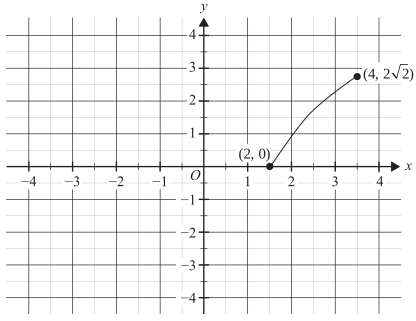
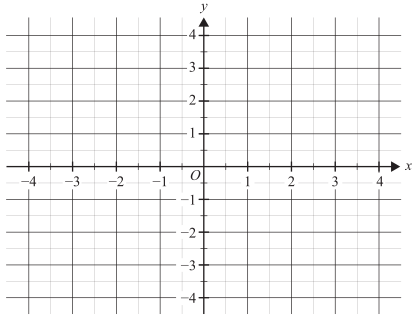
  1. Sketch the curve  `y = sqrt(x^2-2x)`  on the axes below for  `x ∈ [2, 4]`, labelling the endpoints with their coordinates.   (2 marks)

    --- 0 WORK AREA LINES (style=lined) ---


  2. The portion of the curve given by  `y = sqrt(x^2-2x)`  for  `x ∈ [2, 4]`  is rotated about the `y`-axis to form a solid of revolution.
  3. Write down, but do not evaluate, a definite integral in terms of  `t`  that gives the volume of the solid formed.   (2 marks)

    --- 6 WORK AREA LINES (style=lined) ---

Show Answers Only
  1. `text(See Worked Solutions)`
  2. `text(Domain:)\ x ∈ [2, ∞)`


    `text(Range:)\ y ∈ [0, ∞)`

    1. `(dy)/(dx) = ((dy)/(dt))/((dt)/(dx)) = (sec^2(t))/(sin(t)sec^2(t)) = 1/(sin(t))`
    2. `(dy)/(dx) -> 1`
  3.  
  4. ` V = pi int_0^(tan^(−1)(2sqrt2)) (sec(t) + 1)^2sec^2(t)dt`
Show Worked Solution

a.   `x = sec(t) + 1 \ => \ sec(t) = x-1`

`y = tan(t)`

`text(Using)\ \ tan^2(t) + 1 = sec^2(t):`

`y^2 + 1` `= (x-1)^2`
`y^2 + 1` `= x^2-2x + 1`
`y^2` `= x^2-2x`
`y` `= sqrt(x^2-2x), \ y >= 0\ \ text(as)\ \ t ∈ [0, pi/2)`


b.   `text(Sketch:)\ \ x = sec(t) + 1, \ y = tan(t)\ \ text(for)\ \ t ∈ [0, pi/2)`

`text(Domain:)\ \ x ∈ [2, ∞)`

`text(Range:)\ \ y ∈ [0, ∞)`


c.i.   `(dy)/(dt) = sec^2(t), \ (dx)/(dt) = sin(t)sec^2(t)\ \ \ (text(by CAS))`

`(dy)/(dx) = ((dy)/(dt))/((dx)/(dt)) = (sec^2(t))/(sin(t)sec^2(t)) = 1/(sin(t))`


c.ii.   `text(As)\ \ t -> pi/2:`

`(dy)/(dx) -> 1`


d.   


e.   `V = pi int_0^(2sqrt2) x^2\ dy`

`x^2 = (sec(t) + 1)^2`

`(dy)/(dt) = sec^2(t) \ => \ dy = sec^2(t)\ dt`

`text(When)\ y = 0, t = 0`

`text(When)\ y = 2sqrt2, t = tan^(−1)(2sqrt2)`
 

`:. V = pi int_0^(tan^(−1)(2sqrt2)) (sec(t) + 1)^2sec^2(t)\ dt`

Filed Under: Solids of Revolution, Trigonometry (SM) Tagged With: Band 3, Band 4, Band 5, smc-1150-20-Parametric, smc-1180-30-Square root, smc-1180-60-y-axis rotation

Trigonometry, SPEC2 2013 VCAA 2 MC

The rule of the relation determined by the parametric equations  `x = 2text(cosec)(t) + 1`  and  `y = 3cot(t) -1`  is

  1. `((x - 1)^2)/4 - ((y + 1)^2)/9 = 1`
  2. `((y + 1)^2)/9 - ((x - 1)^2)/4 = 1`
  3. `((x - 1)^2)/4 + ((y + 1)^2)/4 = 1`
  4. `((y + 1)^2)/3 - ((x - 1)^2)/2 = 1`
  5. `((x - 1)^2)/2 - ((y + 1)^2)/3 = 1`
Show Answers Only

`A`

Show Worked Solution

`(x – 1)/2 = text(cosec)(t)qquad(y + 1)/3 = cot(t)`

`text(Using)\ \ 1 + cot^2(t)= text(cosec)^2(t)`

`1 + ((y + 1)/3)^2` `= ((x – 1)/2)^2`
`((x – 1)^2)/4 – ((y + 1)^2)/9` `=1`

 
`=> A`

Filed Under: Trigonometry (SM) Tagged With: Band 3, smc-1150-20-Parametric

Copyright © 2014–2025 SmarterEd.com.au · Log in