SmarterEd

Aussie Maths & Science Teachers: Save your time with SmarterEd

  • Login
  • Get Help
  • About

Functions, SPEC2 2024 VCAA 2 MC

Consider the function \(f\) with rule \(f(x)=\left\{\begin{array}{cl}\dfrac{x^2+3 x-10}{x-2} & , x \in R \backslash\{2\} \\ 7 & , x=2\end{array}\right.\)

Which of the following statements is correct?

  1. The function \(f\) is continuous.
  2. The graph of  \(y=f(x)\)  has a vertical asymptote.
  3. The graph of  \(y=f(x)\)  has a horizontal asymptote.
  4. The graph of  \(y=f(x)\)  has a point of discontinuity.
Show Answers Only

\(A\)

Show Worked Solution

\(\dfrac{x^2+3 x-10}{x-2} = \dfrac{(x+5)(x-2)}{x-2} \)

\(\text{As}\ x\rightarrow 2,\ \dfrac{(x+5)(x-2)}{x-2}\rightarrow 7 \)

\(\text{Piecewise function is continuous at}\ \ x=2.\)

\(\Rightarrow A\)

♦ Mean mark 48%.

Filed Under: Partial Fractions, Quotient and Other Functions (SM) Tagged With: Band 5, smc-1154-10-Quotient functions/Asymptotes, smc-1154-45-Piecewise

Calculus, SPEC2 2022 VCAA 1

Consider the family of functions \(f\) with rule  \(f(x)=\dfrac{x^2}{x-k}\), where \(k \in R \backslash\{0\}\).

  1. Write down the equations of the two asymptotes of the graph of \(f\) when \(k=1\).   (2 marks)

    --- 3 WORK AREA LINES (style=lined) ---

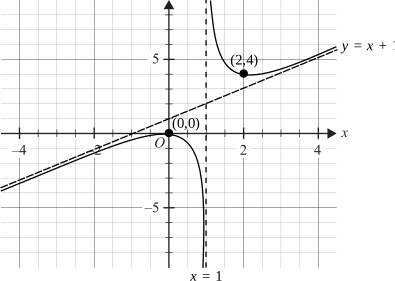
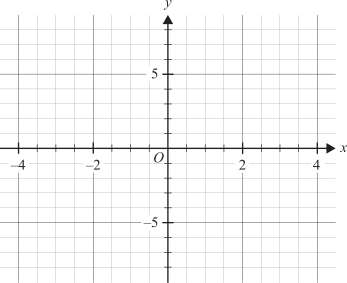
  2. Sketch the graph of  \(y=f(x)\)  for  \(k=1\)  on the set of axes below. Clearly label any turning points with their coordinates and label any asymptotes with their equations.   (3 marks)
     

--- 0 WORK AREA LINES (style=lined) ---

  1.  i. Find, in terms of \(k\), the equations of the asymptotes of the graph of  \(f(x)=\dfrac{x^2}{x-k}\).   (1 mark)

    --- 2 WORK AREA LINES (style=lined) ---

  2. ii. Find the distance between the two turning points of the graph of  \(f(x)=\dfrac{x^2}{x-k}\) in terms of \(k\).   (2 marks)

    --- 4 WORK AREA LINES (style=lined) ---

  3. Now consider the functions \(h\) and \(g\), where  \(h(x)=x+3\)  and  \(g(x)=\abs{\dfrac{x^2}{x-1}}\).
  4. The region bounded by the curves of \(h\) and \(g\) is rotated about the \(x\)-axis.
    1. Write down the definite integral that can be used to find the volume of the resulting solid.   (2 marks)

      --- 5 WORK AREA LINES (style=lined) ---

    2. Hence, find the volume of this solid. Give your answer correct to two decimal places.   (1 mark)

      --- 2 WORK AREA LINES (style=lined) ---

Show Answers Only

a.  \(\text {Asymptotes: } x=1,\  y=x+1\)

b.   
       

c.i.   \(\text {Asymptotes: } x=k,\  y=x+k\)

c.ii.  \(\text {Distance }=2 \sqrt{5}|k|\)

d.i.  \(\displaystyle V=\pi \int_{\frac{-\sqrt{7}-1}{2}}^{\frac{\sqrt{7}-1}{2}}(x+3)^2-\left(\frac{x^2}{x-1}\right)^2 dx\)

d.ii.  \(V=51.42\ \text{u}^3 \)

Show Worked Solution

a.    \(\text {When } k=1 :\)

\(f(x)=\dfrac{x^2}{x-1}=\dfrac{(x+1)(x-1)+1}{(x-1)}=x+1+\dfrac{1}{x-1}\)

\(\text {Asymptotes: } x=1,\  y=x+1\)
 

b.    


c.i. \(f(x)=\dfrac{x^2}{x-k}=\dfrac{(x+k)(x-k)+k^2}{x-k}=x+k+\dfrac{k^2}{x-k}\)

\(\text {Using part a.}\)

\(\text {Asymptotes: } x=k,\  y=x+k\)
 

c.ii.  \(f^{\prime}(x)=1-\left(\dfrac{k}{x-k}\right)^2\)

\(\text {TP’s when } f^{\prime}(x)=0 \text { (by CAS):}\)

\(\Rightarrow(2 k, 4 k),(0,0)\)

\(\text {Distance }\displaystyle=\sqrt{(2 k-0)^2+(4 k-0)^2}=\sqrt{20 k^2}=2 \sqrt{5}|k|\)
 

d.i  \(\text {Solve for intersection of graphs (by CAS):}\)

\(\displaystyle x+3=\left|\frac{x^2}{x-1}\right|\)

\(\displaystyle \Rightarrow x=\frac{3}{2}, x=\frac{-1 \pm \sqrt{7}}{2}\)

\(\displaystyle V=\pi \int_{\frac{-\sqrt{7}-1}{2}}^{\frac{\sqrt{7}-1}{2}}(x+3)^2-\left(\frac{x^2}{x-1}\right)^2 dx\)
 

d.ii. \(V=51.42\ \text{u}^3 \text{ (by CAS) }\)

♦♦ Mean mark (d)(ii) 37%.

Filed Under: Partial Fractions, Quotient and Other Functions (SM), Solids of Revolution Tagged With: Band 3, Band 4, Band 5, smc-1154-10-Quotient functions/Asymptotes, smc-1154-30-Absolute value, smc-1154-50-Sketch graph, smc-1180-40-Other graphs, smc-1180-50-x-axis rotations

Graphs, SPEC2 2022 VCAA 3 MC

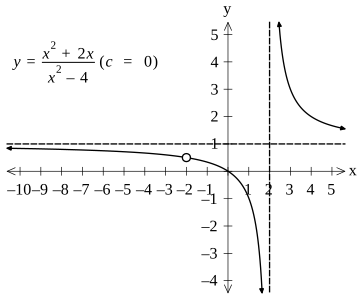
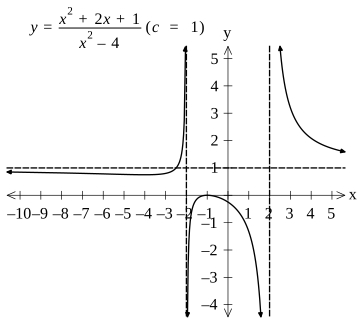
The graph of  `y=\frac{x^2+2x+c}{x^2-4}`, where `c \in R`, will always have

  1. two vertical asymptotes and one horizontal asymptote.
  2. two horizontal asymptotes and one vertical asymptote.
  3. a vertical asymptote with equation `x=-2` and one horizontal asymptote with equation `y=1`.
  4. one horizontal asymptote with equation `y=1` and only one vertical asymptote with equation `x=2`.
  5. a horizontal asymptote with equation `y=1` and at least one vertical asymptote.
Show Answers Only

`E`

Show Worked Solution

`y=\frac{x^2+2x+c}{x^2-4}\ \ =>\ \ y=\frac{x^2+2x+c}{(x-2)(x+2)}`

`text{Vertical asymptotes:}\ x=2, \ x=-2`

`->\ text{However, if}\ c=0,\ \text{only 1 vertical asymptote at}\ \ x=2.`

`text{Horizontal asymptote:}\ y=1`

`text{Using CAS to graph for different values of}\ c:`

`=>E`


♦♦ Mean mark 38%.
41% of students chose `A` and did not consider when `c = 0`

Filed Under: Partial Fractions, Quotient and Other Functions (SM) Tagged With: Band 5, smc-1154-10-Quotient functions/Asymptotes

Functions, SPEC2 2023 VCAA 2 MC

The graph of  \(y=\dfrac{x^3}{a x^2+b x+c}\)  has asymptotes given by  \(y=2 x+1\)  and  \(x=1\). The values of \(a, b\) and \(c\) are, respectively

  1. \(2,-4,2\)
  2. \( \dfrac{1}{2},-\dfrac{1}{4},-\dfrac{1}{4} \)
  3. \( \dfrac{1}{2}, \dfrac{1}{4},-\dfrac{3}{4} \)
  4. \( \dfrac{1}{2},-\dfrac{1}{4},-\dfrac{3}{4} \)
  5. \(2,-4,-8\)
Show Answers Only

\(B\)

Show Worked Solution

\(\text{Using partial fractions (by calc):}\)

\(\text{Remainder}\ =  \dfrac{x}{a}-\dfrac{b}{a^2} =  2x+1\)

\(a=\dfrac{1}{2},\ \ b=-\dfrac{1}{4} \)

\(x=1\ \ \text{is a solution of}\ \ ax^2+bx+c=0\)

\(c=-\dfrac{1}{4} \)

\(\Rightarrow B\)

Filed Under: Partial Fractions, Quotient and Other Functions (SM) Tagged With: Band 4, smc-1154-10-Quotient functions/Asymptotes, smc-1154-20-Partial fractions

Functions, SPEC1 2023 VCAA 1

Consider the function \(f\) with rule  \(f(x)=\dfrac{x^2+x-6}{x-1}\).

  1. Show that the rule for the function \(f\) can be written as  \(f(x)=x+2-\dfrac{4}{x-1}\).   (1 mark)

--- 6 WORK AREA LINES (style=lined) ---

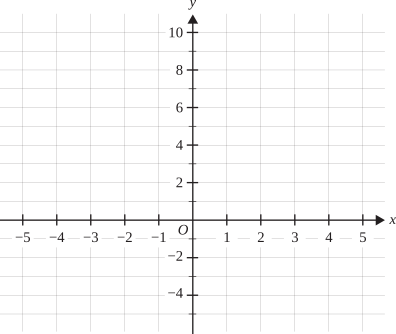
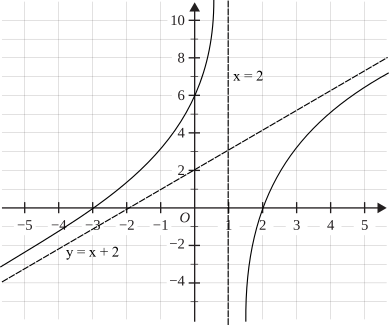
  1. Sketch the graph of \(f\) on the axes below, labelling any asymptotes with their equations.   (3 marks)


--- 0 WORK AREA LINES (style=blank) ---

Show Answers Only
a.     \(f(x)\) \(=\dfrac{x^2+x-6}{x-1}\)
    \(=\dfrac{(x-1)(x+2)-4}{x-1}\)
    \(=x+2-\dfrac{4}{x-1} \)

 
b.
    \(\text{Asymptotes at:}\ x=1, \ y=x+2 \)

\begin{array} {|l|c|c|c|c|c|}
\hline
\rule{0pt}{2.5ex} x \rule[-1ex]{0pt}{0pt} & -3 & -1 & 0 & 1 & 2 \\
\hline
\rule{0pt}{2.5ex} y \rule[-1ex]{0pt}{0pt} & 0 & 3 & 6 & \infty & 0 \\
\hline
\end{array}


Show Worked Solution
a.     \(f(x)\) \(=\dfrac{x^2+x-6}{x-1}\)
    \(=\dfrac{(x-1)(x+2)-4}{x-1}\)
    \(=x+2-\dfrac{4}{x-1} \)

 
b.
    \(\text{Asymptotes at:}\ x=1, \ y=x+2 \)

\begin{array} {|l|c|c|c|c|c|}
\hline
\rule{0pt}{2.5ex} x \rule[-1ex]{0pt}{0pt} & -3 & -1 & 0 & 1 & 2 \\
\hline
\rule{0pt}{2.5ex} y \rule[-1ex]{0pt}{0pt} & 0 & 3 & 6 & \infty & 0 \\
\hline
\end{array}


Filed Under: Partial Fractions, Quotient and Other Functions (SM) Tagged With: Band 3, Band 4, smc-1154-10-Quotient functions/Asymptotes, smc-1154-50-Sketch graph

Graphs, SPEC2-NHT 2019 VCAA 1 MC

The graph of which one of the following relations does not have a vertical asymptote?

  1.  `y = (x^3 - 1)/x`
  2.  `y = (5x^2 + 2)/(x^2 + 1)`
  3.  `y = (x^4 - 3)/(x^2)`
  4.  `y = 1/(x^2 + 4x)`
  5.  `y = (x - 1)/(sqrt(x + 2))`
Show Answers Only

`B`

Show Worked Solution

`text(Vertical asymptote when denominator = 0)`

`x^2 + 1 != 0`

`=>\ B`

Filed Under: Partial Fractions, Quotient and Other Functions (SM) Tagged With: Band 3, smc-1154-10-Quotient functions/Asymptotes

Graphs, SPEC2 2019 VCAA 2 MC

The asymptote(s) of the graph of  `f(x) = (x^2 + 1)/(2x - 8)`  has equation(s)

  1. `x = 4`
  2. `x = 4 and y = x/2`
  3. `x = 4 and y = x/2 + 2`
  4. `x = 8 and y = x/2`
  5. `x = 8 and y = 2x + 2`
Show Answers Only

`C`

Show Worked Solution
`(x^2 + 1)/(2x – 8)` `= ((x – 4)(x + 4) + 17)/(2(x – 4))`
  `= (x + 4)/2 + 17/(2x – 8)`
  `= x/2 + 2 + 17/(2x – 8)`

 
`:.\ text(Asymptotes at)\ \ x = 4 and y = x/2 + 2`

`=>C`

Filed Under: Partial Fractions, Quotient and Other Functions (SM) Tagged With: Band 4, smc-1154-10-Quotient functions/Asymptotes

Graphs, SPEC2 2011 VCAA 1 MC

The number of straight line asymptotes of the graph of  `y = (2x^3 + x^2 - 1)/(x^2 - x - 2)`  is

A.   0

B.   1

C.   2

D.   3

E.   4

Show Answers Only

`D`

Show Worked Solution
`y` `= (2x^3 + x^2 – 1)/(x^2 – x – 2)`
  `= 2x + 3 + (7x + 5)/((x – 2)(x + 1))`

 
`:.\ text(Straight line asymptotes occur at:)`

♦♦ Mean mark 34%.

`y = 2x + 3, \ x = 2\ \ text(and)\ \ x = −1`

`=> D`

Filed Under: Partial Fractions, Quotient and Other Functions (SM) Tagged With: Band 5, smc-1154-10-Quotient functions/Asymptotes

Graphs, SPEC2 2012 VCAA 3 MC

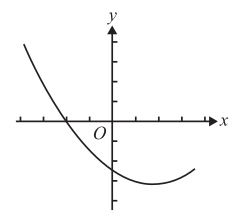
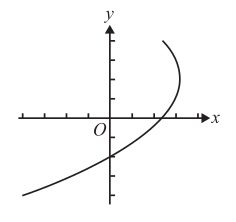
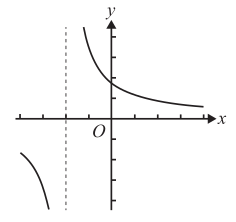
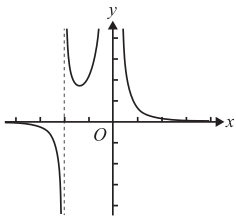
The graph of  `y = f(x)`  is shown below.
 

All the axes below have the same scale as the axes in the diagram above.

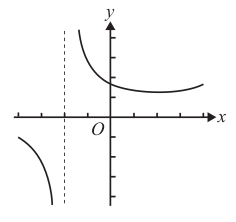
The graph of  `y = 1/(f(x))`  is best represented by

A.    B.   
C.    D.   
E.       

Show Answers Only

`E`

Show Worked Solution

`y(-1) = 0`

`-> 1/(y(-1)):\ text(asymptote)\ x = -1`

`text(Eliminate A and B.)`

`text(Local max at)\ \ x = 1`

`-> 1/(y(1)):\ text(local min)`
 

`=> E`

Filed Under: Partial Fractions, Quotient and Other Functions (SM) Tagged With: Band 4, smc-1154-10-Quotient functions/Asymptotes

Graphs, SPEC2 2012 VCAA 1 MC

The graph with equation  `y = 1/(2x^2 - x - 6)` has asymptotes given by

A.  `x = -3/2,\ x = 2 and y = 1`

B.   `x = -3/2 and x = 2`  only

C.   `x = 3/2,\ x = -2 and y = 0`

D.   `x = -3/2,\ x = 2 and y = 0`

E.   `x = 3/2 and x = -2`  only

Show Answers Only

`D`

Show Worked Solution
`y` `=1/(2x^2 – x – 6)`  
  `=1/((2x + 3)(x – 2))`  


`:.\ text(Asymptotes:)`   `x = 2`
  `x = -3/2`
  `y = 0`

 
`=> D`

Filed Under: Partial Fractions, Quotient and Other Functions (SM) Tagged With: Band 3, smc-1154-10-Quotient functions/Asymptotes

Algebra, SPEC2 2013 VCAA 3 MC

The graph of  `y = 1/(ax^2 + bx + c)`  has asymptotes at  `x = − 5`, `x = 3`  and  `y = 0`.

Given that the graph has one stationary point with a `y`-coordinate of  `−1/8`, it follows that

A.   `a = 1`, `b = 2`, `c = −15`

B.   `a = 1/2`, `b = −1`, `c = −15/2`

C.   `a = −1/2`, `b = −1`, `c = 15`

D.   `a = −1`, `b = −2`, `c = −15`

E.   `a = 1/2`, `b = 1`, `c = −15/2`

Show Answers Only

`E`

Show Worked Solution
`y` `= 1/(ax^2 + bx + c)`
  `= 1/(a(x + 5)(x – 3))`
  `= 1/(ax^2 + 2ax – 15a)`

 
`ax^2 + bx + c = ax^2 + 2ax – 15a`

♦ Mean mark 47%.

 
`text(Vertex:)\ \ ((− 5 + 3)/2, – 1/8) = (– 1,– 1/8)`

`- 1/8` `= 1/(a – 2a – 15a)`
`- 1/8` `= -1/(16a)`
`a` `= 1/2`


`:. a = 1/2, \ b = 2a = 1, \ c = − 15a = − 15/2`

`=> E`

Filed Under: Partial Fractions, Quotient and Other Functions (SM) Tagged With: Band 5, smc-1154-10-Quotient functions/Asymptotes

Graphs, SPEC2 2016 VCAA 3 MC

The straight-line asymptote(s) of the graph of the function with rule  `f(x) = (x^3 - ax)/x^2`, where  `a`  is a non-zero real constant, is given by

A.  `x = 0`  only.

B.  `x = 0`  and  `y = 0`  only.

C.  `x = 0`  and  `y = x`  only.

D.  `x = 0, \ x = sqrt a`  and  `x = -sqrt a`  only.

E.  `x = 0`  and  `y = a`  only. 

Show Answers Only

`C`

Show Worked Solution

`f(x) = x – a/x,\ x != o`

`lim_(x -> oo) f(x) = x`

`:.\ text(Asymptotes):\ \ x = 0,\ \ y = x`

 
`=>  C`

Filed Under: Partial Fractions, Quotient and Other Functions (SM) Tagged With: Band 4, smc-1154-10-Quotient functions/Asymptotes

Graphs, SPEC2-NHT 2017 VCAA 1 MC

The number of asymptotes of the graph of the function with rule  `f(x) = (x^3 - 7x + 5)/(x^2 + 3x - 4)`  is

A.   0

B.   1

C.   2

D.   3

E.   4

Show Answers Only

`D`

Show Worked Solution

`text(By CAS:)`

`(x^3 – 7x + 5)/(x^2 + 3x – 4)`

`=x-3 +31/(5(x+4)) – 1/(5(x-1))`

 
`:. text(Asymptotes at:)\ \ x=1,\ \ x=-4,\ \ y=x-3`

`=>   D`

Filed Under: Partial Fractions, Quotient and Other Functions (SM) Tagged With: Band 4, smc-1154-10-Quotient functions/Asymptotes

Graphs, SPEC2 2014 VCAA 3 MC

The features of the graph of the function with rule  `f(x) = (x^2 - 4x + 3)/(x^2 - x - 6)` include

A.   asymptotes at  `x = 1`  and  `x = −2`

B.   asymptotes at  `x = 3`  and  `x = −2`

C.   an asymptote at  `x = 1`  and a point of discontinuity at  `x = 3`

D.   an asymptote at  `x = −2`  and a point of discontinuity at  `x = 3`

E.   an asymptote at  `x = 3`  and a point of discontinuity at  `x = −2`

Show Answers Only

`D`

Show Worked Solution
`f(x)` `= (x^2 – 4x + 3)/(x^2 – x – 6)`
  `=(x^2 -x-6 -3x+9)/(x^2 – x – 6)`
  `= 1 – (3(x – 3))/((x + 2)(x – 3))`
  `=1 – 3/(x + 2)\ text(where)\ x != 3`

 
`=> D`

Filed Under: Partial Fractions, Quotient and Other Functions (SM) Tagged With: Band 4, smc-1154-10-Quotient functions/Asymptotes

Graphs, SPEC1 2018 VCAA 5

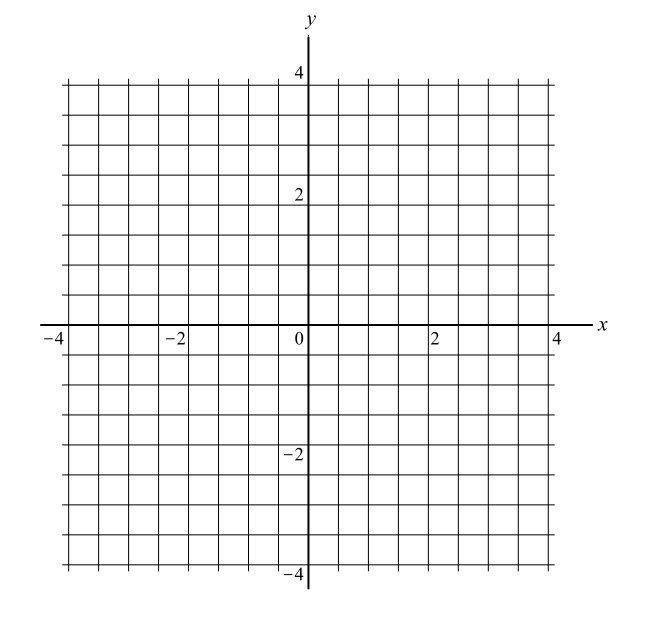
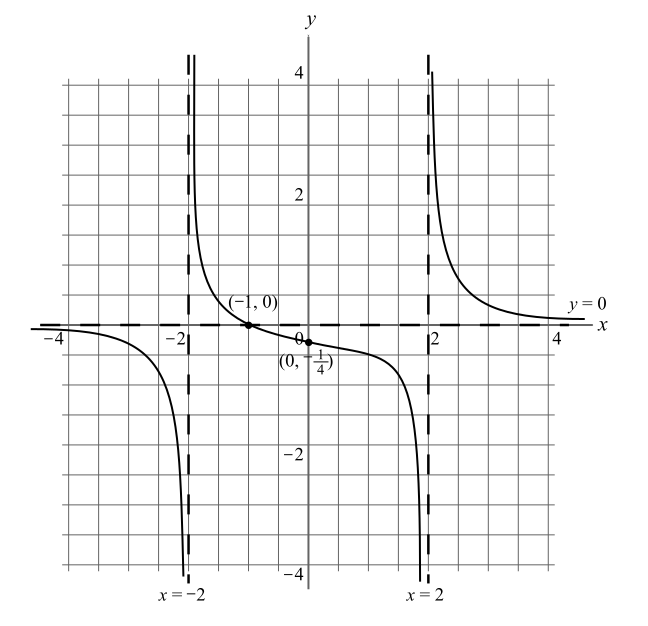
Sketch the graph of  `f(x) = (x + 1)/(x^2 - 4)`  on the axes provided below, labelling any asymptotes with their equations and any intercepts with their coordinates.  (4 marks)

Show Answers Only

Show Worked Solution

`text(Using partial fractions:)`

`(x + 1)/(x^2 – 4)= A/(x – 2) + B/(x + 2)`

`A(x + 2) + B (x – 2) = x + 1`

 
`text(When)\ \ x = 2,`

`4A` `= 3 => \ A=3/4`

 
`text(When)\ \ x = -2`

`-4B` `= -1 =>\ B=1/4`

 
`f(x)= 1/(4(x + 2)) + 3/(4(x – 2))`
 

`text(As)\ \ x->oo, \ f(x)->0^+`

`text(As)\ \ x->- oo, \ f(x)->0^-`

`f(0)= – 1/4`
 

`text(Find)\ x\ text(when)\ \ f(x)=0:`

`x + 1` `= 0`
`x` `= -1`

Filed Under: Partial Fractions, Quotient and Other Functions (SM) Tagged With: Band 4, smc-1154-10-Quotient functions/Asymptotes, smc-1154-50-Sketch graph

Copyright © 2014–2025 SmarterEd.com.au · Log in