Let \(z \in C\).
Given that \(|z|=1\) and \(z \neq 1, \operatorname{Re}\left(\dfrac{1}{1-z}\right)\) is
- \(-\dfrac{1}{2}\)
- \(0\)
- \(\dfrac{1}{2}\)
- \(\dfrac{\sqrt{3}}{2}\)
Aussie Maths & Science Teachers: Save your time with SmarterEd
Let \(z \in C\).
Given that \(|z|=1\) and \(z \neq 1, \operatorname{Re}\left(\dfrac{1}{1-z}\right)\) is
\(C\)
\(z=a+b i\)
\(\abs{z}=a^2+b^2=1\)
\(\dfrac{1}{1-z}=\dfrac{1}{1-(a+bi)}=\dfrac{1}{(1-a)-bi} \times \dfrac{(1-a)+bi}{(1-a)+bi}=\dfrac{(1-a)+bi}{(1-a)^2+b^2}\)
| \(\operatorname{Re}\left(\dfrac{1}{1-z}\right)\) | \(=\dfrac{-a+1}{a^2-2 a+b^2+1}\) |
| \(=\dfrac{-a+1}{1-2 a+1}\) | |
| \(=\dfrac{-(a-1)}{-2(a-1)}\) | |
| \(=\dfrac{1}{2}\) |
\(\Rightarrow C\)
Let \(z=3+k i\) where \(k \in R\).
A value of \(k\) that makes \(z^2+4 i z+3\) purely imaginary is
\(D\)
\(\text{Substitute}\ \ z=3+ki\ \ \text{into equation:}\)
| \(z^2+4iz+3\) | \(=(3+ki)^2+4i(3+ki)+3\) | |
| \(=9+6ki-k^2+12i-4k+3\) | ||
| \(=-k^2-4k+12 +(6k+12)i\) |
\(\text{Purely imaginary if}\ \ -k^2-4k+12=0:\)
\(k=-6, 2\)
\(\Rightarrow D\)
Given the complex number \(z=a+b i\), where \(a \in R \backslash\{0\}\) and \(b \in R, \dfrac{4 z \bar{z}}{(z+\bar{z})^2}\) is equivalent to
\(A\)
\(z=a+i b, \quad \bar{z}=a-i b\)
| \(\dfrac{4 z \bar{z}}{(z+\bar{z})^2}\) | \(=\dfrac{4\left(a^2+b^2\right)}{4 a^2}\) |
| \(=1+\left(\dfrac{b}{a}\right)^2\) | |
| \(=1+\left(\dfrac{\operatorname{Im}(z)}{\operatorname{Re}(z)}\right)^2\) |
\(\Rightarrow A\)
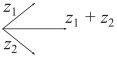
Which one of the following statements is false for `z_1, z_2 ∈ C`?
`B`
If `z = a + bi`, where both `a` and `b` are non-zero real numbers and `z in C`, which of the following does not represent a real number?
`E`
`text(Consider each option:)`
`text(A.) quad a + bi + a-bi = 2a` ✔
`text(B.) quad sqrt(a^2 + b^2)` ✔
`text(C.) quad (a + bi) (a-bi) = a^2 + b^2` ✔
`text(D.) quad (a + bi)^2-2abi`
`= a^2 +2abi-b^2-2abi`
`= a^2-b^2` ✔
`text(E.) quad (a + bi-(a-bi))((a + bi + a-bi))`
`= (2bi) (2a)`
`= 4abi` ✖
`=> E`
Which one of the following relations has a graph that passes through the point `1 + 2i` in the complex plane?
`E`
`text(Consider each option:)`
`A:\ \ (1 + 2i)(1 – 2i) = 1 – 4i^2 = 5`
`B:\ \ alpha = tan^(−1)(2) != pi/3`
`C:\ \ |(1 + 2i)-1 | = |2i| = 2,\ \ |1 + 2i – 2i| = |1| = 1`
`D:\ \ text(Re)(z) = 1 != 2text(Im)(z)`
`E:\ \ 1 + 2i + 1 – 2i = 2\ \ text{(correct)}`
`=> E`
Let `z = a + bi`, where `a, b in R\ text(\ {0})`
If `z + 1/z \ in R`, which one of the following must be true?
`D`
| `z + 1/z` | `= a + bi + 1/(a + bi)` |
| `= a + bi + (a – bi)/{(a + bi)(a – bi)}` | |
| `= a + bi + (a – bi)/(a^2 + b^2)` | |
| `= {(a + bi)(a^2 + b^2) + a – bi}/(a^2 + b^2)` | |
| `= {a(a^2 + b^2) + a}/(a^2 + b^2) + {b (a^2 + b^2) – b}/(a^2 + b^2)\ i` |
`text(If)\ \ z + 1/z in R\ \ =>\ {b (a^2 + b^2) – b}/(a^2 + b^2) = 0`
`b(a^2 + b^2) – b = 0`
`b(a^2 + b^2 – 1) = 0`
`a^2 + b^2 = 1,\ \ (b !=0)`
`a^2 + b^2 = |z|^2 = 1`
`:. |z| = 1`
`=> D`