SmarterEd

Aussie Maths & Science Teachers: Save your time with SmarterEd

  • Login
  • Get Help
  • About

Vectors, SPEC1 2022 VCAA 6b

`OPQ` is a semicircle of radius `a` with equation  `y=sqrt(a^(2)-(x-a)^(2))`. `P(x,y)` is a point on the semicircle `OPQ`, as shown below.
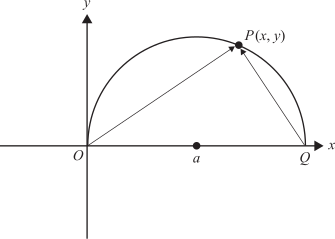
  1. Express the vectors `vec(OP)` and `vec(QP)` in terms of  `a`, `x`, `y`, `underset~i` and `underset~j`, where `underset~i` is a unit vector in the direction of the positive `x`-axis and `underset~j` is a unit vector in the direction of the positive `y`-axis.   (1 mark)

    --- 3 WORK AREA LINES (style=lined) ---

  2. Hence, using the vector scalar (dot) product, determine whether `vec(OP)` is perpendicular to `vec(QP)`.   (3 marks)

    --- 8 WORK AREA LINES (style=lined) ---
Show Answers Only

i.    `vec(OP)= xunderset~i + sqrt(a^2-(x-a)^2 underset~j`

`vec(QP)= (x-2a) underset~i + sqrt(a^2-(x-a)^2) underset~j`
 

ii.   `vec(OP)* vec(QP)` `=x(x-2a)+a^(2)-(x-a)^(2)`
  `=x^(2)-2ax+a^(2)-x^(2)+2ax-a^(2)`
  `= 0`

 
`:. vec(OP)\ \text{and}\ vec(QP)\ \text{are perpendicular.}`

Show Worked Solution

i.    `vec(OP)= xunderset~i + sqrt(a^2-(x-a)^2 underset~j`

`vec(QP)= (x-2a) underset~i + sqrt(a^2-(x-a)^2) underset~j`
 

ii.   `vec(OP)* vec(QP)` `=x(x-2a)+a^(2)-(x-a)^(2)`
  `=x^(2)-2ax+a^(2)-x^(2)+2ax-a^(2)`
  `= 0`

 
`:. vec(OP)\ \text{and}\ vec(QP)\ \text{are perpendicular.}`

Filed Under: Vector Lines, Planes and Geometry Tagged With: Band 4, smc-1177-40-Triangles, smc-1177-45-(Semi)circles, smc-1177-50-2D problems

Vectors, SPEC2 2023 VCAA 5

The points with coordinates \(A(1,1,2), B(1,2,3)\) and \(C(3,2,4)\) all lie in a plane \(\Pi\).

  1. Find the vectors \(\overrightarrow{A B}\) and \(\overrightarrow{A C}\), and hence show that the area of triangle \(A B C\) is 1.5 square units.  (2 marks)

    --- 5 WORK AREA LINES (style=lined) ---
  2. Find the shortest distance from point \(B\) to the line segment \(A C\).  (2 marks)

    --- 3 WORK AREA LINES (style=lined) ---
A second plane, \(\psi\), has the Cartesian equation  \(2 x-2 y-z=-18\).

  1. At what acute angle does the line given by \(\underset{\sim}{ r }(t)=3 \underset{\sim}{ i }+2 \underset{\sim}{ j }+4 \underset{\sim}{ k }+t(\underset{\sim}{ i }-2 \underset{\sim}{ j }+2\underset{\sim}{ k }), t \in R\), intersect the plane \(\psi\) ? Give your answer in degrees correct to the nearest degree.  (2 marks)

    --- 4 WORK AREA LINES (style=lined) ---

A line \(L\) passes through the origin and is normal to the plane \(\psi\). The line \(L\) intersects \(\psi\) at a point \(D\).

  1. Write down an equation of the line \(L\) in parametric form.  (1 mark)

    --- 2 WORK AREA LINES (style=lined) ---

  2. Find the shortest distance from the origin to the plane \(\psi\).  (2 marks)

    --- 3 WORK AREA LINES (style=lined) ---

  3. Find the coordinates of point \(D\).  (2 marks)

    --- 5 WORK AREA LINES (style=lined) ---

Show Answers Only

a.     \(\overrightarrow{A B}  =\overrightarrow{O B}-\overrightarrow{O A}=\left(\begin{array}{l}1 \\ 2 \\ 3\end{array}\right)-\left(\begin{array}{l}1 \\ 1 \\ 2\end{array}\right)=\left(\begin{array}{l}0 \\ 1 \\ 1\end{array}\right)\)
  \(\overrightarrow{A C}  =\overrightarrow{O C}-\overrightarrow{O A}=\left(\begin{array}{l}3 \\ 2 \\ 4\end{array}\right)-\left(\begin{array}{l}1 \\ 1 \\ 2\end{array}\right)=\left(\begin{array}{l}2 \\ 1 \\ 2\end{array}\right)\)

\(\text{Area}=\dfrac{1}{2}\ \bigg|\overrightarrow{AB} \times \overrightarrow{AC}\bigg|=\dfrac{1}{2}\ \left|\begin{array}{ccc}\underset{\sim}{i} & \underset{\sim}{j} & \underset{\sim}{k} \\ 0 & 1 & 1 \\ 2 & 1 & 2\end{array}\right|=\dfrac{1}{2}\ \bigg|\underset{\sim}{i}+2 \underset{\sim}{j}-2 \underset{\sim}{k}\bigg|=\dfrac{3}{2}\)

b.    \(\text {Shortest distance }=1 \text { unit }\)

c.     \(26^{\circ}\)

d.    \(\underset{\sim}{r}(t)=\underset{\sim}{n} \times t=2 t \underset{\sim}{i}-2 t \underset{\sim}{j}-t \underset{\sim}{k}\)

\(x=2 t, y=-2 t, z=-t \quad \text{(also accepted)}\)

e.    \(\text {Shortest distance }=6\)

f.    \(D(-4,4,2)\)

Show Worked Solution

a.     \(\overrightarrow{A B}  =\overrightarrow{O B}-\overrightarrow{O A}=\left(\begin{array}{l}1 \\ 2 \\ 3\end{array}\right)-\left(\begin{array}{l}1 \\ 1 \\ 2\end{array}\right)=\left(\begin{array}{l}0 \\ 1 \\ 1\end{array}\right)\)
  \(\overrightarrow{A C}  =\overrightarrow{O C}-\overrightarrow{O A}=\left(\begin{array}{l}3 \\ 2 \\ 4\end{array}\right)-\left(\begin{array}{l}1 \\ 1 \\ 2\end{array}\right)=\left(\begin{array}{l}2 \\ 1 \\ 2\end{array}\right)\)

\(\text{Area}=\dfrac{1}{2}\ \bigg|\overrightarrow{AB} \times \overrightarrow{AC}\bigg|=\dfrac{1}{2}\ \left|\begin{array}{ccc}\underset{\sim}{i} & \underset{\sim}{j} & \underset{\sim}{k} \\ 0 & 1 & 1 \\ 2 & 1 & 2\end{array}\right|=\dfrac{1}{2}\ \bigg|\underset{\sim}{i}+2 \underset{\sim}{j}-2 \underset{\sim}{k}\bigg|=\dfrac{3}{2}\)

 
b.   
\(\text {In } \triangle ABC \text {, shortest distance of } B \text { to } A C\ \text {is the} \perp \text {distance }\)

\(|\overrightarrow{A C}|= \displaystyle{\sqrt{2^2+1^2+2^2}}=3\)

\(\dfrac{3}{2}=\dfrac{1}{2}\ |\overrightarrow{A C}| \times h \ \Rightarrow \ h=1\)

\(\therefore \text { Shortest distance }=1 \text { unit }\)
 

♦♦ Mean mark (b) 35%.

c.    \(\text {Vector} \perp \text {to plane}\ \psi\  \text {is}\ \ \underset{\sim}{n}=2 \underset{\sim}{i}-2 \underset{\sim}{j}-\underset{\sim}{k}\)

\(\text{Parallel line to}\ \underset{\sim}{r}(t) \ \text{is}\ \ \underset{\sim}{m}=\underset{\sim}{i}-2 \underset{\sim}{j}+2\underset{\sim}{k}\)

\(\text{Find angle } \alpha \text{ between }\underset{\sim}{n} \text{ and } \underset{\sim}{m},\)

\(\text{Solve for } \alpha:\)

\((2 \underset{\sim}{i}-2 \underset{\sim}{j}-\underset{\sim}{k})(\underset{\sim}{i}-2 \underset{\sim}{j}+\underset{\sim}{2 k})=3 \times 3 \times \cos \, \alpha\)

\(\Rightarrow \alpha=64^{\circ} \text { (nearest degree) }\)
 

\(\text{Find angle } \theta \text{ between } \underset{\sim}{m} \text{ and plane } \psi :\)

\(\theta=90-64=26^{\circ}\)
 

d.    \(\underset{\sim}{r}(t)=\underset{\sim}{n} \times t=2 t \underset{\sim}{i}-2 t \underset{\sim}{j}-t \underset{\sim}{k}\)

\(x=2 t, y=-2 t, z=-t \quad \text{(also accepted)}\)
 

♦ Mean mark (d) 52%.

e.    \(|\overrightarrow{OD}|=\text{shortest distance from } O \text{ to plane } \psi\).

\(\Rightarrow D \text{ is on } L \text{ and } \psi\)

\(\text{Solve for } t: \  2(2 t)-2(-2 t)-(t)=-18\)

\(\Rightarrow t=-2\)

\(|\overrightarrow{OD}|=-4 \underset{\sim}{i}+4 \underset{\sim}{j}+2 \underset{\sim}{k}\)

\(\text {Shortest distance }=\displaystyle{\sqrt{(-4)^2+4^2+2^2}}=6\)
 

f.    \(\overrightarrow{OD}=-4 \underset{\sim}{i}+4 \underset{\sim}{j}+2 \underset{\sim}{i}\)

\(D(-4,4,2)\)

♦ Mean mark (f) 41%.

Filed Under: Basic Concepts and Calculations, Vector Lines, Planes and Geometry Tagged With: Band 4, Band 5, smc-1176-20-Angle between vectors, smc-1176-45-Vector planes, smc-1177-40-Triangles, smc-1177-50-2D problems

Vectors, SPEC2 2023 VCAA 15 MC

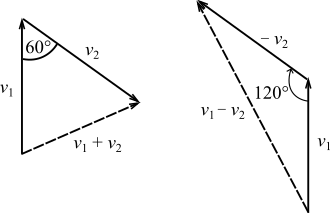
If the sum of two unit vectors is a unit vector, then the magnitude of the difference of the two vectors is

  1. \(0\)
  2. \(\dfrac{1}{\sqrt{2}}\)
  3. \(\sqrt{2}\)
  4. \(\sqrt{3}\)
  5. \(\sqrt{5}\)
Show Answers Only

\(D\)

Show Worked Solution

\(\text{Vectors can be drawn as two sides of an equilateral triangle.}\)

\(\text{Using the cosine rule for the difference between the two vectors:}\)

\(c^2\) \(=a^2+b^2-2ab\, \cos C\)  
  \(=1+1-2\times -\dfrac{1}{2} \)  
  \(=3\)  
\(c\) \(=\sqrt{3}\)  

 
\(\Rightarrow D\)

Filed Under: Vector Lines, Planes and Geometry Tagged With: Band 4, smc-1177-40-Triangles, smc-1177-50-2D problems

Vectors, SPEC1 2023 VCAA 9

A plane contains the points \( A(1,3,-2), B(-1,-2,4)\) and \( C(a,-1,5)\), where \(a\) is a real constant. The plane has a \(y\)-axis intercept of 2 at the point \(D\).

  1. Write down the coordinates of point \(D\).   (1 mark)

--- 1 WORK AREA LINES (style=lined) ---

  1. Show that \(\overrightarrow{A B}\) and \(\overrightarrow{A D}\) are \(-2 \underset{\sim}{\text{i}}-5 \underset{\sim}{\text{j}}+6 \underset{\sim}{\text{k}}\)  and  \(-\underset{\sim}{\text{i}}-\underset{\sim}{\text{j}}+2 \underset{\sim}{\text{k}}\), respectively.   (1 mark)

--- 4 WORK AREA LINES (style=lined) ---

  1. Hence find the equation of the plane in Cartesian form.  (2 marks)

--- 7 WORK AREA LINES (style=lined) ---

  1.  Find \(a\).   (1 mark)

--- 3 WORK AREA LINES (style=lined) ---

  1.  \(\overline{A B}\) and \(\overline{A D}\) are adjacent sides of a parallelogram. Find the area of this parallelogram.   (1 mark)

--- 2 WORK AREA LINES (style=lined) ---

Show Answers Only

a.    \(D(0,2,0)\)

b.    \(\overrightarrow{A B}=\overrightarrow{O B}-\overrightarrow{O A}=\left(\begin{array}{c}
-1 \\
-2 \\
4
\end{array}\right)-\left(\begin{array}{c}
1 \\
3 \\
-2
\end{array}\right)=\left(\begin{array}{c}
-2 \\
-5 \\
6
\end{array}\right)=-2 \underset{\sim}{\text{i}}-5\underset{\sim}{\text{j}}+6 \underset{\sim}{\text{k}}\)

\(\overrightarrow{A D}=\overrightarrow{O D}-\overrightarrow{O A}=\left(\begin{array}{c}0 \\ 2 \\ 0\end{array}\right)-\left(\begin{array}{c}1 \\ 3 \\ -2\end{array}\right)=\left(\begin{array}{c}-1 \\ -1 \\ 2\end{array}\right)=-\underset{\sim}{\text{i}}-\underset{\sim}{\text{j}}+2\underset{\sim}{\text{k}}\)

c.    \(4 x+2 y+3 z =4\)

d.    \(a=-\dfrac{9}{4}\)

e.    \(A=\sqrt{29}\)

Show Worked Solution

a.    \(D(0,2,0)\)

 
b.   
\(\overrightarrow{A B}=\overrightarrow{O B}-\overrightarrow{O A}=\left(\begin{array}{c}
-1 \\
-2 \\
4
\end{array}\right)-\left(\begin{array}{c}
1 \\
3 \\
-2
\end{array}\right)=\left(\begin{array}{c}
-2 \\
-5 \\
6
\end{array}\right)=-2 \underset{\sim}{\text{i}}-5\underset{\sim}{\text{j}}+6 \underset{\sim}{\text{k}}\)

\(\overrightarrow{A D}=\overrightarrow{O D}-\overrightarrow{O A}=\left(\begin{array}{c}0 \\ 2 \\ 0\end{array}\right)-\left(\begin{array}{c}1 \\ 3 \\ -2\end{array}\right)=\left(\begin{array}{c}-1 \\ -1 \\ 2\end{array}\right)=-\underset{\sim}{\text{i}}-\underset{\sim}{\text{j}}+2\underset{\sim}{\text{k}}\)

 
c.
    \(\overrightarrow{A B} \times \overrightarrow{A D}=\left|\begin{array}{ccc}
\underset{\sim}{\text{i}} & \underset{\sim}{\text{j}} & \underset{\sim}{\text{k}} \\ -2 & -5 & 6 \\ -1 & -1 & 2\end{array}\right|\)

\(\ \quad \quad \quad \quad \   \begin{aligned} & =(-10+6)\underset{\sim}{\text{i}}-(-4+6)\underset{\sim}{\text{j}}+(2-5) \underset{\sim}{\text{k}} \\ & =-4 \underset{\sim}{i}-2 \underset{\sim}{j}-3 \underset{\sim}{k}\end{aligned}\)

\(\text{Plane:}\ \ -4 x-2 y-3 z=k\)

\(\text{Substitute}\  D(0,2,0)\  \text{into equation}\ \ \Rightarrow \ \text{k}=-4\)

\begin{aligned}
\therefore-4 x-2 y-3 z & =-4 \\
4 x+2 y+3 z & =4
\end{aligned}

 
d.
    \(\text{Find}\ a\ \Rightarrow \ \text{substitute}\ (a, 1,-5)\ \text{into plane equation:}\)

\begin{aligned}
-4 & =-4a+2-15 \\
4 a & =-9 \\
a & =-\dfrac{9}{4}
\end{aligned}

e.     \(\text{Area}\) \(=|\overrightarrow{A B} \times \overrightarrow{A D}|\)
    \(=|-4\underset{\sim}{i}-2\underset{\sim}{j}-3\underset{\sim}{k}|\)
    \(=\sqrt{16+4+9} \)
    \(=\sqrt{29}\)

Filed Under: Basic Concepts and Calculations, Vector Lines, Planes and Geometry Tagged With: Band 4, Band 5, smc-1176-45-Vector planes, smc-1176-55-Cross product, smc-1177-30-Quadrilaterals, smc-1177-50-2D problems

Vectors, SPEC1-NHT 2019 VCAA 5

A triangle has vertices  `A(sqrt3 + 1, –2, 4), \ B(1, –2, 3)`  and  `C(2, –2, sqrt3 + 3)`.

  1. Find angle `ABC`   (3 marks)

    --- 6 WORK AREA LINES (style=lined) ---

  2. Find the area of the triangle.   (2 marks)

    --- 4 WORK AREA LINES (style=lined) ---

Show Answers Only

  1. `∠ABC = (pi)/(6)`
  2. `1 \ text(u²)`

Show Worked Solution

a.     `overset(->)(BA) = ((sqrt3 + 1), (-2), (4))-((1), (-2), (3)) = ((sqrt3), (0), (1))`

`overset(->)(BC) = ((2), (-2), (sqrt3 + 3))-((1), (-2), (3)) = ((1), (0), (sqrt3))`

`cos ∠ABC` `= (overset(->)(BA) · overset(->)(BC))/ (|overset(->)(BA)| |overset(->)(BC)|`
  `= (2 sqrt3)/(sqrt4 sqrt4)`
  `= (sqrt3)/(2)`

 
`:. \ ∠ABC = (pi)/(6)`


b.     `text(Area)` `= (1)/(2) · |overset(->)(BA)| |overset(->)(BC)| \ sin ∠ABC`
    `= (1)/(2) xx 2 xx 2 xx sin \ (pi)/(6)`
    `= 1 \ text(u²)`

Filed Under: Vector Lines, Planes and Geometry Tagged With: Band 4, smc-1177-40-Triangles, smc-1177-50-2D problems

Vectors, SPEC2 2009 VCAA 17 MC

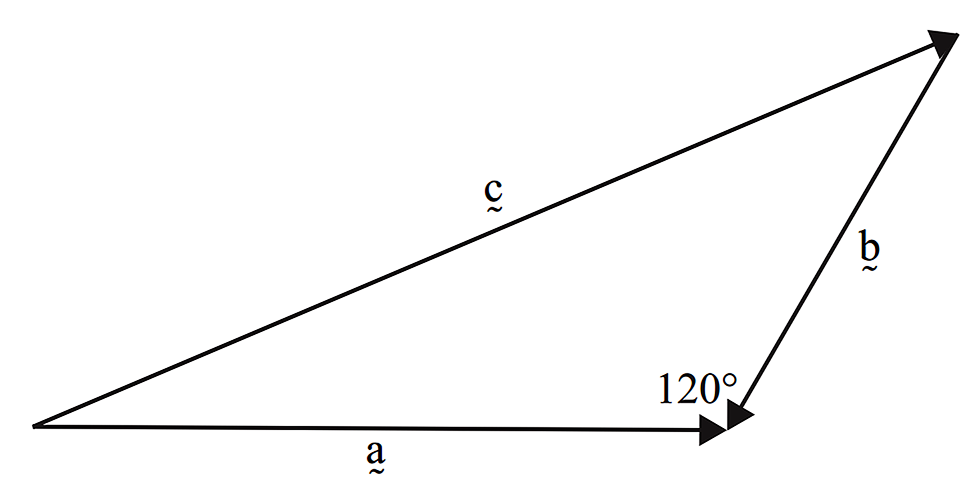
Vectors `underset ~a, underset ~b` and `underset ~c` are shown below.
 

VCAA 2009 spec2 17mc
 

From the diagram it follows that

A.   `|\ underset ~c\ |^2 = |\ underset ~a\ |^2 + |\ underset ~b\ |^2`

B.   `|\ underset ~c\ |^2 = |\ underset ~a\ |^2 + |\ underset ~b\ |^2 - |\ underset ~a\ | |\ underset ~b\ |`

C.   `|\ underset ~c\ |^2 = |\ underset ~a\ |^2 + |\ underset ~b\ |^2 + |\ underset ~a * underset ~b\ |`

D.   `|\ underset ~c\ |^2 = |\ underset ~a\ |^2 + |\ underset ~b\ |^2 + |\ underset ~a\ | |\ underset ~b\ |`

E.   `|\ underset ~c\ |^2 = |\ underset ~a\ |^2 + |\ underset ~b\ |^2 - |\ underset ~a * underset ~b\ |`

Show Answers Only

`D`

Show Worked Solution

`underset~ c + underset~ b = underset~ a\ \ => \ underset~ c = underset~ a – underset~ b`

♦♦ Mean mark 30%.

`:. underset~ c * underset~ c` `= (underset~ a – underset~ b) * (underset~ a – underset~ b)`
  `= underset~ a * underset~ a – underset~ a * underset~ b -underset~b*underset~a + underset~ b * underset~ b`
  `= underset~ a * underset~ a  + underset~ b * underset~ b-2underset~b*underset~a `

`:. |\ underset~ c\ |^2 = |\ underset~ a\ |^2 + |\ underset~ b\ |^2 – 2 |\ underset~ a\ | |\ underset~ b\ | cos 120^@`

`:. |\ underset~ c\ |^2 = |\ underset~ a\ |^2 + |\underset~ b\ |^2 + |\ underset~ a\ | |\ underset~ b\ |`

`=>   D`

Filed Under: Vector Lines, Planes and Geometry Tagged With: Band 5, smc-1177-40-Triangles, smc-1177-50-2D problems

Vectors, SPEC2 2011 VCAA 10 MC

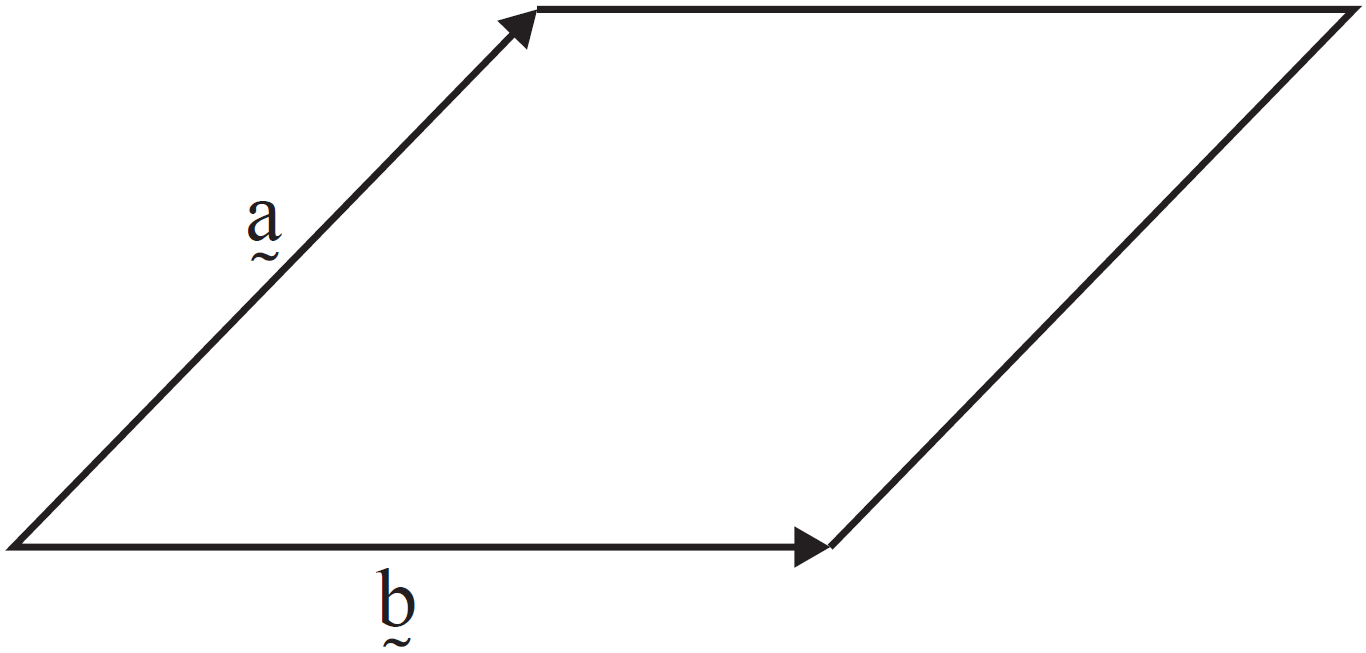
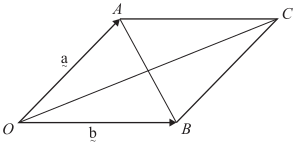
The diagram below shows a rhombus, spanned by the two vectors  `underset~a`  and  `underset~b`.
 

SPEC2 2011 VCAA 10 MC
 

It follows that

A.   `underset~a.underset~b = 0`

B.   `underset~a = underset~b`

C.   `(underset~a + underset~b).(underset~a - underset~b) = 0`

D.   `|\ underset~a + underset~b\ | = |\ underset~a - underset~b|`

E.   `2underset~a + 2underset~b = underset~0`

Show Answers Only

`C`

Show Worked Solution

`text(Consider A:)`

`text(If)\ \ underset~a · underset~b = 0\ \ =>\ \ underset~a ⊥ underset~b\ \ text{(incorrect)}`

`text(Consider B:)`

`underset~a != underset~b\ \ text{(incorrect)}`

`text(Consider C:)`

`underset~a + underset~b` `= overset(->)(OC)`
`underset~a – underset~b` `= overset(->)(BA)`

 
`overset(->)(OC) · overset(->)(BA)=0`

`text{The diagonals of a rhombus are perpendicular  (correct)}`

`=> C`

Filed Under: Vector Lines, Planes and Geometry Tagged With: Band 4, smc-1177-30-Quadrilaterals, smc-1177-50-2D problems

Vectors, SPEC1 2013 VCAA 3

The coordinates of three points are  `A (– 1, 2, 4), \ B(1, 0, 5) and C(3, 5, 2).`

  1. Find  `vec (AB)`  (1 mark)

    --- 2 WORK AREA LINES (style=lined) ---

  2. The points `A, B` and `C` are the vertices of a triangle.
  3. Prove that the triangle has a right angle at `A.`  (2 marks)

    --- 5 WORK AREA LINES (style=lined) ---

  4. Find the length of the hypotenuse of the triangle.  (1 mark)

    --- 5 WORK AREA LINES (style=lined) ---

Show Answers Only

  1. `2underset~i – 2underset~j + underset~k`
  2. `text(Proof)\ \ text{(See Worked Solutions)}`
  3. `sqrt 38`

Show Worked Solution

a.   `vec(AB)` `=(1 – −1)underset~i + (0 – 2)underset~j + (5 – 4)underset~k`
    `= 2underset~i – 2underset~j + underset~k`


b.    `overset(->)(AC)` `= (3 – −1)underset~i + (5 – 2)underset~j + (2 – 4)underset~k`
    `= 4underset~i + 3underset~j – 2underset~k`


`overset(->)(AB) · overset(->)(AC)` `= 2 xx 4 + (−2) xx 3 + 1 xx (−2)`
  `= 8 – 6 – 2`
  `= 0`

 
`=>  overset(->)(AB) ⊥ overset(->)(AC)`

`:. DeltaABC\ text(has a right angle at)\ A.`
 

c.    `overset(->)(BC)` `= (3 – 1)underset~i + (5 – 0)underset~j + (2 – 5)underset~k`
    `= 2underset~i + 5underset~j – 3underset~k`


`|overset(->)(BC)|` `= sqrt(2^2 + 5^2 + (−3)^2)`
  `= sqrt(4 + 25 + 9)`
  `= sqrt38`

Filed Under: Vector Lines, Planes and Geometry Tagged With: Band 3, Band 4, smc-1177-40-Triangles, smc-1177-50-2D problems

Vectors, SPEC1 2015 VCAA 1

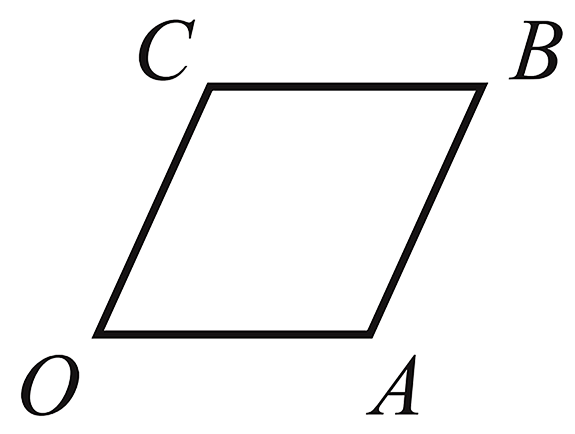
Consider the rhombus  `OABC`  shown below, where  `vec (OA) = a underset ~i`  and  `vec (OC) = underset ~i + underset ~j + underset ~k`, and `a` is a positive real constant.
 

VCAA 2015 spec 1a
 

  1. Find  `a.`  (1 mark)

    --- 2 WORK AREA LINES (style=lined) ---

  2. Show that the diagonals of the rhombus  `OABC`  are perpendicular.  (2 marks)

    --- 6 WORK AREA LINES (style=lined) ---

Show Answers Only

  1. `sqrt 3`
  2. `text(Proof)\ \ text{(See Worked Solutions)}`

Show Worked Solution

a.   `|\ vec(OA)\ | = |\ vec(OC)\ |,`

`:. a` `= sqrt (1^2 + 1^2 + 1^2)`
  `= sqrt 3`


b.   `overset(->)(CB) = overset(->)(OA), \ \ overset(->)(AB) = overset(->)(OC)`

MARKER’S COMMENT: Vector notation was poor in many answers.

`overset(->)(OB) = overset(->)(OC) + overset(->)(CB)`

`= underset~i + underset~j + underset~k + sqrt3 underset~i`

`= (sqrt3 + 1)underset~i + underset~j + underset~k`
 

`overset(->)(AC) = overset(->)(AO) + overset(->)(OC)`

`= −sqrt3underset~i + underset~i + underset~j + underset~k`

`= (1 – sqrt3)underset~i + underset~j + underset~k`
 

`overset(->)(AC) · overset(->)(OB)` `= (1 + sqrt3)(1 – sqrt3) + 1 + 1`
  `= 1 – 3 + 1 + 1`
  `= 0`

 
`:. overset(->)(AC) ⊥ overset(->)(OB)`

Filed Under: Vector Lines, Planes and Geometry Tagged With: Band 4, smc-1177-30-Quadrilaterals, smc-1177-50-2D problems

Vectors, SPEC2-NHT 2018 VCAA 12 MC


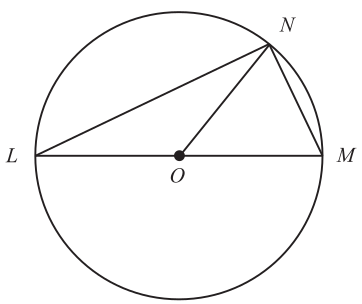
In the diagram above, `LOM` is a diameter of the circle with centre `O`.

`N` is a point on the circumference of the circle.

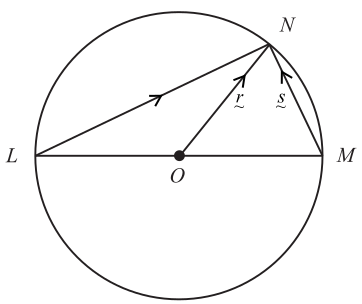
If  `underset~r = vec(ON)`  and  `underset ~s = vec(MN)`, then  `vec(LN)`  is equal to

  1. `2 underset ~r - 2 underset ~s`
  2. `underset ~r - 2 underset ~s`
  3. `underset ~r + 2 underset ~s`
  4. `2 underset ~r + underset ~s`
  5. `2 underset ~r - underset ~s`
Show Answers Only

`E`

Show Worked Solution

`vec(LN)` `= vec(LM) + vec(MN)`
`vec(LN)` `= vec(LO) + vec(ON)`
  `= 1/2\ vec(LM) + vec(ON)`


`:. vec(LM) + underset~s` `= 1/2\ vec(LM) + underset~r`
`1/2\ vec(LM)` `= underset ~r – underset~s`
`vec(LM)` `= 2 underset~r – 2 underset~s`


`:. vec(LN)` `= 2 underset~r – 2 underset~s + underset~s`
  `= 2 underset~r –  underset~s`

 
`=>  E`

Filed Under: Vector Lines, Planes and Geometry Tagged With: Band 4, smc-1177-40-Triangles, smc-1177-50-2D problems

Copyright © 2014–2025 SmarterEd.com.au · Log in