SmarterEd

Aussie Maths & Science Teachers: Save your time with SmarterEd

  • Login
  • Get Help
  • About

Vectors, SPEC2 2024 VCAA 5

Consider the points  \(A(1,-2,3)\) and \(B(2,-5,-1)\).

  1. Find a vector equation, in terms of the components \(\underset{\sim}{i}, \underset{\sim}{j}\) and \(\underset{\sim}{k}\), for the line passing through these points.   (1 mark)

    --- 3 WORK AREA LINES (style=lined) ---

  2. Consider the different line  \(L_1: r _1(t)=2 \underset{\sim}{ i }+\underset{\sim}{ j }-3 \underset{\sim}{k}+t(-\underset{\sim}{ i }+2\underset{\sim}{ j }+\underset{\sim}{ k }), t \in R\).
  3. Find the shortest distance from \(L_1\) to point \(A\).
  4. Give your answer in the form  \(\dfrac{a \sqrt{b}}{c}\)  where  \(a, b\) and \(c\) are positive integers.   (3 marks)

    --- 14 WORK AREA LINES (style=lined) ---

  5. Let \(C\) be the point \((0,2,-5)\).
  6. Find the Cartesian equation of the plane that contains the points \(A, B\) and \(C\).   (3 marks)

    --- 7 WORK AREA LINES (style=lined) ---
  7. Another plane has the Cartesian equation  \(2 x-3 y+4 z=12\).
  8. This plane intersects the coordinate axes at three points, which form the vertices of a triangle.
    1. Find the coordinates of these three points.   (1 mark)

      --- 3 WORK AREA LINES (style=lined) ---

    2. Find the area of the triangle.
    3. Give your answer in the form  \(m \sqrt{n}\)  where \(m\) and \(n\) are integers.   (2 marks)

      --- 4 WORK AREA LINES (style=lined) ---

Show Answers Only

a.    \(\underset{\sim}{r}(t)=\underset{\sim}{i}-2 \underset{\sim}{j}+3 \underset{\sim}{k}+t(\underset{\sim}{i}-3\underset{\sim}{j}-4 \underset{\sim}{k}), \quad(t \in R)\)

\(\text{or}\)

\(\underset{\sim}{r}(t)=2\underset{\sim}{i}-5 \underset{\sim}{j}-\underset{\sim}{k}+t(\underset{\sim}{i}-3\underset{\sim}{j}-4 \underset{\sim}{k}), \quad (t \in R)\)

b.  \(\text{Shortest distance}=\dfrac{5 \sqrt{66}}{6}\)

c.   \(40x+12 y+z=19\)

d.i.  \(X(6,0,0), Y(0,-4,0), Z(0,0,3)\)

d.ii.  \(\text{Area}=3 \sqrt{29}\)

Show Worked Solution

a.    \(\overrightarrow{AB}=\left(\begin{array}{c}2 \\ -5 \\ -1\end{array}\right)-\left(\begin{array}{c}1 \\ -2 \\ 3\end{array}\right)=\left(\begin{array}{c}1 \\ -3 \\ -4\end{array}\right)\)

\(\underset{\sim}{r}(t)=\underset{\sim}{i}-2 \underset{\sim}{j}+3 \underset{\sim}{k}+t(\underset{\sim}{i}-3\underset{\sim}{j}-4 \underset{\sim}{k}), \quad(t \in R)\)

\(\text{or}\)

\(\underset{\sim}{r}(t)=2\underset{\sim}{i}-5 \underset{\sim}{j}-\underset{\sim}{k}+t(\underset{\sim}{i}-3\underset{\sim}{j}-4 \underset{\sim}{k}), \quad (t \in R)\)
 

b.    \({\underset{\sim}{r}}_\text{A}=\underset{\sim}{i}-2\underset{\sim}{j}+3 \underset{\sim}{k}\)

\({\underset{\sim}{r}}_1=(2-t) \underset{\sim}{i}+(1+2 t) \underset{\sim}{j}+(t-3) \underset{\sim}{k}\)

\({\underset{\sim}{r}}_1-{\underset{\sim}{r}}_\text{A}=(1-t)\underset{\sim}{i}+(2 t+3) \underset{\sim}{j}+(t-6) \underset{\sim}{k}\)

\(\abs{{\underset{\sim}{r}}_1-{\underset{\sim}{r}}_\text{A}}=\sqrt{(1-t)^2+(2 t+3)^2+(t-6)^2}\)

\(\text{Find \(t\) when} \ \ \dfrac{d}{dt}\left(\abs{{\underset{\sim}{r}}_1-{\underset{\sim}{r}}_\text{A}}\right)=0:\)

  \(t=\dfrac{1}{6}\)

\(\therefore\ \text{Shortest distance}=\dfrac{5 \sqrt{66}}{6}\)
 

c.    \(C(0,2,-5)\)

\(\text{Plane equation:} \ \dfrac{x}{a}+\dfrac{y}{b}+\dfrac{z}{c}=1\)

\(\text{Solve:} \ \ \dfrac{1}{a}-\dfrac{2}{b}+\dfrac{3}{c}=1, \quad \dfrac{2}{a}-\dfrac{5}{b}-\dfrac{1}{c}=1, \quad \dfrac{0}{a}+\dfrac{2}{b}-\dfrac{5}{c}=1\)

\(a=\dfrac{19}{40}, \quad b=\dfrac{19}{12}, \quad c=19\)

\(\text{Equation of plane:}\)

\(\dfrac{40x}{19}+\dfrac{12y}{19}+\dfrac{z}{19}=1 \ \Rightarrow \ 40x+12 y+z=19\)
 

d.i.   \(2 x-3 y+4 z=12\)

\(2x=12\ \) \(\ \Rightarrow \ x=6\ \) \(\Rightarrow\  X(6,0,0)\)
\(-3 y=12\ \) \(\ \Rightarrow \ y=-4\ \) \(\Rightarrow\  Y(0,-4,0)\)
\(4 z=12\ \) \(\ \Rightarrow \ z=3\ \) \(\Rightarrow\  Z(0,0,3)\)
 

d.ii  \(\overrightarrow{XY}=\left(\begin{array}{c}0 \\ -4 \\ 0\end{array}\right)-\left(\begin{array}{l}6 \\ 0 \\ 0\end{array}\right)=\left(\begin{array}{c}-6 \\ -4 \\ 0\end{array}\right)\)

\(\overrightarrow{X Z}=\left(\begin{array}{l}0 \\ 0 \\ 3\end{array}\right)-\left(\begin{array}{l}6 \\ 0 \\ 0\end{array}\right)=\left(\begin{array}{c}-6 \\ 0 \\ 3\end{array}\right)\)
 
\(\text{Area}=\dfrac{1}{2}\abs{\overrightarrow{XY} \times \overrightarrow{XZ}}=\dfrac{1}{2}\abs{-12\underset{\sim}{i}+18 \underset{\sim}{j}-24 \underset{\sim}{k}}=\sqrt{261}=3 \sqrt{29}\)

Filed Under: Vector Lines, Planes and Geometry Tagged With: Band 3, Band 4, smc-1177-60-3D problems, smc-1177-80-Planes

Vectors, SPEC1 2024 VCAA 10

Let the lines \(l_1\) and \(l_2\) be defined by

\(l_1:{\underset{\sim}{r}}_1(\lambda)=\underset{\sim}{i}+m \underset{\sim}{k}+\lambda(\underset{\sim}{i}+2\underset{\sim}{j}+\underset{\sim}{k})\)  and  \(l_2:{\underset{\sim}{r}}_2(\mu)=2 \underset{\sim}{ i }-\underset{\sim}{ k }+\mu(-\underset{\sim}{ i }+3 \underset{\sim}{ j }+2 \underset{\sim}{ k })\),  where  \(m \in R \backslash\left\{-\dfrac{4}{5}\right\}\) and \(\lambda, \mu \in R\).

If the shortest distance between the two skew lines \(l_1\) and \(l_2\) is \(\dfrac{14}{\sqrt{35}}\), find the values of \(m\).   (3 marks)

--- 10 WORK AREA LINES (style=lined) ---

Show Answers Only

\(m=\dfrac{-18}{5}\ \text{or}\ 2\)

Show Worked Solution

\begin{array}{lll}
\text{Let} \ & {\underset{\sim}{a}}_1=\underset{\sim}{i}+m\underset{\sim}{k}, &{\underset{\sim}{d}}_1=\underset{\sim}{i}+2 \underset{\sim}{j}+\underset{\sim}{k}\\
\quad &{\underset{\sim}{a}}_2=2\underset{\sim}{i}-\underset{\sim}{k}, & {\underset{\sim}{d}}_2=\underset{\sim}{i}+3\underset{\sim}{j}+2 \underset{\sim}{k}\\
\end{array}

♦♦ Mean mark 27%.

\(\underset{\sim}{n}={\underset{\sim}{d}}_1 \times{\underset{\sim}{d}}_2=\left|\begin{array}{ccc}\underset{\sim}{i} & \underset{\sim}{j} & \underset{\sim}{k} \\ 1 & 2 & 1 \\ -1 & 3 & 2\end{array}\right|=\underset{\sim}{i}+3 \underset{\sim}{j}+5 \underset{\sim}{k}\)
 

\(\hat{\underset{\sim}{n}} = \dfrac{\underset{\sim}{i}+3 \underset{\sim}{j}+5 \underset{\sim}{k}}{\sqrt{1+9+25}}=\dfrac{1}{\sqrt{35}}\left(\underset{\sim}{i}+3\underset{\sim}{j}+5\underset{\sim}{k}\right)\)
 

\(\text{Distance}\) \(=\abs{\left({\underset{\sim}{a}}_2-{\underset{\sim}{a}}_1 \right) \cdot  \hat{\underset{\sim}{n}}}\)
  \(=\abs{\left( \underset{\sim}{i}-\left(1+m\right)\underset{\sim}{k}\right) \cdot \dfrac{1}{\sqrt{3}} \left(\underset{\sim}{i}+3 \underset{\sim}{j}+5 \underset{\sim}{k}\right) }\)
  \(=\abs{\dfrac{1+0-5-5 m}{\sqrt{3}}}\)
  \(=\abs{\dfrac{-4-5 m}{\sqrt{35}}}\)

 
\(\text{Find \(m\) such that:}\)

\(\abs{\dfrac{-4-5 m}{\sqrt{35}}}\) \(=\dfrac{14}{\sqrt{35}}\)    
\(-4-5 m\) \(=14\) \(\qquad 4+5 m\) \(=14\)
\(m\) \( =\dfrac{-18}{5}\ \ \ \ \ \  \text{or}\) \(m\) \(=2\)

Filed Under: Vector Lines, Planes and Geometry Tagged With: Band 5, smc-1177-60-3D problems, smc-1177-70-Distance b/t lines

Vectors, SPEC2 SM-Bank 23

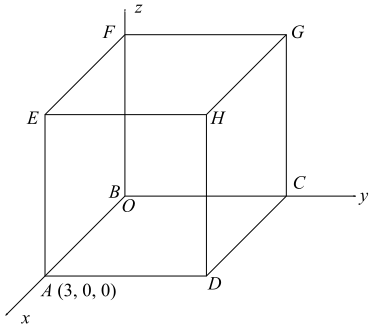
A cube with side length 3 units is pictured below.


  1. Calculate the magnitude of vector `vec(AG)`.  (1 mark)

    --- 3 WORK AREA LINES (style=lined) ---

  2. Find the acute angle between the diagonals `vec(AG)` and `vec(BH)`.  (3 marks)

    --- 7 WORK AREA LINES (style=lined) ---

Show Answers Only

  1. `3 sqrt 3\ text(units)`
  2. `70^@32′`

Show Worked Solution

i.   `A(3, 0 , 0), \ \ G(0, 3, 3)`

  `vec(AG)` `= ((0), (3), (3))-((3), (0), (0)) = ((text{−3}), (3), (3))`
  `|\ vec(AG)\ |` `= sqrt (9 + 9 + 9)`
    `= 3 sqrt 3\ text(units)`


ii.    `H (3, 3, 3)`
  `vec(BH) = ((3), (3), (3))`
`vec(AG) ⋅ vec(BH)` `= |\ vec(AG)\ | ⋅ |\ vec(BH)\ |\ cos theta`
`((text{−3}), (3), (3)) ⋅ ((3), (3), (3))` `= sqrt (9 + 9 + 9) ⋅ sqrt (9 + 9 + 9) cos theta`
`-9 + 9 + 9` `= 27 cos theta`
`cos theta` `= 1/3`
`theta` `= 70.52…`
  `= 70^@32′`

Filed Under: Vector Lines, Planes and Geometry Tagged With: Band 3, Band 4, smc-1177-10-Cube/Rect prism, smc-1177-60-3D problems

Vectors, SPEC2 2019 VCAA 4

The base of a pyramid is the parallelogram  `ABCD`  with vertices at points  `A(2,−1,3),  B(4,−2,1),  C(a,b,c)`  and  `D(4,3,−1)`. The apex (top) of the pyramid is located at  `P(4,−4,9)`.

  1. Find the values of  `a, b`  and  `c`.  (2 marks)

    --- 5 WORK AREA LINES (style=lined) ---

  2. Find the cosine of the angle between the vectors  `overset(->)(AB)`  and  `overset(->)(AD)`.  (2 marks)

    --- 5 WORK AREA LINES (style=lined) ---

  3. Find the area of the base of the pyramid.  (2 marks)

    --- 5 WORK AREA LINES (style=lined) ---

  4. Show that  `6underset~i + 2underset~j + 5underset~k`  is perpendicular to both  `overset(->)(AB)`  and  `overset(->)(AD)`, and hence find a unit vector that is perpendicular to the base of the pyramid.  (3 marks)

    --- 6 WORK AREA LINES (style=lined) ---

  5. Find the volume of the pyramid.  (2 marks)

    --- 5 WORK AREA LINES (style=lined) ---

Show Answers Only

  1. `a = 6, b = 2, c = −3`
  2. `4/9`
  3. `2sqrt65 u^2`
  4. `text(See Worked Solutions)`
  5. `24\ text(u³)`

Show Worked Solution

a.    `overset(->)(AB)` `= (4-2)underset~i + (−2 + 1)underset~j + (1-3)underset~k`
    `= 2underset~i-underset~j-2underset~k`

 
`text(S)text(ince)\ ABCD\ text(is a parallelogram)\ => \ overset(->)(AB)= overset(->)(DC)`

`overset(->)(DC) = (a-4)underset~i + (b-3)underset~j + (c + 1)underset~k`

`a-4 = 2 \ => \ a = 6`

`b-3 = −1 \ => \ b = 2`

`c + 1 = −2 \ => \ c = −3`


b.   `overset(->)(AB) = 2underset~i-underset~j-2underset~k`

`overset(->)(AD) = 2underset~i + 4underset~j-4underset~k`

`cos angleBAD` `= (overset(->)(AB) · overset(->)(AD))/(|overset(->)(AB)| · |overset(->)(AD)|)`
  `= (4-4 + 8)/(sqrt(4 + 1 + 4) · sqrt(4 + 16 + 16))`
  `= 4/9`


c.    `1/2 xx text(Area)_(ABCD)` `= 1/2 ab sin c`
  `text(Area)_(ABCD)` `= |overset(->)(AB)| · |overset(->)(AD)| *sin(cos^(−1)\ 4/9)`


`:. text(Area)_(ABCD)` `= 3 · 6 · sqrt65/9`
  `= 2sqrt65\ text(u²)`


d.   `text(Let)\ \ underset~r = 6underset~i + 2underset~j + 5underset~k`

`underset~r · overset(->)(AB)` `= 6 xx 2 + 2 xx −1 + 5 xx −2 = 0`
`underset~r · overset(->)(AD)` `= 6 xx 2 + 2 xx 4 + 5 xx −2 = 0`

 
`:. underset~r\ \ text(is ⊥ to)\ \ overset(->)(AB)\ \ text(and)\ \ overset(->)(AD)`

`text(Let)\ \ hatr\ = text(unit vector ⊥ to pyramid base)`

`underset~overset^r = 1/sqrt(6^2 + 2^2 + 5^2) *underset~r = 1/sqrt65(6underset~i + 2underset~j + 5underset~k)`


e.   `text(Find height)\ (h)\ text(of pyramid:)`

`overset(->)(AP)` `= (4-2)underset~i + (−4 + 1)underset~j + (9-3)underset~k`
  `= 2underset~i-3underset~j + 6underset~k`


`h` `= overset(->)(AP) · underset~overset^r`
  `= (2 xx 6/sqrt65)-(3 xx 2/sqrt65) + (6 xx 5/sqrt65)`
  `= 36/sqrt65`


`:. V` `= 1/3 b xx h`
  `= 1/3 xx 2sqrt65 xx 36/sqrt65`
  `= 24\ text(u³)`

Filed Under: Vector Lines, Planes and Geometry Tagged With: Band 3, Band 4, Band 5, smc-1177-20-Pyramids, smc-1177-60-3D problems

Vectors, SPEC2-NHT 2017 VCAA 13 MC

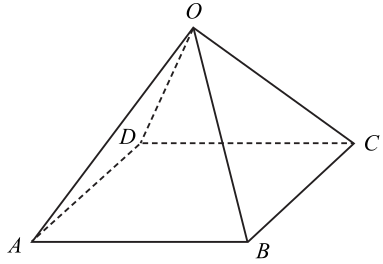
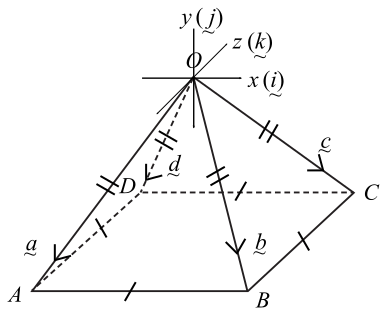
Let  `OABCD`  be a right square pyramid where  `underset ~a = vec(OA),\ underset ~b = vec(OB),\ underset ~c = vec(OC)`  and  `underset ~d = vec(OD)`.

An equation correctly relating these vectors is

A.   `underset ~a + underset ~c = underset ~b + underset ~d`

B.   `(underset ~a - underset ~c) ⋅ (underset ~d - underset ~c) = 0`

C.   `underset ~a + underset ~d = underset ~b + underset ~c`

D.   `(underset ~a - underset ~d) ⋅ (underset ~c - underset ~b) = 0`

E.   `underset ~a + underset ~b = underset ~c + underset ~d`

Show Answers Only

`A`

Show Worked Solution

`|underset ~a| = |underset ~b| = |underset ~c| = |underset ~d|`

`text(Let)\ \ underset ~a` `= alpha underset ~i + beta underset ~j + gamma underset ~k`
`underset ~b` `= -alpha underset ~i + beta underset ~j + gamma underset ~k`
`underset ~c` `= -alpha underset ~i + beta underset ~j – gamma underset ~k`
`underset ~d` `= alpha underset ~i + beta underset ~j – gamma underset ~k`


`A:\ \ underset ~a + underset ~ c` `= 2 beta underset ~ j`
`underset ~b + underset ~d` `= 2 beta underset ~j`


`=>   A`

Filed Under: Vector Lines, Planes and Geometry Tagged With: Band 5, smc-1177-20-Pyramids, smc-1177-60-3D problems

Copyright © 2014–2025 SmarterEd.com.au · Log in