SmarterEd

Aussie Maths & Science Teachers: Save your time with SmarterEd

  • Login
  • Get Help
  • About

Vectors, SPEC1 2021 VCAA 9

Let  `underset~r(t) = (-1 + 4cos(t))underset~i + 2/sqrt3\ sin(t)underset~j`  and  `underset~s(t) = (3 sec(t)-1)underset~i + tan(t)underset~j`  be the position vectors relative to a fixed point `O` of particle `A` and particle `B` respectively for  `0 <= 1 <= c`, where `c` is a positive real constant.

    1. Show that the cartesian equation of the path of particle `A` is  `((x + 1)^2)/16 + (3y^2)/4 = 1`.   (1 mark)

      --- 4 WORK AREA LINES (style=lined) ---

    2. Show that the cartesian equation of the path of particle `A` in the first quadrant can be written as  `y = sqrt3/6 sqrt(-x^2-2x + 15)`.   (1 mark)

      --- 4 WORK AREA LINES (style=lined) ---

    1. Show that the particles `A` and `B` will collide.   (1 mark)

      --- 5 WORK AREA LINES (style=lined) ---

    2. Hence, find the coordinates of the point of collision of the two particles.   (1 mark)

      --- 3 WORK AREA LINES (style=lined) ---

    1. Show that  `d/(dx)(8arcsin ((x + 1)/4) + ((x + 1)sqrt(-x^2 -2x + 15))/2) = sqrt(-x^2-2x + 15)`.   (2 marks)

      --- 6 WORK AREA LINES (style=lined) ---

    2.    

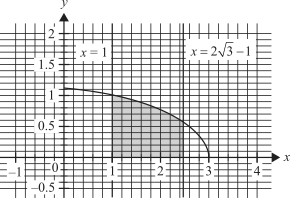
      Hence, find the area bounded by the graph of  `y = sqrt3/6 sqrt(-x^2-2x + 15)`,  the `x`-axis and the lines  `x = 1`  and  `x = 2sqrt3-1`,  as shown in the diagram above. Give your answer in the form  `(asqrt3pi)/b`, where `a` and `b` are positive integers.   (2 marks)

      --- 6 WORK AREA LINES (style=lined) ---

Show Answers Only
    1. `text(See Worked Solutions)`
    2. `text(See Worked Solutions)`
    1. `text(See Worked Solutions)`
    2. `-1 + 2sqrt3, 1/sqrt3`
    1. `text(See Worked Solutions)`
    2. `(2sqrt3pi)/9`
Show Worked Solution

a.i.   `text(Particle A)`

`underset~r(t) = (-1 + 4cos(t))underset~i + 2/sqrt3\ sin(t)underset~j`

`x` `= -1 + 4cos(t)`
`x + 1` `= 4cos(t)`
`cos(t)` `= (x + 1)/4`
`y` `= 2/sqrt3\ sin(t)`
`sin(t)` `= (sqrt3 y)/2`

 
`text(Using)\ \ cos^2(t) + sin^2(t) = 1`

`((x + 1)^2)/16 + (3y^2)/4 = 1`


a.ii.  `((x + 1)^2)/16 + (3y^2)/4 = 1`

♦ Mean mark part (a)(ii) 41%.
`(x + 1)^2 + 12y^2` `= 16`
`12y^2` `= 16-x^2-2x-1`
`y^2` `= 1/12(15-x^2-2x)`
`y` `= ±sqrt(1/12 (-x^2-2x + 15))`

 
`text(In the 1st quadrant,)\ \ y > 0`

`:. y` `= 1/sqrt12 sqrt(-x^2-2x + 15)`
  `= 1/(2sqrt3) xx sqrt3/sqrt3 sqrt(-x^2-2x + 15)`
  `= sqrt3/6 sqrt(-x^2-2x + 15)`


b.i.   `text(If particles collide, find)\ \t\ text(that satisfies)`

`-1 + 4cos(t)` `= 3sec(t)-1\ \ text(and)`
`2/sqrt3 sin(t)` `= tan(t)`

 
`text(Equate)\ underset~j\ text(components:)`

`2/sqrt3 sin(t)` `= (sin(t))/(cos(t))`
`cos(t)` `= sqrt3/2`
`t` `= pi/6`

 
`text(Check)\ underset~i\ text(components at)\ \ t= pi/6 :`

`-1 + 4cos(pi/6)` `= 3 sec(pi/6)-1`
`-1 + 4 · sqrt3/2` `= 3· 2/sqrt3-1`
`2sqrt3` `= 2sqrt3`

 
`:.\ text(Particles collide.)`


b.ii.   `text(Collision occurs at)\ \ r(pi/6)`

`r(pi/6)` `= (-1 + 4cos\ pi/6, 2/sqrt3 sin\ pi/6)`
  `= (-1 + 2sqrt3, 1/sqrt3)`
♦ Mean mark part (c)(i) 37%.


c.i.   `d/dx (8sin^(-1) ((x + 1)/4) + ((x + 1)sqrt(-x^2 -2x + 15))/2)`

`= 8/(sqrt(1-((x + 1)/4)^2)) xx 1/4 + ((x + 1))/2 xx (-2x-2)/(2sqrt(-x^2-2x + 15)) + sqrt(-x^2-2x + 15) xx 1/2`

`= 8/(sqrt(16-(x + 1)^2))-((x + 1)^2)/(2sqrt(-x^2-2x + 15)) + sqrt(-x^2 -2x + 15)/2`

`= 16/(2sqrt(-x^2-2x + 15))-((x + 1)^2)/(2sqrt(-x^2-2x + 15))+ (-x^2-2x + 15)/(2sqrt(-x^2-2x + 15))`

`= (16-x^2-2x-1-x^2-2x + 15)/(2sqrt(-x^2-2x + 15))`

`= (2(-x^2-2x + 15))/(2sqrt(-x^2-2x + 15))`

`= sqrt(-x^2-2x + 15)`

♦ Mean mark part (c)(ii) 45%.


c.ii.    `text(Area)` `= int_1^(2sqrt3-1) sqrt3/6 sqrt(-x^2-2x + 15)\ dx`
    `= sqrt3/6 int_1^(2sqrt3-1) sqrt(-x^2-2x + 15)\ dx`
    `= sqrt3/6 [8sin^(-1)((x + 1)/4) + ((x + 1)sqrt(-x^2-2x + 15))/2]_1^(2sqrt3-1)`
    `= sqrt3/6 [(8sin^(-1)(sqrt3/2) + 2sqrt3 sqrt(-(2sqrt3 -1)^2-2(2sqrt3-1) + 15)/2)-(8sin^(-1)(1/2) + (2sqrt(-1-2 + 15))/2)]`
    `= sqrt3/6 [(8pi)/3 + sqrt3 sqrt(-12 + 4sqrt3-1-4sqrt3 + 2 + 15)-((8pi)/6 + sqrt12)]`
    `= sqrt3/6 ((8pi)/3 + 2sqrt3-(8pi)/6-2sqrt3)`
    `= sqrt3/6 ((8pi)/6)`
    `= (2sqrt3pi)/9`

Filed Under: Position Vectors as a Function of Time Tagged With: Band 4, Band 5, Band 6, smc-1178-10-Find Cartesian equation, smc-1178-30-Collision

Vectors, SPEC2 2020 VCAA 4

A pilot is performing at an air show. The position of her aeroplane at time `t` relative to a fixed origin `O` is given by 

   `underset~r_text(A) (t) = (450-150sin((pit)/6))underset~i + (400-200cos((pit)/6))underset~j`,

where  `underset~i`  is a unit vector in a horizontal direction, `underset~j`  is a unit vector vertically up, displacement components are measured in metres and time `t` is measured in seconds where  `t >= 0`.

  1. Find the maximum speed of the aeroplane. Give your answer in `text(ms)^(−1)`.  (3 marks)

    --- 6 WORK AREA LINES (style=lined) ---

  2.  i. Use  `underset~r_text(A)(t)`  to show that the cartesian equation of the path of the aeroplane is given by
  3.     `((x-450)^2)/(22\ 500) + ((y-400)^2)/(40\ 000) = 1`.  (2 marks)

    --- 6 WORK AREA LINES (style=lined) ---

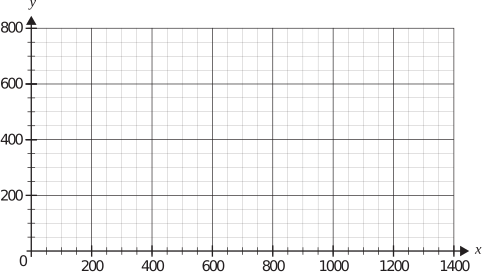
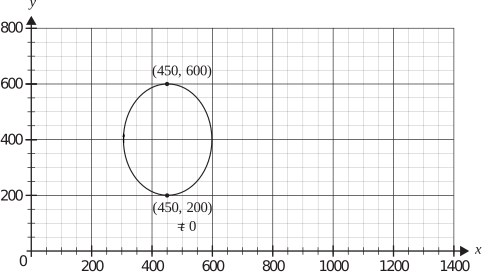
  4. ii. Sketch the path of the aeroplane on the axes provided below. Label the position of the aeroplane when  `t = 0`, using coordinates, and use an arrow to show the direction of motion of the aeroplane.  (3 marks)
  5. --- 0 WORK AREA LINES (style=lined) ---


A friend of the pilot launches an experimental jet-powered drone to take photographs of the air show. The position of the drone at time `t` relative to the fixed origin is given by  `underset~r_text(D)(t) = (30t)underset~i + (−t^2 + 40t)underset~j`, where `t` is in seconds and  `0 <= t <= 40, underset~i`  is a unit vector in the same horizontal direction, `underset~j`  is a unit vector vertically up, and displacement components are measured in metres.

  1. Sketch the path of the drone on the axes provided in part b.ii. Using coordinates, label the points where the path of the drone crosses the path of the aeroplane, correct to the nearest metre.  (3 marks)

    --- 6 WORK AREA LINES (style=lined) ---

  2. Determine whether the drone will make contact with the aeroplane. Give reasons for your answer.  (3 marks)

    --- 6 WORK AREA LINES (style=lined) ---

Show Answers Only

  1. `(100pi)/3 text(ms)^(−1)`
  2.  i. `text(See Worked Solutions)`
  3. ii.
  4.  

     
  5. `text(See Worked Solutions)`

Show Worked Solution

a.    `underset~r_text(A)′(t)` `= −25picos((pit)/60)underset~i + 100/3pisin((pit)/6)underset~j`
    `= (25pi)/3(−3cos((pit)/6) + 4sin((pit)/6))`
`|underset~r_text(A)′(t)|` `= (25pi)/3 sqrt(9cos^2((pit)/6) + 16sin^2((pit)/6))`
  `= (25pi)/3 sqrt(9 + 7sin^2((pit)/6))`
`:. |underset~r_text(A)′(t)|_text(max)` `= (25pi)/3 sqrt(9 + 7)`
  `= (100pi)/3\ text(ms)^(−1)`


b. i.   `x = 450-150 sin((pit)/6) \ => \ sin((pit)/6) = (450-x)/150`

`sin^2((pit)/6) = ((x-450)^2)/(22\ 500)`
 

`y = 400-200cos((pit)/6) \ => \ cos((pit)/6) = (400-y)/200`

`cos^2((pit)/6) = ((y-400)^2)/(40\ 000)`
 

`text(Using)\ \ sin^2theta + cos^2theta = 1:`

`((x-450)^2)/(22\ 500) + ((y-400)^2)/(40\ 000) = 1`


b. ii.   `text(When)\ x = 450, \ y = 200, 600`

`text(When)\ y = 400, \ x = 300, 600`

`text(As)\ \ t -> 1, \ x↓, \ y↑`

`:.\ text(Motion is clockwise.)`


c.   `x = 30t \ => \ t = x/30`

`y` `= −t^2 + 40t`
  `= −(x^2)/900 + 4/3 x`


d.   `text(The graph shows 2 points where the paths cross.)`

`text(Consider)\ (316, 310):`

`text(Drone passes through when)`

`t = 316/30 ~~ 10.53\ text(seconds)`

`text(Plane passes through when)`

`450-150sin((pit)/6) = 316 \ => \ t ~~ 12.85\ text{seconds (no contact)}`
 

`text(Similarly, consider)\ (600, 400):`

`text(Drone passes through when)`

`t = 600/30 = 20\ text(seconds)`

`text(Plane passes through when)`

`400-200cos((pit)/6) = 400 \ => \ t = 10\ text(or)\ ~~ 14.7\ text{seconds (no contact)}`
  

`:.\ text(Drone will not make contact with the plane.)`

Filed Under: Position Vectors as a Function of Time Tagged With: Band 4, smc-1178-20-Find r(t) v(t) a(t), smc-1178-30-Collision

Vectors, SPEC1 2019 VCAA 4

The position vectors of two particles  `A`  and  `B`  at time  `t` seconds after they have started moving are given by  `underset~r_A(t) = (t^2-1)underset~i + (a + t/3)underset~j`  and  `underset~r_B(t) = (t^3-t)underset~i + (text(arccos)(t/2))underset~j`  respectively, where  `a`  is a real constant and  `0 <= t <= 2`.

Find the value of  `a`  if the particles collide after they have started moving.   (3 marks)

--- 8 WORK AREA LINES (style=lined) ---

Show Answers Only

`(pi-1)/3`

Show Worked Solution

`text(Collision occurs when)\ underset~i\ text(and)\ underset~j\ text(components are equal).`

`text(Equating)\ underset~i\ text(components:)`

`t^2-1` `= t^3-t`
`t^3-t^2-t + 1` `= 0`
`t^2(t-1)-(t-1)` `= 0`
`(t^2-1)(t-1)` `= 0`

 
`:. t = 1\ \ (t > 0)`
 

`text(Equating)\ underset~j\ text{components (when}\ t = 1text{):}`

`a + 1/3` `= cos^(−1)(1/2)`
`:. a` `= (pi-1)/3`

Filed Under: Position Vectors as a Function of Time Tagged With: Band 4, smc-1178-30-Collision

Vectors, SPEC2 2015 VCAA 18 MC

The position vectors of two moving particles are given by  `underset~r_1(t) = (2 + 4t^2)underset~i + (3t + 2)underset~j`  and  `underset~r(t) = (6t)underset~i + (4 + t)underset~j`, where  `t >=0`.

The particles will collide at

  1. `3underset~i + 3.5underset~j`
  2. `6underset~i + 5underset~j`
  3. `3underset~i + 4.5underset~j`
  4. `0.5underset~i + underset~j`
  5. `5underset~i + 6underset~j`
Show Answers Only

`B`

Show Worked Solution

`text(Equating)\ \ underset~i\ \ text(components:)`

`2 + 4t^2 = 6t`

`t=1\ \ text(or)\ \ t = 1/2`
 

`text(Equating)\ \ underset~j\ \ text(components:)`

`3t + 2=4+t`

`t = 1`
 

`underset~r_1(1) = 6underset~i + 5underset~j`

`=> B`

Filed Under: Position Vectors as a Function of Time Tagged With: Band 4, smc-1178-30-Collision

Vectors, SPEC2 2018 VCAA 4

Two yachts, `A` and `B`, are competing in a race and their position vectors on a certain section of the race after time  `t`  hours are given by

`underset ~ r_A (t) = (t + 1) underset ~i + (t^2 + 2t) underset ~j \ and \ underset ~r_B (t) = t^2 underset ~i + (t^2 + 3) underset ~j, \ t >= 0`

where displacement components are measured in kilometres from a given reference buoy at origin `O`.

  1. Find the cartesian equation of the path for each yacht.   (2 marks)

    --- 4 WORK AREA LINES (style=lined) ---

  2. Show that the two yachts will not collide if they follow these paths.   (2 marks)

    --- 4 WORK AREA LINES (style=lined) ---

  3. Find the coordinates of the point where the paths of the two yachts cross. Give your coordinates correct to three decimal places.   (2 marks)

    --- 5 WORK AREA LINES (style=lined) ---

One of the rules for the race is that the yachts are not allowed to be within 0.2 km of each other. If this occurs there is a time penalty for the yacht that is travelling faster.

  1. For what values of `t` is yacht `A` travelling faster than yacht `B`?   (2 marks)

    --- 6 WORK AREA LINES (style=lined) ---

  2. If yacht `A` does not alter its course, for what period of time will yacht `A` be within 0.2 km of yacht `B`? Give your answer in minutes, correct to one decimal place.   (2 marks)

    --- 6 WORK AREA LINES (style=lined) ---

Show Answers Only
  1. `y_A = x_A^2-1, x_A > 1; qquad y_B = x_B + 3, x_B > 0`
  2. `text(Proof)\ \ text{(See Worked Solutions)}`
  3. `(x, y) ~~ (2.562, 5.562)`
  4. `0 < t < 5/2`
  5. `4.1\ text(minutes)`
Show Worked Solution

a.  `x_A = t + 1,\ \ y_A = = t^2 + 2t`

`y_A` `= t^2 + 2 t + 1-1`
  `= (t + 1)^2-1`
`:. y_A` `= x_A^2-1`

 
`x_B = t^2,`

`y_B` `= t^2+3`
`:.y_B` `= x_B+3`


b.  `text(Same)\ \ xtext(-coordinate occurs when:)`

`t+1` `= t^2`
`t` `= (1+sqrt5)/2,\ \ \ (t>0)`

 
`text(When)\ \ t = (1+sqrt5)/2,`

`y_A=(3sqrt5+5)/2`

`y_B= (sqrt5+9)/2  !=y_A`
 

`:.\ text(No collision)`


c.   `x + 3` `= x^2-1`
  `x^2-x-4` `= 0`
  `x` `= (1 + sqrt 17)/2,\ \ \ (t>0 \ =>\ x>1)`
  `y` `= (7 + sqrt 17)/2`
  `:. (x, y)` `= ((1 + sqrt 17)/2, (7 + sqrt 17)/2)`
    `=(2.562, 5.562)`


d.    `underset ~dot r_A (t)` `= underset ~i + (2t + 2)underset ~j`
  `|underset ~dot r_A (t)|` `= sqrt(1 + (2t + 2)^2)`
    `= sqrt(4t^2 + 8t + 5)`
     
  `underset ~dot r_B (t)` `= 2t underset ~i + 2t underset ~j`
  `|underset ~dot r_B (t)|` `= sqrt (4t^2 + 4t^2)`
    `= sqrt(8t^2)`

  
 `text(Yacht A is travelling faster when:)`

♦ Mean mark part (d) 41%.

`sqrt(4t^2 + 8t + 5)` `> sqrt (8t^2)`
`4t^2 + 8t + 5` `> 8t^2`
`4t^2-8t-5` `< 0`

 
`:. 0 < t < 5/2`


e.    `underset ~ r_B-underset ~r_A` `= (t^2-(t + 1)) underset ~ i + (t^2 + 3-(t^2 + 2t)) underset ~j`
    `= (t^2-t-1) underset ~i + (-2t + 3) underset ~j`


`d = |underset ~r_B-underset~r_A|= sqrt ((t^2-t-1)^2 + (3-2t)^2)`
 

`text(Find)\ \ t\ \ text(such that:)`

♦ Mean mark part (e) 37%.

`sqrt ((t^2-t-1)^2 + (3-2t)^2) < 0.2`

`=> 1.52883 < t < 1.59734`

 
`:.\ text(Period of time yachts are within 0.2 km)`

`~~ 1.59734-1.52883`

`~~0.068506\ text(hours)`

`~~ 4.1\ text(minutes)`

Filed Under: Position Vectors as a Function of Time Tagged With: Band 4, Band 5, smc-1178-10-Find Cartesian equation, smc-1178-20-Find r(t) v(t) a(t), smc-1178-30-Collision, smc-1178-50-Other

Vectors, SPEC2-NHT 2017 VCAA 11 MC

Two particles have positions given by  `underset ~r_1 = (3 - 4t^2) underset ~i + (t + b) underset ~j`  and  `underset ~r_2 = 5t^2 underset ~i + (t^2 - 1) underset ~j`, where  `t >= 0`  and `b` is a real constant.

The particles will collide if the value of `b` is

  1. `(2 - sqrt 3)/3`
  2. `sqrt 3 - 1`
  3. `(2 + sqrt 3)/3`
  4. `(-2 - sqrt 3)/3`
  5. `-sqrt 3 - 1`
Show Answers Only

`D`

Show Worked Solution
`3 – 4t^2` `= 5t^2`
`9t^2` `= 3`
`t^2` `= 1/3`
`t` `= 1/sqrt 3\ \ \ (t >= 0)`


`t + b` `= t^2 – 1`
`1/sqrt 3 + b` `= 1/3 – 1`
`b` `= – 2/3 – 1/sqrt 3`
  `= (-2 – sqrt 3)/3`

 
`=>   D`

Filed Under: Position Vectors as a Function of Time Tagged With: Band 4, smc-1178-30-Collision

Copyright © 2014–2025 SmarterEd.com.au · Log in